Almighty and eternal God, who in the fullness of time sent forth His Son, born of a woman, born under the law, has placed us within the joyful mystery of the Octave of Christmas.
In these sacred days time is suspended, as if Mother Church reached out and gently stopped the pendulum. A single day cannot contain the grandeur of the Nativity. Eight days allow us to linger, to contemplate the Word made flesh, to let God direct our minds and shape our hearts. We rest in the mystery all the more so that the Holy Spirit can act in us, guiding us into the deep things of God. The Octave is a school of patient beholding. We are bidden to rest within Bethlehem’s radiance.
In the Collect of the Sunday within the Octave of Christmas in the 1962 Missale Romanum, we beg the Father:
Omnipotens sempiterne Deus,
dirige actus nostros in beneplacito tuo:
ut in nomine dilecti Filii tui
mereamur bonis operibus abundare.
The snippers and pasters of the Consilium deigned to allow this prayer to survive in the Missal of Paul VI on the Third Sunday of Ordinary Time.
Lex orandi reveals lex credendi.
The super helpful Lewis & Short Latin Dictionary tells us beneplacitum means “good pleasure, gracious purpose”. The preposition in using the ablative case indicates a condition, situation or relation rather than a reference to space where or time when something was occurring. In the Vulgate beneplacitum translates the original Greek eudokia in, e.g., Eph 1:9; 1 Cor 10:5. Other phrases are used for eudokia too (e.g., bona voluntas in Luke 2:14, the famous “peace on earth to men of good will” or “peace on earth good will toward men”). Paul wrote eudokia at the beginning of 2 Thessalonians (1:11-12), rendered as voluntas bonitatis in the Vulgate:
…oramus semper pro vobis ut dignetur vos vocatione sua Deus et impleat omnem voluntatem bonitatis et opus fidei in virtute ut clarificetur nomen Domini nostri Iesu Christi in vobis et vos in illo secundum gratiam Dei nostri et Domini Iesu Christi …
we always pray for you, that our God may make you worthy of his call, and may fulfill every good resolve (omnem voluntatem bonitatis) and work of faith by his power, so that the name of our Lord Jesus may be glorified in you, and you in him, according to the grace of our God and the Lord Jesus Christ (RSV).
It strikes me that this passage might be conceptually behind this ancient prayer for today’s Mass. We can find connections between 2 Thessalonians and our Collect at several points: mereamur in the Collect with dignetur in Paul (both having to do with meriting or being worth of), beneplacitum with voluntas bonitatis, bona opera with opus fidei (good works flowing from lived faith), nomen Filii with nomen Domini Iesu Christi. Taken in the sense of “gracious purpose” we can make a connection to Paul’s vocatio too, our “calling” or the purpose for which God placed us on this earth with a part of His plan to fulfill.
Abundo means, “to overflow with any thing, to have an abundance or superabundance of, to abound in.” If we go back to the idea of the preposition in and the ablative indicating place or location in space, (in beneplacito tuo) we have an image of our good works originating in God and, coming from Him, overflowing out from us. Some Protestants labor under the false impression that Catholics think we “earn” our way to heaven by our own good works, as if our good works had their own merit apart from God. Catholics believe, however, that true good works always have their origin in God, but the works are truly our works as well: we cooperate with God in performing them. Therefore, having their origin and purpose in God, they merit the reward of God’s promises. Whenever we find a reference to works in these liturgical prayers, do not forget the Catholic understanding of good works.
LITERAL RENDERING:
Almighty eternal God,
direct our actions in Your gracious purpose,
so that in the name of Your beloved Son,
we may merit to abound with good works.
The Latin Collect reminds us that God has a plan for each of us. From before time and the universe was created, God knew each one of us. Of all the possible universes He could have created, He chose to create this one, into which He called us into existence at the precise moment He foresaw we would be needed in His plan. Along with existence, He gives us work to do. Our Lord, the Incarnate Word, framed this well for us when He taught that we must love both God and our neighbor.
Speaking of plans, in our Epistle reading for this Sunday in the Octave of Christmas we hear from Galatians 4:1-7. Let’s see the reading:
[Brethren] [T]he heir, as long as he is a child, is no better than a slave, though he is the owner of all the estate; 2 but he is under guardians and trustees until the date set by the father. 3 So with us; when we were children, we were slaves to the elemental spirits of the universe. 4 But when the time had fully come, God sent forth his Son, born of woman, born under the law, 5 to redeem those who were under the law, so that we might receive adoption as sons. 6 And because you are sons, God has sent the Spirit of his Son into our hearts, crying, “Abba! Father!” 7 So through God you are no longer a slave but a son, and if a son then an heir.
The “plan” part: Paul teaches that the Son came “when the time had fully come”. He was “born of woman, born under the law” to redeem us that we might receive adoption as sons. In this brief, dense pericope there are two points that demand special attention.
First, Paul declares that we are no longer slaves but sons. Because we are sons, the Spirit of the Son cries within our hearts, “Abba, Father”. There has been sloppy teaching that Aramaic abba means “Daddy”, a term sometimes advanced in preaching or catechesis. Joachim Jeremias popularized that claim. However, James Barr clarified matters decisively: “in any case it was not a childish expression comparable with ‘Daddy’: it was more a solemn, responsible, adult address to a Father” (Barr, “Abba isn’t Daddy,” Journal of Theological Studies, NS, Vol. 39, Pt 1, April 1988). The three New Testament occurrences of “Abba, Father” do not permit diminishment of divine majesty. The anguished prayer of Christ in Gethsemane reveals reverent intimacy, not sentimental childishness. The Spirit’s cry in believers expresses filial boldness grounded in the Son’s obedience.
Secondly, there is Paul’s single, veiled reference to Mary: “God sent forth his Son, born of woman.” Without naming her, he affirms the reality of the Incarnation. Christ has two natures, divine from God and human from His Mother. Since Mary gave birth to a Person, not merely a nature, she is truly Theotokos. The Council of Ephesus (431) solemnly defined that she is Mother of God. The mystery of Mary’s divine Maternity emerges from this simple Pauline assertion. A person cannot receive a more exalted dignity. Her maternity is the guarantee of the Son’s humanity and the pledge of our sonship.
Joseph Ratzinger once corrected Rahner’s notions about God as an “Existenz-modus”, which is rather abstract, a mode or structure of existence rather than a concrete, personal Being who intervenes freely in history. God becomes understood less as the transcendent Lord and more as the horizon of human self-realization. As Ratzinger put it an “Existenz-modus” doesn’t need a mother and cannot be the object of prayer. The Incarnate Word is a concrete Person. His Mother stands near the manger and at the cross. Ratzinger, later Pope Benedict XVI, who died on 31 December 2022, left the Church profound theological clarity. As this anniversary nears, prayers for the repose of his soul arise naturally. His death on the vigil of Mary, Mother of God, seems a final teaching gesture, pointing again toward the mystery of the Theotokos.
From Paul’s teaching on adoption we turn to the Gospel, Luke 2:33-40.
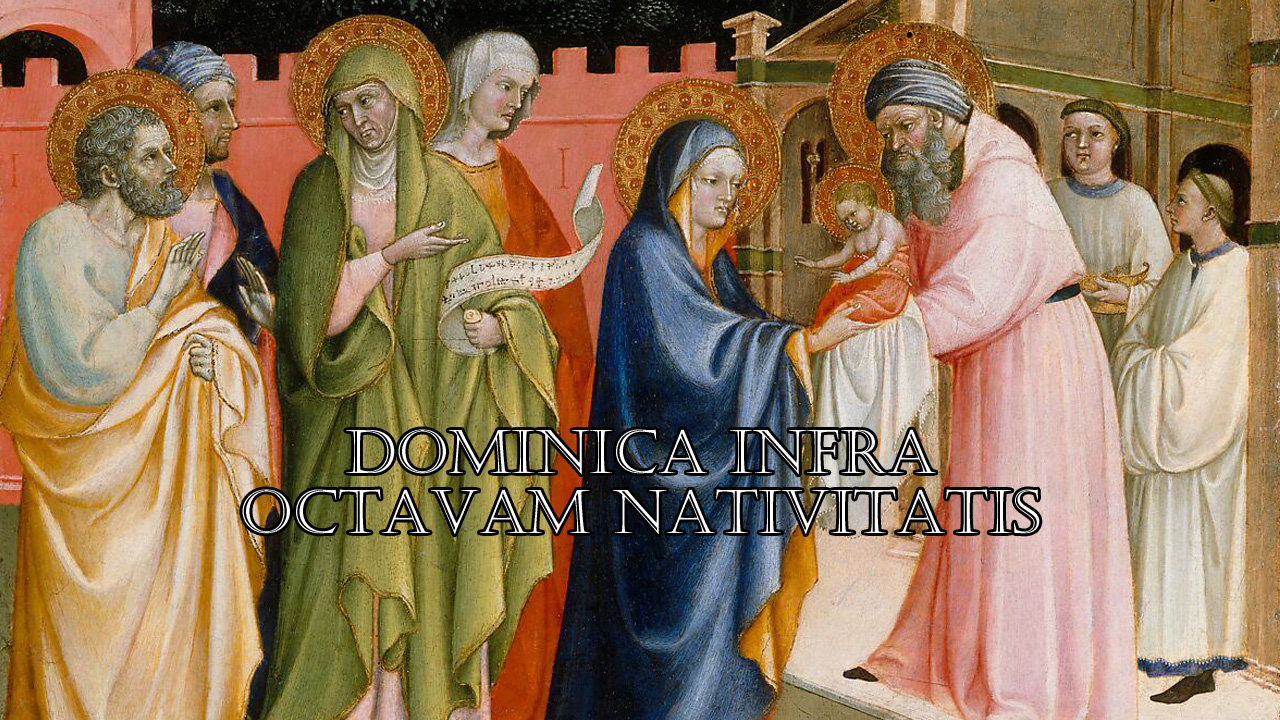
The Holy Family, faithful to the Law, presented Jesus in the Temple.
The Jewish ritual impurity laws – God’s punishment for the constant infidelity to covenants – were tied to contact with death or loss of life-associated elements such as blood. Mary and Joseph were ritually impure, though morally sinless. They required ritual purification before reintegration into full participation in worship. In the Temple awaited Simeon, righteous and devout, moved by the Holy Spirit. He prophesied that Christ will be a “sign of contradiction” and that a sword will pierce Mary’s soul. The Greek romphaía indicates a heavy, curved Thracian sword, fearsome enough to alter a Roman legionary’s head integrity. In Revelation the romphaía proceeds from the mouth of the Son of Man (Rev 1:16). It slays those opposed to God (Rev 2:16). In Rev 19:15 and 21 it executes judgment from the Lord of Lords.
Simeon’s vision places Mary within the field of that eschatological battle. Her soul will endure the mystery of the Passion and the universal judgment bound within the mission of her Son.
Luke also introduces Anna, daughter of Phanuel, of the tribe of Asher, a prophetess who lived in the Temple. Her Byzantine feast is 3 February, near Candlemas. The Greek text makes it ambiguous whether Anna was widowed for 84 years or was about 84 years old. The more compelling reading suggests she was widowed 84 years. If married at 14 and widowed at 21, she would be 105 at the encounter. A second biblical widow attained that age: Judith, who delivered Israel by the death of Holofernes. The last verse of Judith proclaims: “And no one ever again spread terror among the people of Israel in the days of Judith, or for a long time after her death” (Jud 16:25 Vulg.).
Judith and Anna signify fidelity sustained through decades. They reveal that God preserves His servants for decisive moments. Anna embodies the yearning expressed in Ps 27:4:
4 One thing have I asked of the Lord,
that will I seek after;
that I may dwell in the house of the Lord
all the days of my life,
to behold the beauty of the Lord,
and to inquire in his temple.
The psalmist’s desire shapes every life consecrated to God’s plan. Anna’s perseverance across thirty thousand days testifies to enduring hope. In the Octave of Christmas the Church points to her as a guide to contemplate the Christ Child with steadfast love. The encounter with the Infant Jesus was the consummation of her lifelong vigil. Her example instructs hearts troubled by the trials of the present age.
God knew Anna from all eternity, just as He knew you, too. He ordained that she would witness the arrival of the Messiah. She accepted her place and lived her task with fidelity. Her earthly obscurity concealed a glory known to God. He has a plan for you, too.
We live in a moment foreknown by God. Of all possible universes God could have created, He created this one. He called us into existence now according to His beneplacitum. This epoch is our battlefield and our proving ground. The turbulence of the Church and world becomes our particular path toward sanctity.
When hardships rise, grace abounds for those who persevere. God’s gracious purpose directs our actions, and if we cooperate, we merit to overflow with good works within the name of His beloved Son.
The Collect thus becomes a daily plea: that by our abundant good works which the Lord’s merits crown in us our lives may glorify God as adopted sons and heirs.
The Sunday during the Octave of Christmas joins these luminous truths. God sent His Son at the appointed time. Mary cooperated with divine will perfectly. Joseph exercised silent stewardship. Simeon and Anna treasured the promise across decades. They received an epiphany of Christ. The piercing sword and the sign of contradiction reveal the horizon of redemption already present within the swaddling cloths. Christ’s Nativity opens immediately toward His Passion. The manger and the cross are linked in the single mission of salvation. In contemplating this mystery through the Octave, the believer learns that divine purpose guides every circumstance of life. The Spirit within us cries “Abba, Father”. The Savior before us calls us to trust.
The mysteries of this day, unfolding in the Octave, direct our minds to adore the divine Child, to embrace our identity as heirs, and to submit every action to the grace that gives merit. Amid turbulence, confusion, and trial, our trust rests in the same God who guided Anna for decades. He sustains our weary steps. He preserves every faithful soul for a moment known only to Him. Perseverance obtains the reward. On this battlefield, the grace of Christmas victory already dawns. Christ is our peace, our adoption, our joy. Therefore, accompanied by Mary, the Mother of God, guided by Joseph, strengthened by the Spirit, observed by Simeon, encouraged by Anna, enlightened by Paul, and directed by the Church’s prayer, we walk confidently as heirs toward the eternal Temple where contemplation never ends.
St. Anna, daughter of Phanuel of the tribe of Asher, pray for us.
St. Simeon, pray for us.
Mary, Mother of God, pray for us.