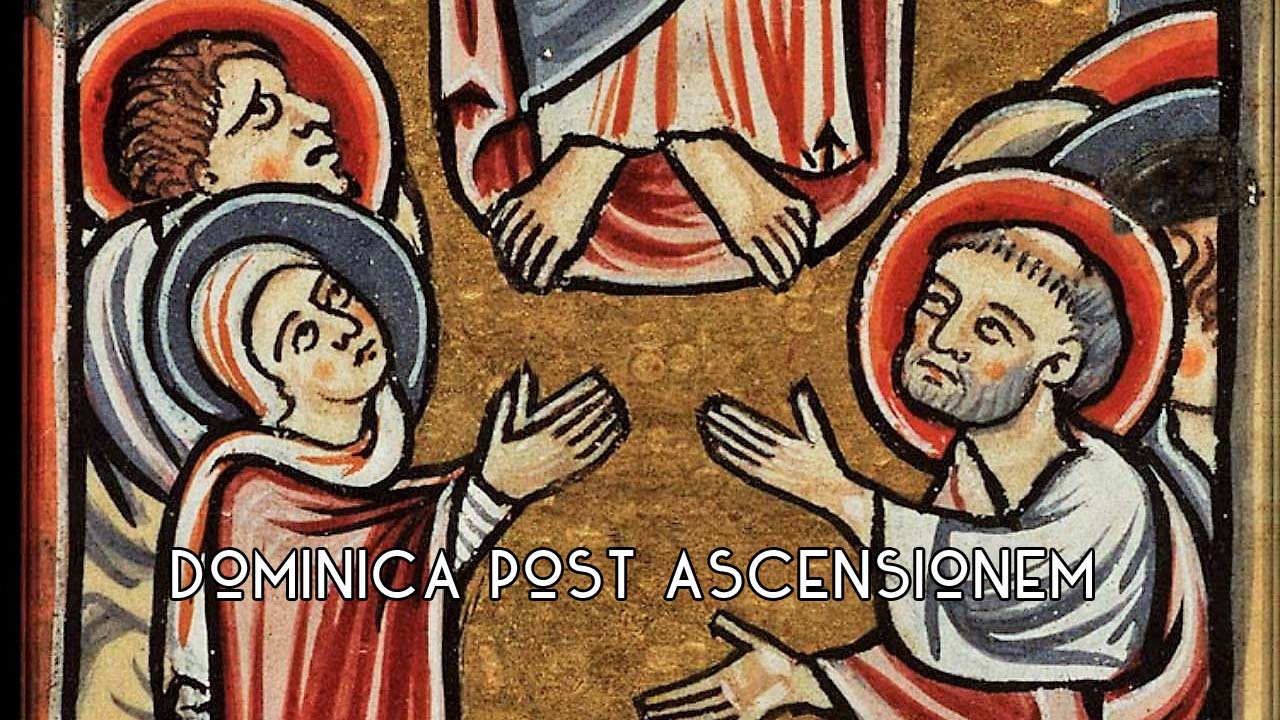
The Sunday after the Ascension places us in a holy interval. The Lord has gone up in glory but the promised Spirit has not yet descended like fire. The Apostles have returned from the Mount of Olives to Jerusalem. They are gathered in the Upper Room with Mary, with memories still burning from the Last Supper, from Calvary, from the empty tomb, from Emmaus, from locked doors suddenly penetrated by the Risen Lord, from the cloud that received Him out of their sight. They are in the Church’s first novena.
The Roman Church once graced the Ascension with an Octave. Pius XII suppressed all but the Octaves of Christmas, Easter, and Pentecost in 1955, and those three remain in the Vetus Ordo. The Ascension Octave, venerable though it was, had entered the Roman books relatively late, in the fifteenth century. Earlier, the Sunday after Ascension Thursday bore another Roman memory, dominica de rosa, because at the station of Santa Maria ad Martyres, the Pantheon, rose petals fell through the oculus during Mass. In our own day this custom has been transferred to Pentecost, where it still teaches by sight and sense what the liturgy teaches by prayer and Scripture. Roses fall. Grace descends. Fire comes from above. The Church, gathered under the great opening in the dome, learns to look up without standing idle.
This Roman memory matters because it binds doctrine to place, air, stone, and gesture. The Pantheon, once a temple of pagan cosmic ambition, became Santa Maria “ad Martyres”, Church of the Queen of Martyrs and of those who conquered by witness. Through its great eye the petals fell, frail and bright, a visible sign that heavenly gifts descend upon the gathered Church. Rome once catechized with architecture. The dome became a kind of inverted chalice pouring its contents upon those whose receptive hearts are sursum, upward.
The interval itself remains. Just as octaves allow the Church to contemplate a mystery from various angles after the feast has dawned, so novenas help her to prepare for a grace still to be received. We live these days after the Ascension in view of Pentecost. The Apostles had those nine days between the vanishing of the visible Lord and the descent of the promised Paraclete. We have them too, though with one considerable advantage. We know what happened. They did not. They had a command, memory, hope, fear, Scripture, the Mother of God, and prayer. We have retrospect and centuries of reflection.
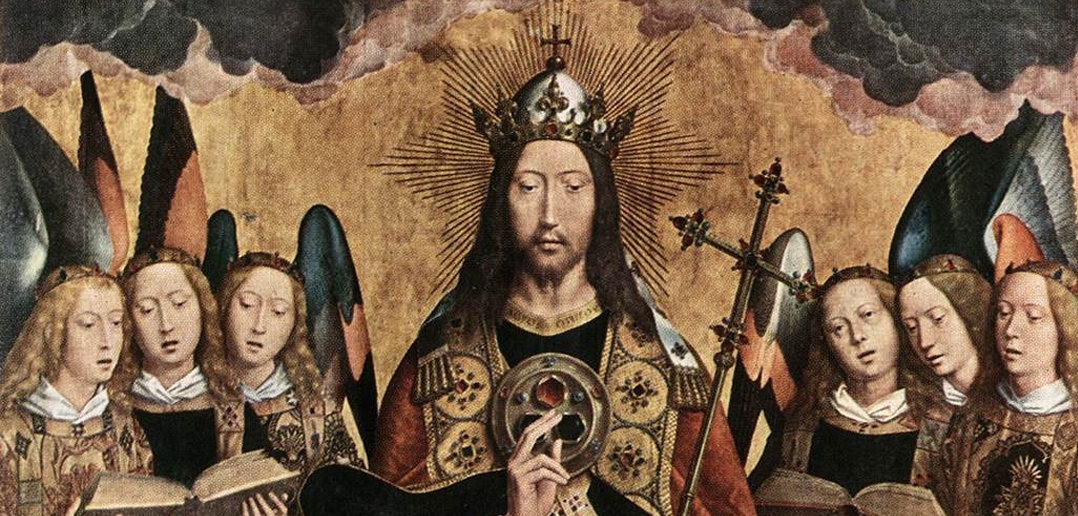
The Ascension is the supreme glorification of Christ and, in Him, the exaltation of our humanity. The old theological axiom of St. Gregory of Nazianzus governs the mystery: “what has not been assumed has not been healed” (Epistle 101, To Cledonius). At the Annunciation the Son of God assumed our humanity, body and rational soul, into an indestructible union with His divinity. Therefore, what happens to Christ happens, in Him, to the nature He assumed. When He died, our humanity passed through death in Him. When He rose, our humanity rose in Him. When He ascended, our humanity was carried beyond the angelic choirs to the right hand of the Father.
This is the Christian’s great consolation in prosperity, trial, humiliation, illness, bereavement, persecution, and the long exhaustion of daily fidelity. In Christ, our humanity is already glorious. In each of us, individually, glory remains to be attained through grace, repentance, perseverance, and final purification. The Christian life is already and not yet: already fulfilled in the Head, still being brought to completion in the members.
The ancient Collect of the Ascension, found in the tradition of the Gelasian sacramentaries, gives the Church’s mind with lapidary Roman restraint:
Concede, quaesumus, omnipotens Deus:
ut, qui hodierna die Unigenitum tuum Redemptorem nostrum
ad caelos ascendisse credimus;
ipsi quoque mente in caelestibus habitemus.
Grant, we beseech You, Almighty God,
that we who believe Your Only Begotten Son, our Redeemer,
to have ascended this day into heaven,
may ourselves also dwell in mind among heavenly things.
Blessed Columba Marmion, commenting on this mystery in Christ in His Mysteries, calls the Ascension “the supreme glorification of Christ Jesus.” He observes that this collect testifies to our faith by recalling the titles “Only-begotten Son” and “Redeemer,” while also indicating the grace contained in the feast for our souls. He writes that
“the mystery of Jesus Christ’s Ascension is represented to us in a manner suitable to our nature: we contemplate the Sacred Humanity rising from the earth and ascending visibly towards the heavens.”
God teaches us as embodied creatures. When Christ instituted the sacraments, He used sensible signs to convey insensible realities of grace. When He teaches us His entrance into the heavenly sanctuary and the elevation of our humanity, He does so by the visible sign of His rising.
St. Leo the Great preached the same doctrine with magnificence. In Sermon 73, on the Ascension, he says:
“And truly great and unspeakable was their cause for joy, when in the sight of the holy multitude, above the dignity of all heavenly creatures, the Nature of mankind went up, to pass above the angels’ ranks and to rise beyond the archangels’ heights, and to have Its uplifting limited by no elevation until, received to sit with the Eternal Father, It should be associated on the throne with His glory, to Whose Nature It was united in the Son.”
The Lord also taught the Apostles during those forty days to know Him according to His new mode of presence. During His earthly life they saw Him, walked with Him, ate with Him, touched Him, heard Him with their ears. After the Resurrection, He appeared, vanished, entered through closed doors, showed His wounds, broke bread, and corrected their desire to cling to Him in a merely earthly way. To Mary Magdalene He said, “Do not hold on to me” (John 20:17). At Emmaus He was known “in the breaking of the bread” (Luke 24:35). He was training their faith, and ours.
Had the Risen Christ remained visibly on earth in the earlier manner, sight would have swallowed up faith. Faith adheres to what God reveals when the eyes cannot command the mind. The Apostles had to learn, and we must learn, to find Christ where He wills to be found: in Scripture, in apostolic preaching, in the poor and needy, in the priest who acts as alter Christus, and supremely in the Eucharist. “Truly, I say to you, as you did it to one of the least of these my brethren, you did it to me” (Matthew 25:40). Every mode of Christ’s presence is a summons to be clean, ready, and worthy.
The Ascension also reveals Christ as High Priest. He ascends to the Father, into the heavenly temple, to present perpetually the Sacrifice once offered in blood upon Calvary. Hebrews says that Christ entered “into heaven itself, now to appear in the presence of God on our behalf” (Hebrews 9:24). The Catechism states:
“There Christ permanently exercises his priesthood, for he ‘always lives to make intercession’ for ‘those who draw near to God through him’. As ‘high priest of the good things to come’ he is the centre and the principal actor of the liturgy that honours the Father in heaven” (CCC 662).
This is why the Mass reaches us here and now. The Last Supper, Calvary, the empty tomb, the Ascension, and the heavenly intercession of Christ are inseparable mysteries of the one saving work. Because the High Priest has entered the sanctuary beyond space and time, His one Sacrifice can be made present on many altars in many places at the same time. Christ is present whole and entire in this Host and in that Host, on this altar and on altars across the world, in one church and in ten thousand churches. He acts through His priests, His other Christs, who offer in persona Christi.
Think about this at Mass. How does Calvary come to me? Because Christ ascended. How can the Sacrifice offered once for all be present in Rome, Manila, Lagos, Milwaukee, and some hidden chapel where three old women and a tired priest keep the lamps of faith lit? Because Christ ascended. How can hundreds of Hosts be consecrated on the same altar and remain the one Christ, whole and entire? Because Christ ascended. The heavenly altar makes the earthly altar possible.
The forty days would have struck the Apostles with force. They were first century Jews in Jerusalem. They knew the forty days of the flood, the forty years in the wilderness, the forty days of Moses on Sinai, the forty days of Elijah’s journey, the forty days of the Lord’s own fasting in the desert. We know from the Gospel that Christ opened the Scriptures after the Resurrection. On the road to Emmaus He interpreted “in all the scriptures the things concerning himself” (Luke 24:27). How much more did He form the Apostles before He sent them into the world?
Then, forty days after the Resurrection, He ascended in a cloud. In Scripture the cloud is no mere weather phenomenon. The cloud of glory settled upon the tent of meeting. The glory of the Lord filled the Temple. On Tabor, the bright cloud overshadowed the disciples. At the Ascension, the cloud receives the Son of Man. The Apostles surely recognized the sign. Jesus, the new Moses, had gone up, and they were commanded to remain in Jerusalem until they were clothed with power from on high.
They were also living within the rhythm of Israel’s feasts. The Lord rose in the season of the first fruits. Bikkurim, the offering of first fruits, pointed beyond itself to the true first fruits of a new creation. St. Paul says, “Christ has been raised from the dead, the first fruits of those who have fallen asleep” (1 Corinthians 15:20). From there the count moved toward Shavuoth, “Weeks,” called Pentecost in Greek, the fiftieth day. Jerusalem would already be swelling with pilgrims. The city would be tightening, brightening, burgeoning, preparing.
Shavuoth was a harvest festival. Like all the feasts of Israel, it looked both backward and forward. It remembered God’s deeds and awaited their fulfillment. In the first century, Shavuot was linked with Sinai. Israel had passed through the waters after Passover. Moses and the twelve tribes came to the mountain. Three days later the fiery glory descended. God gave the Law. God formed a people.
Now the Apostles, by Christ’s intention twelve, sit in Jerusalem after the true Passover. The Lamb has been slain. The waters have been crossed. The First Fruits have risen. The new Moses has ascended, and He has told them to wait. “John baptized with water, but before many days you shall be baptized with the Holy Spirit” (Acts 1:5). They must have asked each other what it meant to be clothed with power. Like Moses? Like the prophets? Like the cloud? Like fire? They had retrospect for the old covenant and expectancy for the new.
The word novena comes easily to us. In Latin there is novendialis, a nine day observance, which in ancient Rome could carry a dark overtone, associated with prodigies, misfortune, death rites, and the funeral banquet on the ninth day. Christ turns mourning inside out. He told the Apostles that His departure should lead to joy, since He was going to the Father and would send the Paraclete, the Comforter, Advocate, and Counselor. Death’s death-dealer had entered glory. The nine days after the Ascension are therefore charged with paradoxical Christian gladness. The Bridegroom has gone up, and the Spirit is coming down.
This is why the Epistle of the Sunday after the Ascension is so apt. St. Peter writes:
“The end of all things is at hand; therefore keep sane and sober for your prayers. Above all hold unfailing your love for one another, since love covers a multitude of sins. Practice hospitality ungrudgingly to one another” (1 Peter 4:7-9).
The end of all things is at hand. Therefore the beginning of all things is at hand. The meaning of all things is at hand. The Lord has ascended and will come again as He ascended. The angels asked, “Men of Galilee, why do you stand looking into heaven?” (Acts 1:11). Christian hope never excuses Christian idleness.
The Holy Spirit who descended upon them is the same Holy Spirit lavished upon you in Baptism. He is the same Spirit who was strengthened and deepened in you in Confirmation. He is the same Spirit whom you grieve by mortal sin, resist by venial sin, and smother by tepidity. He is the same Spirit who restores life in the confessional when sanctifying grace returns, and who deepens His action through worthy Holy Communion, prayer, penance, works of mercy, hospitality, chastity, humility, and self-emptying. The more you get out of the way, the more the Holy Spirit can abide in you and manifest His gifts and fruits.
Do you want renewal in the Church? Do you sense, as any honest Catholic must, that the Church needs a new bursting forth from behind locked doors? The first answer is prayer. The second is repentance. The third is docility. Committees, slogans, programs, and posters have their place, (a smaller place than their makers imagine). The Apostles did not emerge from the Upper Room because they had by dialogue and listening developed a cunning plan. They emerged because the Holy Spirit came upon them. Fire did what human planning could never achieve.
Take these days seriously. Keep sane and sober for your prayers. Hold unfailing charity for one another. Practice hospitality ungrudgingly. Remember that you do not have forever to become a saint. There will be a final cut-off, a last breath, a fixed state, a judgment. Remember your Confirmation. Remember the hands once extended over you. Remember the chrism. Remember that you are marked for witness and battle. Transform daily tasks into prayer. Lift up your hearts: sursum corda! Let your mind dwell among heavenly things: mente in caelestibus habitemus, because your humanity is already there in Christ.
The Ascension teaches us that our hope is enthroned in Christ. Pentecost teaches us that the power to live toward that hope comes from above and within. Between the two stands this sacred novena, with Mary and the Apostles, with the Church waiting, with heaven opened, with the altar ready, with the Spirit promised. Christ has ascended. Christ intercedes. Christ is present. Christ will return. Therefore, do not stand idle, staring into space. Pray. Repent. Receive. Go. And with hearts on high, as if stretching raised hands toward the opened heavens, ask the Holy Spirit to bring it. Bring it, Holy Spirit.