We stand now nine Sundays out from Easter, poised at a hinge in the liturgical year where memory, expectation, and discipline converge. Context is decisive. The Church does not move through time as a mere sequence of dates but as a pedagogy of salvation, a slow schooling of the soul by repetition, anticipation, and restraint. The great cycle that began in Advent and unfolded through Christmas and Epiphany reaches its terminus, in important respects, with the Feast of the Purification or Presentation on 2 February. Advent trained us in a joyful penitence, Christmas and Epiphany disclosed the mystery prepared for, and the manifestations of the Lord’s divinity were pressed upon us week after week. Now another great arc comes into view, the cycle that stretches from Ash Wednesday through the austerities of Lent, bursts forth in Easter, and reaches its fullness in Pentecost and its Octave. The Church, knowing human nature too well to assume that we can pass instantly from ordinary time into the rigors of Lent, provides a threshold. She prepares us to prepare. Or rather she did prepare us. The pre-Lent Sundays were abolished with the Novus Ordo, a titanic loss which should be reinstated. Happily, they are retained in the traditional calendar of the Roman Rite.
The three Sundays before Lent, clothed already in penitential purple yet not themselves Lenten, form what tradition has long called Pre-Lent. Septuagesima, Sexagesima, and Quinquagesima sound at first like a numerical riddle. Their names, “Seventieth, Sixtieth, Fiftieth,” do not correspond with mathematical precision to the calendar. Weeks have seven days, not ten, and no advanced study in higher mathematics is required to notice that the numbers do not quite add up. Yet the Church was never counting with a calculator. She works with “decades”. Septuagesima falls on the 63rd day before the Triduum and thus within the seventh “decade”, the span from the 61st to the 70th day. Note that in Latin we call this Sunday “Domina in Septugesima… Sunday in the seventieth”. Sexagesima Sunday is the 56th day out, in the 6th decade, and Quinquagesima the 49th, in the 5th. Lent itself, Quadragesima, the Fortieth, begins after this measured approach. The names make sense once one understands that they indicate approximation within ordered bounds rather than arithmetic exactitude.
These Sundays slide around from year to year because Easter itself slides. The date of Easter is governed by the paschal full moon, the Sunday following the first full moon after the Vernal Equinox. The Moon, as Shakespeare’s Juliet observed, is inconstant, and so Easter ranges from as early as 22 March to as late as 25 April. The span is wide, thirty five days, and the ripple effects are felt throughout the calendar. One can calculate ecclesiastical full moons and synodic months, but the essential point is simpler. Because Easter moves, Pre-Lent moves with it, and each year the Church again usher her children toward the fast by stages rather than by surprise.
That element of surprise is precisely what the traditional calendar foils. With the Vetus Ordo, Lent never sneaks up unannounced. The signals are unmistakable. From First Vespers of Septuagesima onward, the Alleluia falls silent. The exuberant cry that has punctuated the liturgy since Christmas is laid aside, and in its place the more austere Tract is sung. In some regions a poignant custom grew up around this silence. A beautifully written or carved “Alleluia” would be carried in procession and buried, sometimes literally in the ground near the church, to await its resurrection at the Easter Vigil. The Church does not merely omit a word; she dramatizes its absence, impressing upon the senses that something precious has been withheld for a time. Vestments turn purple. The music darkens. Even before Lent begins, the atmosphere has shifted.
These Sundays were never marginal. They were important enough to have their own Roman Station churches, and this alone should give pause to those who imagine them as late medieval accretions of little consequence. Septuagesima’s Station is at San Lorenzo fuori le mura, St. Lawrence outside the walls. There, in spirit, the Church gathers with the ancient catechumens who stood at the threshold of baptism. Over the day looms the figure of the deacon martyr Lawrence, stretched upon an iron grate over live coals, serenely confessing Christ unto death. His presence is catechetical. From the outset of their journey toward incorporation into Christ’s Mystical Body, the catechumens were reminded that Christianity is serious business, that it involves the Cross, and that baptism is a passage into death and resurrection rather than a rite of social belonging.
The Mass formulary itself reinforces this gravity. The Introit, drawn from Psalm 17 or 18, cries out, “The terrors of death surged round me, the cords of the nether world enmeshed me.” The Latin sings “circumdederunt me dolores mortis”, and the imagery is visceral. Lawrence can sing these words from his grate. Christ can sing them as His Passion begins to loom in earnest. The catechumens can sing them as they sense what it means to commit themselves wholly to the Lord. The Church, in every age, is invited to sing them as well, because the Christian life never ceases to be a struggle unto glory.
The Epistle, from the First Letter to the Corinthians, deepens the theme. St. Paul speaks of the race run for an imperishable crown, of passing through the sea, of eating manna from heaven and drinking from the spiritual rock. The imagery is drawn from Exodus and applied to the Christian pilgrimage. Deliverance comes through trial. Nourishment is given along the way, yet not all who begin the journey reach its end. Paul concludes with the sobering line, “Nevertheless with most of them God was not pleased” (10:5). The warning is clear, especially at the threshold of Lent. Privilege does not guarantee perseverance.
Blessed Ildefonso Schuster, the great liturgist and Cardinal Archbishop of Milan, unfolds the historical weight behind these formularies. He observed that the Masses of Septuagesima, Sexagesima, and Quinquagesima seem to date from the time of St. Gregory the Great (+604), reflecting “the terror and grief that filled the minds of the Romans in those years during which war, pestilence, and earthquake threatened the utter destruction of the former mistress of the world.”
St. Gregory’s Rome was a city battered by plague, famine, invasion, and administrative collapse. Totila had sacked it. The Lombards pressed in. Refugees crowded its streets. The formal seat of imperial power lay far away in Constantinople. Gregory, son of a senator and once Prefect of Rome, became pope from a monastic cell and found himself the one figure capable of restoring some order. He organized relief, fed the poor, and delayed his own meals until the indigent had eaten. The liturgy he shaped bears the imprint of those hard years. Its tone is bracing, realistic, and unsentimental.
Nowhere is this clearer than in the Collect of Septuagesima:
Preces populi tui,
quaesumus, Domine, clementer exaudi:
ut, qui iuste pro peccatis nostris affligimur,
pro tui nominis gloria misericorditer liberemur.
The prayer opens with urgency. In the prayer’s prelude or protasis we ask God the omnipotent Creator to listen to us little finite sinful creatures in a manner that is not only attentive but also patient and indulgent. Preces, prayers, stand at the head of the sentence, and the imperative exaudi, “harken, listen attentively,” gives the petition force. The adverb clementer tempers the boldness. God is asked to listen in a manner that is indulgent and compassionate toward the faults of His people. In the apodosis, the logic of proportion comes into view. One of the 15 meanings of the preposition pro is “in proportion to”. We are justly afflicted for our sins, “iuste affligimur pro peccatis nostris”, yet we ask to be mercifully freed in proportion to the glory of His Name, “pro tui nominis gloria misericorditer liberemur”. The parallelism, the repetition of pro, the chiasm between nostris and tui, all drive home the point. Our sins have a measure, and so does God’s mercy, yet the measure of His mercy is His own glory, not our deserving. The homoioteleuton (similar endings) of affligimur and liberemur carries the prayer to its close with a resonance that is meant to linger in the ear.
In your clemency, O Lord, hearken
to Your people’s prayers:
that we who are for our sins justly afflicted,
may be for Your Name’s glory mercifully delivered.
These masterfully constructed orations are offered by the priest in persona Christi capitis and taken up by the faithful through attentive participation. In that attentive listening, which is far from passive, Christ the Head and Christ the Body are joined. Writing about the voice of Christ ringing out in the psalms, St. Augustine spoke of Christus Totus, the Whole Christ, Head and members together. Throughout the Mass this dynamic unfolds, culminating in the physical encounter at the rail, that liminal place where priest and communicant meet in the sacramental exchange. Every word of the liturgy belongs to Christ, and because Christ makes what is His our own, every word belongs to us as well. In this sense, we are our rites.
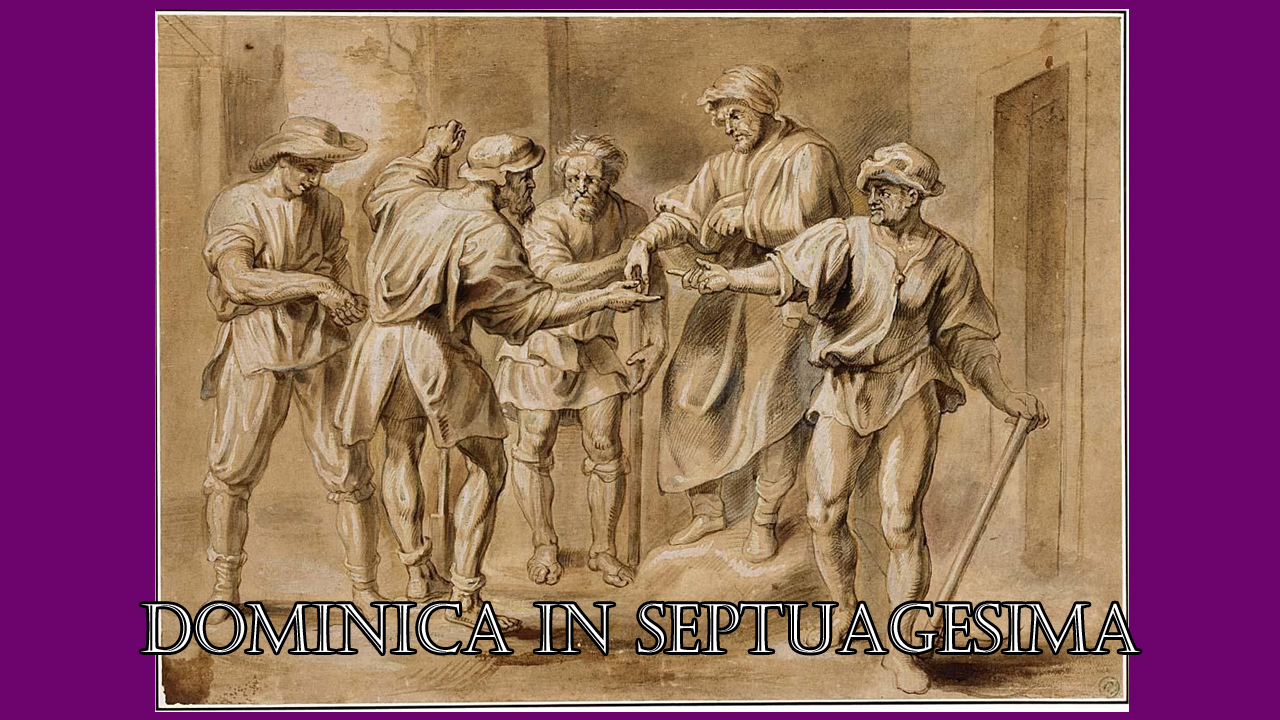
The Gospel appointed for Septuagesima is the Parable of the Laborers in the Vineyard from Matthew 20. The context is that Jesus is on His way to Jerusalem, the shadow of His Passion looming. He has just spoken with the rich young man and has warned of the difficulty the wealthy face in entering the kingdom. The disciples, startled, ask who then can be saved. Peter, ever ready to speak, reminds the Lord that they have left everything to follow Him and asks what their reward will be. Jesus promises thrones and hundredfold recompense, then adds the unsettling line, “many that are first will be last, and the last first.” It is in immediate continuation of this exchange that the parable is told.
A householder goes out at various hours of the day to hire laborers for his vineyard, agreeing with each for the standard wage of a denarius. At day’s end, he pays those hired last first, giving each the same coin. Those who bore the heat of the day murmur. The master’s reply cuts to the heart of the matter. He has done no injustice. He has honored the agreement. “Is your eye evil because I am good?” The Greek phrase speaks of the eye as the seat of perception and desire. The Douay version preserves the bluntness. The RSV softens it to “Do you begrudge my generosity?” Either way, the question exposes the danger of judging divine action by human expectations.
Parables work by reversal. Common sense is upended. What seems fair by human calculation is revealed as inadequate for the kingdom. The temptation is to force God into our own categories of fairness, to measure His gifts by our sense of proportion. Yet God is not bound by our expectations. He gives as He wills. The denarius, as Augustine of Hippo taught, signifies the Beatific Vision, the one common reward of heaven. No matter how long the road or how late the conversion, those who enter heaven behold God. In that vision there is equality, even as there are differing degrees of glory according to the charity lived. A long life of fidelity, of labor under the sun from early morning, gives more glory to God and forms the soul more deeply. A late repentance, sincerely embraced, can still receive the coin, though it is a perilous path on which to stake one’s soul.
St. Gregory the Great, preaching in the very basilica of St. Lawrence, today’s Roman Station, illustrated this truth with the story of his own three aunts, all of whom had consecrated themselves to God. Two persevered. One did not and ended in misery. The lesson was direct. God’s mercy is vast, yet presumption is deadly. Grace must be sought continually and cooperated with through disciplined living. Habit shapes destiny. We tend to die as we have lived.
The parable also casts light backward. Peter’s question about reward carries within it the same impulse as the complaint of the early hired laborers. Service rendered with an eye fixed on recompense risks missing the point of the call. The call itself, to labor in the vineyard of the Lord, is the gift. To be with Him longer, to share His work, is already a privilege beyond calculation.
All of this converges in the season now upon us. Pre-Lent is a mercy. It removes excuses. No Catholic formed by the traditional calendar can claim to be caught off guard. The purple vestments, the silenced Alleluia, the somber chants, the Roman Stations, the stern yet hopeful prayers, all press the same question upon the soul. How will you prepare? Not tomorrow, not on the morning of Ash Wednesday, but now. Shrovetide, whose name comes from shriving, from absolution, reminds us that confession stands like a door to Lent, a threshold and beginning. To sweep the house, like the woman in Luke’s parable searching for her lost coin, is fitting work for these days.
It is Septuagesima Sunday. The Church has begun to count down, not with numbers alone but with signs, sounds, and words shaped by centuries of faith under pressure. To heed them is to enter Lent already awake, already oriented, already engaged in the work that leads, by mercy, to glory.