Context is important. We are in “Gesima” time, Pre-Lent, a time of preparation for the time of preparation for Easter. Holy Church, with the sober maternal realism of one who knows human nature, reminds us that obligations are coming due. After this “Sunday in the Fiftieth”, Quinquagesima, in three days comes Ash Wednesday and the beginning of “Fortieth”, the season of Lent or Quadragesima. Lent cannot ambush the attentive Christian. In Pre-Lent, we can feel Holy Church tightening the laces, checking the straps, handing us the canteen, and pointing at the map with a finger that does not tremble. The summit is Jerusalem, and beyond Jerusalem, the Pasch.
This period has long been known as Shrovetide, from “to shrive”, to absolve, to be confessed and loosed from mortal sin in both kind and number. Language records habit. “Shrove” became associated not only with absolution but also with festivity, because the absolved man was free to rejoice. Hence the more carnal name, “carnival”, from carne-vale. Latin vale means “farewell”. Carnival is “Goodbye meat”. In a time when Lenten discipline was understood as abstinence from meat and animal fats for the whole season, households cleared their stores. “Collop Monday” consumed the bacon. “Shrove Tuesday”, also called “Fat Tuesday” or Mardi Gras, used up butter and grease in pancakes. The point was not indulgence for its own sake, which is what Mardi Gras has become far and wide, but rather the orderly closing of one mode of life and the deliberate preparation of another.
The Church’s pedagogy remains, even if modern sensibilities resist it. Lent is upon us. It isn’t a surprise because of pre-Lent. Confession is obligatory but it really isn’t optional either, is it. Go to confession.
The Church marks these preparatory Sundays with unmistakable signs. The “Alleluia” disappears from the liturgy and will not return until the Easter Vigil. Violet penitential vestments clothe the sanctuary. The Roman Stations fix the Sundays geographically, historically, pedagogically. On Septuagesima the Church goes to St. Lawrence outside-the-walls, to the tomb of the deacon Lawrence burned on a grate. On Sexagesima she assembles at St. Paul’s outside-the-walls, where the Apostle rests after martyrdom by the sword. On Quinquagesima she crosses the Tiber and climbs the Vatican Hill to the burial place of Peter, crucified upside-down near the Circus of Caligula. These Mass formularies go back at least to St. Gregory the Great (+604). They were forged in times of plague and invasion. They are sober by experience, not artificially cobbled up theory by liturgical experts. The Church walks us up to the bones of those who remained faithful unto death so that our Lent will not collapse into abstraction. At least she does so in the Vetus Ordo: the Stations were removed from the post-Conciliar Missale Romanum.
The road motif governs the Mass formulary. The Gospel of Quinquagesima from Luke 18 places Christ and the Apostles on the road to Jerusalem. Jesus announces His Passion, Death, and Resurrection. Luke records with unsparing clarity that “they did not grasp what was said” (v. 34). Their blindness is theological: they still imagine a Messiah who restores earthly sovereignty and visible triumph. Their bodily eyes function. Their spiritual sight does not.
Regarding the Station, we ascend the Vatican Hill to Peter in his tomb. Tradition remembers Peter fleeing Rome in fear, meeting Christ on the Appian Way, and asking Him, “Domine, quo vadis? … Lord, where are you going?” The reply pierces complacency: “Romam eo iterum crucifigi.… I am going to Rome to be crucified again.” The Lord goes where His shepherds are tempted to flee. Fidelity always costs more than flight… even when the flight is, in fact, from the wolves. Someone pays. We are all paying.
The liturgical context broadens further when one remembers that Holy Mass is not the only “liturgy”. Some people use “liturgy” when they mean Mass. The Divine Office, read in the Breviarium Romanum or the Liturgia Horarum, supplies a deeper typological frame. At Matins on this Sunday, Abraham ascends Mount Moriah to sacrifice Isaac. Isaac carries the wood on his shoulders. Abraham is priest. Isaac is victim. They climb together. The Fathers discerned the foreshadowing of Christ ascending Golgotha: Jesus ascends to Jerusalem as both Priest and Victim, offering Himself in perfect obedience.
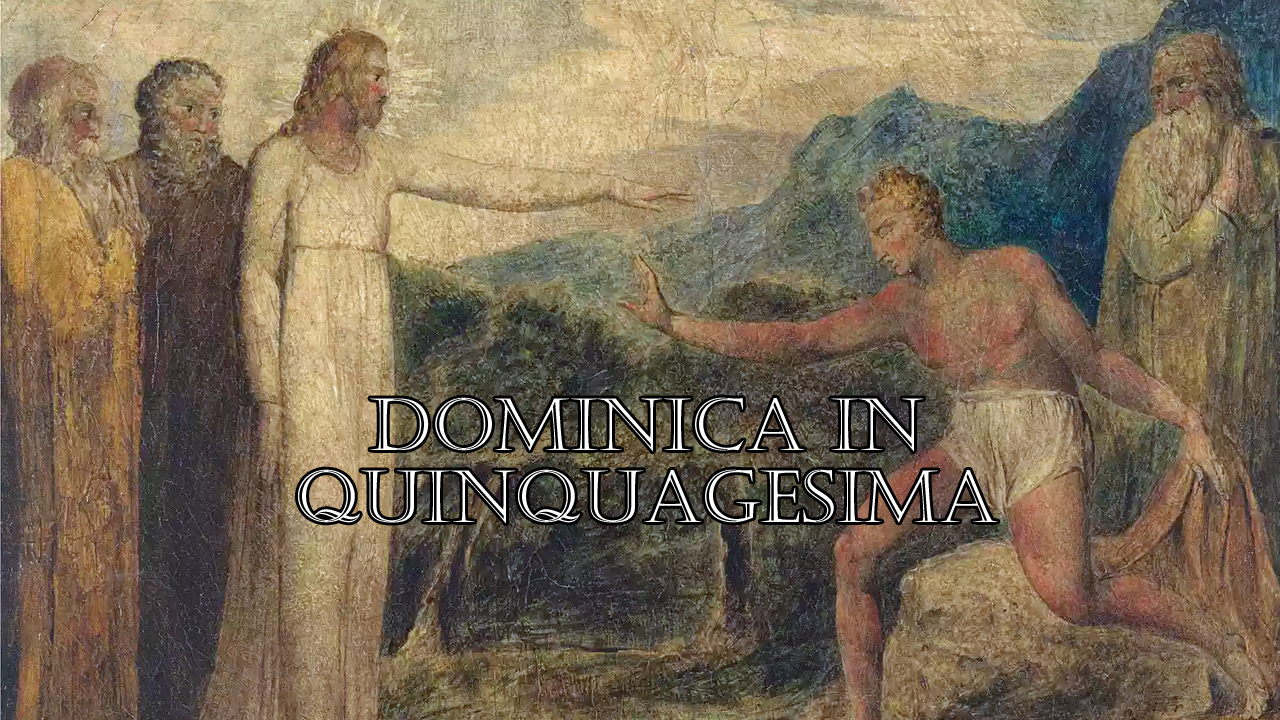
Against this backdrop Luke introduces the blind beggar on the road near Jericho. The Lord is close to the city when the man cries out, “Jesus, Son of David, have mercy on me!” The crowd attempts to silence him. He persists. Jesus summons him and asks what he desires. The request is direct. He wants sight. Christ grants it, saying, “Your faith has made you well” (Luke 18:42).
Mark’s parallel account supplies the blind man’s name – Bartimaeus, “son of Timaeus”. The name Bartimaeus appears to combine a Hebrew patronymic with a Hellenic name. This man, marginalized and vulnerable, addresses Jesus with precision. He calls Him “Son of David”, the Messianic title. In Mark’s account he adds, “Rabbuni”. Translation: “My teacher.” He knows who Christ is, and he knows who he is in relation to Christ. He approaches as a learner. Given the timing of it all, Bartimaeus may well be the second blind man healed by Jesus as He went to Jerusalem via Jericho, which helps explain why this beggar is shouting. He has heard about Jesus and he believes. As the Angelic Doctor says, “Ex auditu solo, tuto creditur….From hearing alone, one believes securely.” Faith comes by hearing. The ears become the eyes.
Bartimaeus asked for the miracle. He asked. Divine generosity presupposes human petition. The Church forms this posture through her prayers. The Sunday Collect articulates our urgency:
Preces nostras, quaesumus, Domine,
clementer exaudi:
atque, a peccatorum vinculis absolutos,
ab omni nos adversitate custodi.
Literal translation:
We beseech You, O Lord,
in clemency attentively hear our prayers,
and, once loosed from the fetters of sins,
guard us from every adversity.
The prayer hinges on imperatives. Exaudi. Hear. Custodi. Guard. The structure moves from petition to liberation to protection. Sin is named as bondage, vincula. Lent is a process of unchaining. The Collect begs as Bartimaeus begged, openly, insistently, without disguise. Moreover, Mark says that Bartimaeus throws aside his cloak, apobalón, and springs up, anastás from anístemi the verb of resurrection, “having risen”. His bodily movement anticipates the Paschal pattern. Casting off, rising, following. Our Collect also presents the image of a burden being removed, like Bartimaeus cloak.
Afterwards, Bartimeaus follows Jesus … up the road toward Jerusalem and Calvary.
The Marcan account of the healing of Bartimaeus adds a further layer. The Greek verb káleo, “to call”, is repeated insistently. Jesus says, “Call him.” The bystanders say, “He is calling you” (Mark 10:49). From this verb comes ekklesía, the Church, the assembly of the called.
Hence, the miracle unfolds “ecclesially”. Bartimaeus is not healed in isolation. Others tell him who passes. Others lead him forward. There is a relay. Charity is already active before sight is restored. Someone tells him who is passing. Someone guides him. Someone repeats the invitation: “Take heart; rise, He is calling you.” The Church speaks that sentence every time she beckons a sinner toward confession, every time she urges a weary soul toward prayer, every time she drags the reluctant toward the altar rail. Lent is not a solitary endurance test. Your neighbor has you. You have your neighbor. “Get this man to CHRIST” is not only a line for Bartimaeus of Jericho. It is a description of Christian charity in action.
Are we not all like Bartimaeus at certain points in our lives?
The road to Jerusalem ascends sharply. Jericho lies far below sea level. Jerusalem rises more than a thousand meters above it. Luke’s “Behold, we go up to Jerusalem” (Luke 18:31) describes geography and theology together. Lent means ascent. It is participation in Christ’s Passion.
The contrast between the disciples and Bartimaeus becomes instructive. The Apostles can see yet fail to grasp. Bartimaeus cannot see yet recognizes the Messiah and persists in faith. Physical vision does not guarantee spiritual insight. Faith illumined by charity does.
For centuries the Church has on this Sunday paired this Gospel with the Epistle from 1 Corinthians 13. Before Lent begins in earnest, Paul strips away illusions. Charisms, eloquence, knowledge, faith that moves mountains, heroic sacrifice, all can be emptied of value without charity, Greek agape, Latin caritas: sacrificial love.
In 1 Cor 12: 31, the verse just before our Epistle, Paul describes this path as katá hyperbolèn hodòn “a surpassing way”, “a supremely excellent road”. The Church sets this road before us at Quinquagesima because Lent is about conforming the soul to divine love, not just checking the boxes of prayer, fasting and almsgiving.
St. Paul’s words are unsparing:
“If I have all faith, so as to remove mountains, but have not charity, I am nothing.” (v.2)
The verdict is absolute. Without charity, even faith can become sterile.
Bl. Ildefonso Schuster comments on this passage by noting that Paul lifts a corner of the veil hiding eternal love, directing attention not to abstract contemplation of God alone, but to love exercised toward men as images of God and members of Christ’s Mystical Body. Love of the invisible God proves itself through love of visible neighbors. Charity becomes the measure of authenticity.
This principle governs Lenten discipline. Prayer, fasting, and almsgiving acquire merit through charity. Without it, almsgiving reduces to philanthropy, fasting to hunger, prayer to mere sound… on might say as Paul did: a noisy gong or a clanging cymbal (v. 1). Pius Parsch expresses the same truth succinctly when he writes that love alone makes us children of God and love alone will be the measure of judgment.
The Gospel reinforces the Epistle. Bartimaeus’ faith is not vain, vanus, empty. His cry is persistent, directed, confident. When called, he throws off what hinders him and follows Christ. The among the first sights granted to his healed eyes are the events leading to the Passion and, possibly, the risen Lord Himself.
Lent is given so that Easter will not be a date on the calendar, but a victory in the soul. The nearness of Lent therefore demands honesty. One must ask whether charity governs one’s faith. Do we cry out to Christ with the blind man’s insistence? Do we allow others to carry us when needed? Do we carry others when they cannot see the way?
Prepare now to go up to Jerusalem with Christ. Embrace the Cross through agápe. Cry out with confidence. Let the Church call you forward. Be unchained. Be guarded. Receive sight, and follow.