Of all the treasures in the sacred liturgy of Holy Roman Catholic Church, Pentecost is surely among the richest, perhaps the richest, especially as it comes to us in the Vetus Ordo. Easter has its Vigil with the blessing of baptismal water, its octave, its addition to the Roman Canon. Pentecost, mirroring Easter as a kind of Pascha of the Holy Ghost, has its own Saturday Vigil with the blessing of baptismal water, because those who had not received the foundational sacrament at Easter could be baptized and confirmed. It has an Octave during which the Church sings the stunning Sequence Veni Sancte Spiritus. It has proper inserts in the Roman Canon, the Communicantes and Hanc igitur. It contains within its octave the Spring Ember Days on Wednesday, Friday, and Saturday. In other words, Pentecost once had liturgical weight, thickness, texture.
This is why the diminution of Pentecost in the post-Conciliar reform was no small matter. Paul VI, ensorcelled by the Consilium’s leadership, stripped away much of Pentecost’s liturgical mass and gravity. That is hard to square with the command of the Council Fathers in Sacrosanctum Concilium 23, that innovations are to be made only when the good of the Church genuinely and certainly requires them, and that new forms must grow organically from forms already existing. A feast that had borne baptismal memory, confirmation strength, canonical solemnity, octaval extension, and ember discipline became liturgically thinner. The faithful were poorer for it, not richer. We are our rites.
For Pentecost we must scrabble after context, because context deepens content. The sacred liturgical celebration of the mysteries of our salvation makes us present to them and them to us. Sacramental reality embraces, elevates, and transforms sensible reality. Again, we are our rites. Therefore, we are never deeply content unless we are willing to deepen content, and for that we need context, even from the depths of history.
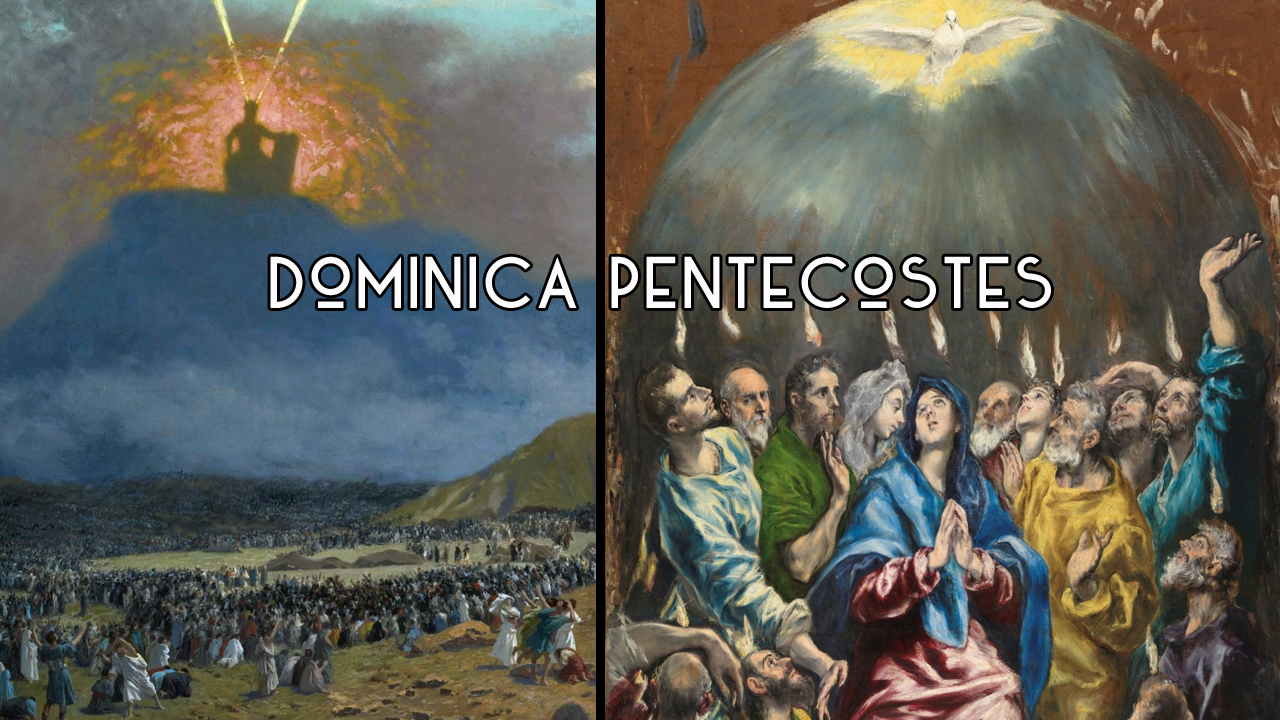
The Greek pentekosté means Fiftieth Day. Christian Pentecost completes the ancient Jewish Spring Festival of Shavuot, the Feast of Weeks, one of the three great annual pilgrimage feasts which brought adult male Jews to Jerusalem. The city population swelled enormously. Jews came from many lands. Languages, garments, accents, memories, sacrifices, and expectations converged around the Temple. Jewish festivals simultaneously looked back to an historical event and forward to its fulfillment. Shavuot looked backward to Sinai, where God gave the Law to Moses amid fire, cloud, thunder, and fear fifty days after the Exodus. It also looked forward to the return of God’s fiery presence, the glory cloud, the Shekinah, to the Temple.
Shavuot was also a first fruits festival. At Passover the first barley sheaves were presented to God by waving them. Fifty days later the wheat harvest had come to completion and two loaves were offered by waving. Alfred Edersheim, Jewish convert and biblical scholar, wrote in The Temple: Its Ministry and Services that, “The ‘Feast of Unleavened Bread’ may be said not to have quite passed till fifty-days after its commencement, which it merged in that of Pentecost” (ch. 14). He then makes the Christian application:
“the memorial of Israel’s deliverance appropriately terminated in the giving of the Law – as, making the highest application of it, the Passover sacrifice of the Lord Jesus may be said to have been completed in the outpouring of the Holy Spirit on the day of Pentecost.”
Passover ripens into Shavuot. Easter ripens into Pentecost. The first fruits of the Resurrection become the Church, the harvest. The Lord, first fruits of those who sleep, rises. He ascends. Then, from Heaven, He and the Father send the Holy Ghost upon the Apostles, and about three thousand souls are gathered in one day. The wave offering of loaves became living flesh and blood, men and women marked for Christ.
With inclusive counting, fifty days after the Resurrection, ten days after the Ascension, the Holy Ghost descended in fire upon the Apostles and first believers, breathing grace-filled life into Christ’s Mystical Body, the Church. At Sinai God descended upon the Twelve Tribes and gave the Law written on stone. At Jerusalem, God the Holy Ghost descended upon the Twelve Apostles and upon the company of believers (Acts 1:15) giving their number as about one hundred and twenty, a number that itself suggests twelve multiplied by ten, perfection multiplied by apostolic foundation. The Old Law was written upon still stones. The New Law was written upon beating stones, hearts.
There is a fruitful discussion about where the Apostles were when the Holy Ghost came upon them. Acts 2:2 says that the sound filled the “house,” Greek oikos. On the surface, oikos suggests the upper room where they had kept the Passover. Yet oikos can signify the “house of God”, as in Acts 7:47, where Solomon built a “house” for Him. The Temple is usually hierón, or naós for the inner sanctuary, yet the word oikos deserves attention. Acts 2:15 places the Pentecost event at the third hour, about 9 AM, the time of the morning tamid, the sacrifice of a spotless lamb. Acts 3:1 shows Peter and John later going up to the Temple at the ninth hour, about 3 PM, the hour of the second tamid. Hence, the Apostles were still living in the rhythm of Temple prayer. Acts 2 also describes a multitude gathering and about three thousand being baptized. That is rather hard group to fit into the upper room but it fits the Temple precincts very well.
Given this, at the hour of the morning tamid, in the oikos (Temple), the longed-for fiery presence of God does in fact return, yet now in tongues of fire upon living stones to be built into the Church. Christ, the true Temple, had already taught in the earthly Temple. Now the Holy Ghost fills the Temple and makes people the living dwelling of God. Sinai is fulfilled. Multiplicity of languages which all understand shows the reversal of Babel. The scattered tongues of men are gathered into the confession of the mighty works of God. The heavenly fire descends, and the first fruits of the Christian harvest are gathered at the festival of first fruits which looked for the return of the presence of God.
The crowd itself matters. Jews and proselytes from across the ancient world heard the Apostles speaking “the wonderful works of God” in their own tongues. Peter, once frightened before a servant girl, now stands in the fire of the Paraclete and preaches with apostolic parrhesia. The darkness of minds and hearts is dispelled. Eyes open. Hearts are pierced. They ask what they must do. They are baptized. They are added. The Church, born from the pierced side of Christ on Calvary, now breathes aloud in the streets of Jerusalem.
The ancient Collect for Pentecost sings of this opening, illuminating, transforming mystery with Roman concision:
Deus, qui hodierna die
corda fidelium Sancti Spiritus illustratione docuisti:
da nobis in eodem Spiritu recta sapere,
et de eius semper consolatione gaudere.
O God, who on this day
taught the hearts of the faithful by the light of the Holy Spirit,
grant to us, in the same Spirit, to savor rightly the things that are right,
and always to rejoice in His consolation.
This prayer, found at least by the time of the Liber sacramentorum Gellonensis and very probably older, survived in the post-Conciliar books as the Collect for a Votive Mass of the Holy Spirit and is also used after the Veni Sancte Spiritus. Its hodierna die links Pentecost to Easter’s own “this day.” Today is the liturgical today of salvation. The mystery is present and it transforms.
The verb sapere is a jewel. It first means to taste, to savor, to have the flavor of something. From that bodily root it extends to knowing and understanding. Hence sapientia, wisdom. A homo sapiens is one who knows the savor of things. The English “insipid” points to what lacks flavor and, by extension, lacks good sense. To have wisdom is to relish the right things, to taste reality according to God. The Collect asks that, in the Holy Ghost, we may recta sapere, savor “straight, right” things, know rightly, be wise rightly. Savvy?
“O taste and see that the LORD is good,” sings the Psalmist, “happy are those who take refuge in him” (Ps 34:8 RSV). Taste and sight meet. Savor/knowing and illumination/understanding fuse. The Collect says that God taught the hearts of the faithful by the Holy Ghost’s illustratio. Illumination is teaching by light. In rhetoric, illustratio, “vivid speech” brings things before the eyes of hearers’ minds. Peter’s Spirit-breathed preaching gave evidentia, the thing seen, an illustration: he lit them up. Those who converted had to know something in order to believe. Once instructed by preaching, they were illumined by grace and they believed. Once believing, they in turn understood what had been preached even more deeply. Here we have the ancient Augustinian cadence from Isaiah in the Old Latin form, nisi credideritis non intelligetis, unless you will have first believed, you will not understand.
The Spirit teaches what the Son has given. The Gospel of the Mass draws us into the Farewell Discourse of the Last Supper, where the Lord speaks of love, obedience, the coming of the Paraclete, and peace. “If a man loves me, he will keep my word,” He says, “and my Father will love him, and we will come to him and make our home with him.” The unity of Father, Son, and Holy Ghost is woven through the passage. The Holy Ghost, whom the Father will send in the Son’s name, will teach all things and bring to remembrance all that Christ has said. The Son speaks the Father’s word. There is distinction of Persons and perfect unity of Godhead. It is fitting that the week after Pentecost, when the Holy Ghost is so gloriously manifest, the Church gives us Trinity Sunday.
A word about Holy “Spirit” and Holy “Ghost”. English speakers have traditionally used Holy Ghost because of early English Bibles and inherited prayers. The King James Version and the Douay-Rheims use both Ghost and Spirit. The English “ghost,” related to German Geist, once meant spirit more broadly, and could translate Greek pneuma and Latin spiritus. It became part of common Catholic and biblical speech, fixed in hymns, devotions, and memory. There is no reason to be embarrassed by archaic words in prayer. Archaic sacred language links us with our forebears. The ancient Church in Rome did something analogous when she adopted a highly stylized Latin for liturgy, a language redolent of ancient prayer, ornamented with technical, biblical, and philosophical vocabulary, a language baptized for the expression of Catholic identity and theology. Ancient liturgical Latin was not “street Latin”, “vernacular”.
Paraclete also needs savoring. The Latin Vulgate has paraclitus. The Greek parákletos comes from para, beside, and kaleo, to call. He is one called to stand beside us: Advocate, Counselor, Intercessor, Comforter. The Hebrew analogue menahhem means comforter. The English “Comforter” deserves to be rescued from sentimental thinness. It comes from Latin fortis, strong. To comfort is to strengthen. The Holy Ghost is the Fortifier, the divine Strengthener. He stands with the baptized and confirms the Christian in the fight, strengthening him inwardly for outward confession.
This leads naturally to consideration of Confirmation, so fittingly associated with Pentecost. The Holy Ghost was given to us in Baptism and deepened in us in Confirmation, a sacrament distinct from Baptism, which also imprints an indelible character. Ludwig Ott, in Fundamentals of Catholic Dogma, explains that Confirmation increases sanctifying grace and perfects baptismal grace for the strengthening of the recipient, so that he may bear witness to Christ, as Acts 1:8 says, and confess the Faith outwardly with courage. It is a sacrament of the living, requiring the state of grace for fruitful reception. It can never be repeated. Its character can never be erased. Its grace can lie dormant through mortal sin, yet the sacramental seal remains. St. Thomas teaches that, although Confirmation is not absolutely necessary for salvation, one can receive its effects by desire, as with Baptism, in the appropriate sense (STh III, q. 72, a. 6, ad 1 and ad 3).
The matter and form of Confirmation have long been treated with care. Trent speaks of chrism, olive oil mingled with balsam and consecrated by a bishop. Many theologians hold that the imposition of hands and the anointing together, as remote and proximate matter, belong to the full sacramental sign. Practices varied over centuries, as medieval and Renaissance art sometimes shows anointing with a stylus. Yet the Church’s substance remains stable beneath legitimate ritual variation. In the older Roman rite, the bishop lays his hand upon each confirmand’s head and anoints the forehead with chrism, saying in Latin: “N., signo te signo Crucis, et confirmo te chrismate salutis; in nomine Patris, et Filii, et Spiritus Sancti.” That is, “N., I sign thee with the sign of the Cross, and I confirm thee with the chrism of salvation; in the name of the Father, and of the Son, and of the Holy Ghost.”
The newer rite usually places Confirmation within Mass after the homily, where the Creed would ordinarily be, and includes a renewal or profession of faith, an extension of hands over the confirmands, intercessions, and the formula: “N., be sealed with the Gift of the Holy Spirit.” This formula has Eastern resonance. Since antiquity the Greek tradition has used a form such as, “The seal of the gift of the Holy Ghost.” In the older Roman form the bishop says “I sign” and “I confirm.” In the newer form the language is more indirect. The sacramental validity of the newer rite is a distinct question from the prudence and clarity of its formulation. Still, it is fair to observe that the older rite states with Roman precision what is being done, who is acting ministerially, what is being conferred, and in whose divine Name it is conferred.
Nor should we neglect the small martial sign in the older rite, when the bishop gives the newly confirmed a light blow or tap on the cheek. It is not part of the essence of the sacrament, but how gloriously Catholic it is! The confirmed is a soldier of Christ in the Church Militant. He must be ready to suffer. He must be strong inwardly and outwardly. He must bear witness when witness costs something. “Peace I leave with you; my peace I give to you,” says the Lord. This peace is not a truce with worldliness or falsehood. “My peace” means the Cross. “My Cross I give to you”.
The Gospel also contains the Lord’s saying, “the Father is greater than I,” which has often confused people. The Catholic answer is precise. The Son is equal to the Father according to His divinity. The Son alone among the divine Persons has assumed a human nature, and according to that humanity He can say that the Father is greater. This same Gospel passage, therefore, prepares us for Trinity Sunday. Pentecost places the Holy Ghost before our eyes, yet always as the Spirit sent by the Father in the name of the Son. Father, Son, and Holy Ghost come to make their home in the soul in grace. Something in which God dwells is a temple. Hence Paul says, “your body is a temple of the Holy Spirit within you, which you have from God” (1 Cor 6:19 RSV).
Thus, Pentecost is not just a memorial. It is the Church’s life, its fiery today. It is Sinai fulfilled, Babel healed, Temple filled, harvest gathered, Easter completed, Ascension crowned, the Commission’s EXORD.
Therefore, in these days of Pentecost, review your Confirmation. Ask whether its grace is active in you or dormant through sin, cowardice, worldliness, or tepidity. Ask whether you savor rightly or whether your taste has been corrupted by the world’s insipid fare. Ask whether the Fortifier finds in you a willing soldier. The enemies of the Faith are real. Many are within the walls. It has ever been so, but now it is increasingly obvious: they are not even sneaking anymore.
We need the Holy Ghost more than ever. We need our Tradition, the sacraments, our firm Faith. We need each other to be strong.
Come, Holy Ghost. Illuminate our hearts. Console and strengthen us. Teach us to savor what is right. Seal and steel us constantly in the memory of that mark which can never be erased. And now, with the Lord’s own words echoing from the end of the Gospel passage, arise, let us go hence.