Ever since we set out on this spiritual journey on the Gesima Sundays, step by step we have drawn nearer to Holy Week. Now we stand at the threshold of the remaining days of Holy Week and the Sacred Triduum, those three days which are at once the Church’s deepest descent and highest elevation. Weariness may cling to us by now yet our hearts rise, for the goal is in view: Easter glory.
This Sunday, Christ’s final days began historically. This Sunday, they begin again liturgically. Through sacred worship and by virtue of our baptismal character, these mysteries are made present to us and we to them in their devout celebration. Therefore, context matters. For months the Scribes and Pharisees had grown hostile toward the Lord, who moved the people through miracles and teaching with true authority. Shortly before the pilgrimage to Jerusalem for Passover, He worked His greatest public sign before the Passion, the raising of Lazarus at Bethany. After that, as John records, “from that day therefore they took counsel to put Him to death” (John 11:53).
Following a brief stay at Ephraim and then Jericho, where He taught, healed, and foretold His betrayal, Passion, and Resurrection, the Lord returned to Bethany, to the house of Mary, Martha, and Lazarus. News had spread. When at last He turned toward Jerusalem for His final Passover, He went by the pilgrim road with many others. Christ the true Paschal Lamb came by way of Bethphage, whence the paschal lambs were brought toward the Temple. Geography had itself become typology.
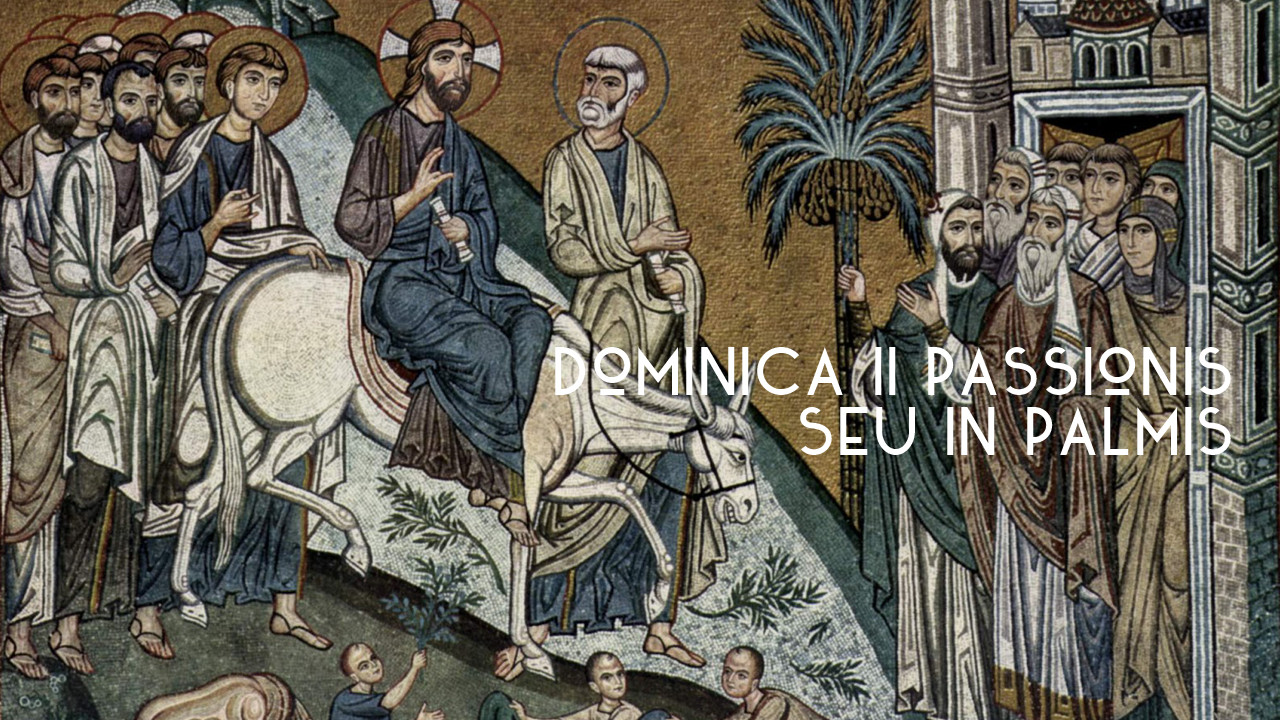
There He instructed His disciples to bring the colt of an ass. They cast their cloaks over it for Him to ride. The gesture was royal and scriptural evoking Solomon, son of David, who rode David’s mule into the city amid acclamation and enthronement. The crowd answered similarly. Cloaks were thrown down. Branches were cut and strewn. With every turn of the road from the Mount of Olives, the holy city and then the Temple flashed into view. Pilgrims sang and city dwellers responded. The cry rose: “Hosanna…Save us! Blessed is he who comes in the name of the Lord.”
However, as the procession continued something changed in the crowd’s song. The people moved from the usual Passover psalmody and into the psalms and gestures of Sukkoth, the autumn harvest feast of Booths or Tabernacles. During that feast palms were waved, and there was a ritual libation of water and wine at the altar. Sukkoth looked back to the booths of the wilderness and forward to the return of the divine Presence to the Temple. The Presence glory cloud had departed, the Ark was gone and Israel longed for the return of glory. Thus, the branches waved toward Christ were charged with expectation. The people thought the Davidic priest-king had come to inaugurate a new age, to purify, to restore, to reign. Ironically, it truly was the return of God to the Temple, but not in the way they desired.
There was also the memory of the Temple’s purification in the days of the Maccabees, when palms marked the joy of deliverance after the defeat of foreign profanation. Yet the Lord came for a victory of another order. He cleansed the Temple, overturning the changing of money from pagan coins to Temple coins without images that had encroached even into the court of the Gentiles, thus depriving the nations of a place to pray to the true God. Jesus then would receive Greeks who sought Him, first fruits of the nations drawn to the lifting up of the Son. This is when He said that His hour had come and the Father’s voice boomed out for the third time. Christ’s Passion began in earnest.
Palm Sunday stands in that tension between what the crowd saw and what Christ knew. He was acclaimed as king, and rightly. He was greeted as priestly Messiah, and rightly. He was therefore expected to manifest divine triumph. Yet all of these would be fulfilled but through humiliation. The little ass bore Him toward His Passion and His Victory. It was lofty because of Solomon and it was lowly because it was a donkey, and not even a full-grown one. The eternal Word entered His city in a manner both regal and humbling. That conjunction prepares us for the Epistle of the day, the great hymn-like passage from Philippians 2. Here the Church places before us the inner law of Holy Week: glory through obedience. St. Paul writes:
“For let this mind be in you, which was also in Christ Jesus: who being in the form of God, did not deem equality with God something to be clung to; but emptied Himself, taking the form of a servant, being made in the likeness of men; and being found in habit as a man, He humbled Himself, becoming obedient unto death, even death on a cross” (Phil 2:5-8).
This text teaches Christ’s pre-existence, His equality with the Father, the reality of the Incarnation, the sacrificial obedience of the Passion, and the exaltation that follows. The Greek repays close attention. He was “ἐν μορφῇ Θεοῦ… en morphē Theou … in the form of God,” and then took “μορφὴν δούλου… morphēn doulou … the form of a servant.” Paul also says that He came “ἐν ὁμοιώματι ἀνθρώπων … en homoiōmati anthrōpōn … in the likeness of men,” and was found “σχήματι ὡς ἄνθρωπος … schēmati hōs anthrōpos … in appearance as a man.” Morphē touches what underlies being. Schēma points to outward bearing. Homoiōma indicates likeness between distinct realities. The Son remained what He eternally is while truly taking to Himself our human nature. He did not cease to be God. Rather, “semetipsum exinanivit … He emptied Himself” by taking the condition of a servant and entering into the humiliations proper to human history, sin excepted.
The Vulgate’s exinanivit renders the Greek ἐκένωσεν… ekénōsen, from κενόω, “to empty.” Here the Church has drawn the rich term kenosis, self-emptying. Yet the emptying does not mean subtraction from divine being. It means the assumption of lowliness, concealment of glory, entrance into suffering, and obedience unto death. The one through whom all things were made accepted spittle, blows, mockery, scourging, and the public shame of crucifixion. Thus, Palm Sunday, with its palms and acclamations, already contains Good Friday. The colt beneath Him points already toward the Cross above Him.
Then comes the exaltation. “For which cause God also hath exalted Him, and hath given Him a name which is above all names” (Phil 2:9). The One who descended is raised. The one obedient unto death is proclaimed in glory. Jesus means “the Lord saves.” The name given at the Annunciation and declared to Joseph reveals mission as well as identity. His name is His work and His work is redemption. When Paul says that every tongue shall confess that Jesus Christ is “κύριος … Kyrios… Lord”, he assigns to Him the title by which the Greek Scriptures render the divine Name. The one riding the colt is no mere prophet.
The Church’s sacred liturgy places these mysteries before us so that we may be conformed to them. “Hoc enim sentite in vobis … Have this mind in yourselves.” Palm Sunday is the beginning of the great enactment in which liturgical participation forms the baptized to live what they celebrate. We are our rites. We do not cease being configured to Christ when we return to the world after church on Sunday. Rather, we must carry Him into every corner of our sphere of life and into every open heart.
Here the little ass becomes a fruitful image. The Lord had His donkey colt to bear Him toward His Passion and victory. You must become a good donkey colt yourself.
Obedient. Docile. Patient. Useful. Steady. Willing to carry.
Willing to be overlooked if only Christ is seen.
The saints teach this. Above all, the Blessed Virgin teaches it. She said, “Be it done unto me according to thy word” (Luke 1:38). She bore Christ before any beast of burden did. In hidden fidelity, in silence, in steadfastness without complaint, she shows how Christ is borne into the world.
There is another side of the image. We are also borne along by our own donkey colts, namely, the ordinary and everyday tasks and events that make up our days. Responsibilities, duties, troubles, sicknesses, interruptions, humiliations, tedium, fatigue, disappointments. These are often the means by which Christ is carried into the cracks and corners of our lives and into the lives of others. The ordinary has extraordinary reach when offered in union with Christ.
That is why a life need not be exotic to have dramatic results. Great sanctity ordinarily matures in the soil of repeated acts done for love of God. Palm Sunday reminds us that the Lord comes amid branches and chanting, yet mounted upon a common working animal. The Church bids us acclaim Him in solemn procession, and then to bear Him through the unnoticed duties of the week. Holy Week is not a pageant set beside real life. It is the revelation of what real life is for.
This is one reason the old rites are so rich. Take, for example, the traditional blessing of palms, before the procession. Blessed Cardinal Schuster observed that in the older form the structure of the blessing bore a resemblance to an anaphora. One of the vanished prayers in 1955 deserves to be heard again:
“Increase the faith of those who hope in You, O God, and mercifully hear the prayers of Your suppliants: let Your manifold mercy come upon us; may these branches of palm and olive be blessed; and as in a figure of Your Church You multiplied Noah going forth from the ark, and Moses going out of Egypt with the children of Israel, so may we, bearing palms and olive branches, go forth to meet Christ with good works, and through Him enter into eternal joy.”
There it is in plain liturgical theology. The branches are not trophies of sentiment. They are signs. They summon good works. They point to Noah, to Exodus, to the Church, and above all to meeting Christ. If we carry branches in our hands but refuse conversion in our lives, then we reduce the liturgy to theater. If, however, grace forms us through these rites, then the blessed palm tucked later behind a crucifix becomes a domestic sermon. It will dry and fade. The victory it signifies does not.
Palm Sunday heralds the defeat of death and Hell. Yet that heralding is stern. It calls for confession, renewed seriousness, and actual participation in the rites of the coming days. There will be people who choose the road of the least they can do and perhaps appear only at Easter. There will be others who understand the wondrous opportunity given by the Church and will do more.
Go to confession. Go to your rites. Take others to both. The Triduum is the heart of Christian worship.