We bring to completion the great Octave of Easter this Sunday, though “completion” here is to be understood in the Church’s own liturgical sense. For a full eight days, by that ancient inclusive counting which the Romans knew so well and Christians inherited, it has still been Easter Day. The Church has, as it were, stopped the liturgical clock so that we might rest within the mystery of the Resurrection and contemplate it from differing angles through the Mass and Office.
This Sunday has many nicknames. The post-Conciliar calendar calls it the Second Sunday of Easter and, by reason of John Paul II’s strong promotion of St. Faustina Kowalska’s theme, Divine Mercy Sunday. In older and more historically saturated usage it is Low Sunday, because it was kept with less outward solemnity than Easter itself. It is Thomas Sunday, because the Gospel draws our attention to the Apostle’s doubt and confession. It is Quasimodo Sunday, from the first word of the Introit. Most anciently and most evocatively it is Dominica in albis, or Dominica in albis depositis, the Sunday “of the white garments laid aside”. All these names gather around the same mystery, and each of them opens a different facet of the jewel.
The Introit from 1 Peter 2:2 gives us at once the tone of the day: “Quasimodo geniti infantes, rationabile, sine dolo lac concupiscite ut in eo crescatis in salutem si gustastis quoniam dulcis Dominus.” In the Vulgate, the opening is “Sicut modo” rather than “Quasimodo”, and that very variation is a small but eloquent witness to the conservatism of Roman liturgical tradition. In many antiphons sung by the Church a form of the Latin Scriptures older than Jerome’s Vulgate has been preserved because the Roman liturgy, shaped by reverence and repetition, ought to change only slowly, without sudden, forced, artificial alterations desired only by a few modernists who wanted to change what people believe. “Like newborn babes, long for the pure spiritual milk, that by it you may grow up to salvation, for you have tasted the kindness of the Lord.” The Church addresses these words first to the newly baptized, the infantes of the ancient Church, spiritual newborns who passed through the waters at the Paschal Vigil. Yet she addresses them also to all the baptized, for the grace of Easter does not belong only to neophytes. Every Christian life has its origin in those same waters, its nourishment in that same milk, its growth in that same divine kindness.
Hence the ancient title Dominica in albis. In the ancient Latin Church the newly baptized wore their white robes through the week after Easter and received from the bishop special mystagogical instruction about the sacred mysteries into which they had now been admitted. On this Sunday those garments were laid aside and deposited as a witness to their vows and to their new life in Christ. The image is striking and tender. For a week they had remained close to the bishop, as nestlings under the wing. Then came the day when they were to go forth into ordinary Christian life, carrying inwardly what they would no longer bear outwardly in white. St. Augustine, preaching in this season, compared them to little birds trying their wings while he, like a parent bird, fluttered and chirped about them to encourage their flight. The whole scene belongs perfectly to the springtime of Easter, to the freshness of baptismal innocence, and to the sobering realization that the Christian life must now be lived in the world, among its pressures, temptations, and confusions.
That movement from liturgical celebration into lived Christian conduct is captured with Roman brevity and force in the Collect:
Praesta, quaesumus, omnipotens Deus:
ut, qui paschalia festa peregimus;
haec, te largiente, moribus et vita teneamus.
LITERAL VERSION:
Grant, we beg You, Almighty God,
that we who have carried through the paschal feasts
may, You bestowing it, hold to them in morals and in life.
The prayer is old, at least as old as the 8th century Liber sacramentorum Gellonensis, and it presses the mystery inward. We who have “carried through” the paschal feasts now ask that, by God’s largesse, we may hold to these things “moribus et vita… in conduct and in life”. The verb perago is suggestive. It can mean “to carry through, complete, accomplish”. It can also, in its more concrete force, mean “to thrust through, to pierce through, to transfix”. That verbal “thrust” energy in perago perhaps is by this “Thomas Sunday”, when the Gospel itself will speak of the Risen Christ’s nail wounds and open side. More on that below. Yet in the Collect the point is clear enough. The octave is ending. The liturgical observance has been completed. The question now rises with evangelical urgency: what will remain?
“Haec… teneamus … let us hold on to these things”. Keep Easter. Maintain its mysteries. The neuter plural reaches back to the paschalia festa, the paschal solemnities and all that they contain and communicate. “Moribus et vita” can be heard with the pleasing compression of Roman prayer either as a kind of pleonasm, conduct and life together intensifying the whole, or as a genuine distinction between one’s habitual moral comportment and the larger arc of one’s existence. In either case, Easter is to be kept beyond Easter.
The grace of the mysteries is to shape both our habits and our whole course. Bl. Ildefonso Schuster says, “To bring our actions into harmony with the Easter rites means to live a life of resurrection and innocence.” Fr. Pius Parsch pressed the same point: “Easter, indeed, is past but its transforming power should show itself in how we ‘act and live.’” This is the enduring program of Low Sunday. Keep Easter forever.
That imperative acquires still more edge when one remembers the moral thread linking Easter Sunday to its Octave Day. Last week the Church heard from 1 Corinthians 5:8: “Let us, therefore, celebrate the festival, not with the old leaven, the leaven of malice and evil, but with the unleavened bread of sincerity and truth.” This week the Introit from 1 Peter urges the baptized to put away malice, guile, insincerity, envy, and slander, and to long instead for pure spiritual milk.
The Resurrection presses moral consequences upon those who have been joined to Christ. The ancient Christians lived cheek by jowl with pagans in a world where their manner of life had to be visibly different if the Gospel was to remain intelligible. The question falls upon us with similar force in an age that has again grown pagan in so many respects. If the Church bids us keep the paschal mysteries moribus et vita, then Easter must become evident in our speech, in our judgments, in our honesty, in our charity, in our refusal to be conformed to the world. “Do not be conformed to this world but be transformed by the renewal of your mind” (Rom 12:2). The Church’s sacred liturgy always aims at that transformation.
All this prepares us to hear the Gospel of John 20:19-31. The chapter has already given us the empty tomb, Mary Magdalene’s witness, and the first reports of the Resurrection. Our pericope brings us to the evening of the first day, Easter itself, and then to the second appearance, “eight days later”, on the Octave. Eight is never a mere number in Scripture. It harks to the day beyond the sevenfold rhythm of the first creation, the day of fulfillment, the sign of a new creation and of eternal rest. The Octave itself thrums with that significance. We are, liturgically, poised at the edge of the world to come.
In John 20, the disciples are gathered behind closed doors “for fear of the Jews.” Here one ought to remember that the Apostles themselves were Jews. The Greek term, Ioudaioi, points more specifically to Judeans, and to the hostility that had hardened around Jesus in Jerusalem and its authorities. Into that locked and fearful enclosure the Risen Christ comes suddenly and says, “Peace be with you.” That greeting is no mere courtesy. When the Eternal Word speaks “peace”, He effects what He says. He Himself is peace, present in their midst. It is fitting that bishops, successors of the Apostles, use in the sacred liturgy the greeting “Pax vobis”, while the priest says “Dominus vobiscum.” The apostolic resonance is deliberate. The Risen Lord who stood among the Eleven continues to address and steady His Church.
He Christ shows them His hands and His side. This detail is crucial. The Resurrection is not the exchange of one body for another, nor the appearance of some ghostly substitute. Christ did not cast off His wounded Body and take up a pristine replacement. The Body that hangs on the Cross and the Body that stands risen in glory are one and the same. The wounds remain, and their permanence establishes continuity with the Passion even as the properties of the risen Body begin to shine forth: clarity, impassibility, agility, subtlety. The glorified Christ passes through doors unhindered, yet He remains truly Himself, marked forever by the saving violence He endured for us.
Then comes the moment of immense ecclesial and sacramental consequence. “As the Father has sent me, even so I send you” (v. 21). The Son is the One sent by the Father. The Apostles now become sent ones in and through Him. He breathes on them and says, “Receive the Holy Spirit. If you forgive the sins of any, they are forgiven; if you retain the sins of any, they are retained.” This is the institution of the Sacrament of Penance. The power promised in the discourse about the keys and in the authority to bind and loose now takes concrete form in the breath, Hebrew ruach, of the Risen Christ.
When a priest absolves sins, it is not a mere declaration that sins are somehow ignored, covered, or externally imputed away. It is a true remission, a true cleansing, a real loosing. The Council of Trent affirmed de fide that the Church received from Christ the authority to remit post-baptismal sins. The text itself makes plain that such remission requires judgment, and judgment requires knowledge. If sins are to be forgiven or retained, they must therefore be known to the minister to whom Christ entrusted this authority. Hence, verbal confession of sins belongs to the sacrament’s very logic.
Here mercy shows its concrete and incarnate face. The newly baptized of Dominica in albis are not left to imagine that any failure after baptism places them beyond return, a matter which the ancient Church worked through. The Lord who gave them rebirth also provided the remedy for their falls. God’s mercy is not abstract. It is sacramental, breathed into the Church by the Risen Christ and exercised through the Apostles and their successors. Hence this Sunday’s later association with Divine Mercy is not an extrinsic attachment. It rises naturally from the Gospel itself. In confession, the Heart that was opened on Calvary continues to pour out mercy blood and cleansing water in the sacramental life of the Church.
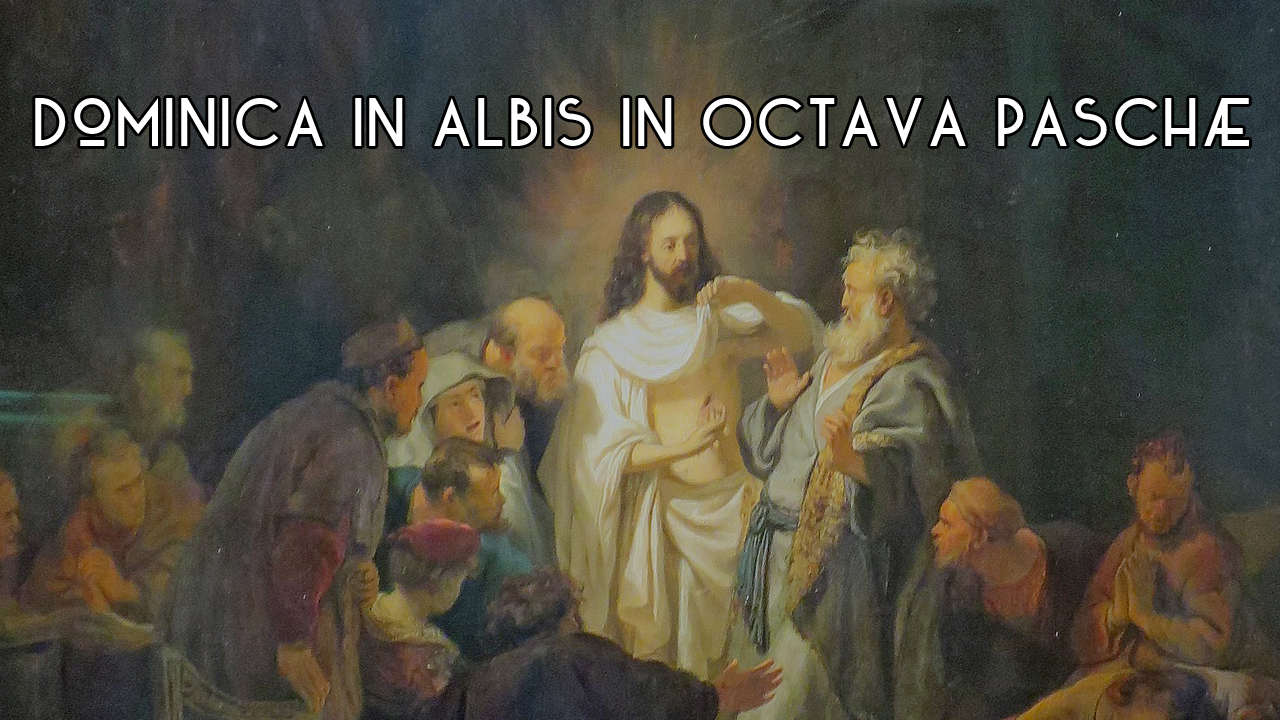
Thomas is absent during Christ’s first post-Resurrection appearance. We are not told why. I like to think that it was his turn to go pick up the takeout for the others. The theological point is more serious. Christ did not choose to wait until all were present. Thomas’s absence therefore becomes part of God’s providential pattern. Thomas hears the testimony of the others and resists it. He demands contact with the wounds: the mark of the nails in the hands, and the hand thrust into the side. Eight days later the Lord returns, again bestowing peace, and then in verse 20:27 turns directly to Thomas’s demand.
Put your finger here, and see my hands; and put out your hand, and thrust it into my side; do not be faithless, but believing.
The details here invite a close reading. The Greek dáktylos is finger. Cheír can mean hand, but in some contexts hand together with arm or forearm. That is the second meaning of cheír in the great Liddell & Scott, A Greek-English Lexicon which adds that “sometimes words are added to denote the hand as distinct from the arm”(p. 1719). Christ directs Thomas to use his “finger” to check the wounds of the nails, but his “hand” for the side. The verb is forceful: bále, “put, cast, thrust”, “eis tèn pleurán mou… into my side”. This implies a wound channel both wide and deep, opened by a Roman lance, extending through the lung, the place of ruach, to the Sacred Heart. Christian imagination and art have lingered over this scene. Caravaggio famously showed Thomas probing with concentrated intensity. St. Bonaventure contemplated Thomas as passing through the visible wounds to the invisible wound of love.
John does not explicitly say that Thomas physically carried out what Christ commanded. He records only the Apostle’s cry: “My Lord and my God.” Yet that cry comes with such force, and John’s immediate conclusion to chapter 20 has such definitive character, that one senses the Evangelist has arrived at the summit. He continues (vv. 30-31):
Now Jesus did many other signs in the presence of the disciples, which are not written in this book; but these are written that you may believe that Jesus is the Christ, the Son of God, and that believing you may have life in his name.
Thomas’s confession is the high point of the Gospel’s testimony.
Faith reaches full voice before the wounds of the Risen One.
There is room here for reverent speculation. Thomas had not been present when Christ breathed on the Apostles on Easter evening. However, the breathing of the Spirit is central to the Apostolic mission. The wound in the side remains open in the risen Body. The Lord commands Thomas to thrust his cheír – arm/hand – into it. One can at least contemplate the possibility that, in this singular encounter, Thomas received in a different way the breathing the others had received on the first evening. When at Christ’s command Thomas thrust his arm into the blade channel opened by the lance to the pierced Heart, the Lord breathed His ruach on Thomas hand within His own torn lung. Thomas thus received the ruach breathing, and so was drawn into the mystery of mercy with a tactile intimacy granted to no other Apostle. Witnessing that, no wonder John concludes as he does. My speculation here cannot be pressed into assertion, but it is plausible, given the post-Resurrection qualities of the Risen Lord’s Body.
This in turn opens a profoundly sacramental reading of the day. In the Sacrament of Penance Christ’s breath touches us again. In Holy Communion we draw near to the same living Heart. Pius Parsch, commenting on the faith that believes without seeing, could say: “when you find it difficult to believe, put your finger into Christ’s wound, that is, receive the holy Eucharist. Then you will be strengthened, then you will see Christ; and with Thomas you will say, ‘My Lord and my God.’”
The line is bold, yet it is spiritually exact. The sacraments bring us into contact with the Risen Christ in the concrete order He Himself established. When faith wavers, when life grinds us down, when sin has dulled the soul, the remedy is confession, Communion. It is a return to grace through the very wounds from which the Church was born.
Thus, Low Sunday, Quasimodo Sunday, Dominica in albis, Thomas Sunday, Divine Mercy Sunday, all converge. The white garments are laid aside, yet baptismal innocence must remain inwardly. The octave ends, yet Easter is to be held fast moribus et vita. The doubting Apostle confesses, and through his confession the whole Church learns how to pass from fear into adoration. The Risen Christ stands in the midst of His Church with wounds intact, peace on His lips, Spirit in His breath, mercy gushing from His Heart.
The ancient infantes needed that lesson when they stepped out into a savage pagan world. As do we.