It is a fact of human nature that when our senses are incessantly struck by the same impression, we begin to dull. Noise that never ceases is no longer truly heard. Color without contrast becomes flat. Images, especially wicked images, can first disturb and then stupefy. For this reason deprivation has a place in a healthy human life, and variety has a place in the Church’s sanctifying wisdom. Holy Mother Church, expert in humanity because she is the Mystical Body through which Christ heals humanity, knows that there must be fasting before feasting, restraint before abundance, silence before song. Thus, deep into Lent, when penance has already formed us by repetition and want, there comes this fixed and gracious pause, the Fourth Sunday, Laetare Sunday, a moment to draw breath before the final descent into the more severe stretch that leads toward the Passion and the blaze of Easter.
The day takes its name from the first word of the Introit, “Laetare, Ierusalem …Rejoice, O Jerusalem,” from Isaiah 66. The command is liturgical joy set within prophecy, and prophecy set within the Church’s pilgrim life. Isaiah speaks to the humble who accept the Lord’s ways, to those who mourned and shall now be consoled, to those who will be nourished as children at the breast of mother Jerusalem. The image is maternal, ecclesial, eschatological. Jerusalem is at once the historical city, the figure of the Church, the heavenly patria, and, as John Cassian says, even the soul itself. In the Conferences he writes that Jerusalem may be understood “historically as the city of the Jews, allegorically as the Church of Christ, anagogically as that heavenly city of God which is the mother of us all, tropologically as the human soul” (Collationes XIV, 8, 4). That fourfold reading gathers rather than scatters the meaning. On this day the Church sings to Jerusalem because she stands in Jerusalem, journeys toward Jerusalem, and becomes Jerusalem.
In Rome the Station is at the Basilica of the Holy Cross in Jerusalem, the venerable Sessorian Basilica which held for the Romans a sacramental likeness to the Holy City itself. Blessed Ildefonso Schuster remarks that “the Introit for the fourth Sunday of Lent, Laetare Jerusalem, makes a graceful allusion to the Church of Jerusalem, as the Sessorian Basilica was called, in which the Station took place.” He also notes that in the Middle Ages the basilica “was called simply Sancta Hierusalem,” a title that explains the liturgy’s many allusions to Jerusalem on this day.
St. John Henry Newman, in a description preserved in Wilfrid Ward’s Life of Cardinal Newman, captured the Roman concreteness of the place: “This Basilica is so called, because Saint Helena, not only brought the True Cross there, but earth from Mount Calvary on which the Chapel or the Altar there is built.” The translation needed is scarcely more than the sentence itself, for it is plain English and deeply suggestive: Rome received Jerusalem into herself, so that one may stand in the heart of Rome and touch, as it were, the soil of Calvary. Newman continues, “thus if there be a centre of the Church, we shall be there, when we are on earth from Jerusalem in the midst of Rome.”
Hence the joy of this Sunday is not mere relief that Lent is passing. Rather, it is the joy of nearing home. Psalm 121(122), one of the gradual psalms of pilgrimage, sounds through the Mass: “Laetatus sum in his quae dicta sunt mihi: in domum Domini ibimus,… I rejoiced at the things that were said to me: we shall go into the house of the Lord.” The catechumens of ancient Rome would have heard these words with a peculiar intensity. They had undergone the scrutinies. They had been exorcized. They stood close to the threshold of the font, close to being reborn in the Vigil of Easter, close to becoming, in the old Roman idiom, infantes, newborns, newly entered into the bosom of Mother Church. So the maternal imagery of Isaiah 66, sung in the Introit, was not a pious flourish to them either. The Church rejoiced because she was about to bear children.
This also explains the slight relaxation in the external austerity of Lent. Flowers may appear on the altar. Instrumental music, usually restrained in this season, may support the sacred texts. Violet gives way, where the custom is observed, to rosacea. One should say rosacea and think of something between madder and dark salmon. One should not think of confectionary pink. The color is Roman, and its Romanity matters. Schuster records the medieval custom: “In the Middle Ages, the Pope used to proceed to the station at Sta Croce in Gerusalemme holding in his hand a golden rose, the mystical significance of which he afterwards explained to the people. On his return he presented it to the Prefect of Rome, and this gave rise to the custom, which continues to this day, of sending the golden rose blessed by the Pope as a gift to one of the Catholic princes.”
It required no great leap for the “Sunday of the rose … Dominica de rosa”, to be associated with rose vestments. And from Rome the custom passed outward by means of the Roman books. By a kind of mutual enrichment across the liturgical year, the same rose tone crossed into Advent’s own day of restrained joy, Gaudete Sunday. In both cases the Church, with ancient pedagogical precision, gives a hint of feast in the midst of fast. There is respite, though not release. The Collect says as much with admirable economy:
Concede, quaesumus, omnipotens Deus:
ut, qui ex merito nostrae actionis affligimur,
tuae gratiae consolatione respiremus.
Grant, we beseech You, almighty God, that we, who are afflicted on account of the blameworthiness of our own acting, may breathe again, may be refreshed, by the consolation of Your grace.
That respiremus is marvelous. The word means to breathe again, to recover breath, to revive after strain. The Church asks for refreshment, not exemption. She asks for consolation, not cancellation of penance. There is also, in the prayer, a salutary tension between merito nostrae actionis and tuae gratiae consolatione. Our action, considered as ours, merits affliction. His grace gives refreshment. The Roman Canon is the Church’s central actio, yet Christ is the true Actor in that actio, and through baptism we participate in what He does. Left to ourselves, our acts bear the marks of Adam. Joined to His merits, they are taken up into the movement of salvation. The Sunday therefore teaches us how to interpret the whole of Lent. We are pruned, chastened, deprived, and then consoled by a gift we do not generate.
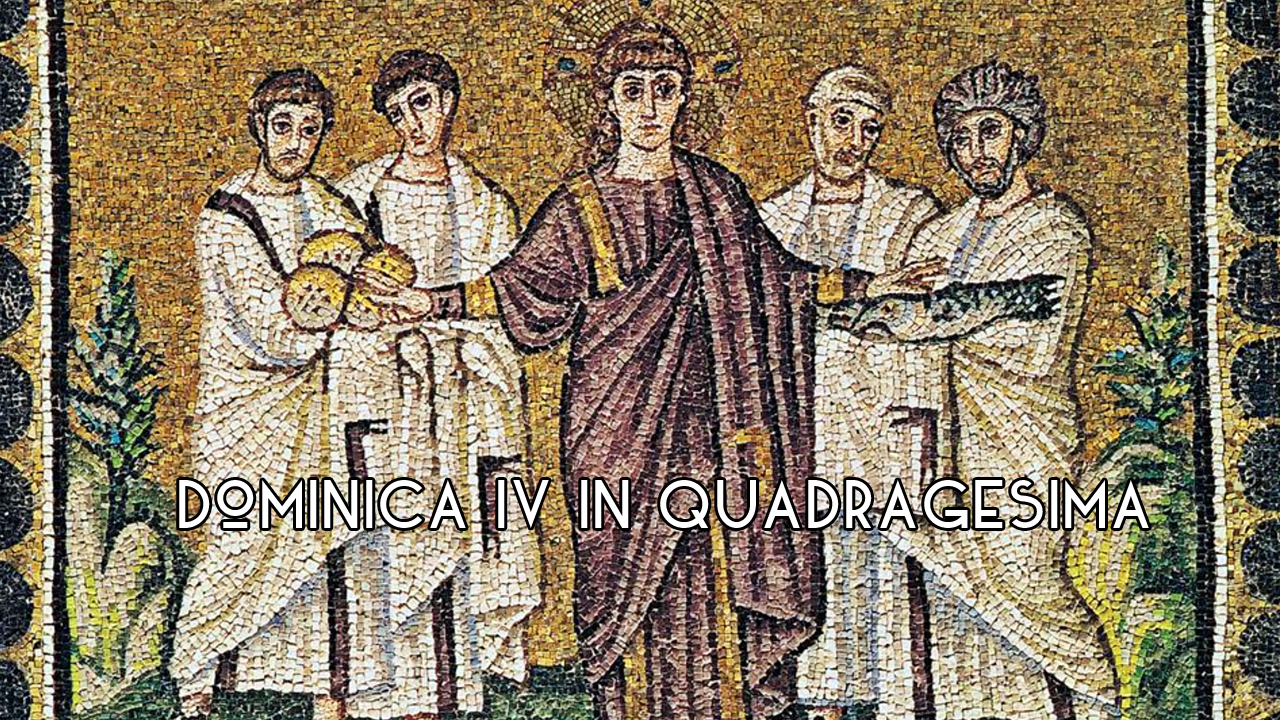
The Gospel makes this logic visible. John 6 recounts the multiplication of the loaves near Bethsaida, and the Church places it here with exquisite fitness. After the sorrowful news of John the Baptist’s death, Christ withdrew to a deserted place. The crowd followed. The Greek word ἔρημος evokes the wilderness, the desert, the place of hunger and testing, the stage of Exodus. The people are in want, in deprivation, in a kind of fast. Evening draws on. There is no sensible worldly solution. Christ asks Philip, native to that region, “Where are we to buy bread, so that these people may eat?” John adds the crucial note: “This he said to test him, for he himself knew what he would do.” The Lord permits the need, indeed sharpens the perception of the need, before He answers it with abundance.
Andrew points to the boy’s five barley loaves and two fish. What are they among so many? This is the perennial question of the timid soul. What are my prayers, my sacrifices, my little acts of mortification, my narrow resources, my exhausted patience, my poor handful of bread, among so many needs? Yet divine economy delights to begin there. The Lord takes what is manifestly inadequate and makes it the occasion of superabundance. All eat. All are satisfied. And then comes the phrase that should ring in every Catholic ear: “Colligite quae superaverunt fragmenta, ne pereant… Gather up the fragments left over, lest they perish” (John 6:12).
One must say this plainly: the event is a real multiplication, not a pious lesson about sharing disguised as a miracle. John’s narrative excludes that flattening reduction, for the twelve baskets of leftovers are gathered from the bread multiplied by Christ’s act. The supernatural is not an embarrassment in the Gospel. It is the point. The New Moses does in the wilderness what only God can do. And because the sign stands in an Exodus context, the reduction of the miracle to spontaneous human generosity collapses the typology. Israel in the desert was fed by manna from heaven. The Lord in the desert feeds the multitude by His own sovereign act. A mere human redistribution of lunches will not bear the theological weight the evangelists place upon it.
The details matter, and the numbers matter. In Mark’s parallel account the people are organized in groups of hundreds and fifties. This calls to mind Exodus 18:25-26, where Moses appoints leaders over thousands, hundreds, fifties, and tens. The old wilderness order is being recapitulated and surpassed. Christ is the New Moses, and a New Exodus is underway. The twelve baskets gathered afterward readily suggest the regathering of the twelve tribes. The miracle occurs in Jewish territory, near Bethsaida, on the way, as it were, toward the restoration of Israel in the Messiah. Yet this sign is not self-enclosed. It reaches forward as well as backward.
For the multiplication of loaves looks back to manna and ahead to the Eucharist. John situates it near Passover. The timing is deliberate. In both the multiplication and the Last Supper, there is bread taken, blessed, distributed. There is thanksgiving, εὐχαριστήσας, “having given thanks.” There is the posture of those reclining at table. There is the movement from hunger to divine feeding. The line extends from the manna of the wilderness, to the miraculously increased bread in the deserted place, to the true heavenly Bread given in the Eucharistic mystery, and from there to the wedding feast of the Lamb and the New Jerusalem. The sign does not exhaust itself in bodily feeding. It unveils a divine pedagogy in which earthly hunger becomes the grammar for eternal nourishment.
The second multiplication, that of the four thousand in Gentile territory, strengthens the point. There the leftover baskets are seven. If the twelve baskets by Bethsaida signify the tribes of Israel, the seven evoke the nations of the Gentile world, as in Deuteronomy 7:1. The Lord Himself presses the disciples to reflect on these numbers in Mark 8:17-21. “Do you not yet understand?” They had seen the signs and remained slow. We read their slowness with some sympathy, because our own is no less. Yet the meaning emerges with beautiful force. First in Jewish territory, then in Gentile territory, Christ feeds and gathers. The final horizon is one flock, one people, one Church, one heavenly Jerusalem. Thus Galatians 4 and John 6, the Epistle and Gospel of this Sunday, stand in consonance. Paul contrasts Hagar and Sarah, slavery and freedom, Sinai and Jerusalem. “That Jerusalem which is above is free, which is our mother.” Through baptism we pass from bondage to sonship, from alienation to inheritance, from the hunger of exile to the table of the household.
This is why Laetare Sunday is so well placed in Lent. It shows the structure of Christian life itself. There is deprivation before bounty. There is fasting before feasting. There is scrutinizing before baptism, wilderness before manna, Calvary before resurrection, pruning before blossom. The rose on this belongs to a theology of ripening through diminishment. The branch cut back blooms more richly in season. So too with us. Voluntary mortification trains us to receive, and involuntary loss trains us to hope. As health weakens, as faculties dull, as the body yields to time, the Christian does not look only at subtraction. He reads within it a preparation, provided he dies in grace, for the restoration and perfection of all that sin and decay have marred. The tradition’s language for the glorified body, impassibilitas, subtilitas, agilitas, claritas, names this promised plentitude. Here below we are schooled by want. There we shall be filled.
This has pastoral consequences: we must not despise the little. The little lad’s little loaves were little. The Apostles’ resources were little. Our own efforts are usually little. Yet God asks for that little and works with it. Never let the smallness of your prayer, your almsgiving, your fasting, your hidden reparation, become an excuse for inaction. The Lord who fed thousands from five loaves is able to magnify what is offered in faith. What He requires is fidelity. The Church’s rites teach us to make such offerings with regularity, according to a holy rhythm that shapes desire and reorders the soul. We fast because joy requires capacity. We are deprived because abundance otherwise passes unnoticed.
So on this Sunday, rejoice. Rejoice with Jerusalem, with the catechumens, with the Church near the relics of the Passion, with pilgrims who see the city at last within reach, with those who have mourned and now hear the promise of consolation. Rejoice with sobriety, with gratitude, with sharpened hope. Draw breath. Respiremus. The rosy horizon is visible because the sun of Easter is approaching. Yet the Cross still is in our midst, in Rome as in Jerusalem, in the liturgy as in life.