
We are in Epiphanytide, that stretch of the liturgical year whose very name, drawn from the Greek ἐπιφάνεια, signals manifestation, disclosure, the making-visible of divine reality within human history. From the beginning, Epiphany held a privileged place in the ancient Eastern Churches, where the Feast gathered into a single luminous focus several moments in which the hidden glory of Christ shone forth. The Roman tradition, while receiving and developing these themes in its own way, has never lost sight of the triad that the Church sings each year in the great antiphon of Vespers: Hodie caelesti Sponso iuncta est Ecclesia… Hodie stella Magos duxit ad praesepe; hodie vinum ex aqua factum est ad nuptias; hodie in Iordane a Ioanne Christus baptizari voluit, ut salvaret nos. Alleluia. Today the star leads the Magi to the manger; today water is changed into wine at the wedding; today Christ wills to be baptized by John in the Jordan that He might save us. The Church marks these events not as disconnected episodes, but as facets of one mystery, each introduced by hodie, each proclaimed as sacramentally present.
Editor’s note: hear this great antiphon of Epiphany below.
In the older Roman arrangement of the calendar, these manifestations are drawn out and contemplated in turn. Epiphany itself, on 6 January, centers upon the Magi, whose gifts reveal the kingship, priesthood, and divinity of the Child, frankincense rising as a sign of worship offered to God. The octave day, 13 January, brings the Baptism of the Lord, the moment when the hidden life gives way to the public ministry, when the heavens open and the Father’s voice is heard over the waters of the Jordan. The Second Sunday after Epiphany presents the wedding feast at Cana, the first of the signs by which Jesus “manifested His glory” (Jn 2:11), an event that in the Johannine sequence stands as an octave echo of the Baptism itself. In John’s Gospel the days unfold with deliberate symmetry, leading from the testimony of the Baptist to the revelation of the Bridegroom.
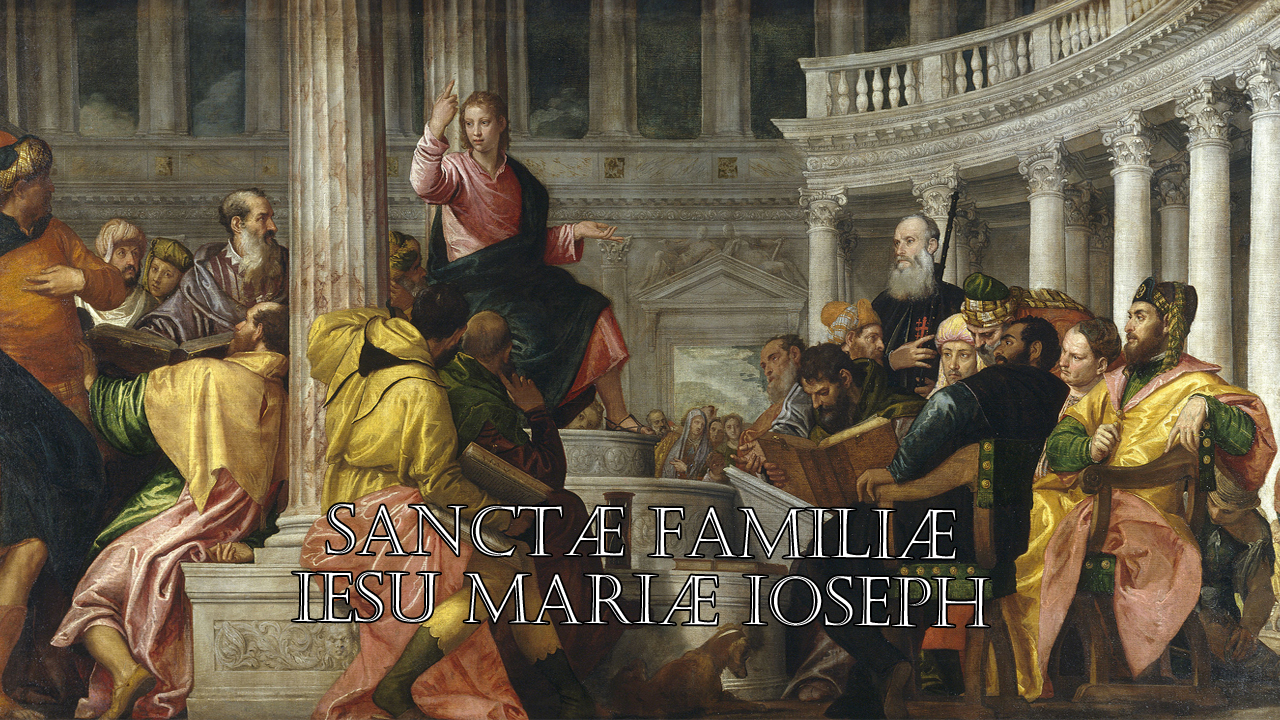
Within this Epiphanytide framework, the Traditional Roman Rite places before us the Feast of the Holy Family. The juxtaposition is not accidental. The manifestations of Christ’s divinity are set alongside the quiet, hidden years of Nazareth and the single Gospel scene that draws back the veil for a moment, the Finding of the Lord in the Temple (Lk 2:41–52). In the Novus Ordo calendar this Sunday is occupied by the Baptism of the Lord – which brings the Novus Ordo cycle of Advent/Christmas to its close – and the Feast of the Holy Family is placed within the Christmas Octave. The movement of feasts over the last century has been considerable. As Fr. Pius Parsch observed in The Church’s Year of Grace, the Holy Family feast was promoted in the wake of the First World War with an explicitly pastoral aim, the renewal and strengthening of family life after devastation and upheaval. Before those adjustments, the Sunday after Epiphany remained closely tied to the octave of the Feast itself, an octave later suppressed with a confidence that now seems hasty. Even so, the Gospel remains the same in the older use, and the theological threads remain intact.
The Gospel of the Finding of the Lord in the Temple stands at a hinge point in salvation history. Luke tells us that Jesus was twelve years old when Joseph and Mary took Him up to Jerusalem for Passover, in obedience to the Law (Ex 23:14–17). The detail is historical, yet Luke writes with a Scriptural ear attuned to resonance and fulfillment. Those formed by Israel’s Scriptures would hear an echo of Samuel, dedicated to the service of God at a young age. In 1 Samuel 2:26 we read, “Now the boy Samuel continued to grow both in stature and in favor with the Lord and with men.” Luke closes his account of the Temple episode with words deliberately parallel: “And Jesus increased in wisdom and in stature, and in favor with God and man” (Lk 2:52). Samuel, born of a mother who prayed in anguish and hope, grows in favor with God and men; Jesus, born of the Virgin who sang the Magnificat, grows likewise. Hannah’s canticle, Exsultavit cor meum in Domino (1 Sam 2:1), already anticipates Mary’s Magnificat anima mea Dominum (Lk 1:46). Luke establishes from the outset the prophetic dimension of Christ’s mission.
Yet the parallel goes further. Samuel is separated from his family to serve before the Lord in the tabernacle, the precursor of the Temple. Jesus, too, is separated, remaining behind while His parents depart with the caravan. Luke uses a term that repays attention. The group with whom Joseph and Mary traveled is called a συνoδία (synodía) a company “together on the road.” The word itself speaks of “walking together.” The irony is sharp. In fact, just as the “walking together” of Luke 2 lost Jesus, so it seems that the “walking together” of the last few years may have done the same.
In any event Jesus is not “walking together” at that moment. He sets aside ordinary human expectation in order to be found where He must be found. Only when He is “about His Father’s (business)” does He rejoin them. Quaerite primum regnum Dei (Mt 6:33) takes flesh here as a priority that disrupts even the holiest of human bonds.
Having sought Jesus in all the wrong places, Joseph and Mary find Jesus in the Temple, the central place of worship and sacrifice which was the microcosm of the universe for the Jews. They found Him in the place of worship, not the markets and byways. It is as if this moment, counted among both the Sorrows of Mary and Joyful Mysteries, is shouting at us today that our best path to Jesus is not in endless process but rather in sacred liturgical worship received from our loving forebears. We are our rites. When our pastors remember this, then we shall see what happens.
In any event, when Mary and Joseph discover Him in the Temple, seated among the teachers, listening and asking questions, His response opens a depth that they cannot yet fully grasp. The Greek is spare and suggestive: ἐν τοῖς τοῦ πατρός μου δεῖ εἶναί με. This is often rendered as “I must be in my Father’s house.” There is no explicit word in Greek for “house.” Literally, “I must be in the things of my Father.” The phrase gathers within it the Father’s concerns, affairs, purposes, all that pertains to Him. Some translations render it “about my Father’s business,” others “in my Father’s house.” Both are attempts to articulate what the Greek leaves open. A similar openness appears at the foot of the Cross, when the beloved disciple takes Mary εἰς τὰ ἴδια (Jn 19:27). The word οἶκος, “house” does not appear. Instead, Mary is taken into what in Latin is “in sua,” that is, “into his own,” that which pertains to the self, to one’s care and responsibility. In Luke, Jesus’ words signal an orientation that transcends Nazareth without rejecting it, an allegiance that orders and subordinates all other loyalties.
Luke is careful to note that Mary and Joseph did not understand what He said. Mary’s response is familiar. She keeps these things, συνετήρει, and ponders them in her heart. The verb suggests guarding, treasuring, weighing. Pondering in this sense is actively receptive, attentiveness, a patient holding of mystery until light is given. Joseph, characteristically, says nothing. The silence of Joseph is itself instructive. Words are few in the Gospel accounts of the Holy Family. In this passage deeds, obedience, and quiet fidelity manage still to speak loudly.
The scene closes with a return to Nazareth and a statement that grounds the extraordinary in the ordinary: Jesus goes down with them and is subject to them, ἦν ὑποτασσόμενος αὐτοῖς. The Son, who knows Himself to be about “His Father’s,” lives for years in obedience within the household. The hierarchy of the home remains intact. At some point Joseph, descendant of David, will complete his earthly course, and Jesus will be the true Davidic King, Priest, and Prophet. Until then, hiddenness prevails.
The Feast of the Holy Family shows that each member of that household lived a form of subjection, not as humiliation but as ordered love. Charity governs the relationships, a charity in which each is deeply attentive to the good of the other. It requires no great imaginative leap to envision Nazareth as a place of unity, calm joy, prayerful labor according to proper roles, spoken prayer joined to long silences. Such an image is consonant with the persons involved and with the Gospel’s restraint.
The Church places alongside this Gospel the Epistle from Colossians 3:12–17, a text that Holy Church, the greatest expert in humanity there has every been, proposes repeatedly. It appears on the Feast of the Holy Family in the modern rite on the same feast within the Christmas Octave, and again on the Fifth Sunday after Epiphany. Repetita iuvant. Paul knows that simplicity does not equate to ease. The virtues he enumerates demand continual recommitment. “Put on then, as God’s chosen ones, holy and beloved, compassion, kindness, lowliness, meekness, and patience” (v. 12). The Greek verb ἐνδύσασθε for “put on” is an aorist imperative in the middle voice (sort of active and passive at the same time, the effects are often in relation to the subject): clothe yourselves. Take up these dispositions deliberately. The Vulgate renders it induite. Virtue is not something you acquire by accident. It must be assumed by effort, then worn, lived over time until it is a habit of life.
Paul’s imagery is sustained through the passage. Over these garments, another is placed: “And above all these put on love, which binds everything together in perfect harmony” (Col 3:14). Charity is put on over all, as a cloak that both covers and unifies. The Greek ἐπὶ πᾶσι τούτοις suggests both priority and encompassing presence. Charity binds the virtues into harmony, not by flattening them, but by drawing each into its proper expression. St. Francis de Sales captured this dynamic with characteristic clarity: “The queen bee never takes wing without being surrounded by all her subjects; even so Love never enters the heart but it is sure to bring all other virtues in its train; marshalling and employing them as a captain his soldiers” (Introduction à la vie dévote, III, 1).
The context of Paul’s letter sharpens the point. Colossae, in Phrygia of Asia Minor, was a community facing doctrinal confusion and moral pressure. Paul writes from imprisonment, weaving together high Christology and concrete exhortation. The section from which this pericope is drawn addresses the ordering of Christian households. The peace of Christ is to rule in hearts. The word of Christ is to dwell richly, expressed even in sung prayer, psalms and hymns and spiritual songs. Gratitude permeates all. Whatever is done, in word or deed, is done in the name of the Lord Jesus, with thanksgiving to the Father through Him.
In the family, these exhortations take on particular urgency. Words wound. Silence can wound as well. Restraint of speech, patience under strain, readiness to forgive as the Lord has forgiven should be daily disciplines. Charity is sacrificial love. It seeks the good of the other, even at cost to oneself. The pattern is given in Christ Himself, in the abasement of the Incarnation and the self-gift of the Cross. Paul’s paradox stands firm: “For the sake of Christ, then, I am content with weaknesses, insults, hardships, persecutions, and calamities; for when I am weak, then I am strong.” (2 Cor 12:10).
The challenge of charity exposes deeper currents. Fear lies close at hand, fear of loss, fear of vulnerability, fear of diminished control. Pride lurks beneath such fear, the root from which sins grow. Courage is required, particularly within the family, courage that refuses to harm, courage that keeps the true good of the other always in view. That true good reaches beyond immediate comfort to the horizon of Heaven.
Paul’s counsel in Ephesians resonates here as well: “Be angry but do not sin; do not let the sun go down on your anger, and give no opportunity to the devil” (Eph 4:26–27). Speech is to build up, impart grace. Bitterness and clamor are to be put away. Kindness and tenderhearted forgiveness mark those sealed by the Holy Spirit.
The family stands at the center of the struggles now manifesting in society. His Eminence Carlo Card. Caffarra once recounted a letter from Sr. Lucia of Fatima: “Father, a time will come when the decisive battle between the kingdom of Christ and Satan will be over marriage and the family. And those who will work for the good of the family will experience persecution and tribulation. But do not be afraid, because Our Lady has already crushed his head.” The warning carries with it a promise. Fidelity is costly, yet victory belongs to Christ.
Epiphanytide thus gathers doctrine, devotion, and daily life into a single contemplative arc. The manifestations of Christ’s glory illuminate the hidden fidelity of Nazareth. The Gospel of the Temple teaches priority, obedience, pondering. Paul’s exhortations give concrete shape to charity within the household. Together they form a pattern that remains demanding and luminous. The Church proposes it again and again, knowing that repetition assists memory, and memory forms life.