The 2nd Sunday after Easter in the traditional Roman Rite is called Good Shepherd Sunday. The nickname is well deserved. The Gospel presents Christ’s discourse in John 10, the Epistle from 1 Peter gathers into itself Isaiah’s Suffering Servant, and the Roman Station in ancient times was St. Peter’s on the Vatican Hill, at the grave of the first and foremost pastor ovium. The Mass is woven with one image, though that image is richer and harder than sentimental piety usually allows. Christ is the Good Shepherd. He knows His sheep. He calls them. He seeks them. He gathers them. He lays down His life for them. He is also, in Peter’s striking phrase, the pastor et episcopus animarum vestrarum, the Shepherd and Bishop of your souls.
That title from 1 Peter 2:25 deserves attention. Peter writes to Christians under persecution in Asia Minor, Christians being tried by fire. He places before them the Passion of Christ not merely as a distant object of admiration, but as the pattern into which they themselves are being drawn.
“For to this you have been called, because Christ also suffered for you, leaving you an example, that you should follow in his steps” (v. 21).
The Christian vocation has many forms according to state in life, but beneath them all is one universal call: to follow the Lord even into suffering. This is no accident tacked onto discipleship, no unfortunate side effect of religion. Peter says, “to this you have been called.” The disciple follows the master where the master goes, just as sheep follow the shepherd.
Peter’s use of Isaiah 53 deepens the point. Christ’s suffering is innocent suffering. “He committed no sin; no guile was found on his lips” (v. 22). The Suffering Servant “opened not his mouth”; there was “no deceit in his mouth”; “with his stripes we are healed.” Peter draws those lines into the Passion of Christ and then extends them into the life of Christians. Suffering in itself is common to mankind. Peter is speaking of suffering as Christian, suffering endured in union with Christ, suffering which can be borne with innocence, patience, and charity. There is suffering which comes because men do evil and are punished. Peter has no interest in glorifying that. He says elsewhere, “let none of you suffer as a murderer, or a thief, or a wrongdoer, or a meddler” (1 Peter 4:15). Yet “if one suffers as a Christian, let him not be ashamed, but under that name let him glorify God.” The distinction matters. Christian suffering is not mere pain. It is suffering caught up into Christ’s own obedient offering.
That is why the shepherd image and the cross belong together. In the Gospel, the Lord says, “I am the good shepherd. The good shepherd lays down his life for the sheep.” He says it to men who knew their Scriptures. They knew Psalm 23 (in the Vulgate numbering, Psalm 22), “The Lord is my shepherd.” They knew Ezekiel 34, with its blistering denunciation of false shepherds who fed themselves and scattered the flock. They knew that God promised to come Himself, to seek His sheep Himself, to rescue them Himself, and yet also to set over them “my servant David.” Therefore when Christ says, “I am the good shepherd,” He is claiming more than pastoral concern. He places Himself in the line of the divine promises. The shepherd to come would not be merely another religious leader among many. He would be the Davidic shepherd and, in the full force of Ezekiel, God with His people.
The contrast with the hireling sharpens everything. The hireling runs because the sheep are not truly his. He has no inward bond with them. He calculates risk. He values himself above the flock. Christ, however, says, “I know my own and my own know me, as the Father knows me and I know the Father” (John 10:14-15) That is a staggering elevation of the idea of “knowing.” This is not bare cognition, just a shepherd’s set of index cards. The Son knows the Father in the eternal intimacy of love and self-gift. Christ places the flock within the radiance of that relationship. The flock knows Him because grace has created a real bond. The sheep hear His voice, follow Him, and in that following are gathered into unity. “There shall be one flock, one shepherd” (John 10:16).
That promise of unity is no minor afterthought. The scattered sheep are in peril precisely because they are scattered. Sheep wandering alone do not remain sheep for long. They “became food for all the wild beasts” as Ezekiel put it. The same urgency lies under the Lord’s words in John 10. If the Shepherd lays down His life, the danger must be proportionate to the sacrifice. He does not die because the flock is mildly inconvenienced. He dies because the sheep are in mortal peril. That theme is sounded magnificently in the traditional Collect for this Sunday:
Deus, qui in Filii tui humilitate iacentem mundum erexisti:
fidelibus tuis perpetuam concede laetitiam;
ut, quos perpetuae mortis eripuisti casibus,
gaudiis facias perfrui sempiternis.
A literal rendering
O God, who by the abasement of Your Son raised up a fallen world,
grant to Your faithful perpetual joy,
so that those whom You snatched from the calamities of perpetual death,
You may cause to enjoy everlasting joys.
The prayer does not permit a shallow estimate of our condition. We were stranded in a fallen world. We were snatched by Christ from perpetual death. The height of the joy offered here is sharpened by the depth of the abyss from which we were delivered.
Even rhetorically the prayer preaches. The repeated perpetua… perpetuam… sempiternis insists on finality. The hyperbaton gives stress. The opposition between perpetuae mortis casibus and gaudiis sempiternis presses the soul toward decision. The whole oration stands as a reminder that the Shepherd’s work addresses the Last Things. He rescues from eternal death. He leads toward eternal joy. Christ knows His sheep because He knows their danger. He seeks them because He knows their weakness. He lays down His life because the predator is real.
Moreover, the Cross is embedded phonically within the prayer, if you tune your ears. Here it is visually. That gaudiis sempiternis (with hyperbaton, the separation of words) at the end of the colon is an antithesis to perpetuae mortis casibus (also with hyperbaton). Together they form a chiasmus, like the Greek letter x-shaped chi, a common figure of speech, used for emphasis, in ancient Greek and Latin. A chiasmus is an A-B-B-A structure which, when placed like this reveals the form:

“To this you have been called.” The disciple follows the master wherever he goes as the sheep follow the shepherd. Peter used not only the image of a shepherd (poimaino) of our soul who guides us into the path of suffering, but also that of, as it says in the RSV, the “Guardian” of our soul. Here the RSV stumbles a little, or rather loses something in translation. That’s always a danger with translation: we have to pick some word in our language to claim a meaning of a word in another. Sometimes there are more than one competing good meaning. The Greek word behind “guardian” of our soul is epískopos, which is an “overseer.” Later, in 1 Peter 5:1-2 (often read for Mass in the Vetus Ordo, as it was on the very day I originally posted this), the terms poimaíno and epískopos are merged interchangeably with “elder… presbýteros.”
So I exhort the elders among you, as a fellow elder (sympresbýteros) and a witness of the sufferings of Christ as well as a partaker in the glory that is to be revealed. Tend (poimánate) the flock of God that is your charge (episkopoûntes), …. (cf. also Acts 20:28).
On a perhaps somewhat frivolous note, there is another, related term found in 1 Peter 4:15: allotriepískopos, which is “meddler, busybody,” someone who sticks him nose into other people’s business.
The flock, shepherding, oversight, ecclesial office, suffering, and glory all hold together. Christ is not merely an inspiring rustic figure. He is the crucified and risen Shepherd whose own pastoral office grounds and judges every ecclesial ministry. This is why the Station at St. Peter’s is so apt. The Church assembles near the bones of the Apostle who heard on the shore of Galilee, “Do you love me? Feed my lambs… feed my sheep… follow me.” Peter could be the shepherd of Christ’s flock only after being reconciled by love and drawn into the pattern of the Lord’s own sacrifice. The command “Follow me” is pastoral and martyrial at once.
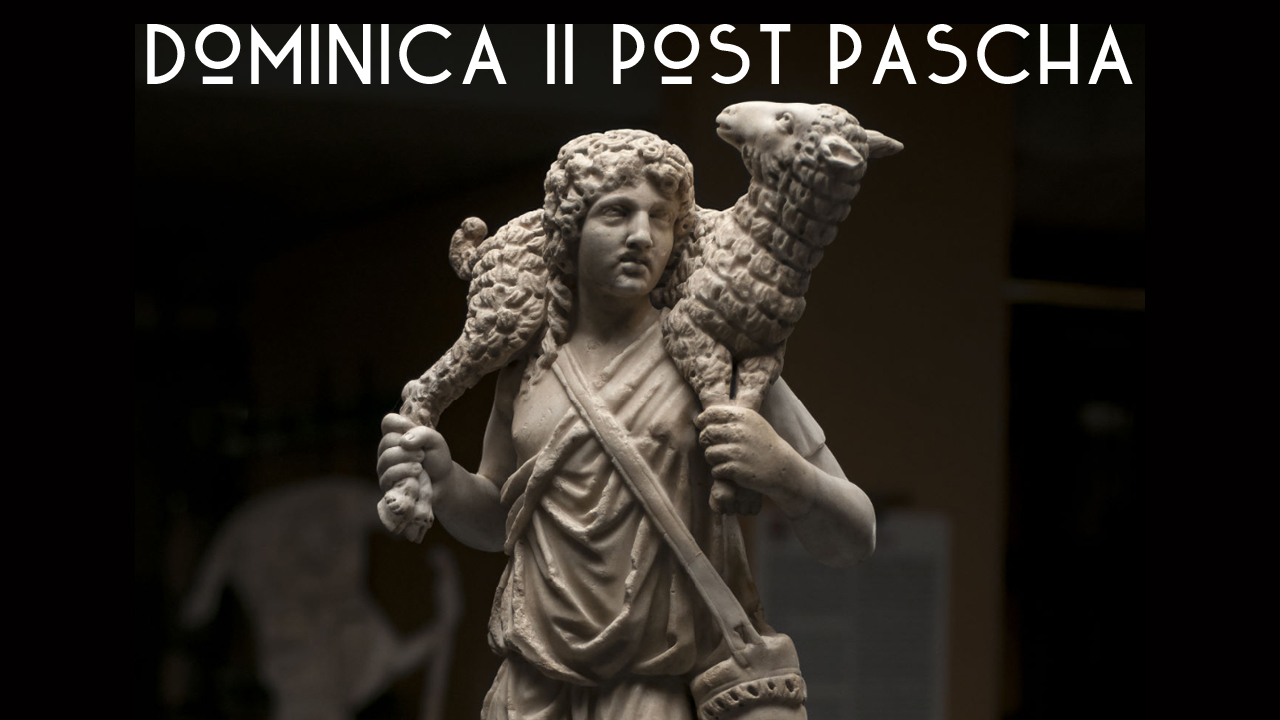
From the earliest centuries Christians understood the potency of this image. The Good Shepherd appears everywhere in catacombs, mosaics, sculpture, and funerary art. The old kriophoros motif, the bearer of the sheep, was readily assumed into Christian imagination, precisely because the image already suggested peace and safe passage. The Church baptized the form by filling it with the content of the Gospel. Yet Christian usage pressed beyond bucolic charm. The Shepherd carries the sheep because the sheep was lost. He bears it because it could not save itself. He searches because it strayed. Bede saw this clearly in his commentary on 1 Peter: “Jesus wanted to redeem us so much that he put our sins on his shoulder and bore them for us on the tree, in order to give us eternal life as well as blessings in this world. He comes to us daily to visit the light which he has given us, in order to tend it and to help it grow. This is why he is called not only the shepherd but also the guardian of our souls” (In I Petri epistolam expositio, ad 1 Pet 2:25, PL 93:54). Bede’s reading binds together the parable of the lost sheep, the Passion, daily grace, and the title epískopos. The Shepherd carries the sheep on His shoulders because He first carried our sins on the tree.
Hence, the liturgy of this Sunday brings the present action of Christ upon us. In the sacred rites, His words are living words. The Shepherd still speaks. He still gathers. He still heals. He still seeks “other sheep” and wills that there be one flock and one shepherd. There is a pastoral and missionary pressure in the passage that no honest hearing can evade. When Christ says that He has other sheep not of this fold, He reveals both the breadth of His intention and the instrumentality of His Church. The fruit of His death is gathering. John makes this plain after Caiaphas’s grim prophecy: Jesus would die “not for the nation only, but to gather into one the children of God who are scattered abroad.” Therefore, ecclesial unity belongs to the purpose of the Cross.
That gives force to the Roman note that resounds through this Sunday. The Station is St. Peter’s. The Epistle is from Peter. The visible shepherding office in the Church is thereby set under the exemplum of Christ the archipoímen, the chief Shepherd. Peter and his successors are not parallel shepherds alongside Christ, but ministers within His one shepherding. The hope of visible unity in the Holy Roman Catholic Church flows from this. Consider the force of Lumen gentium 14:
Quare illi homines salvari non possent, qui Ecclesiam Catholicam a Deo per Iesum Christum ut necessariam esse conditam non ignorantes, tamen vel in eam intrare, vel in eadem perseverare noluerint. “For this reason, those who, not being ignorant that the Catholic Church was founded by God through Jesus Christ as necessary, nevertheless do not wish either to enter it or to persevere in it, cannot be saved.”
This is hard language only if one has forgotten the wolves. Once the peril of scattered sheep is remembered, the severity becomes medicinal. The Shepherd wills the safety of the flock.
This Sunday also addresses pastors. The shepherding of Christ is self-sacrificial. Any office in the Church that forgets that becomes hireling work. Any exercise of authority severed from love of the flock becomes alien to the Gospel. Peter himself learned that the pastoral charge begins in the question, “Do you love me?” It continues in feeding the sheep. It is sealed in following the Lord to the cross. Christ the Good Shepherd remains the measure. He alone can make human shepherds true.
Good Shepherd Sunday is a consolation. He calls the lost. He does not cease to tend what He has redeemed. It is therefore also an exhortation. If we are sheep, we must hear His voice. If we have strayed, we must return. If there is mortal sin, confession is not optional. Return to the Shepherd and Bishop of your soul. If we know fallen away Catholics, or those outside the fold, we are not permitted a lazy graze. Perhaps you know someone who, by your good example, your cheerful demeanor, your good knowledge of doctrine and history might be raised back up from a fallen world once again into the happiness of being a devout and practicing Catholic.
No suffering joined to Christ is vain. No return to Him is wasted. No sheep kept close to such a Shepherd can finally be lost, provided it does not refuse His voice.