
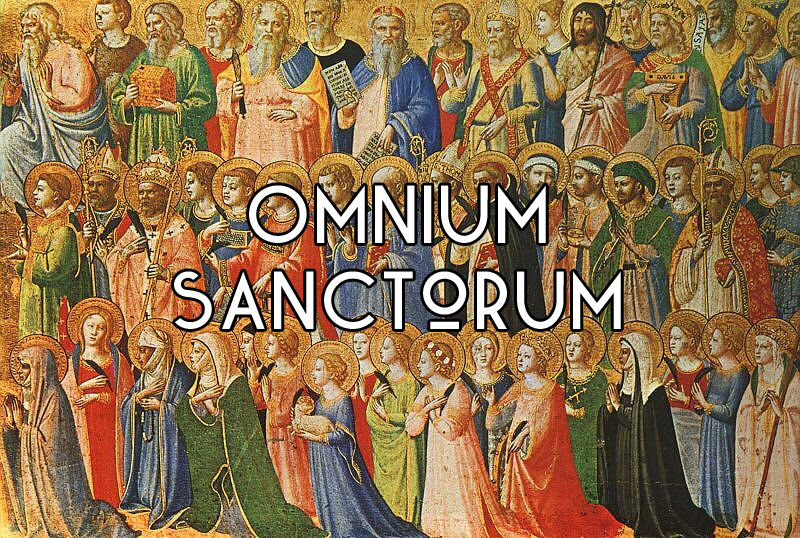
On Sunday, 1 November in both the Vetus Ordo and the Novus Ordo Holy Mother Church celebrates the great feast of All Saints, Omnium Sanctorum. We honor all who have attained the Beatific Vision, including the vast multitude of blessed souls whose names and histories are known to God alone. It is a beautiful bouquet of the famous and the unknown, the later, perhaps, elevated even higher in the Beautiful Vision than the famous. Today we honor them and we beg God that, through their intercession, through an abundance of His mercy we may join them.
This is the central argument of the Collect for today’s Mass. The Church asks God for something extraordinary, and she grounds her petition in the very multitude of the saints whom we celebrate.
Omnipotens sempiterne Deus,
qui nos omnium Sanctorum tuorum
merita sub una tribuisti celebritate venerari:
quaesumus; ut desideratam nobis tuae propitiationis abundantiam,
multiplicatis intercessoribus, largiaris.
LITERAL VERSION:
Almighty eternal God,
who granted us to venerate the merits of all Your Saints
under one solemn celebration,
we beseech You, that, our intercessors having been multiplied,
You may bestow upon us the longed-for abundance of Your atoning mercy.
Latin celebritas means, first of all, “a great number, a multitude”. By extension it is “a festal celebration, a solemnity” as in “celebritas supremi diei… a solemn procession for the dead”, which links our oration through the scant hours of this feast into the commemoration of the Poor Souls.
God granted us the privilege of venerating the merits of all His saints “sub una celebritate”, under one solemn celebration by a vast throng. Having gathered them together in our liturgical observance, we invoke them together in our petition. Hence our intercessors are multiplied, “multiplicatis intercessoribus”. We ask Almighty God to pour out upon us the abundance of His mercy. The saints are our force multipliers. They are highly motivated and want for us the joy they have for God’s greater glory.
We can squeeze the Collect for more. Tribuisti, “you have granted,” recalls God’s generosity in the past, while largiaris, “may You bestow,” petitions His generosity in the present. The whole prayer moves from the gift already received to the greater gift now requested. We honor the merits of all the saints together and, precisely because we have so many heavenly advocates, we implore a more abundant share in God’s propitiatory mercy. Heaven is our force multiplier here and now!
The expression “multiplicatis intercessoribus” is an ablative absolute. Grammatically, it establishes the circumstance accompanying our petition. The saints are gathered in one celebration and their multiplied intercession is invoked in seeking God’s favor. There is in this vision a great consolation. Every soul entering heaven increases the company of those who, perfected in charity, can intercede for us before God. Each soul attaining the Beatific Vision is another victory of Christ’s saving grace, an additional member of the Church Triumphant who can pray for those of us still struggling along in this vale of tears. God acquires no new perfection through their arrival, since He is infinitely perfect and blessed. But His glory is more widely manifested in redeemed creatures.
Bl. Ildefonso Schuster, the great Benedictine liturgist and Cardinal Archbishop of Milan, places the Feast of All Saints within the historical development of the Church’s collective commemoration of the martyrs, which eventually broadened to embrace the entire company of the blessed in Heaven. The Roman observance became associated with 1 November, particularly through the dedication of an oratory at St. Peter’s by Pope Gregory III (+741) and the wider diffusion of the feast under Gregory IV (+844). From Rome, of course, the Feast spread to the whole world, especially through the work of missionaries seeking (pace some cardinals today) to obey Christ’s explicit command to convert pagans and bring them into the one true Church He founded.
Here we see the import of the oration’s phrase “sub una celebritate”. The Church gathers all her heavenly citizens into one celebration because their number and variety far exceed what can be adequately commemorated by individual feasts. We know the names of great saints honored by the Church. But what of the countless mothers and fathers who raised their children in the Faith amid poverty and hardship, priests who served obscure parishes faithfully, religious who spent their lives in cloistered prayer? Their merits, themselves the fruits of grace, are honored along with those of the most celebrated doctors and martyrs.
The Epistle reading from Revelation 7:2-12, gives us a glimpse of the multitude whose assistance we desire.
St. John sees an angel ascending from the rising of the sun carrying the seal of the living God. The angel commands that the earth, sea, and trees be spared “Until we mark the servants of our God upon their foreheads.” The sealing signifies divine possession and protection. John then hears the number of those sealed from the tribes of Israel, 144,000, twelve thousand from each of twelve tribes. In the ancient world, people were not so used to very large numbers, so that was taken to be so vast it was hard to imagine as we as a symbol of ordered completeness.
“Post haec vidi turbam magnam,…After this I saw a great multitude, which no man could number, of all nations, and tribes, and peoples, and tongues.”
There is our “multiplicatis intercessoribus” again. The heavenly multitude surpasses human enumeration. Its members come from every nation and language, underscoring the universal redemption accomplished by Christ. Clothed in white garments and carrying palms, they stand before the throne and the Lamb, their purity and victory deriving from the saving Blood of the Redeemer.
Only the pure can see God. Go to confession and do penance.
They redeemed cry out: “Salvation belongs to our God, who sits upon the throne, and to the Lamb.” That is to say that the blessed in Heaven possess no independent power by which they can confer grace upon us. Whatever holiness or merit they enjoy derives from Christ, whose saving work has brought them to glory. Their intercession depends entirely upon their union with Him and His unique mediation before the Father.
Consequently, when the Church invokes their multiplied intercession, she seeks the mercy of God through the prayers of those who already enjoy perfect communion with Him. Their wills are completely conformed to His, their charity has been purified, and justice regarding previous sins during earthly life has been perfected.
The entire heavenly host is enraptured with the adoration of Triune God. The angels, elders, and four living creatures fall upon their faces before the throne, offering a sevenfold acclamation of blessing, glory, wisdom, thanksgiving, honor, power, and strength. The blessed find their consummate happiness in the possession and praise of God.
Heaven is profoundly liturgical.
This should affect our understanding of and our offering of Holy Mass. The Church on earth participates sacramentally in the worship of Heaven. When we join the angels and saints in the Sanctus, we enter into a reality far greater than our immediate earthly circumstances. Our sacred rites, music, vestments, gestures, and churches themselves ought to reflect that supernatural mystery. Those who regard the liturgy principally as an occasion for experimentation or self-expression might have got it exactly wrong, backwards.
The Gospel from Matthew 5:1-12 supplies another dimension for this feast. Christ ascends the mountain and teaches His disciples, in a setting recalling Moses upon Sinai. While Revelation reveals the blessed in the fulfillment of their pilgrimage, the Beatitudes in the Sermon on the Mount describe the dispositions we should have in our pilgrimage toward that fulfillment. The saints whose intercession we invoke already traveled the path which Our Lord sets before us. Sometimes we hear highly placed prelates talk about virtues and a holy state of life as nearly impossible “ideals” which people cannot possibly be expected to attain. Christ disagrees. As the divine Lawgiver, He proclaims the characteristics of those who belong to His Kingdom.
“Blessed are the poor in spirit, for theirs is the kingdom of heaven.”
The Greek μακάριοι, makarioi, signifies those who are “blessed, happy” in a profound sense. The blessedness described by Christ rests upon one’s relationship with God and the promise of eternal fulfillment, even when one’s present circumstances seem to offer little reason for happiness.
Our Lord calls blessed the poor in spirit, those who mourn, the meek, those who hunger and thirst for justice, the merciful, the clean of heart, the peacemakers, and those who suffer persecution for righteousness. Such dispositions stand in sharp contrast with the world’s preoccupation with wealth, influence, comfort, and the satisfaction of disordered desires.
Among the Beatitudes, one is especially illuminating for today’s feast.
“Blessed are the clean of heart, for they shall see God.”
Here we encounter the essential happiness of the saints: the Beatific Vision. By the supernatural light of glory, the blessed behold God immediately, without the obscurity of faith which characterizes our earthly condition. Their intellects and wills are perfected in the possession of the Supreme Good, and their happiness cannot be lost.
This perfection of heavenly life explains the extraordinary value of their intercession. Their charity, purified and perfected, reaches out to us as if to embraces us who strive pilgrimage toward the same destination. The saints love us and desire our salvation because they love God, whose saving will has brought them into glory which they long to share as much as possible.
Thus, the Gospel and Collect illuminate one another. The Beatitudes describe the holiness to which God calls us. The Collect petitions the mercy necessary for us to pursue that holiness, appealing to the prayers of those who have already attained its fulfillment.
Notice also the word merita in the Collect. The Church venerates the merits of the saints. Catholic teaching concerning merit must always be understood within the primacy of grace. Their good works possessed supernatural value because they cooperated with Christ’s grace, which preceded, sustained, and brought their efforts to fulfillment. Their sanctity redounds to God’s glory precisely because He is its first cause. As St. Augustine taught, God crowns His own merits in us.
This is encouraging when we consider that the saints were human beings who confronted temptations, weaknesses, and the consequences of original sin. Some persevered in remarkable innocence. Others had profound conversions after lives of grave sin. Their circumstances varied enormously but all attained Heaven through cooperation with grace.
The saints are therefore both our examples and our intercessors. We honor what God accomplished in them, attempt to imitate their virtues, and seek their prayers because we recognize how urgently we need the mercy requested in today’s Collect.
We can circle back to the Collect’s petition:
…ut desideratam nobis tuae propitiationis abundantiam, multiplicatis intercessoribus, largiaris. … (we beseech You), that, our intercessors having been multiplied, You may bestow upon us the longed-for abundance of Your atoning mercy.
The Church asks for the longed-for abundance of God’s propitiatio, His favorable mercy and pardon, grounded in the atoning Sacrifice of Christ. The noun directs us toward the reconciliation of sinners with Almighty God. The adjective desideratam indicates how ardently that mercy is desired, while abundantiam expresses the lavish generosity with which we ask God to bestow it.
The word multiplicatis provides the particular circumstance of the petition. Having celebrated all the saints together, the Church Militant invokes the united intercession of the Church Triumphant in seeking an abundant share of divine mercy (cf Lumen gentium 49).
This also helps explain why All Souls follows immediately upon All Saints. Today we contemplate the Church Triumphant, while the next day we offer suffrages for the faithful departed undergoing purification in the Church Suffering or Purifying. Meanwhile, we of the Church Militant continue our march, assisted by the prayers of the blessed and obliged to pray for one another here and now as well as for the Poor Souls. The Communion of Saints embraces all three conditions within the one Mystical Body of Christ.
We are all in this together. This is why our personal sins bring all of us down while our living a virtuous and devout life raises, as the tide does, “all boats”.
A caution is in order. We should not be presumptuous about heavenly intercession by the saints. Their loving aid must never become an excuse for neglecting our personal obligations. The saints cannot repent in our place, fulfill our duties for us, or substitute their cooperation with grace for ours. They can, however, pray that we receive the graces necessary for sincere conversion, perseverance, and final fidelity.
A take away or action item from this Feast might be to examine the Beatitudes and consider which one most clearly exposes a defect in your spiritual life. Ask your patron saint or saints for whom you have particular devotion, to intercede for the grace necessary to overcome that defect and be willing to suffer in tackling it. Make a good confession if you need one, receive Holy Communion worthily, and resolve to make good use of the ordinary means of sanctification offered us by the Church.
Then, with All Souls and the days that follow when indulgences are available, remember also the faithful departed through prayers, Masses offered for their repose, visits to cemeteries, and the indulgenced works recommended by Holy Mother Church. If we desire the aid of the saints in Heaven, we ought to aid the suffering members of Christ’s Mystical Body as well.
One day, please God, we shall stand among the multitude which St. John saw before the throne and the Lamb. Then we shall understand more fully the workings of divine Providence, the value of crosses which once seemed unbearable, and the assistance received through the prayers of heavenly friends whose names we may never have known during our earthly lives.
Perhaps we shall also discover that souls reached Heaven in part through prayers and sacrifices which we offered long ago and subsequently forgot. We are all in this together and even our small contributions can make a big difference in the long run.
All ye holy men and women, Saints of God, pray for us.