Pius Parsch observed that the Sundays after Pentecost may be viewed in three movements. The first draws attention to Christ’s healings and, through them, to the salvation of souls. The second, from the Seventh through the Fourteenth Sunday, sets God’s kingdom against the world. The final group turns toward the Parousia. The Ninth Sunday belongs to the second movement, though it carries the accents of the third. Christ comes as King to His city, judges in His Temple, and foretells a destruction which images the judgment awaiting every soul. At the same time, He weeps. The King who settles accounts is the Savior who desires that the sinner recognize the hour of grace and turn freely while there is time.
The Collect offers a key by which the Epistle (1 Cor 10:6-13) and Gospel (Luke 19:41-47) can be opened:
Pateant aures misericordiae tuae, Domine,
precibus supplicantium:
et, ut petentibus desiderata concedas,
fac eos, quae tibi sunt placita, postulare.
LITERAL ATTEMPT
Open the ears of Your mercy, O Lord,
to the prayers of those humbly beseeching:
and, that You might grant the things desired to those seeking them,
cause them to ask for the things which are pleasing to You.
The prayer belongs to the ancient Roman sacramentary tradition as an Oratio super populum, a prayer over the people, and in the 1962 Missale Romanum it serves as this Sunday’s Collect. Supplico evokes one bent beneath the weight of need, while postulo can mean “to ask, request, demand, or desire”. The Church places a profound and necessary correction upon our praying. She does not ask that our every desire be satisfied. She asks our desire itself be healed. Before God gives what His children seek, He prompts them to seek what pleases Him. Otherwise, prayer becomes language placed at the service of appetite, ambition, fear, resentment, or some cherished idol.
Hence the anthropomorphic boldness of pateant aures misericordiae tuae, “may the ears of Your mercy be opened.” God has no bodily ears and need not incline Himself lest He miss our prayer. Yet the Church speaks in the language of children who want their Father near and attentive. His transcendence does not make Him distant. The Collect asks that we be heard, then immediately asks that we be changed. The deepest mercy may be the refusal of what we presently desire and the infusion of a desire conformed to the divine will.
That prayer illuminates the situation in 1st century Jerusalem. The Lord approaches the holy city upon the colt of an ass, bearing the signs of the Davidic priest-king. The multitude has heard His teaching, witnessed His miracles, and learned of the raising of Lazarus. Many expect the restoration of David’s kingdom, the expulsion of Rome, and perhaps the return of God’s glory to the Temple. Their hopes contain elements drawn from prophecy, yet remain cramped by worldly categories. They want a Messiah who will ratify their desires. Christ comes to purify them. They seek liberation from Caesar while exposed to subtler tyrannies within the heart.
From the Mount of Olives the city lies open across the Kidron Valley. There, near the place where He will pray in agony after the Last Supper, Jesus beholds Jerusalem and weeps. Luke 19:41 uses ἔκλαυσεν, from κλαίω (klaío, “weep, bewail, mourn as for the dead”), to describe His sorrow. The word conveys real grief, the grief of the Incarnate Word over a people who have failed to recognize “the things that are to thy peace” or “make for peace” (v. 41) His tears are fully human yet governed by divine charity. He sees the legions, embankments, famine, crosses outside the walls, and the Temple stones cast down. More deeply, He sees the free refusals by which the city has closed itself against mercy.
He speaks of “the time of thy visitation” (v.44). The Greek ἐπισκοπή, episkopé, can indicate an inspection, oversight, or visitation. Our word “bishop” from Latin episcopus comes from it. A visitatio, like an adventus, evokes the arrival of one who possesses authority and comes to examine, judge, and settle accounts. In Scripture, a visitation may bring deliverance or punishment and sometimes both, according to the disposition of those visited. Jerusalem’s visitation stands before her in the flesh: God Himself has entered His city. The prayer of the people that divine glory would returned to the Temple has taken place, but not in the way the people expected. It turned in a manner surpassing the glory cloud, the shekinah, of former times, since the Son Himself has come. Yet the city does not know Him. The eyes that can measure Roman power fail to recognize the day of divine mercy.
Our Lord’s prophecy was fulfilled in the Roman siege. The 1st century Jewish historian Josephus records famine, factional violence, vast numbers of dead, and hundreds crucified outside the walls each day. The destruction of the Temple meant more than the loss of a building. It was the “end of the world as they knew it”. The Temple represented the ordered cosmos, God’s dwelling among His people, and the place of sacrifice and reconciliation. Its fall was an end of the world for those whose religious existence had been gathered around it. Christ wept because He knew what hardness and rejected grace would bring to pass.
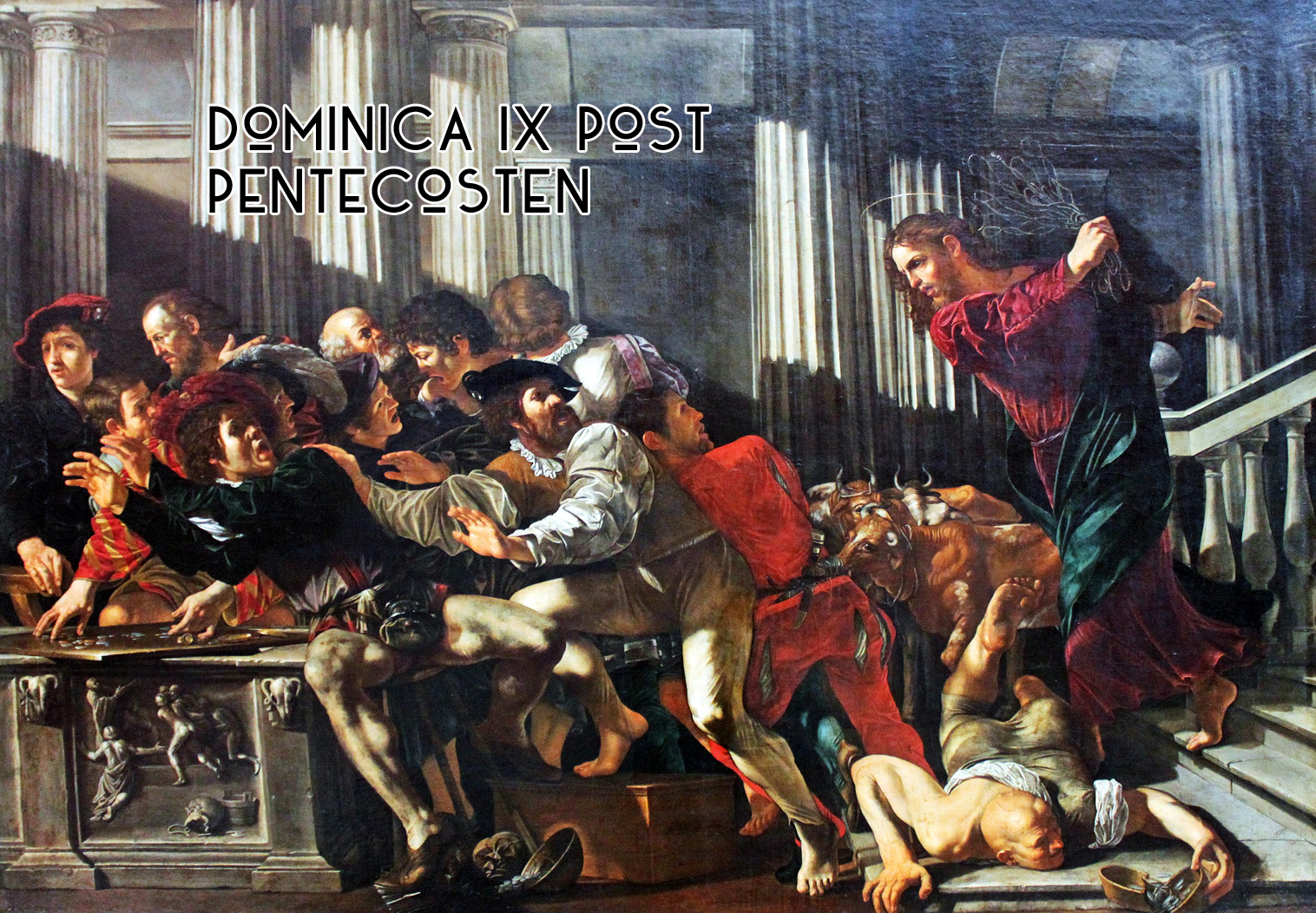
Having foretold the city’s ruin, the Davidic King ascends to the Temple. Those who acclaimed Him might have expected a royal sacrifice, enthronement, or declaration against Rome. Instead, He casts out those buying and selling and joins Isaiah’s “house of prayer” (56:7) to Jeremiah’s “den of thieves” (7:11). Jeremiah had preached at the gate of the earlier Temple, warning a people who trusted in sacred structures while practicing idolatry and injustice. The Babylonians would become agents of visitation. Christ now takes up the same accusation before the Romans came in force.
To be clear, at the Temple, the sellers and money changers served a purpose. Pilgrims needed animals for sacrifice, and the Temple dues required acceptable coinage, ritually pure and without graven images. However, the commerce itself had encroached upon the Court of the Gentiles, frustrating Isaiah’s purpose, “My house shall be called a house of prayer for all peoples.” The nations were to be drawn toward Israel’s God. Arrangements connected with sacrifice had become an obstacle to those seeking Him. Zeal for machinery-like religion had displaced zeal for the divine purpose.
Commenting on this dramatic “cleansing of the Temple” moment, St. Jerome (+420) remarked that this was perhaps the Lord’s greatest miracle, considering their numbers and the way enemies were arrayed against Him. Jerome opined that something of His divine authority must have shined forth in that moment which could not be withstood:
To me, among all the other [miracles], it seems more wonderful that, as one Man, and He at the time contemptible and so vile as to be subsequently crucified, with the Scribes and Pharisees raging against Him, and seeing their gains destroyed, He could by the stripes of His single scourge cast out so great a multitude, overthrow the tables, break the seats, and do other things, which a whole army could not have done. For something of fire and of the sidereal flashed from His eyes, and the majesty of His Divinity shone in His face (Commentarii in Matthaeum III, on Matt. 21:12).
Sentimentality watches corruption and murmurs about patience. Charity takes cords in hand when God’s honor and souls require decisive action. The Lord who weeps over the city acts with authority in the Temple. He grieves because He loves, and because He loves He refuses to leave desecration undisturbed. As St. Augustine (+430) preached:
Prohibe quos potes, tene quos potes, terre quos potes, quibus potes blandire; noli tamen quiescere.
Stop those whom you can, restrain those whom you can, frighten those whom you can, gently win over those whom you can; nevertheless, do not remain silent (In Ioannis Evangelium Tractatus 10.9).
Forms of correction vary according to office, prudence, and circumstance. Silence cannot always be baptized as meekness. Indifference to sacrilege, false worship, or another soul’s ruin reveals a want of zeal for God’s house. Augustine’s counsel begins with personal responsibility: act within your competence and vocation. The Christian is obliged to resist evil rather than make peace with it.
St. Gregory the Great (+604) is sterner:
Qui enim narravit mala ventura, et protinus templum ingressus est ut de illo vendentes et ementes eiceret, profecto innotuit quia ruina populi maxime ex culpa sacerdotum fuit.
For He who foretold the evils to come and immediately entered the Temple to cast out those who sold and bought plainly showed that the ruin of the people arose chiefly from the fault of the priests (Homiliae in Evangelia II, hom. 39.2).
Gregory continues that the doves signify the gift of the Holy Ghost. Those who sold them in the Temple represented the simoniacal exchange of spiritual things for temporal advantage. The application extends beyond overt payment. Ecclesiastical office can be trafficked through patronage, faction, flattery, calculated silence, or agreements in which souls are secondary. When sacred authority becomes merchandise, the Court of the Gentiles again fills with noise and sincere seekers find their way obstructed. The ruin of a people can arise chiefly from priestly sins, since corruption at the altar spreads through the body. I wonder sometimes about the ripple effects of chanceries being more and more the sites of the modern equivalent of the money changers, houses of administration, dens of lawyers and accountants. I digress.
The Temple is also an image of the baptized soul. The glory cloud once signified God’s dwelling in the sanctuary. In the new covenant, the Holy Ghost makes the soul in grace His temple. How beautiful is that interior house when adorned with faith, hope, charity, the cardinal virtues, works of mercy, disciplined study, and understanding of the fides quae creditur, the faith which is believed. Negligence can transform the house of prayer into a den of thieves. Created goods occupy the chambers of the heart and establish themselves where God alone should reign.
In the Epistle St. Paul recalls Israel’s sins in the wilderness: the golden calf, sexual immorality joined to idolatrous worship, the testing of God, the serpents, and the destroyer. These events “were written down for our instruction, upon whom the end of the ages has come.” The Apostle refuses to treat the Old Testament judgments as curiosities belonging to a primitive age. They reveal the holiness of God and the deadly logic of idolatry. “Therefore let him that thinketh himself to stand, take heed lest he fall” (1 Cor. 10:12).
The golden calf disclosed the speed with which desire manufactures a god. Israel had been redeemed from Egypt, passed through the sea, and stood beneath the mountain of revelation. Impatience with Moses sufficed to turn gold into an idol and worship into debauchery. The sons of Levi rallied to the Lord, and their zeal was sealed in blood. At Baal-Peor, sexual sin and false worship intertwined. Grumbling against the food given by God opened the camp to serpents. The pattern is consistent. Idolatry promises unshackling and produces slavery. It enthrones a creature, then demands sacrifices from the worshipper.
The First Commandment remains as serious now as when thunder sounded over Sinai. Modern idols appear under names such as power, pleasure, money, race, nation, ideology, reputation, career, health, political deliverance, or ecclesiastical influence. Superstition, divination, magic, astrology, and mediums retain their ancient character however packaged. Even a legitimate affection can become idolatrous when it receives the fear, hope, sacrifice, or absolute loyalty due to God.
What created thing should justify me to excuse sin, neglect worship, hate my neighbor, distort truth, or refuse obedience to God?
Such idols turn our interior Temple into a market. The soul bargains with conscience, exchanges truth for comfort, and offers outward religion while protecting the stalls within.
Then Christ comes in visitation. His prevenient grace is like the first merciful touch of the whip of cords, disturbing arrangements we had learned to call normal. Examination of conscience names the tables. Contrition overturns them. Sacramental confession casts out what profanes the sanctuary. Absolution restores grace, so that prayer and good works may again rise from a living member of Christ.
The Lord’s tears keep this examination from despair. Augustine speaks of the God who remains near even when the sinner has fled far away:
Thou alone art near even to those that remove far from You. Let them, then, be converted and seek You; because not as they have forsaken their Creator have You forsaken Your creature (conf 5, 2.2).
Jerusalem’s tragedy arose from refusing this nearness. God visited His people, taught in their streets, entered their sanctuary, and wept over their blindness. The sinner’s return begins when he ceases to imagine God as absent. He discovers that grace has preceded every movement homeward. The Father whom he fled was already at work in the uneasiness that exposed the hardness of the foreign land.
Augustine returns to the same mystery when describing the soul that seeks rest apart from God:
O crooked ways! Woe to the audacious soul which hoped that, if it forsook Thee, it would find some better thing! It hath turned and returned, on back, sides, and belly, and all was hard, and Thou alone rest. And behold, Thou art near, and deliverest us from our wretched wanderings, and stablishest us in Thy way, and dost comfort us, and say, ‘Run; I will carry you, yea, I will lead you, and there also will I carry you’ (conf. 6, 16.26, trans. Pilkington).
This answers both presumption and discouragement. Paul warns the one who thinks he stands, then proclaims God’s faithfulness:
No temptation hath taken you, but such as is human. And God is faithful, who will not suffer you to be tempted above that which you are able; but will make also with temptation issue, that you may be able to bear it (1 Cor. 10:13).
The escape is not always removal from struggle. Often God gives strength to endure, light to recognize the idol, humility to seek confession, and grace to perform the good work that weakens the adversary’s claim.
The visitation of Jerusalem continues now. Christ stands before the city, the Church, the clergy, and the individual soul. He comes with tears and cords, warning and mercy. The Collect teaches us to bend low and distrust desires formed without grace. We ask that the ears of divine mercy be opened while surrendering to the deeper petition that our hearts be cleansed.
Cause us, O Lord, to ask what pleases You: true worship, a purified Temple, faithful priests, courageous correction, honest confession, and perseverance in good works. Cause us to know the reality of our visitation.
A good preparation for our final visitation is the practice of frequent confession and good works in the state of grace. The adversary must find fewer stalls to occupy, fewer bargains to expose, fewer idols claiming the sanctuary. We will still tremble at death, as the saints trembled, yet Christian fear is joined to confidence in the One who says, “Run, I will carry you.” The Lord who wept over Jerusalem does not delight in destruction. He desires to gather, cleanse, restore, and save. Let our heart remain houses of prayer. Let the Holy Ghost dwell therein without rival. Then our King’s arrival, in the quiet visitation of grace or in the supreme hour when time gives way to eternity, will bring the peace which Jerusalem failed to know.