The Mass of the 8th Sunday after Pentecost sets before us the household of God and the household of this world, the inheritance promised to sons and the account demanded of stewards, the freedom of those led by the Spirit and the anxious calculations of those who live according to the flesh. The Collect, Epistle, and Gospel converge upon a single demand: we must become in conduct what grace has made us in being. Baptism has transferred us from the dominion of sin into the familia of God, yet the adopted child must live according to the Father, and the steward must use the goods of his Lord with the eternal reckoning always before his eyes.
The Collect expresses this dependence with typical economy and balance:
Largire nobis, quaesumus, Domine, semper spiritum
cogitandi quae recta sunt,
propitius et agendi:
ut, qui sine te esse non possumus,
secundum te vivere valeamus.
We beseech You, O Lord, bestow upon us always the spirit
of pondering the things that are right
and, in Your kindness, of carrying them out,
so that we who cannot exist without You
may be able to live according to Your will.
The prayer is found in the ancient sacramentaries, including the Veronese, Gelasian, and Gregorian traditions. Its Latin has the compact artistry characteristic of the Roman orations. Spiritum is held over the conjunction et so that it governs both cogitandi and agendi. The petition concerns the interior principle of right thought and the effective grace of right action. The parallel sine te esse and secundum te vivere joins ontology to morality: we cannot exist without God, and we cannot live rightly except according to God. The juxtaposition of possumus and valeamus adds another shade of meaning: God sustains our being and strengthens our willing. The prayer therefore anticipates the scholastic axiom agere sequitur esse, “action follows being.” Since our being is received and continuously conserved by God, the actions proper to our supernatural life must likewise proceed from His grace.
Cogitare means more than allowing an idea to pass through the mind. It means to consider, weigh, ponder, and pursue something inwardly. Recta sunt are the things “kept straight”, those which do not deviate from the divine rule. Secundum means “according to,” “in conformity with,” or “agreeably to.” The Christian asks for a mind shaped by truth and a will strengthened for obedience. Right action cannot be reduced to external conformity, because the Collect asks for a spiritus, an inward disposition bestowed from above. Nor does inward aspiration suffice without agere. Grace straightens the mind so that the will may carry into deed what has been recognized as pleasing to God.
This prayer supplies the key to this Sunday’s Epistle from Romans 8:12–17. St. Paul writes to Christians who have been freed from slavery to sin and incorporated into Christ, yet he warns them that the flesh continues to press its claims. “We are debtors, not to the flesh, to live according to the flesh.” The flesh here means more than the body considered as God’s creature. It signifies fallen human nature insofar as it is ruled by disordered appetite and resistant to the Spirit. The baptized have no obligation to obey that usurping creditor. They have received a new principle of life, and therefore a new manner of living.
Paul states the alternatives with eschatological force: “If you live according to the flesh, you will die; but if by the Spirit you put to death the deeds of the body, you will live” (v. 13) The Vulgate gives the sequence with force: “si autem Spiritu facta carnis mortificaveritis, vivetis …if by the Spirit you will have put to death the deeds of the flesh, you will live.” Mortificaveritis is future perfect, followed by vivetis. The deeds of the flesh must first be put to death, and life follows as the promised consequence. The Greek θανατοῦτε, “you put to death,” is present in form and conveys an action requiring continued exertion. Mortification is therefore woven into the ordinary perseverance of Christian life. It cannot be completed by a single enthusiastic gesture or occasional severity. The flesh renews its demands, and the children of God must renew their obedience.
This continual mortification is impossible without the Holy Ghost. Paul does not propose a program of natural willpower or a merely Stoic mastery of emotion. He says, “if by the Spirit” you put the deeds of the body to death. The indwelling Spirit supplies the strength by which the will can refuse what is disordered and choose what accords with the Father. Christian asceticism is conscious cooperation with grace. A diet may restrain appetite for health or appearance. Mortification directs restraint toward supernatural freedom, the reordering of love, and the inheritance of Heaven. The exterior act may look similar, while the interior form and final cause differ radically.
St. Augustine gives language to this ordering of love: “Pondus meum amor meus; eo feror, quocumque feror… My weight is my love; by it I am borne wherever I am borne” (conf 13, 9, 10). Ancient physical theory understood weight as an interior tendency carrying a thing toward its proper place. Augustine applies the image to the heart. Love gives the soul its direction. A heart made heavy by created goods as final ends sinks toward the earth. A heart inflamed by charity is carried toward God. Mortification does not leave the heart empty. It removes impediments so that love may move according to its true weight.
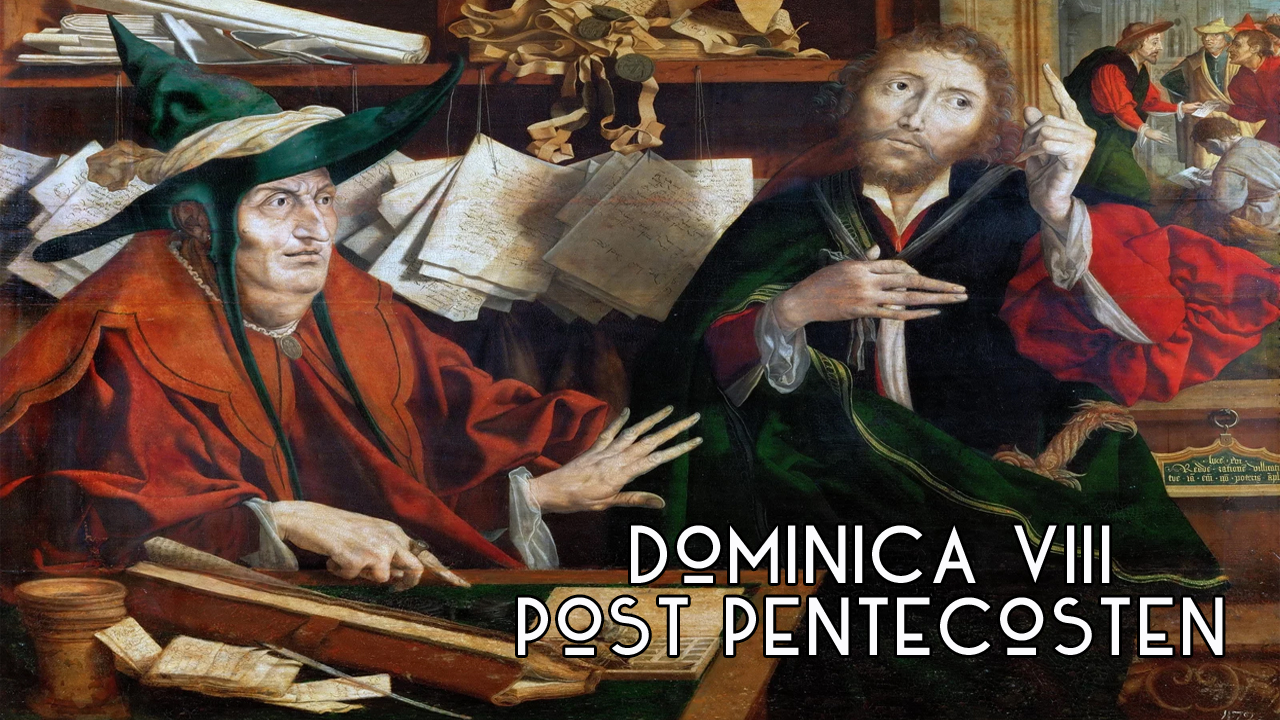
The Gospel reading is from Luke 16, the parable of the unjust servant. The steward illustrates the same urgency from another angle. The steward, οἰκονόμος, is the man charged with the law and management of the household, from οἶκος, “house,” and νόμος, “law.” He administers goods that belong to another. When accused of wasting the master’s property, he is summoned: “Give an account of thy stewardship, for now thou canst be steward no longer” (v. 2). The sentence reveals the truth of every temporal possession. Wealth, influence, time, health, intelligence, office, and opportunity are entrusted goods. Their present administrator will be removed, and an account will be demanded.
The steward knows that his dismissal is certain. “Fodere non valeo, mendicare erubesco… I am not able to dig; I am ashamed to beg” (v.3) Ease has softened him, reputation has trapped him, and necessity has finally awakened his prudence. He reduces the bills of his master’s debtors, fifty measures in place of a hundred measures of oil, eighty measures in place of a hundred measures of wheat, so that they will receive him when he is put out of office. His conduct remains unjust, yet his foresight is energetic, immediate, and practical. The Lord commends the prudence of the act, not its fraud. Christ uses an argumentum a minori ad maius, an argument from the lesser to the greater. If the children of this world labor so shrewdly for a temporary refuge, the children of light ought to act with greater deliberation for the eternal habitations.
The parable thus reflects the Epistle in the necessity of spiritual foresight. Life according to the flesh procedes as though the stewardship were ownership and the present age were permanent. Life according to the Spirit remembers the Master, the account, and the house that endures. The worldly man calculates rapidly when money, position, or security is threatened. The Christian can become strangely dull when eternal life is at stake. Our Lord holds up the steward’s urgency as a rebuke. The intelligence expended on passing advantages should be surpassed by prudence in almsgiving, penance, forgiveness, worship, and the ordering of one’s state of life.
Christ says, “Make unto you friends of the mammon of iniquity, that when you shall fail, they may receive you into everlasting dwellings.” Mammon, from the Aramaic term for wealth or profit, had acquired a morally charged sense. Wealth easily takes on the character of a rival master. “You cannot serve God and mammon” (Matt 6:24). Yet temporal goods can be made to serve the supernatural end when they are given in mercy. The poor become friends and advocates, not because salvation is purchased, but because charity uses the goods of the Lord according to His will. Almsgiving loosens the false claim of possession, relieves the suffering member of Christ, and lays up treasure where thieves cannot break in and plunder.
St. Augustine interprets the parable by urging expansive mercy. Since the giver cannot read hearts, he should not make excessive scrutiny an excuse for withholding alms. The possibility of aiding an unworthy recipient must not close the hand against the worthy. Such counsel does not approve disorder or imprudence in every circumstance. It is a warning against the self-protective calculation that preserves mammon while pretending to defend justice. We are stewards of what belongs to God. Lavishness toward mercy answers, in a sanctified way, the steward’s vigorous concern for his future reception.
The Epistle reveals why the Christian can use temporal things with this freedom. “As many as are led by the Spirit of God, they are the sons of God.” The Greek υἱοθεσία, huiothesia, joins υἱός, “son,” with τίθημι, “to place” or “to establish.” It signifies adoption as a son, being placed in the legal and familial condition of sonship. The Vulgate says, “accepistis spiritum adoptionis filiorum … you have received the Spirit of the adoption of sons” (v. 15) Paul’s Roman hearers knew the legal force of adoptio and adrogatio. Adoption transferred a person from one familia into another and placed him under a new paterfamilias. It could confer a new name, a new authority, a new patrimony, and the rights of heirship.
That Roman background gives Paul’s language a solemn concreteness. Baptism removes us from the household of the old master and incorporates us into the household of God.
The Christian receives more than manumission. A freed slave did not necessarily acquire the full rights of Roman citizenship. Divine adoption makes the baptized a member of the Church, a citizen of Heaven, an heir of God, and a coheir with Christ. God recognizes him as His own. The sacramental character marks a permanent belonging, while sanctifying grace gives the living participation in divine life proper to the child of God. Confirmation deepens this baptismal configuration and strengthens the adopted child for witness and spiritual combat. The laying on of hands recalls manumission and military enrollment at once. The Christian belongs to the Church Militant, receives a rule of life, and is armed for obedient service. The Eucharist then nourishes the life first given in the font and fortified by the Holy Ghost. Thus, the whole sacramental economy forms citizens of the heavenly fatherland, patria, who must nevertheless complete their pilgrimage amid temptation, labor, and suffering.
This adoption is perfect in its source and real in its present effect, although its consummation remains ahead. The inheritance is promised, and perseverance is required. Paul joins privilege to obligation: “if sons, heirs also; heirs indeed of God, and joint heirs with Christ: yet so, if we suffer with him, that we may be also glorified with him” (v.17) Sonship and the Cross cannot be separated. St. John says that the disciples beheld the glory of the Only-begotten (John 1:15), and the Fourth Gospel reveals that glory in the hour of Christ’s Passion. The adopted sons are conformed to the natural Son through suffering, obedience, and sacrificial love.
The cry “Abba, Father” expresses this filial intimacy. Abba should not be flattened into the sentimental language of “Daddy.” It belongs to the speech of reverent closeness and obedient trust. In Gethsemane Christ says, “Abba, Father, all things are possible to thee; remove this chalice from me; but not what I will, but what thou wilt” (Mark 14:36). The word of intimacy is uttered at the moment of submission. Sonship reaches its earthly perfection in obedience unto death, even the death of the Cross.
The same filial pattern appears in Isaac, the promised son who carries the wood up the mountain and addresses Abraham as ’ab, “father” (Gen 22:7). Isaac’s ascent prefigures the obedient Son carrying the wood of His sacrifice toward Calvary. Christ is at once the true Isaac, the victim offered, and the High Priest who offers. When Christians cry “Abba,” they enter the obedience of Christ. Their prayer is filial because His Spirit prays within them, and their obedience becomes possible because they are members of His Mystical Body.
Here the Collect rings with greater force. We ask for the spirit of thinking and doing what is right because the Spirit of adoption must shape the whole person. The son resembles his father. Grace restores and elevates the image of God, so that living secundum Deum, according to God, becomes the fulfillment of our deepest identity. Freedom does not consist in multiplying choices against nature, truth, or divine authority. Freedom reaches maturity when the will moves readily toward the good for which it was created.
The attack upon fatherhood in the modern world therefore touches the foundations of Christian identity. When fatherhood is reduced to domination, dissolved into indeterminate symbolism, or displaced by self-created authority, obedience itself appears degrading. Revelation gives another pattern. The Father eternally begets the Son; the Son receives all from the Father and returns all in love; the Holy Ghost is the bond and gift of that communion. Christian obedience participates in divine order and filial love. Refusal of the Father repeats the ancient temptation to become one’s own principle and law.
The unjust steward and the adopted son finally stand before the same Lord. The steward hears, “Render the account.” The son hears the Spirit bearing witness that he is an heir. These truths do not compete. Adoption makes stewardship more exacting because the Father entrusts His children with the goods of His household. Grace, sacraments, time, money, authority, and opportunities for mercy are gifts to be administered in the likeness of Christ. To squander them on the flesh is to live beneath one’s dignity. To invest them in charity is to act as a son who knows the Father’s will.
Holy Church, through this Sunday’s Mass texts, teaches a supernatural prudence. We must think quae recta sunt and act upon them. We must mortify the deeds of the flesh through the Spirit. We must use mammon as a servant of mercy. We must accept suffering as the road by which coheirs are conformed to Christ. We must cry “Abba, Father” with the confidence of children and the obedience of the Son. Every act of self-denial, every alms, every forgiven debt, every faithful duty, and every worthy reception of the sacraments orients the heart toward the everlasting dwelling of Heaven.
The children of this world display great ingenuity in securing houses from which death will remove them. The children of light have been promised a house not made with hands. Their inheritance is God Himself. Let us therefore live with holy urgency, remembering that the goods in our hands belong to Another and that the Spirit within us is the pledge of adoption. When the stewardship ends and the account is opened, may the Father recognize in us the likeness of His obedient Son and receive us, through mercy, into the eternal dwelling place.