The liturgy of the Seventh Sunday after Pentecost places a mirror before the soul and asks a question which cannot be evaded by ecclesiastical position, good intentions, or outward appearance: what fruit is being borne? The Epistle, Gospel, chants, Collect, and Postcommunion converge upon the same point. There are two servitudes, two harvests, two ends. Sin pays wages, and those wages are death. God gives a gift, and that gift reaches its consummation in eternal life in Christ Jesus our Lord
Pius Parsch observed that this Sunday begins a new movement within the long green season after Pentecost:
“Now, however, a sequence of Sundays is beginning that features a series of contrasts; the kingdom of God is shown in opposition to the kingdom of the world, the good Christian versus the bad Christian. Various parables and pictures are employed in developing these antitheses. Mother Church is trying to draw a sharp line of demarcation between the divine and the worldly.”
That line of demarcation was traced upon us at Baptism. Satan, his works, and his pomps were renounced. We were transferred from one dominion to another, washed, incorporated into Christ, and enlisted beneath His standard. Yet fallen man blurs lines which God has drawn clearly. We drift between allegiances but try to retain the consolations of religion. The sacred liturgy refuses such duplicity. Holy Mother Church puts before us slavery and freedom, shame and radiance, sterility and fruitfulness, wolves and sheep, fire and eternal life. Her liturgical severity is medicinal.
St. Paul speaks to the Roman Christians in human terms because of the weakness of the flesh. Formerly, they yielded their members to uncleanness, from iniquity unto iniquity. Now they must yield those same members to justice unto sanctification: “nunc exhibete membra vestra servire iustitiae in sanctificationem… now present your members to serve justice unto sanctification” (Rom 6:19). The body once used for sin must become an instrument of holiness. Eyes, tongue, hands, appetites, imagination, memory, intelligence, ambitions, time, strength, and suffering are claimed by the new Master. Christianity concerns the concrete man. Grace enters the members and redirects their use.
The paradox is deliberate. Those who imagined themselves free were slaves of sin. But once freed from sin, they became slaves of God. Modern ears recoil at the word “slave,” since autonomy has become the dogma of our age. Yet no man is morally masterless. Repeated choices bend the will toward something. A man becomes obedient to what he habitually loves. Sin advertises emancipation and produces bondage. It promises enlargement, but narrows the soul. It offers pleasure, but then demands repetition, secrecy, compromise, and subjugation. The sinner may call this freedom but his habits tighten his chains.
Paul’s imagery gains depth when viewed through the figures of the Hebrew slave and the Roman soldier. Ferdinand Prat, S.J., in The Theology of Saint Paul, draws the two together:
“So Paul, who so forcibly repudiates any suspicion of cringing and servility, loves to call himself the slave of Christ, and even the slave of his brethren for the love of Christ. Though a slave of Christ, he is also the soldier of Christ. It is well-known that the Roman legions enrolled only free men. The recruits, on taking oath, consecrated their life to the imperator and bound themselves to an absolute obedience, often harder than slavery, but elevated and ennobled by their quality as citizens and by the sentiment of a duty freely assumed.”
The Christian is therefore a freed slave who enters the household of Christ and he is simultaneously a citizen-soldier sworn to the true Imperator. Baptism is liberation and enlistment. The old tyrant loses his rights, while the baptized person receives a new dignity and obligation. He belongs to Christ. The language of armor, combat, discipline, service, and wages follows naturally. The soldier learns the order of battle, keeps his equipment ready, obeys commands, holds his post, and seeks to please the one who enrolled him. The Christian likewise receives a dispositio, an ordered plan preceding his own projects and giving them their proper place.
That word appears in the Collect:
Deus, cuius providentia in sui dispositione non fallitur:
te supplices exoramus;
ut noxia cuncta submoveas,
et omnia nobis profutura concedas.
I’m sure you enjoyed the homoioteleuton and homoptoton.
LITERALLY:
God, whose providence in its ordering is never deceived,
we humbly beseech You,
that You remove all harmful things
and grant us all things profitable.
The petition of this Collect closely corresponds to the final petitions of the Our Father: et ne nos inducas in tentationem; sed libera nos a malo, “and lead us not into temptation, but deliver us from evil.” The expression noxia cuncta, “all harmful things,” embraces both tentationes, temptations, and mala, evils. This correspondence is entirely fitting, since the Our Father, the most perfect of all prayers, provides the fundamental pattern for the Church’s official prayer.
The opening clause establishes the horizon for everything which follows. Divine providence does not miscalculate. God does not discover unforeseen obstacles, revise His eternal wisdom, or lose control of the field. Dispositio is an arrangement, the structure of a discourse, and also the drawing up of forces for battle. Through the Logos, the Word who is divine reason and perfect discourse, all things were made and ordered. We were called into existence in a time, place, state, and network of duties. The circumstances in which fidelity must bear fruit are encompassed within providence.
We nevertheless attempt to circumvent the arrangement. We bargain with what ought to be cut away and ask whether some noxious thing may be tolerated, renamed, or managed. The Collect gives a cleaner petition: noxia cuncta submoveas, “remove all harmful things.” Branches must be pruned, infections purged, habits broken, occasions fled, and lies exposed. Providence removes what obstructs our end and bestows omnia nobis profutura, all things which will profit us. Some profitable things arrive under forms we would never have selected.
A fruit tree requires cultivation, nourishment, protection, pruning, and at times a shock severe enough to awaken dormant vigor. I once saw an old groundskeeper attack neglected rose bushes with large shears. To me, an ignorant observer, the work looked savage. The old man knew the cutting would make them blossom. On another occasion he struck an unproductive apricot tree with a baseball bat, explaining that distress sometimes stirred a tree into bearing again. The image carries a sound lesson. Hardship, deprivation, contradiction, humiliation, and suffering can become instruments of providence. They expose weaknesss, loosen attachments, correct directions, and drive roots deeper. The Divine Husbandman knows where to cut and how much the tree can bear.
No suffering lies outside God’s power to use medicinally, though every suffering is not an immediate punishment for a particular sin. The Christian asks, “What must be pruned? What truth about myself has been revealed? What virtue is being demanded? What fruit does God intend?” Paul gives the Romans medicinal shame by recalling their former conduct: “What fruit therefore had you then in those things, of which you are now ashamed? For the end of them is death” (Rom 6:21).
Memory can serve conversion when grace keeps it from morbidity and despair.
There is a healthy way to remember forgiven sins, since contrition can deepen gratitude while shame, purified by grace, teaches prudence. Past falls reveal where greater vigilance is needed and strip away illusions of self-sufficiency, allowing the sinner to look back without minimizing the evil committed or doubting the absolution received. What has been confessed and absolved has been cleansed by the Blood of the Lamb, for sacramental forgiveness truly expunges guilt. Memories may remain, consequences may require repair, and temporal punishment may still reequire satisfaction, yet the sin itself is no longer held against the penitent. Isaiah’s promise becomes intensely personal:
“Come now, and let us accuse one another, saith the Lord: if your sins be as scarlet, they shall be made as white as snow: and if they be red as crimson, they shall be white as wool” (Is 1:18).
The Gradual answers shame with radiance and fear with joy:
“Come, children, hearken to me: I will teach you the fear of the Lord. Come ye to him and be enlightened: and your faces shall not be confounded” (Ps 33:12, 6).
“O clap your hands, all ye nations: shout unto God with the voice of joy” (Ps 46:2).
The former pagan has reason to rejoice because slavery has changed masters and shame has yielded to a clean face turned toward God. Fear of the Lord does not crush this joy. It guards it. Holy fear keeps the soul within the order of love and prevents a return to the conduct whose end is death.
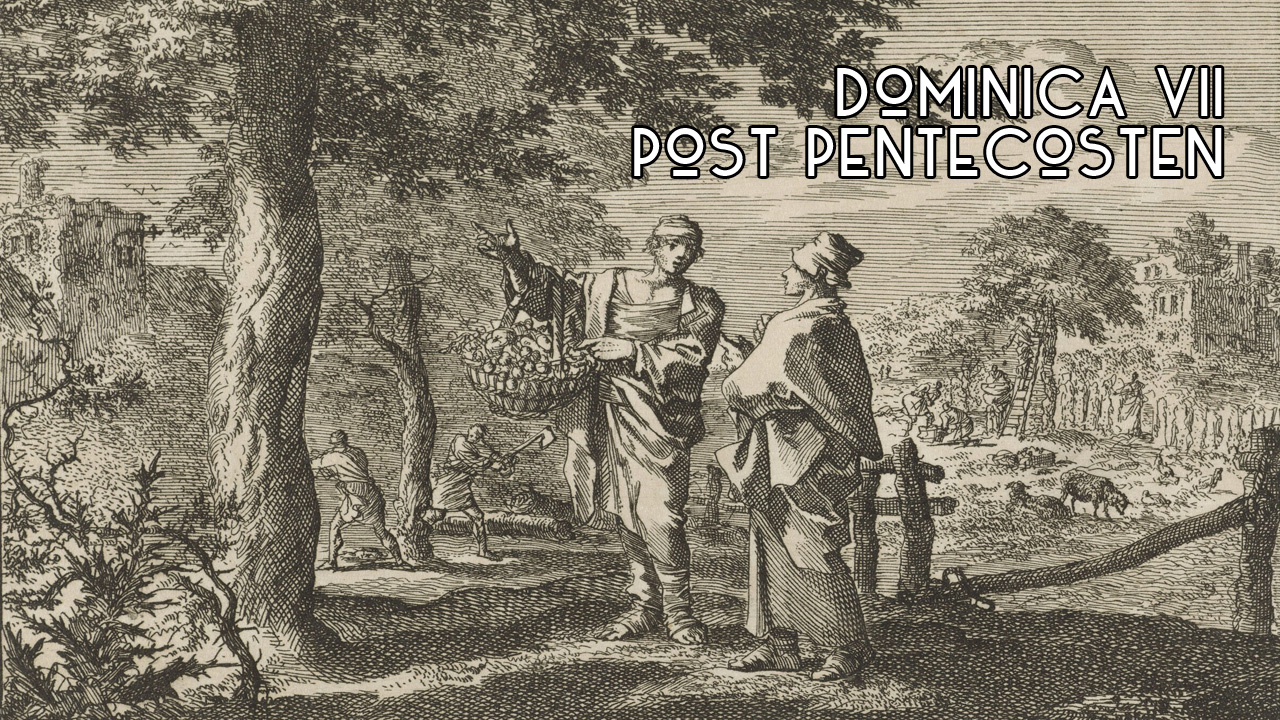
The Gospel shifts from the household and barracks to the flock and orchard. “Beware of false prophets, who come to you in the clothing of sheep, but inwardly they are ravening wolves” (Matt 7:15). Appearance and reality can diverge drastically. Wool does not change the appetite of a wolf. Pious vocabulary, theological credentials, polished ceremonies, bright sashes, impressive rings, institutional office, and repeated cries of “Lord, Lord” cannot convert bad fruit into good. Christ gives a practical criterion: ex fructibus eorum cognoscetis eos, “by their fruits you shall know them” (Matt 7:20).
The biblical background is rich. Isaiah’s carefully planted vineyard yields wild grapes instead of justice (Is 5:1–7). Jeremiah sees baskets of good and bad figs, images of fidelity and corruption (Jer 24). Ezekiel’s vine exposes treachery and decay (Ezek 17). In the Apocalypse the risen Lord repeatedly says, “I know thy works” (Apoc 2:2, 19; 3:1). Fruit is visible moral reality. Doctrine, worship, discipline, mercy, fidelity, chastity, justice, humility, courage, and perseverance bear fruit. Confusion, rebellion, indulgence, cowardice, cruelty, and compromise do likewise.
A tree may flower magnificently in spring and disappoint in autumn. Blossoms promise; fruit fulfills. The same danger appears in ecclesiastical life. Programs, documents, consultations, slogans, assemblies, and processes flower. The harvest may reveal barrenness. Our Lord directs attention to outcome. What happens to faith, reverence, vocations, marriages, doctrine, moral life, worship, repentance, and the salvation of souls? Fruit is the undeniable answer to questions.
Christ’s warning examines the orchard of the Church as well as the individual tree. False prophets may wear shepherd’s clothing, carry croziers, preach smooth words, and hold influence. Their fruit must be tested according to the depositum fidei, the inheritance received from the Apostles. Charity does not require blindness, nor does obedience require calling bitter fruit sweet. The Lord who commands unity also commands vigilance. “Every tree that yieldeth not good fruit, shall be cut down, and shall be cast into the fire” (Matt 7:19).
The first tree requiring inspection is our own. It is easy to diagnose the age, catalogue ecclesiastical failures, and identify wolves at a distance. The Mass presses the blade closer. Where is my fruit? What has my prayer produced? Has reception of the sacraments made me more truthful, patient, chaste, courageous, reverent, and merciful? Do those under the same roof encounter fruits of grace, or only religious opinions? Does my use of time reveal service of God? Have I surrendered my members to justice, or are some still leased to the old master?
Dom Prosper Guéranger gives the examination a sharp edge:
“[S]hall we do less for justice than is being done everywhere in favour of our enemy, sin? Surely justice deserves that we should make greater efforts in her service than for that odious tyrant who requites his slaves with nothing but shame and death.”
The zeal once spent on sin becomes an accusation when service of God is listless. Men labor for money, status, pleasure, resentment, or ideology. They sacrifice health, peace, friendships, and ultimately Heaven for wages which decay. Conversion should enlist that energy under a better commander. Grace heals and elevates the faculties. Imagination can devise works of mercy, persistence can persevere in prayer, and courage can defend truth. Justice deserves at least the earnestness formerly given to iniquity.
The Postcommunion reveals how this transformation occurs:
Tua nos, Domine, medicinalis operatio, et a nostris perversitatibus clementer expediat, et ad ea quae sunt recta perducat… O Lord, may Your medicinal operation mercifully extricate us from our perverse ways and lead us to those things which are right.
Earlier we heard dispositio, the wise arrangement of providence. Now we hear operatio, a working, an effective action, and in ancient religious usage a sacred service or performance. The prayer rises after Holy Communion. Christ the Divine Physician has given Himself as medicine, nourishment, sacrifice, and pledge of glory. His sacramental action reaches into our perversitates, our twisted and turned-away tendencies, frees us from their entanglement, and leads us ad ea quae sunt recta, toward things straight, right, and rightly ordered.
The realism of the Roman Rite is bracing. The soul is wounded and needs treatment. It needs light, discipline, cautery, pruning, grafting, nourishment, absolution, and repeated contact with grace. The sacraments are effective signs instituted by Christ, yet fruitful reception also requires right disposition. A man should not approach the Eucharist while deliberately clinging to grave sin. He should examine himself, confess when necessary, awaken faith and devotion, and receive with reverence. The heavenly medicine is never defective. Our resistance, negligence, presumption, or lack of disposition can impede its fruits in us.
The ancient liturgy trains souls through silence, kneeling, fasting, confession of unworthiness, and acceptance of tradition rather than endless innovation. Its texture teaches that God is God and we are creatures, sinners summoned to sanctity. It has grown through generations of faith, worship, sacrifice, and obedience. It is a fruit of the Church’s life and an instrument of Christ’s operatio medicinalis. Those who find its clarity uncomfortable may be tender in their conscience. A rite which repulses noxious things, such as perversity call us those who would white wash their predilections with liturgical fabrications, banal on-the-spot productions favoring their causes.
Yet the final accent is hope. “The wages of sin is death. But the grace of God, life everlasting, in Christ Jesus our Lord” (Rom 6:23). Wages are earned. Eternal life is given. Divine mercy remains available to the sinner who turns, asks, confesses, and receives. No confessed crime exceeds the price of the Precious Blood. No habit is stronger than grace. No bad season proves that a tree can never be restored. Providence can prune, the sacraments can heal, penance will strengthen, and charity can make the branches fruitful again.
Examine the orchard, then, and test the fruit in the light of the baptismal renunciation by which you were received into Christ’s household and enrolled beneath His standard. Accept the pruning which providence permits, and cut away whatever conscience identifies as harmful. Approach the medicine of the altar with the proper dispositions, and, if mortal sin is present or grave sin remains unconfessed, seek the healing action of Christ in the tribunal of mercy. God already knows what we try to conceal, and flight can neither alter the truth nor heal the wound.
As soldiers and willing servants of Christ, we must therefore put ourselves in order for the struggle to which we have been called. The campaign is real, the Judge is just, the Physician is merciful, and the end promised to those who persevere is eternal life. Go to confession, then return to the post entrusted to you, cultivate the ground assigned by providence, and bring forth good fruit.