As I write, it is the very day – 2 July 2026 – upon which, after yesterday’s episcopal consecrations by the SSPX, the Holy See has declared the same SSPX to be schismatic, its bishops excommunicated, their marriages and confessions invalid, and warns clerics and the lay faithful that formal adherence to the SSPX incurs excommunication. How very sad.
Meanwhile, we read of US bishops suppressing the people who desire the traditional liturgical rites by suppressing the celebration of those rites. It’s really about the people not just about the rites. Tertullian’s famous line presses upon us: “Plures efficimur, quotiens metimur a vobis: semen est sanguis Christianorum… We become more numerous whenever we are mown down by you: the blood of Christians is seed” (Apologeticum 50.13). These good people are experiencing no bloody martyrdom. Their trial is a kind of white martyrdom, made sharper because it comes from those whose office ought to be fatherly. If a stranger wounds you, you hurt. If one to whose care you have been entrusted wounds you, you hurt more.
Yet, when we cross the threshold of a church for Sunday Mass, we enter the Domus Dei by the Porta Caeli, the House of God through the Gate of Heaven. We bring our cares, our indignation, our bruises, our enemies, and even those who betray us. We put them on the altar, where God raises and transforms what we cannot. The 6th Sunday after Pentecost in the 1962 Missale Romanum gives us precisely the mystery needed for such a moment: Romans 6 and Mark 8, baptismal death and desert feeding, burial with Christ and bread multiplied in Gentile territory.
The Collect already gives the key.
Deus virtútum, cuius est totum quod est óptimum:
ínsere pectoribus nostris amórem tui nóminis,
et præsta in nobis religiónis augméntum;
ut, quæ sunt bona, nútrias,
ac pietátis stúdio quæ sunt nutríta custódias.
Literally:
O God of hosts, to whom belongs all that is best:
graft into our hearts the love of Your Name,
and grant in us an increase of religion;
so that You may nourish the things which are good
and, by zeal for dutifulness, guard what has been nourished.
We ask God to plant, increase, nourish, and guard. The verbs are His work first. Our work is pietatis studio, by the zeal of piety, that is, by the dutiful reverence owed to God the Father and, by extension, to His household, His children, His patria which is the Church.
The word religio in the Collect deserves attention. In the classical and Christian sense, it is the binding of man to God by worship, reverence, obedience, and the offering of what is due. Piety, pietas, is closely allied. Among Romans pietas named the dutiful honor owed to parents, fatherland, and the gods. In the liturgy it is baptized and purified. It becomes filial reverence toward the Father and mercy toward His children.
When the Collect asks that what is good be nourished and guarded, it asks that grace produce sturdy Catholics.
St. Paul says: “Do you not know that all of us who have been baptized into Christ Jesus were baptized into His death?” He continues: “For we were buried together with Him by baptism into death.” The baptismal font is a mystical tomb. We went down, figuratively but sometimes literally, into it dead in Original Sin and came up alive in grace. St. Cyril of Jerusalem writes: “For you go down into the water, bearing your sins, but the invocation of grace, having sealed your soul, suffers you not afterwards to be swallowed up by the terrible dragon” (Catechetical Lecture 3.12). He also teaches that baptism is the “counterpart of the sufferings of Christ,” because those baptized become partakers, by representation, of Christ’s true sufferings (Mystagogical Catechesis 2.6).
The old man is supplanted, so to speak. Paul describes the baptized as Greek “σύμφυτοι… sýmphytoi… planted together, grown together,” in the likeness of death and also of resurrection. Origen takes the image in the direction of grafting, a shoot joined into Christ’s Passion. We are not spectators of the Paschal Mystery. We are inserted into it, bound into the Passion, death, burial, Resurrection, and Ascension. Sacraments have real implications. They are not just commemorations of pre-existing realities. Nor are the mere social milestones. They are transformative encounters wrought by God. Paul’s passives hammer the point: baptizati sumus, consepulti sumus, complantati facti sumus. We have been baptized, buried together, planted together. God is the Actor. We receive. T hen we must live as those acted upon.
“Quod autem vivit, vivit Deo … the life He lives, He lives unto God.” In Greek, ζῶντας δὲ τῷ Θεῷ, zôntas dè tô Theô, gives us that ringing dative: “alive toward God, for God, unto God.” Baptism orients us. The lingering wounds of Original Sin remain, and concupiscence keeps whispering its low counsel, but the baptized are no longer oriented toward Egypt, chaos, or death. Genesis begins with waters over which the Spirit moves. The flood is destruction and new beginning. Israel passes through the Red Sea, with death on one side and life on the other. In Mark 10, before going up to Jerusalem, the Lord calls His Passion a baptism. Thus, Romans 6 gathers the waters of Scripture into one font. In Christ, water becomes tomb, womb, battlefield, and passage.
The Church herself must live this pattern. St. John Paul II, expounding Augustine, wrote that because Christ is Head of the Church, “Christ and the Church are one single mystical person, the total Christ” (Apostolic Letter Augustinum Hipponensem, 3). If the Church is joined to the Head, she cannot expect a life severed from His Passion. Diminishment, contradiction, betrayal, institutional coldness, and the suffering of the little ones are painful because they are real. They also belong, mysteriously, to the pattern of the Body. The Body of Christ passes through death toward life.
The faithful who, while clinging to the sensus fidei fidelium and even because of it, suffer at the cold hands of their pastors are not abandoned fragments. They are pieces gathered by the Lord ne pereant… lest they perish.
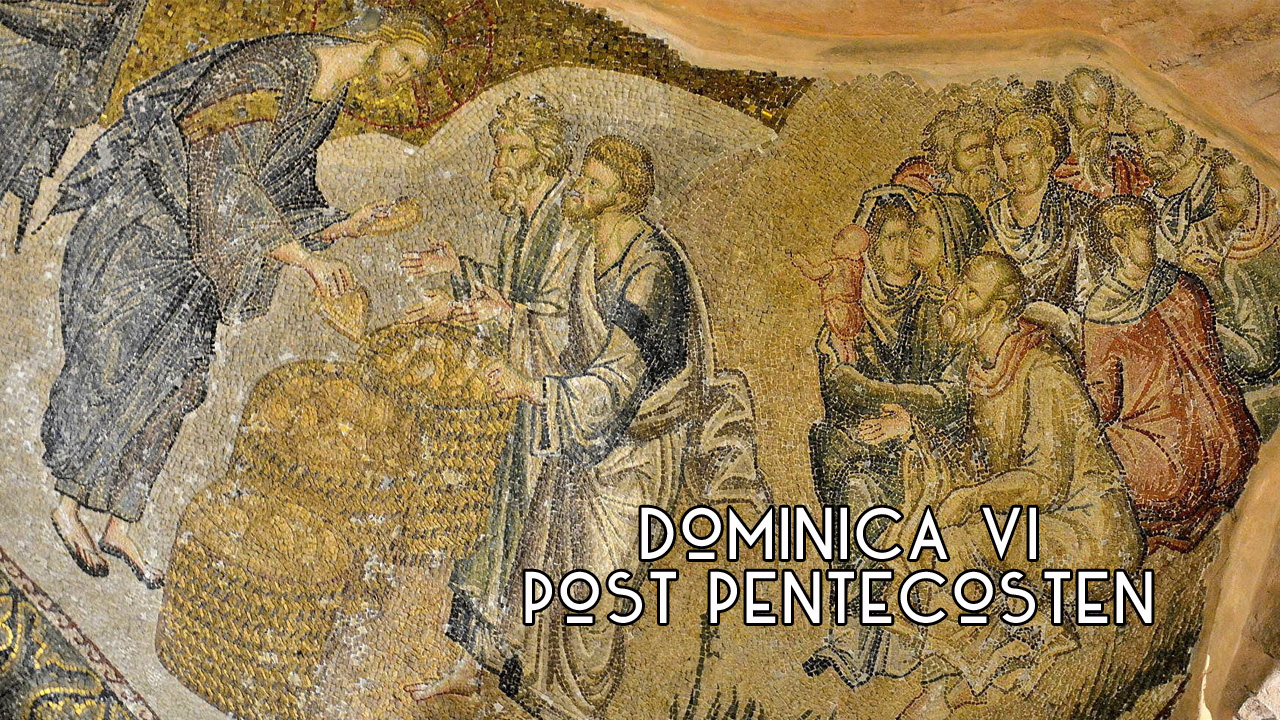
The Gospel presents the Lord in Gentile territory, in the Decapolis, outside the “promised land.” The feeding of the four thousand appears in Mark and Matthew. There is also the feeding of the five thousand in Jewish territory by the Sea of Galilee. The Lord induces the Apostles to ponder the numbers: five loaves, five thousand, twelve baskets; seven loaves, four thousand, seven baskets. “Do you still not understand?” He asks. The twelve baskets in Jewish territory evoke the twelve tribes and the apostolic foundation. The seven baskets in Gentile territory point toward fullness among the nations, by evoking the seven nations once occupying Canaan. The new Moses feeds both Israel and the nations. He is new manna is for the entire world.
Seven also suggests jubilee, fullness, release from debt, the loosening of burdens. A hungry crowd in the wilderness is a living icon of debt, of emptiness, dependence, inability to pay back what life demands. Christ does not invoice them. He feeds them. The mini-jubilee of the Decapolis anticipates the Eucharistic economy in which sinners receive what they could never purchase. The old hunger of Adam is answered by the Bread from Heaven. The empty man who dies in baptism rises to be fed, and then to feed others by the mercy he has received.
Between the two feedings stands the encounter with the Syrophoenician woman, the Canaanite mother who begged deliverance for her daughter. “Yet even the dogs under the table eat the children’s crumbs,” she argues. Israel’s leftover bread will be given to the Gentiles. St. Thomas Aquinas, treating this woman’s plea, sees five qualities in her: humility, patience, prayerfulness, perseverance, and faith. He concludes: “If we had had these five qualities we should be delivered from every devil, that is, from all sin; which may Christ grant us to be. Amen” (Homily 4 for the 2nd Sunday in Lent).
Modern reductionists cannot tolerate this. They look at miracles and explain them downward. The multiplication of loaves becomes, in their telling, a lesson in sharing among people secretly hoarding lunch. The German critic of the Bible Heinrich Paulus (+1851) and later rationalizing modernist interpreters tried to drain the supernatural from the Gospel accounts by reducing them to natural events. This habit remains alive wherever preaching turns divine acts into moral anecdotes and liturgy into leveling sentiment. Be wary of liturgical dumbing down. The Lord used mud and spittle, bread and fish, water and wine, because He elevates nature. Modernism takes the opposite road and lowers grace into psychology, sociology, or etiquette.
St. Augustine, preaching on this Gospel in Sermon 95, compares expounding Scripture to breaking bread. In one English rendering: “What you eat, I eat; what you live on, I live on. We share a common larder in heaven.” The preacher does not own the bread. He breaks what he has received. Augustine’s startling verb eructare gives the image a jolt. Latin eructo means to belch or bring up. Scripture is to be received hungrily and then brought up again in praise. Just as cows chew their cud by throwing it back up again (rumination), when it comes to Scripture and the mysteries of faith, we, too, must ruminate. The heart chews the divine word, draws nourishment from it, and returns it to God. The Marian Introit gives the same image: “Eructavit cor meum verbum bonum: dico ego opera mea regi …My heart has brought forth a good word: I speak my works to the king” (Ps 44:2 Vulgate). The Blessed Virgin heard the angelic word, pondered (ruminated) it, carried it, and then burst forth in the Magnificat. She is the perfect ruminant of revelation. She receives the Word, guards the Word, bears the Word, and gives the Word. As we approach the Feast of Our Lady of Mount Carmel – anniversary of Traditionis custodes and the suppression of God’s people who desire traditional worship – we ask her mantle over those who are wounded by shepherds, over parishes deprived of their inheritance, over priests tempted to timidity, and over the faithful who must keep clean hearts in dirty times.
In the Gospel reading Jesus says: “I have compassion on the crowd.” The Greek σπλαγχνίζομαι, splagchnízomai, from σπλάγχνα, splágchna, the entrails, gives the force of visceral mercy. The Word made flesh is moved in His human heart and, in the ancient image, in the inward seat of compassion. He hungers for our hunger. In John 6, when He commands the eating of His flesh, the verb τρώγω, trógo, has the sense of gnawing, munching. Once again we are brought to rumination. Christianity is not escape into vaporous feelings of self-affirmation. It is contact with the Word through words, water, oil, bread, wine, hands, voice, altar, and sacrifice.
Christ asks, How many loaves do you have?” He was not seeking information, but rather drawing the disciples into cooperation. He gives thanks (eucharistēsas) breaks, and gives. Mark’s imperfect edidou suggests repeated action: He kept giving. He gave and gave again, through the hands of the disciples. Here is divine initiative and human instrumentality. Someone let go of the loaves. Someone distributed. Someone gathered fragments. Grace results in cooperation.
Pius Parsch, writing about this Sunday, gives an image worth carrying for life: “through baptism I became a hand of Christ.” The hand shares the fate of the person. Christ’s hand worked wonders, was pierced on the Cross, lay in the grave, shone with scars after the Resurrection, and entered glory at the Ascension. “Now at baptism you became a hand of Christ; therefore you are reliving all that Christ did and suffered… And as Christ dies now no more, so also you are dead to sin, alive always to God.” The baptized are instruments of the risen Lord.
The priest, in a particular way, knows this at the altar and at the rail. Looking at the Host held by a hand consecrated with chrism, he can say with fear and gratitude: God has made me His hand.
Manus Dei, the hand of God, denotes agency, power in action, instrumentality. The priest is not the source of grace. He is minister. Christ feeds His people with Himself through human means. Fathers, provide the very best for those who come through the doors after years away. Examine your consciences. The people must not encounter indifference, banality, ugliness, slovenly ars celebrandi, or ideological scolding when they return hungry from the far country. They must encounter in the House of God, at the Gate of Heaven, the mercy of Christ, the bread that satisfies.
The same truth applies beyond the sanctuary. Every baptized soul becomes, in some manner, an instrument of mercy. God does great things with small means. We are small means, natural creatures with supernatural souls. The material things we have, including life itself, are from Him. When we let go generously, even little things multiply. Entrepreneurs grasp something of this at the natural level. Risk and venture bring gain and benefit for many. A small invitation, a patient word, a good example, a ride to Mass, a meal after Mass, a rosary offered for a deadened Catholic identity. These can become loaves in the Lord’s hands.
Never underestimate the power of an invitation. We all know Catholics whose conscious and active identity as Catholics is dormant, perhaps dying. Faith is often the last theological virtue to fade, after charity and hope have grown cold. Arguments rarely lead souls back in an age where “That might be true for you,” passes for reason. Show joy in the Catholic Faith. Invite. Some will refuse. Many will be pleased that you thought enough of them to ask. Some will come. If every regular churchgoer invited someone every week, parishes would change, souls would be helped, and God would crown His own gifts in us.
The seven baskets are heavy with superabundance. The fragments matter. “Colligite quae superaverunt fragmenta, ne permeant …Gather up the fragments that remain, lest they perish” (John 6:12). The Lord gathers broken people, wounded traditions, scattered families, discouraged priests, and faithful Catholics treated as problems by those who should love them.
In July, month of the Most Precious Blood, we ask that the Blood wash over the Church, healing what has been injured and strengthening what has been planted. We ask Our Lady Queen of the Clergy to cover her sons with her mantle.
Christ continually says, “I have compassion on the crowd.”
Lord, make us better hands.