
In these United State we had another autumnal round of elections to political offices. When this season comes around, many of us ask the iconic question posed by Ronald Reagan,
“Are you better off than you were four years ago?”
Around election time, people ask this question with the price of groceries and the household accounts in mind. But here we are at the penultimate Sunday of the liturgical year. Next Sunday brings the year to its conclusion and Advent will direct our attention to the Lord’s Second Coming as we prepare to celebrate His First. Surely we can spare a few minutes for the accounts that will matter when the whole business of this world goes up in fire (cf. 2 Peter 3).
How fares your soul? Are you better off than you were last Advent?
In the Vetus Ordo using the 1962 Missale Romanum we will use the Mass formulary of the 6th Sunday after Epiphany. That Mass is, taken now here to fill out the end of the season Pentecost before its Last Sunday next week. Its Collect survived the snipping and pasting of the Consilium under Annibale Bugnini and lives on in the Novus Ordo on the 7th Sunday in Ordinary Time. You can hear its antiquity in its brevity and cadence. We find it in the 8th century Sacramentary of Gellone and the Sacramentary of Angoulême, though it is likely that the oration is much older.
Praesta, quaesumus, omnipotens Deus:
ut, semper rationabilia meditantes,
quae tibi sunt placita,
et dictis exsequamur et factis.
Grant, we beg, Almighty God,
that we, meditating always on rational things,
may fulfill both by words and by deeds
those things which are pleasing to You.
Note the et…et, “both… and,” and the spiffy separation of et dictis…et factis, “both by words and by deeds,” by the very verb that tells us to carry them out. Hear it sung and you will catch the balance. The two neuter plurals, rationabilia… placita, bring together the rational things we ponder and the things pleasing to God that we are to accomplish. Our old companion Lewis & Short gives exsequor a range from pursuing something to carrying it through, even to setting it forth in speech.
Now get a load of the old ICEL version of 1973 forced on the people of God for decades:
Father,
keep before us the wisdom and love
you have revealed in your Son.
Help us to be like him
in word and deed.
Where did the meditation go? The Latin puts us to work with the very faculties by which we can know what pleases God and freely do it. The English gives us a pious thought and moves on.
The Latin Collect brings to mind what the Lord says about the Father in John 8:28–29:
So Jesus said, “When you have lifted up the Son of man, then you will know that I am he, and that I do nothing on my own authority but speak thus as the Father taught me. And he who sent me is with me; he has not left me alone, for I always do what is pleasing to him (quae placita sunt ei, facio semper).”
“I do what is pleasing to Him.” Keep the Lord’s semper, “always,” in your ear when you hear semper rationabilia meditantes, “meditating always on rational things.” Our Lord speaks what the Father taught Him and does what pleases the Father. St. Paul gives us a glimpse of what happens when people receive that teaching and put it into practice. Here is the whole Sunday Epistle reading from 1 Thessalonians 1:2–10.
[Brethren:] We give thanks to God always for you all, constantly mentioning you in our prayers, remembering before our God and Father your work of faith and labor of love and steadfastness of hope in our Lord Jesus Christ. For we know, brethren beloved by God, that he has chosen you; for our gospel came to you not only in word, but also in power and in the Holy Spirit and with full conviction. You know what kind of men we proved to be among you for your sake. And you became imitators of us and of the Lord, for you received the word in much affliction, with joy inspired by the Holy Spirit; so that you became an example to all the believers in Macedo′nia and in Acha′ia. For not only has the word of the Lord sounded forth from you in Macedo′nia and Acha′ia, but your faith in God has gone forth everywhere, so that we need not say anything. For they themselves report concerning us what a welcome we had among you, and how you turned to God from idols, to serve a living and true God, and to wait for his Son from heaven, whom he raised from the dead, Jesus who delivers us from the wrath to come.
This may be Paul’s earliest surviving letter. It was meant to be read aloud and heard by groups. The Thessalonians would have remembered what happened when Paul preached in their city under Roman rule. According to Acts 17, his opponents stirred up a crowd and dragged Jason and some of the brethren before the authorities. The charge? They were proclaiming another king, Jesus. Paul and Silas then went by night to Beroea. The trouble followed them there, too. Paul went on to Athens. Imagine being a Thessalonian Christian hearing Paul’s letter read aloud. You remember the mob, Christians dragged before the city authorities, the escape by night. When the reader came to “much affliction,” you could put faces and events to those words. Then comes “with joy inspired by the Holy Spirit.” Paul recalls the joy which came from the Holy Spirit and accompanied their conversion even when becoming Christian carried a real cost.
The Father, the Son and the Holy Spirit appear already in this thanksgiving. Paul can speak of all three in passing because his hearers have already been instructed. The Gospel came in power, ratifies in the healings and deliverances in the Book of Acts. We can still ask God for such things. The work of evangelization went on after Paul left. Unlike some cardinals these days, Paul and company thought converting people was important. They didn’t have better things to do, it seems. It was their “to érgov písteos… work of faith”, and their “kópos agápes… labor of love”. Greek kópos can mean a blow or the toil that wears you out. Their érgon, “work,” and their kópos, “toil,” gave the communities something concrete to talk about. Hope sustained their perseverance in the faith.
There is a distinction worth making here. The faith in which we believe, fides quae creditur, is what we learn, study, defend and hand down. The faith by which we believe, fides qua creditur, is the faith by which, with the grace of the Holy Spirit, we assent to what God reveals. In each each case the true content of the faith is not encapsulated in doctrinal formulae which can be memorized and analyzed. The true content of faith is the living divine Person of Jesus, the Eternal Word made flesh. Paul loved his hearers and readers enough to tell them the unvarnished truth and to correct their errors and confusion when they strayed. As he says elsewhere, tradidi enim vobis quod et accepi, “For I handed on to you what I also received” (1 Cor 15:3). If a successor of the Apostles proposes that we jettison even Apostolic Tradition because it is, after all, “just a tradition,” or suggests that evangelization is no concern of ours, one might rightly ask what he thinks his job is.
The content of the Faith is, at its heart, a Person, the divine Word incarnate. Love makes you want to know more about the one you love and to give what you have received. Sometimes this looks like teaching the catechism. Sometimes it looks like taking a meal to someone who can scarcely get out of bed. Both can cost you an evening. Charity, true sacrificial love, is a choice, an act of will and not just the ooey gooey feeling of sentiment in easy times. Sometimes loving is hard. This applies also to our love of Holy Church particularly when some of her own shepherds make her institutional dimension very hard to love.
This real, practical challenge suggests an action item, regarding the fides quae and the fides qua. I’m reminded of an old maxim, “Nemo dat quod non habet”, or in the macaronic version, “Nemo dat, quod non ‘got’…. “You can’t give whatchya ain’t got.” The various crises and challenges in the Church and in society have more than likely driven a lot of people to search out and clarify what the Church teaches. Maybe they look online or reach for the Catechism of the Catholic Church. Again in the political vein, I recall the phrase “never let a crisis go to waste”. However, must we wait for the next ecclesiastical uproar to crack open the Catechism? Why wait for some bishop to say or do something questionable (though in fact we don’t usually have to wait very long)? Be proactive. Take advantage of the time we have. Controversy strikes? The truth you learn on a quiet Tuesday may be the truth you have to give somebody on the worst day of his life.
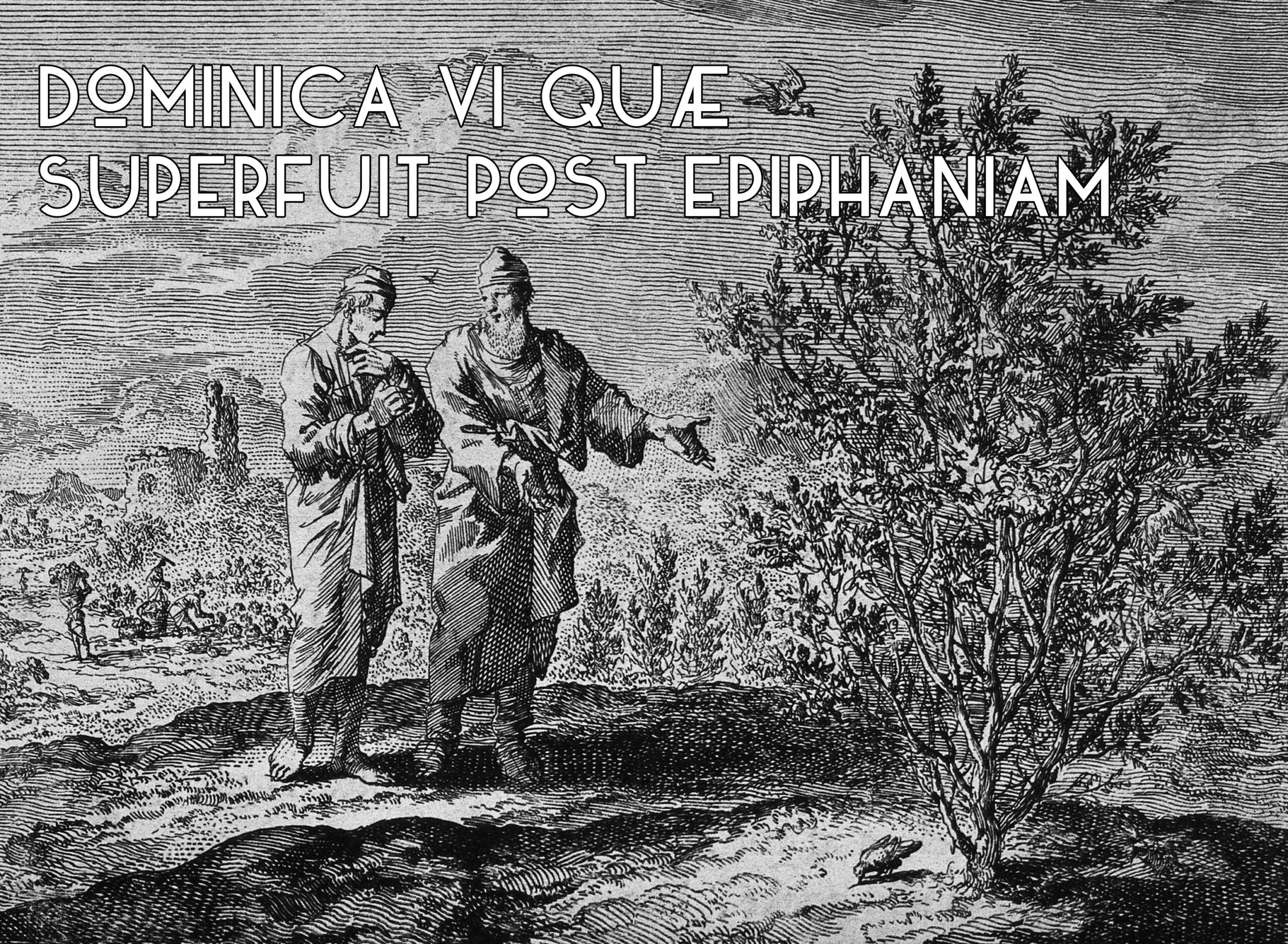
In Matthew 13:31–35 the Lord likens the kingdom of Heaven to a mustard seed and to leaven. From a tiny seed grows a bush large enough for birds to nest in its branches. A woman works a little leaven into three measures of flour, and in time the whole batch rises. Look back at Paul’s Thessalonica. A handful of converts received the Gospel amid an uproar. Before long, their faith was an example to Christians throughout Macedonia and Achaia. This is a “knock-on effect”. Consider what might happen in a parish where a growing number of people pray, learn their Faith, and practice the spiritual and corporal works of mercy.
Back to the Collect, that rationabilia meditantes and our own “status quaestionis… state of the question.” Rationabilis means “reasonable” or “rational.” The rationabilia, “rational things,” are proper objects of thought for creatures who can know and will, faculties wounded by Original Sin but raised by grace. Thus we can distinguish, for example, between “human acts” and “acts of humans”. Critters with non-rational souls (animae) breathe and digest as do we. When we digest, that’s the act of a human, as are only vaguely thought about things we might do out of muscle memory and reactions. On the other hand, a human act, in the stricter sense, involves knowledge and choice in contradistinction to a generic animalian act that doesn’t stem from reason and choice. This is an important distinction for our “full, conscious and active participation” in our sacred worship. Carrying a bowl around is one thing, but focusing with great attention on the words and gestures, their meaning as we receive them is another. Have you ever caught yourself singing a hymn in church while your mind is a hundred miles away, making out a grocery list or thinking about the upcoming ballgame? To onlookers there you are, “actively participating” at Mass as you sing every verse. Inwardly, where is counts, are you really participating? This is why true “full, conscious and active participation” is more about being actively engaged and receptive to what is going on rather than putting on a gunny sack with a cord and carrying stuff around. The key is active receptivity, which is nothing like passive reception.
The heart, will and mind must be engaged in the action of sacred worship. Along those lines I remember a prayer traditionally attributed to St. Thomas Aquinas that we used before philosophy class Ad vitam sapienter instituendam, “For ordering one’s life wisely”, which pertains to all we do, not just studying:
Concede mihi, misericors Deus,
quae tibi sunt placita,
ardenter concupiscere,
prudenter investigare,
veraciter agnoscere,
et perfecte adimplere
ad laudem et gloriam Nominis tui. Amen.
Grant me, O merciful God,
to desire ardently,
to investigate prudently,
to recognize truly,
and to fulfill perfectly
those things that are pleasing to Thee,
to the praise and glory of Thy Name. Amen.
Notice where the prayer begins. Give me the desire. It takes desire even to listen properly at Mass. You may have to drag your mind back from the ballgame several times before the Gospel is over. Listen to the words, attend to the sacred action, let good sacred music (please, Lord, let the music be both sacred and good!) direct your attention to what is taking place at the altar. Offer yourself with the Sacrifice in virtue of your baptismal share in Christ’s priesthood. Christ is the principal actor. To receive what He gives with mind and will engaged is demanding work. To someone watching from across the aisle it may look like sitting still and being passive. There’s nothing “passive” about it.
In Gaudium et spes 22, the Council said that Christ “fully reveals man to man himself and makes his supreme calling clear.” The Son, the perfect image of the invisible Father, took flesh. In His dicta et facta, “words and deeds”, He reveals the Father and shows us how creatures made in God’s image are to live. His words and deeds save as well as teach. Here are rationabilia for a lifetime of meditation.
When fashion treats faith as the intellect’s idiot cousin and regards suspicion of every authority as a mark of intelligence, when yet another controversy about something wicked or stupid or both weighs on you, try praying this Sunday’s Collect, or the prayer above. “Leaven” your words and deeds with prayers. Put your intellect and will at the disposal of the One who gave them to you. With fides qua open the Catechism and other good resources and be actively receptive to the fides quae and not a passive digester.
Along with quiet prayer, examinations of conscience and works of mercy, this is how we make progress in the spiritual life. Over time, you’ll sense the changes. With discipline and perseverance, as even the incoming liturgical year comes to its final days, you might have a different response to the question:
Are you better off than you were four years ago?