
As we approach the end of the liturgical year, an odd thing happens in the Church’s traditional calendar, the Vetus Ordo. Sundays which were left over after Epiphany are dusted off and brought back into service to fill the space between the 23rd Sunday after Pentecost (in 2026 superseded by the Feast of All Saints) and the 24th and Last Sunday after Pentecost. The reason lies in the vagaries of your planet’s Moon, which determines the date of Easter and, therefore, Septuagesima, Ash Wednesday, Pentecost, and the number of Sundays before Advent and the beginning of a new liturgical year. In some years we have quite a few Sundays after Epiphany before Septuagesima arrives. In other years, there are fewer. Hence, in the autumn, we sometimes encounter one of those “Where the heck is this Sunday in my Missal?!?” Sundays.
This year, for the Sunday after what would have been the 23rd Sunday after Pentecost (but bumped by All Saints) we have the 5th Sunday Remaining after Epiphany. Its Epistle and Gospel, Colossians 3:12–17 and Matthew 13:24–30, have particular relevance as the Church approaches the conclusion of her annual liturgical pilgrimage.
The Gospel reading presents the parable of the wheat and the cockles, or tares, with its stark reminder of the final separation and eternal fate of the just and the wicked. The Epistle gives us St. Paul’s practical instructions for living as members of Christ’s Mystical Body while we await that separation. The Collect, meanwhile, gives us the proper attitude with which to face the struggle, asking God to protect us, who rely wholly upon the hope of heavenly grace.
Let’s start with a look at the Collect, which survived the post-Conciliar liturgical reforms and is assigned also to the 5th Sunday in Ordinary Time in the Novus Ordo. In some years the two calendars coincide, giving Catholics attending the older and newer forms of the Roman Rite the same ancient prayer. A liturgical unicorn.
Familiam tuam, quaesumus, Domine,
continua pietate custodi:
ut, quae in sola spe gratiae caelestis innititur,
tua semper protectione muniatur.
LITERAL VERSION:
Guard your family, we beseech you, O Lord,
with continual loving care,
so that that family which is leaning on the sole hope of heavenly grace
may always be fortified by your protection.
CURRENT ICEL (2011):
Keep your family safe, O Lord, with unfailing care,
that, relying solely on the hope of heavenly grace,
they may be defended always by your protection.
There are rich layers in this apparently simple prayer. The vocabulary produces two complementary images. First, we have the image of a family, dependent upon the protection and loving care of its father. In addition, we discern soldiers in formation, relying upon their equipment and fortifications in dangerous territory. These images belong together because Holy Church is both the family of God and the Church Militant.
The verb custodio means “to watch, guard, protect, defend, or keep”. It is frequently employed in military contexts. Innitor, a deponent verb, means “to lean upon, rest upon, or support oneself by something”. Our old friend the Lewis & Short Dictionary supplies examples from Caesar and Livy involving soldiers leaning upon their shields and spears. Caesar, in De bello Gallico 2.27, employs the expression scutis innixi, “leaning upon their shields.” Munio means “to fortify, secure, wall up, or place in a condition of defense”.
In our Collect the familia, family is being guarded. Those who constitute that family are leaning upon the hope of heavenly grace as soldiers might lean upon their shields. They ask to be wall-about by divine protection. There is in the oration the simultaneous awareness of weakness in the face of danger, together with confidence that the necessary assistance will be supplied by the One to whom the family belongs.
We must also drill into pietas. This word gives us English “piety,” but its range of meaning is considerably broader. Lewis & Short describes it in terms of dutiful conduct toward the gods, parents, relatives, benefactors, and country. The heart of pietas is duty, accompanied by the affection and reverence appropriate to the relationship. Applied to God, however, pietas signifies His merciful, loving care for those who belong to Him.
Piety is also one of the seven gifts of the Holy Spirit (cf. Isaiah 11:2; CCC 1831), disposing us to render to God the reverence of sons toward their Father and to fulfill our duties toward those to whom we are bound. There is a reciprocal dimension to this prayer. God watches over His family with unfailing mercy. Members of that family, receiving His grace, must fulfill their duties toward Him and toward one another.
The relationship is hierarchical. Children are fully members of a family, but they are dependent upon their parents. Soldiers belong to their unit, but the effectiveness of the unit depends upon discipline, obedience, and the proper exercise of command. In the Church, all the baptized share a fundamental dignity through incorporation into Christ, while the various members have distinct offices and obligations. Authority exists for the good of those entrusted to its care. Those who exercise it will answer to God for their stewardship.
This brings us to the Epistle reading.
Some context first. St. Paul’s Letter to the Colossians was written – just a few minutes by foot from where I write this – during his imprisonment, traditionally identified with his first Roman captivity. Colossae was a city of Phrygia in Asia Minor, modern Turkey. Paul apparently had never visited the community. Someone named Epaphras, whom he mentions in the Letter, seems to have been a key player in establishing a Church there. Paul also names Luke, “the beloved physician”, and Mark, the cousin of Barnabas (Col 4:10,14).
The Colossians were mostly Gentiles who faced cultural influences incompatible with the Christian faith. Paul therefore begins his Letter by emphasizing the supremacy of Christ and the fullness of divine life found in Him. From this doctrinal foundation he proceeds to practical instructions about Christian conduct, especially the relationships within households and the wider Christian community. Our Sunday pericope comes from this practical portion of the Letter, which we also hear in the traditional Mass for the Holy Family.
Apparently Holy Church thinks we need to hear these commands more than once. Given how we Christians sometimes behave toward one another, she knew what she was doing.
St. Paul writes:
Put on then, as God’s chosen ones, holy and beloved, compassion, kindness, lowliness, meekness, and patience, forbearing one another and, if one has a complaint against another, forgiving each other; as the Lord has forgiven you, so you also must forgive. And above all these put on love, which binds everything together in perfect harmony. (Colossians 3:12–14, RSV)
Note the imagery of clothing. Paul has already instructed the Colossians to put off the old man and put on the new. Here he tells them what garments must characterize their renewed lives. The Greek endúsasthe, from endúo, is an aorist middle imperative, “clothe yourselves.” The Vulgate has induite, likewise an imperative. In v. 14, the Greek verb is understood from the preceding command, whereas the Latin Mass text supplies habete, “have,” before charity.
The point, however, is that Paul is issuing commands. He is not making suggestions for those who might feel inclined to behave charitably when circumstances are favorable. Compassion, humility, patience, forgiveness, and charity are obligations belonging to the Christian vocation. They must be practiced especially when circumstances make them difficult.
Above all these virtues Paul places charity, Greek agápe, Latin caritas. The Greek expression epi pasi toutois signifies “over all these,” suggesting charity as an outer garment placed over the others. Charity binds the virtues together and directs their exercise toward their proper supernatural end. In the Vulgate, charity is vinculum perfectionis, the bond of perfection.
Here the Collect’s imagery of family and military unity finds its practical expression. Members of a family must bear with one another. Soldiers in a unit must be able to rely upon their fellows. How much more should Christians, whose bonds are forged through incorporation into Christ and nourished by His sacraments, fulfill their obligations toward one another?
Imagine a military unit whose members were willing to sacrifice themselves for their companions, to share their provisions, to carry the wounded, and to remain steadfast under attack. Now imagine a parish, a religious community, or a diocese in which the members possessed that same devotion to one another, elevated by supernatural charity.
What could we not accomplish?
By baptism we have been incorporated into Christ’s Mystical Body. Through confirmation we are strengthened for the combat of Christian life. The Holy Eucharist nourishes us, Penance restores us when we fall. The sacramental life supplies the graces necessary for perseverance. We ought to be willing to suffer like good soldiers rather than betray our duty toward God through sin.
We must not be naïve about the situation in which the Church Militant finds herself. Within her visible membership there are divisions, rivalries, scandals, betrayals, and persistent sins. Sometimes those entrusted with defending the flock seem remarkably willing to abandon their posts. Discipline deteriorates, doctrinal confusion spreads, and the faithful suffer from the failures of those who should protect them.
Our Gospel reading, with the parable of the wheat and the tares, or cockles, or sometimes darnels (a rye grass Lolium temulentum) is next.
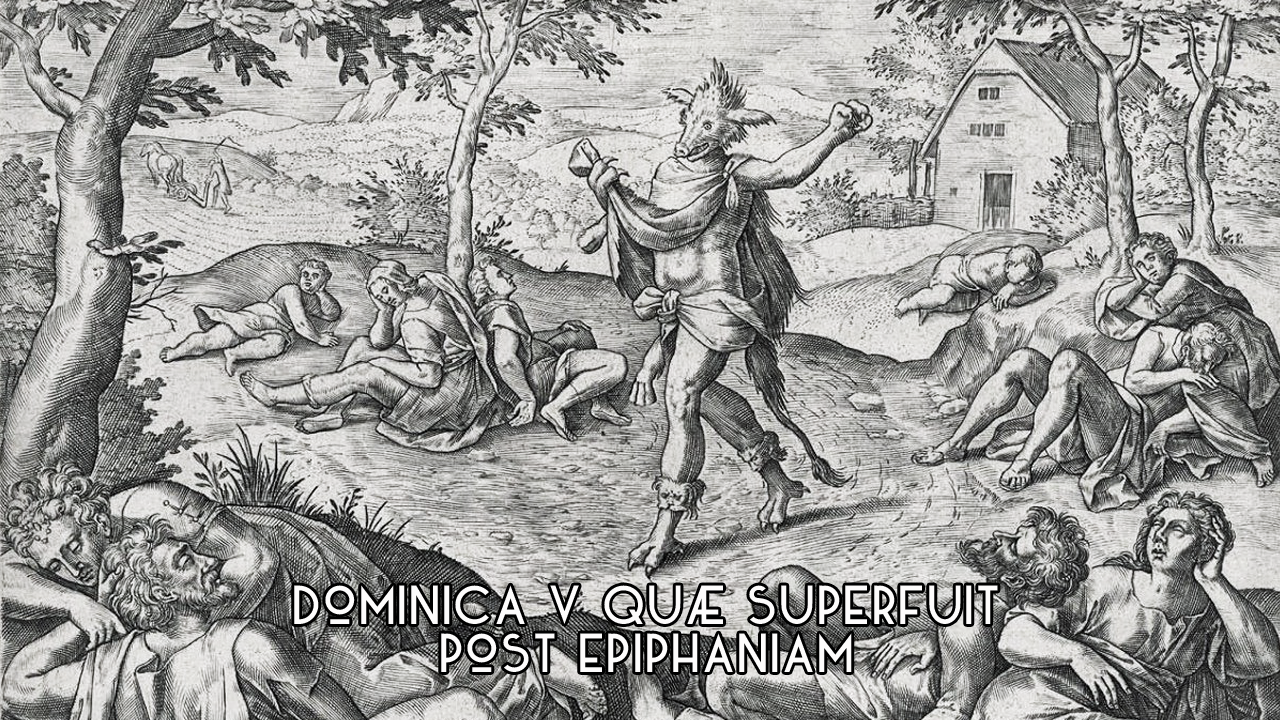
Our Lord describes a householder who sowed good seed in his field. While the men were sleeping, an enemy came and sowed tares among the wheat. The plant commonly identified with the biblical tares, zizania, resembles wheat during its early growth. The malicious sowing of such weeds could cause serious agricultural damage lasting for years, especially because their roots became entangled with those of the wheat. It was tantamount to biological warfare and, hence, there were tough imperial laws against it, even against enemies!
The servants discover the contamination and ask whether they should remove the weeds immediately. The master refuses, lest they uproot the wheat in the process. He commands, “Allow both to grow together until the harvest” (Matthew 13:30).
The parable can be puzzling because it confronts us with the mystery of God’s toleration of evil. In Christ’s own explanation of the parable later in Matthew 13: the field is the world, the good seed represents the children of the kingdom, the tares (zizania) the children of the wicked one, the enemy is the Devil, and the harvest is the consummation of the age at the Second Coming.
The parable also describes the condition of the Church during her earthly pilgrimage. The Church is holy because Christ is holy. Her teaching and sacraments are holy. This is why she produces holy fruit: saints. Nevertheless, sinners remain within her visible boundaries. The consequences of their sins can be a serious burden to the innocent. It’s a paradox.
Bl. Ildefonso Schuster, commenting upon this Sunday reflects:
How profound are the mysteries of Providence! If the Lord does not punish and destroy the wicked in this life, it is in order that the good may not be involved in the same doom, who by ties of blood, of fellow-citizenship and of country are associated together with the sinners. The world never reflects upon the great and important part fulfilled by the saints, whose merits ward off from the world its well-deserved chastisements.
God’s patience permits the wicked time for repentance and spares the good from calamities that might accompany premature judgment. That patience must never become an excuse for indifference toward evil.
The enemy sowed the weeds “cum dormirent homines… while the men were sleeping”.
This is a warning about negligence and presumption. Errors enter when vigilance slackens. Abuses become habitual when those charged with maintaining discipline neglect their duties. The Enemy is patient, industrious, and highly capable of taking advantage of even small opportunities supplied by sleepy shepherds.
The master’s command to leave the weeds until the harvest aims at the final separation of the wicked from the just. It does not abolish the Church’s obligation to correct error, admonish sinners, protect the innocent, or exercise legitimate discipline. Charity and vigilance must work together, particularly when those in authority have the duty to safeguard souls. Nor should we presume that we can always identify with certainty who belongs among the wheat and who among the tares. A sinner can repent. Someone who appears outwardly respectable may be inwardly corrupt. God sees what human judgment cannot.
Pius Parsch, in The Church’s Year of Grace, draws the Epistle and Gospel together in a practical resolution:
My program during the coming week will be to strive zealously to realize St. Paul’s ideal, no matter what happens to me; I will not be scandalized at what others do, but will try to imitate the patience of God toward the wicked. Moreover, I will give serious thought to the reality of hell.
Parsch goes on to underscore the urgency of preparing for the coming of Christ. The approach of the liturgical year’s end places us imaginatively in the shadow of the Parousia, the Lord’s glorious return. The wheat will be gathered into the granary, and the tares will be burned.
At this point in the waning year, we have before our eyes the Four Last Things: Death, Judgment, Heaven, and Hell. The virtues commanded by St. Paul prepare us for that judgment. The patience enjoined by Our Lord in the parable prevents us from arrogating to ourselves the divine prerogative of final separation. That is God’s and God’s alone.
Meanwhile, I must ask myself: How much cockle remains in my own soul?
The images of family and of soldiers return from the Collect. As members of God’s household, we need the loving care of our heavenly Father. As soldiers of Christ, we need His protection against the enemy, including the enemies arising from our own disordered appetites and habitual sins. We cannot safely rely upon ourselves.
In sola spe gratiae caelestis innititur.
The Church leans upon the sole hope of heavenly grace.
Considering the family aspect, I conjure a father who, before retiring, checks in on his sleeping children. He listens for any indication of danger or distress. His care continues even when they are unaware of it. Like a diligent sentry leaning on his spear and shield at the end of his weary day he nevertheless says, “Tonight, nothing will harm you.” This paternal vigilance is in the Collect’s petition for continua pietate custodi. God watches over His children even amid dangers they do not fully comprehend.
At the same time, Christ our King provides for His soldiers on the march. He gives them His commandments, His sacraments, the examples and intercession of the saints, and the grace required to remain faithful. His protection does not dispense us from obedience, sacrifice, and combat.
St. Paul concludes his exhortation by commanding that everything we do, in word or deed, be done in the name of the Lord Jesus, with thanksgiving to God the Father through Him (v. 17).
The Church offers us marching orders as we approach the end of the liturgical year. Put on the garments of mercy, humility, patience, and charity. Be vigilant against the enemy. Fulfill the duties of your state in life. Defend the truth while remembering that judgment belongs ultimately to God. Persevere in prayer and the sacraments.
And get ready for … whatever.