

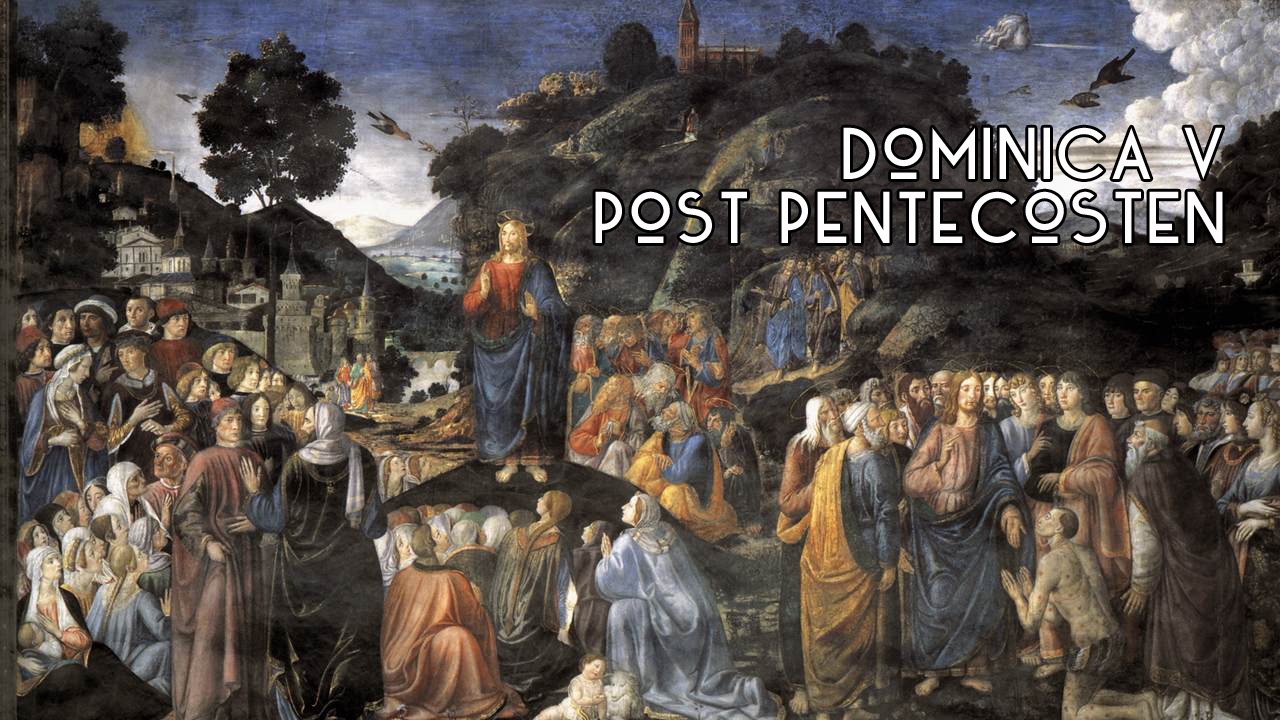
On the 5th Sunday after Pentecost, Holy Church brings us to the school of tough love. As Pius Parsch observed, the recent Sundays have shown God’s love inviting us, seeking us, and bestowing instruments of His mercy. The Good Shepherd has Fishers of Men. Now, after the image of divine love has gone out in search of the lost, the liturgy shines on us the light by which we may see whether we have genuinely received that love. We are asked what the status is of charity in our tongue, in our temper, in the family, in the workplace, in the parish, in the hidden chamber of the heart.
The sequence of images on these Sundays has been instructive. The Parable of the Great Supper showed the invitation of love. The Lost Sheep showed love searching. The miraculous draught and Peter’s calling showed appointing ministers out of love. Now the Church asks whether the invited, rescued, and instructed soul has become merciful. The Mass turns the gaze from God’s mercy toward us to the shape of mercy in us. The altar, the tongue, and the heart are inseparable. One cannot sing Credo authentically and then treat a brother as worthless.
The Sunday Collect is ancient and it survived the post-Conciliar revision in the Mass of the 20th Ordinary Sunday, with a punctuation change. In the 1962 Missale Romanum we pray:
Deus, qui diligentibus te bona invisibilia praeparasti,
infunde cordibus nostris tui amoris affectum;
ut te in omnibus et super omnia diligentes,
promissiones tuas, quae omne desiderium superant, consequamur.
O God, who hast prepared invisible good things for those loving You,
pour into our hearts the disposition of Your love;
so that, loving You in all things and above all things,
we may attain Your promises, which surpass every desire.
The prayer is full of longing words: diligere, amor, affectus, cor, desiderium, promissio. The verb diligo means to esteem, to value highly, to love with attentiveness and care. It is the root of our “diligent.” Affectus is a disposition of mind and heart produced by an influence, a motion, a mood, an affection, a sympathy. Desiderium is longing, ardent desire, often with the ache of absence, as if the heart remembered something lost. Consequamur, from consequor, can mean to pursue, to follow after, to attain. The whole Collect therefore describes an ascent. God has prepared bona invisibilia, invisible goods. He pours into our hearts the affectus of His love. We, loving Him in all things and above all things, press toward the promissiones, the promises, which exceed every desiderium.
Here the Collect gives the inner principle of the Epistle and Gospel. We are commanded to love our neighbor because God has first touched the heart with His own love. Natural love is real, for human nature, wounded by the Fall, retains its created goodness. Yet our loves are disordered, easily narrowed into appetite, pride, faction, or retaliation. St. Thomas gives the axiom with admirable brevity: “gratia non tollat naturam, sed perficiat … grace does not take away nature, but perfects it” (STh I, q. 1, a. 8, ad 2). Grace heals and raises what we are. God does not unmake the creature in order to save him. He gives back the creature to himself, whole, re-ordered.
We might essay to hear this Collect in harmony with Pope Benedict XVI’s Deus caritas est. Benedict spoke of eros and agape, of love that ascends in search of fulfillment and love that descends in self-giving. In fallen man, eros can sink into grasping use. In Christ, eros is purified, disciplined, and opened to agape. A complete Christian love gives and receives, rises and descends, thirsts and pours itself out. The Collect asks for this integration: infunde cordibus nostris tui amoris affectum, pour into our hearts the disposition of Thy love. What is poured into the heart must then flow from the mouth, the hand, the act of reconciliation, the patience that refuses to repay reviling with reviling.
St. Augustine, speaking from the deepest restlessness of the human condition, confessed: “quia fecisti nos ad te et inquietum est cor nostrum, donec requiescat in te … for Thou hast made us for Thyself, and our heart is restless until it rests in Thee” (conf I, 1, 1). The Collect’s desiderium is that restlessness baptized, purified, and directed toward the invisible goods. The Christmas Preface gives the same motion: “ut dum visibiliter Deum cognoscimus, per hunc in invisibilem amorem rapiamur … so that, while we know God visibly, through Him we may be snatched up into invisible love.” Through the Incarnate Word, visible to the eyes of men, we are caught up to invisibilia. Love becomes the eye. Richard of Saint Victor, channeling an Augustinian impluse, says: “amor oculus est, et amare videre est … love is the eye, and to love is to see” (Tractatus de gradibus caritatis, PL 196, 1203). The one who loves God begins to see the neighbor as God sees him, even when the neighbor wounds, vexes, slanders, or fears us.
Sometimes when I am with an annoying person, I try mentally to put on “resurrection glasses”, and attempt to see that person as God might intend in the Resurrection.
In the Sunday Epistle, 1 Peter 3:8-15, the Apostle writes to distressed Christians in Asia Minor, beset by persecution, hostility, and slander. Peter, who once drew a sword in Gethsemane, has learned the costly wisdom of Christ’s silence and meekness. His counsel is austere: have unity of spirit, sympathy, love of the brethren, a tender heart, and a humble mind. The Greek piles up the interior architecture of Christian society: homóphrones, of one mind; sympathés, able to suffer with another; philádelphos, brother-loving; eúsplanchnos, tender in the inward parts, with “bowels of compassion”; tapeinóphrones, humble-minded. These are the stones and mortar of ecclesial life. Without them, communities crack. Under persecution, divisions can become fatal without them.
Peter then places a psalm upon Christian lips.
“For he that will love life, and see good days, let him refrain his tongue from evil, and his lips that they speak no guile. Let him decline from evil, and do good: let him seek after peace, and pursue it. Because the eyes of the Lord are upon the just, and his ears unto their prayers: but the countenance of the Lord upon them that do evil things” (1 Peter 3:10-12, DRV, citing Psalm 33/34).
The tongue is the barometer of the heart. A man may prefer incense, chant, lace, Latin, Greek, scholastic precision, patristic citation, and the Vetus Ordo, and still betray in his speech that the affectus of divine love has not yet entered deeply enough.
Let that observation strike where it must.
Those attached to the traditional Roman Rite must treat each other well. Better.
In Peter’s day, a flock under pressure needed unity, mercy, and discipline of tongue. In our day, when those who love the Vetus Ordo are caricatured as rigid or divisive, the same apostolic remedy is urgent. It is a bitter speculation in retrospect that attacks upon tradition might have been less easily carried out by hostile bishops had there been, from the beginning, more visible charity, more cooperation, more zeal for the neighbor, more works of mercy, more refusal to bite and devour. Yet the spiritual life is lived hic et nunc, here and now. Regret can become useful only when it turns into amendment, obedience to grace, and renewed confidence.
Peter adds a mysterious line:
“Timórem autem eórum ne timuéritis: et non conturbémini … And who is he that can hurt you, if you be zealous of good? But if also you suffer any thing for justice’ sake, blessed are ye. And be not afraid of their fear, and be not troubled” (1 Peter 3:13-14, DRV).
The Greek is striking: τὸν δὲ φόβον αὐτῶν μὴ φοβηθῆτε, tòn dè phóbon autôn mè phobēthête, “do not fear their fear.”
It may mean the terror they try to impose. It may also hint at the fear within the persecutor. The world fears holiness because holiness exposes the world’s poverty. It fears the Christian who blesses when reviled, forgives when wronged, and worships in a form whose content resists reduction to sentiment or utility. The pre-Christian world feared the waxing Church. The post-Christian world fears the stubborn remnant. Plus ça change, plus c’est la même chose. I suspect that some of the hostility of certain leaders within the Church against the traditional Roman Rite is from fear. They don’t know or understand the older forms and so they reject them in misplaced self-defense. Also, it could be that they instinctively, as if by sensing pheromones, know that the content of the prayers and very ethos of the rites will force them to confront uncomfortable truths about themselves.
Peter’s remedy is interior worship: “Dominum autem Christum sanctificate in cordibus vestris … sanctify the Lord Christ in your hearts” (1 Peter 3:15 DRV). John’s Gospel echoes behind it: “Let not your heart be troubled” (John 14:1), and again, “Let not your heart be troubled, nor let it be afraid” (John 14:27). Peter, who had been troubled in the courtyard and had denied the Lord, now gives to frightened Christians the fruit of his tears. Fear is answered by enthroning Christ in the heart. Defense of the faith follows from that enthronement: “Always be ready to satisfy every one that asketh you a reason of that hope which is in you” (1 Peter 3:15 DRV). The Greek adds the required manner: μετὰ πραΰτητος καὶ φόβου, meta prautētos kai phobou, with meekness and fear, meekness toward men and reverent fear toward God.
The Gospel, Matthew 5:20-24 we are on the mountain, in the Sermon in which Christ reveals Himself as the new Moses. In Exodus 19, Moses came down from Sinai to teach the people about divine authority. In Matthew, the Lord, having healed, exorcised, and gathered crowds from the regions where the scattered tribes should have been, goes up and teaches with divine authority. Movies and paintings have depicted Jesus at the summit speaking downward. Yet the place in the Holy Land traditionally associated with the Sermon has a shelf on the side of the great hill, a kind of natural amphitheatre. Had the Lord stood below and preached upward, the people above Him would have heard more clearly. There is a lesson here for priests. Feed people with substance. Give them doctrine, Scripture, Fathers, liturgy, and at times some tough love. Ask them to punch above their weight yet never imagine yourselves above them, except by the accidental height of pulpit or ambo.
The Lord says: “Unless your justice abound more than that of the scribes and Pharisees, you shall not enter into the kingdom of heaven” (Matthew 5:20, Douay-Rheims). The Greek δικαιοσύνη, dikaiosynē, means justice, righteousness, the interior order of man before God. Christ then takes up the commandment, “Thou shalt not kill,” and carries it into the roots of contempt. Murder begins before the blow. It begins when anger is nursed, when the tongue degrades, when the image of God in another is verbally erased. “Whosoever shall say to his brother, Raca, shall be in danger of the council. And whosoever shall say, Thou Fool, shall be in danger of hell fire” (Matthew 5:22, DRV). Raca, ῥακά, is Aramaic, preserved by the Greek and Vulgate, a word of derision, emptiness, worthlessness. In a Semitic world where speech and naming had covenantal force, such a word was a kind of curse.
The Lord’s language is severe because speech matters. The Word made all things by a word. Man is made in the image of the Word. To use words to reduce another man to nothingness is to sin against the God whose likeness he bears. This does not abolish all zealous correction or strong rebuke. Augustine, in De sermone Domini in monte, notes the phrase “without cause” and applies it also to Raca and “fool.”
“For if it is not lawful to be angry with one’s brother without a cause, or to say Raca, or to say You fool, much less is it lawful so to retain anything in one’s mind, as that indignation may be turned into hatred” (De sermone Domini in monte I, 9, 25).
Augustine also points to Paul, who addressed the Galatians as brothers and called them “O senseless Galatians,” ὦ ἀνόητοι Γαλάται, o anóētoi Galátai (Galatians 3:1), because correction can spring from charity rather than contempt.
We had best be wary of anger. The Apostle says: “Be angry, and sin not. Let not the sun go down upon your anger. Give not place to the devil” (Ephesians 4:26-27 DRV). Anger as a sudden movement after Original Sin can arise involuntarily. Sin enters when anger is chosen, fed, savored, aimed at another’s hurt, allowed to harden into wrath. Families should write Ephesians 4:26 on the lintels of their doors. Chapels and sacristies might do the same. If the Lord commands reconciliation before approaching the altar, surely peace should be sought before surrendering the day to sleep.
Christ roots this ethic in worship:
“If therefore thou offer thy gift at the altar, and there thou remember that thy brother hath any thing against thee; leave there thy offering before the altar, and go first to be reconciled to thy brother: and then coming thou shalt offer thy gift” (Matthew 5:23-24, DRV).
The Temple altar was holy. Our altars are holier still, since upon them the Sacrifice of Calvary is sacramentally renewed. The Collect’s invisible promises are approached through visible rites, visible brethren, visible injuries, visible acts of humility. Liturgy and charity cannot be torn apart. The incense that rises from a wrathful heart is choking smoke. Reconciliation may be partial, imperfect, fragile. It is a beginning, and beginnings under grace are precious.
Here Augustine helps priests and people alike. On the anniversary of his consecration, he said: “Vobis enim sum episcopus, vobiscum sum Christianus. Illud est nomen suscepti officii, hoc gratiae; illud periculi est, hoc salutis … For you I am a bishop, with you I am a Christian. The first is the name of an office undertaken, the second a name of grace; the first is of danger, the second of salvation” (s. 340, 1). He called his role his sarcina, his legionary’s pack, his heavy burden, and begged their prayers and obedience so that his ministry might be fruitful. He knew that the turbulent must be corrected, the faint-hearted encouraged, the weak supported, the quarrelsome reconciled, the bad tolerated, and all loved. That is Peter’s Epistle in episcopal flesh.
The 5th Sunday after Pentecost therefore gathers everything into one demand: love God in all things and above all things, then prove it in the brother whose presence tests you. The promises foreseen surpass every desire, but the road to is only navigated with the bridled tongue, the humbled heart, the extinguished grudge, the apology made before Mass, the anger settled before sunset, the defense offered with meekness. Have no fear of their fear, Peter said. Fear only the loss of charity. Sanctify Christ in your hearts, and the heart, made restless for Him, will begin to attain more and more in part what it shall one day attain in full.