We continue our project of delving into the texts for Holy Mass on the 4th Sunday after Pentecost in the Vetus Ordo of the Roman Rite, where the Apostle to the Gentiles gives us a vision of all creation groaning toward liberty and the Evangelist shows us Peter falling at the knees of Christ.
The readings of Mass have their didactic purpose for spiritual and moral instruction, yet they are also sacrificial offerings raised to the Father through the voice of the alter Christus, the other Christ, at the altar of Sacrifice. This is why, in the older Roman Rite, the readings are read at the altar by the priest even if they are repeated solemnly by subdeacon and deacon or later read in the vernacular.
Readings are also sung, in solemn celebration. In ages without microphones, the sung word carried farther. However, they are sung above all because they are the Word of God, every syllable ringing with the Word, the Divine Logos. The Word is proclaimed in sacrifice, chant, ritual form, place, and gesture.
Marshall McLuhan argued in “Liturgy and the Microphone,” (The Critic, 33/1, 1974), that microphones change sacred rites. Once the natural liturgical voice is technologically mediated, the rite’s impact changes, and therefore our participation and identity are touched. Moreover, the preacher himself must put a great deal more energy and thought into proclamation and singing of the Word, which has a knock on effect on those present.
The Epistle is Romans 8:18 to 23. The chapter begins with Paul’s contrast between life according to the flesh and life according to the Spirit. The law of Christ and the Holy Spirit sets us free from the law of sin and death. Those who are in the Spirit have life and peace. Those who are in the Spirit are the “sons of God.” Then comes our pericope, where present suffering is set beside future glory, and “the expectation of the creature waiteth for the revelation of the sons of God,” because creation itself “shall be delivered from the servitude of corruption, into the liberty of the glory of the children of God” (Rom 8:19, 21, Douay-Rheims).
Huh?
Let’s break this down. Paul acknowledges suffering. It comes from Original Sin, from the Enemy, and from his agents. It wounds body, memory, family, city, Church, world. Yet the glory to come is so much greater that present sufferings are unworthy of comparison. This is a profound reason for hope. The next sentence in Greek begins with γάρ, gar, a particle that assigns a reason in an argument. Then comes ἀποκαραδοκία, apokaradokía, “earnest expectation,” “eager longing,” the craning of the head toward what is coming.
Expectations do not float around on their own. Sentient beings have expectations. What is the sentient being with this powerful longing? Greek κτίσις, ktísis, creation, which we saw also last week. Creation is, in this construction, treated as a being that longs for the ἀποκάλυψις, apokálypsis, the manifestation, the revelation, of the sons of God. Why? Because eager, straining κτίσις will also be liberated from the bondage of sin and death that the sons of God will experience. Κτίσις groans together, συστενάζει, systenázei, and travails together, συνωδίνει, synodínei, in the agony of childbirth. That syn, that togetherness in the verbs, gathers creation and the redeemed into one aching expectation. Creation groans with us. We groan with creation. The groaning is painful, and it is ordered toward birth.
At the end of the world, the sons of God shall be revealed, freed from bondage. Christians should desire this and long for it deeply. We hope for it, though now “Videmus nunc per speculum in aenigmate: tunc autem facie ad faciem … We see now through a glass in a dark manner: but then face to face” (1 Cor 13:12). Paul is saying that all creation is also peering toward that day.
Remember what Christ says of this world. “Now is the judgment of the world: now shall the prince of this world be cast out” (John 12:31). Paul speaks of the “prince of the power of this air,” (Eph 2:2), and St. John adds: “The whole world is seated in wickedness” (1 John 5:19).
The Catechism describes the consequences of the sin of our First Parents:
“The harmony in which they had found themselves, thanks to original justice, is now destroyed: the control of the soul’s spiritual faculties over the body is shattered; the union of man and woman becomes subject to tensions, their relations henceforth marked by lust and domination. Harmony with creation is broken: visible creation has become alien and hostile to man. Because of man, creation is now subject ‘to its bondage to decay.’ Finally, the consequence explicitly foretold for this disobedience will come true: man will ‘return to the ground,’ for out of it he was taken. Death makes its entrance into human history” (CCC 400).
Thus all κτίσις, groaning like a woman in labor, longs for the revelation of the sons of God. Christ opened the way for us to receive adoption. Paul says: “But when the fulness of the time was come, God sent his Son, made of a woman, made under the law: that he might redeem them who were under the law: that we might receive the adoption of sons” (Gal 4:4-5). In the new creation we shall have the Heavenly Jerusalem, where “God shall wipe away all tears” (Rev 21:4).
The final state will be more glorious than the original state before the fall. The Catechism teaches:
“The visible universe, then, is itself destined to be transformed, ‘so that the world itself, restored to its original state, facing no further obstacles, should be at the service of the just,’ sharing their glorification in the risen Jesus Christ” (CCC 1047).
Thus we sing at Easter in the Exsultet: “O felix culpa, quae talem ac tantum meruit habere Redemptorem … O happy fault that merited to have such and so great a Redeemer.”
St. Augustine wrote: For He judged it better to bring good out of evils than not to permit any evils to exist” (Ench 8, 27). St. Thomas Aquinas adds: “For God permits evils to happen, that from them He may draw forth something better” (STh III, q. 1, a. 3, ad 3).
As an aside, about the ordering of creation, it has been proposed that everything that moves has its angel to guide it. Everything that moves? Earth, water, air, organic material of whatever kind, down into to molecules, atoms, quarks, leptons, bosons, spinons. Now expand out into the cosmos unto galaxies made up of the same and then clusters of galaxies. There are angels that guide everything that moves? That’s a lot of angels. A third fell. That’s a lot of enemies. Don’t invoke spirits of this or that. You might get more than you bargained for. There pops into mind Francis and Pachamama and when in Canada in a ceremony with a shaman spirits (demons) were summoned.
Be careful about what you ask for. Once thee show up, being legalists, they claim the right to stick to you.
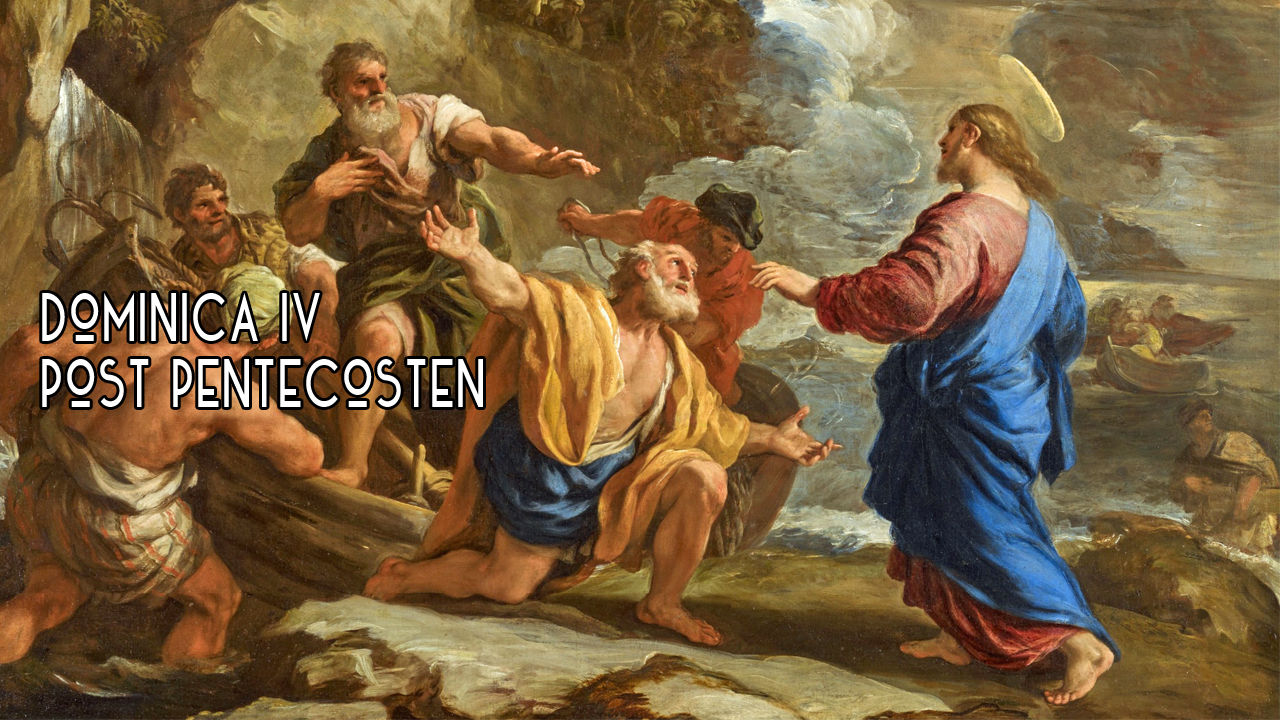
Paul’s vision of creation prepares us for the Gospel, Luke 5, the miraculous catch of fish and the calling of Peter. In earlier days in the Roman Church, one of the calendrical milestones of the liturgical year was the “birthday” of the Apostles Peter and Paul, that is, their martyrdom and birth into new life in Heaven, 29 June. Pilgrims streamed into Rome for this feast. The proximity of this Sunday to the Feast of Saints Peter and Paul probably influenced the choice of the Gospel.
Many of us resonate with Peter’s cry of self-discovery, the recognition of unworthiness, of sins. Again and again, from nothing God makes marvels. He created cosmos and angels when there was nothingness. He took dirt and made man. He took dirt-made-man and made woman. He took our Fall and made of it Felix Culpa.
In the sacraments, we already have a foretaste of the liberation of creation. In instituting them, Christ raised matter to a new dignity in view of our sanctification. Water, oil, bread, wine, hands, words, breath, gesture, time, all are caught into the economy of salvation.
In the Gospel, Christ takes the empty efforts of men laboring in darkness and fills their nets with superabundance.
This is accomplished at Christ’s word: “But at thy word I will let down the net” (Luke 5:5). Christ’s word then led to another down-letting, that of Peter. “He fell down at Jesus’ knees” (v. 8). The Greek verb is προσπίπτω, prospípt?, “to fall forward, to prostrate oneself, to rush upon or against.” Peter threw himself down and bent toward the Lord’s knees: “Depart from me, for I am a sinful man, O Lord” (v. 8).
This is truly the beginning of freedom. The man who has caught everything now sees himself as nothing.
Sometimes God withholds graces and consolations to try us, strengthen us, correct us. Will we persevere? Had Peter and his companions failed to persevere through the dark night of frustration, they would have missed their meeting with the Lord. Had they failed after Pentecost, there would have been no Church, God’s means for freeing us from sin and bringing us to Heaven.
The Apostles also had help. Understanding that, by ourselves, we are inadequate frees us to ask for help, thus providing others with the opportunity to do something good. In Luke, the weight of the fish in the nets was so great that “they beckoned to their partners that were in the other ship, that they should come and help them” (v. 7). People generally rally to a good cause. It is wired into us, at least into our good sides.
Hauling those nets in required serious elbow grease. The helpers may have been happy. Some may have been envious. They hauled equally hard with different hearts. Here is a take away. Good works may benefit recipients, while the same works remain spiritually unfruitful for the doers because they were done in mortal sin or from vainglory. The Sequence Lauda Sion says:
“Sumunt boni, sumunt mali:
sorte tamen inaequali,
vitae vel interitus,”
“The good receive, the wicked receive,
yet with unequal lot,
of life or destruction.”
The act appears the same. The outcome differs utterly.
Pope Benedict XVI made a related point in Deus caritas est. The Church will always be obliged to engage in charitable works, while her deepest concern remains the salvation of souls and the love of God poured into human hearts. When the salvation of souls is obscured, when love of God is absent or tepid, therefore “spewable,” “I will begin to vomit thee out of my mouth” (Rev 3:16), the Church sinks toward the condition of an NGO, and probably not a very good one at that. Works done without grace can help others temporally. Works done in charity become meritorious, ecclesial, sacrificial, ordered toward Heaven.
The Collect gathers these themes into prayer:
Da nobis, quaesumus, Domine,
ut et mundi cursus pacifico nobis tuo ordine dirigatur:
et Ecclesia tua tranquilla devotione laetetur.
Grant us, we beseech Thee, O Lord,
that both the course of the world may be directed for us by Thy peace-making order,
and that Thy Church may rejoice in tranquil devotion.
Cursus means “course,” “way,” “journey.” Dirigo means “to give a particular direction,” “to set straight,” “to guide.” Ordo denotes order, arrangement, a methodical plan. Pacificus combines pax and facio, peace and making. Literally: Grant us, O Lord, that the course of the world be set for us by Your methodical, peace-producing plan, and that Your Church be made joyful by tranquil devotion.
The prayer suggests a ship set upon the sea by its Captain, a route directed, a fleet ordered, tumult calmed. The Church is the ship in the turbulent sea of history. Devotio is the wind in the sails and steadiness at the helm.
St. Thomas Aquinas explains devotion (devotio): “Devotion seems to be nothing else than a certain will to give oneself promptly to those things which pertain to the service of God” (STh II-II, q. 82, a. 1, corpus). He also gives its inner cause: “The extrinsic and principal cause of devotion is God… but the intrinsic cause on our part must be meditation or contemplation” (STh II-II, q. 82, a. 3, corpus). Devotion is sentiment purified into prompt self-offering. It is the will, moved by the known good, giving itself to God’s service here, now, concretely.
Dom Prosper Guéranger, meditating on this Sunday’s Epistle in The Liturgical Year, heard the groaning of creation as an anti-materialist sermon preached by matter itself:
“Men who recognize no other law than that of the flesh may be as deaf and as indifferent as they please to the teachings of positive revelation; but mere matter will go on ever condemning their materialism.”
Nature, he says, “will continue to preach the supernatural with her thousand mouths.” Guéranger, echoing Virgil’s lacrimae rerum, “the tears of things” (Aeneid I, 462), hears in the sufferings of creatures the soul of music of this land of trial. The Holy Ghost explains the strange language of nature, its vehement aspirations, all placed within it by Himself. All creation thrills with expectancy, impatient for the coronation day of the sons of God. Together with them it has suffered. Together with them it shall be set free. Stick that in your demonic Pachamama pantheism and smoke it.
So the Sunday’s Mass formulary gives us a single vision. The Epistle shows creation groaning toward liberation. The Gospel shows Peter groaning inwardly at the knees of Jesus, discovering his sin and vocation in the same instant. The Collect teaches the Church to ask that the world’s course be directed by God’s peace-producing order and that she herself rejoice in tranquil devotion. From darkness to superabundance. From futility to vocation. From bondage to liberty. From scattered effort to ordered charity. From restless groaning to the first notes of glory.
Peter was born into this world, son of Jonah. He was born into Heaven hanging upside down on a cross in sight of the obelisk now viewable before the basilica that bears his name. He was also born, born again, by the Sea of Galilee, bent down at the Lord’s knees, confessing his unworthiness. That is a good starting place for all we undertake. It is also a good ending place for all we do, good or bad.
Our losses and gains, failures and victories, empty nets and breaking nets, must all be returned to knee-rooted, face-planted wonder at Christ’s unfailing love.
“E ’n la sua volontade è nostra pace … And in His will is our peace” (Dante, Paradiso III, 85).