The Church, as she leads us through Advent, does so with a pedagogy at once sober and exultant, marked by a rhythm that quickens as the great mysteries draw near. From the 1st Sunday, when the Lord is announced as still distant yet surely coming, the liturgy – Mass and Office – presses forward with increasing urgency. The initial horizon is eschatological.
The coming of Christ is initially proclaimed not as a tender nativity scene, but as the Adventus of the Judge and King. The 2nd Sunday sharpens this expectation. John the Baptist, imprisoned and awaiting death, sends his disciples to ask Jesus about His identity. Christ’s reply does not consist in abstract definitions, but in signs: the blind see, the lame walk, lepers are cleansed, the deaf hear, the dead rise. These are messianic signs, but they are also eschatological signs. They are about the coming of God, not just of the Messiah. What happens now, in mercy, anticipates what will occur universally at the consummation of all things.
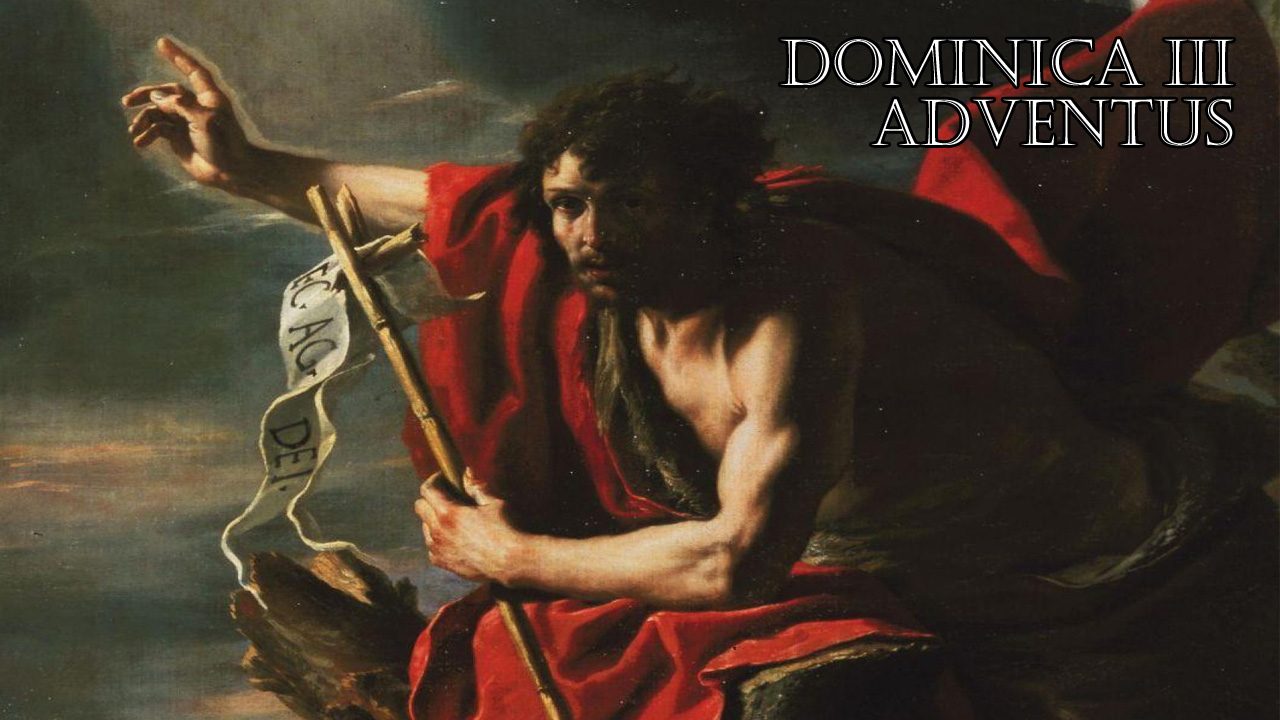
By the 3rd Sunday of Advent, the Church’s chant changes color without abandoning its substance. The Introit sings “Rejoice in the Lord always… Gaudete in Domino semper”, and the rose vestments interrupt the violet. Yet this joy is not a complete interruption of penance, nor a lapse into sentimentality. It is joy because “prope est … He is near”. He is near liturgically, as the Nativity approaches. He is near chronologically, as the end of history draws closer with every passing moment. He is near sacramentally, mystically, morally. The Church does not abandon John the Baptist at this moment. On the contrary, she places him before us again, now in the Gospel according to John, where he is interrogated by messengers from Jerusalem. “Are you the Christ? Are you Elijah? Are you the Prophet?” John answers with austere clarity. He is not the Messiah. He is not Elijah returned in person. He is the Voice. “Ego vox clamantis in deserto: Dirigite viam Domini”, citing Isaiah 40.
This continuity between last week’s Gospel from Matthew and this Sunday’s from John is not accidental. In Matthew, Christ identifies John as “more than a prophet”, as the promised precursor, even as the Elijah who was to come. In John, the Baptist refuses a literalist misunderstanding and locates himself precisely within the prophetic text. He is the voice, not the Word. He prepares the way for Another. Isaiah’s oracle thus frames both the first and the final Advent. “In the wilderness prepare the way of the Lord, make straight in the desert a highway for our God.” Valleys are lifted up. Mountains are brought low. The crooked is made straight. The rough places become plain. This is mercy now. It will be judgment later.
The Lord’s road to us is straightened either by repentance and grace, or by the irresistible advent of the King of fearful majesty.
Will you permit an extended quote from a sermon of St. Augustine of Hippo (+430) preached in 413 for the Feast of the Nativity of John the Baptist? It is about the contrast between the role of John the Baptist, the voice crying out in the wilderness, with that of his cousin, Jesus, the Word of God made flesh. John’s humility prepared the way of the Lord.
John is the voice, but the Lord is the Word who was in the beginning. John is the voice that lasts for a time; from the beginning Christ is the Word who lives forever.
Take away the word, the meaning, and what is the voice? Where there is no understanding, there is only a meaningless sound. The voice without the word strikes the ear but does not build up the heart.
However, let us observe what happens when we first seek to build up our hearts. When I think about what I am going to say, the word or message is already in my heart. When I want to speak to you, I look for a way to share with your heart what is already in mine.
In my search for a way to let this message reach you, so that the word already in my heart may find place also in yours, I use my voice to speak to you. The sound of my voice brings the meaning of the word to you and then passes away. The word which the sound has brought to you is now in your heart, and yet it is still also in mine.
When the word has been conveyed to you, does not the sound seem to say: The word ought to grow, and I should diminish? The sound of the voice has made itself heard in the service of the word, and has gone away, as though it were saying: My joy is complete. Let us hold on to the word; we must not lose the word conceived inwardly in our hearts.
Do you need proof that the voice passes away but the divine Word remains? Where is John’s baptism today? It served its purpose, and it went away. Now it is Christ’s baptism that we celebrate. It is in Christ that we all believe; we hope for salvation in him. This is the message the voice cried out.
Because it is hard to distinguish word from voice, even John himself was thought to be the Christ. The voice was thought to be the word. But the voice acknowledged what it was, anxious not to give offence to the word. I am not the Christ, he said, nor Elijah, nor the prophet.
And the question came: Who are you, then? He replied: I am the voice of one crying in the wilderness: Prepare the way for the Lord. The voice of one crying in the wilderness is the voice of one breaking the silence. Prepare the way for the Lord, he says, as though he were saying: “I speak out in order to lead him into your hearts, but he does not choose to come where I lead him unless you prepare the way for him.”
What does prepare the way mean, if not “pray well”? What does prepare the way mean, if not “be humble in your thoughts”? We should take our lesson from John the Baptist. He is thought to be the Christ; he declares he is not what they think. He does not take advantage of their mistake to further his own glory.
If he had said, “I am the Christ”, you can imagine how readily he would have been believed, since they believed he was the Christ even before he spoke. But he did not say it; he acknowledged what he was. He pointed out clearly who he was; he humbled himself.
He saw where his salvation lay. He understood that he was a lamp, and his fear was that it might be blown out by the wind of pride.
“Make straight His path!” cries the Baptist.
The perennial admonition rings out with such force: go to confession.
The straightening can be gentle now, even if it involves tears, restitution, and penance. Later, the Straightener will do the straightening Himself. Yet this sobering truth does not extinguish joy. On the contrary, it grounds it. There is more than this world. There is Heaven. There is the final summation of all things “ut sit Deus omnia in omnibus… that God may be all in all” (1 Cor 15:28). The reason for joy is not merely approaching. The Reason Himself is drawing near.
The human experience of time mirrors this acceleration.
In finem citius.
Motus in fine velocior.
The closer we get to the end, the more things seem to speed up.
This applies to our aging lives, where years seem to vanish with increasing speed. It applies also to the liturgical year, whose structure sweeps us, swiftly and sweetly, into the heart of the mysteries. Holy Church does not merely inform us about salvation history. She immerses us in it. She draws us into the Mystery which is the cause of our joy.
Nowhere is this more evident than in the Introit which gives this Sunday its name. Taken from Philippians 4,
“Gaudete in Domino semper: iterum dico, gaudete. Modestia vestra nota sit omnibus hominibus: Dominus enim prope est … Rejoice in the Lord always. Again I say, rejoice.”
The imperative is unmistakable. This is not a suggestion. It is a command, grounded not in circumstances but in Christ. The Church has long recognized the parallel between this Sunday and Laetare Sunday in Lent. Both anticipate joy in the midst of penance. Both relax external austerities. Flowers return for a day. Instrumental music is permitted for a moment. Rose vestments appear, rosacea rather than pink. They are a visual homily on restrained gladness.
Advent, however, is not Lent. Its penance is real but distinct. The Alleluia remains. The Gloria is withheld. Violet predominates. Advent fasts historically prepared Christians for the feast of the Nativity, just as vigils and Ember Days punctuated the season. Advent is oriented at least as much to the Second Coming as to the First. Therefore it is joyfully penitential, or penitentially joyful. Christian joy does not exclude penance. Penance, rightly embraced, becomes a source of peace.
St. Leo the Great, preaching in Advent, on 15 December 440, articulated the Roman instinct with crystalline clarity (s. 13).
What is more salutary than fasting, by which we draw nearer to God and, standing firm against the devil, defeat the vices that lead us astray?”
He continues, insisting that fasting must be completed by almsgiving, that what is taken from pleasure be given to virtue, that the abstinence of the fasting become the dinner of the poor. This is Roman Catholicism in its sinews. This is Vetus.
Penance, fasting, and works of mercy straighten the way of the Lord not only in a metaphorical sense, but concretely. They level valleys of despair and lift up mountains of pride. They heal memories and purify intentions. They align us with the sacrificial logic of charity, which seeks the good of another even at cost to oneself. Such works are penitential because they cost us something. They are joyful because they unite us to Christ.
Christ comes to us already, in multiple Advents before the final one. He comes in the person of the priest, alter Christus, acting in persona Christi. He comes at the consecration of the Eucharist. He comes whole and entire in Holy Communion, Body, Blood, Soul, and Divinity. He comes in the Word, when Scripture is read attentively and devoutly. He comes in the poor and the needy, in whom He awaits our mercy. Each of these is a coming that prepares us for the definitive Coming. Each is a mini-advent, joyfully penitential.
Hence joy is not optional. It is the default setting of the Christian life. Even amid ecclesial confusion, suffering, and scandal, joy remains possible because it is rooted not in institutional performance but in baptismal identity. Through baptism we are members of the Body of Christ. Even sorrow and anxiety, when united to this identity, can be transfigured into a deeper joy, sometimes austere, sometimes tear-stained, but real.
The Epistle proclaimed today extends the Introit’s logic. After urging rejoicing and prayerful trust, Paul adds,
“Et pax Dei, quae exsuperat omnem sensum, custodiat corda vestra et intelligentias vestras in Christo Iesu…. The peace of God, which surpasses all understanding, will guard your hearts and minds in Christ Jesus.”
Peace is joy’s echo. It is not the absence of struggle, but the presence of Christ.
This Pauline exhortation is mirrored in the Collect of the traditional Roman Mass:
Aurem tuam, quaesumus, Domine,
precibus nostris accommoda:
et mentis nostrae tenebras,
gratia tuae visitationis illustra.
LITERAL VERSION:
Lend your ear, we beseech you,
to our prayers, O Lord,
and by the grace of your visitation,
illuminate the shadows of our mind.
The Church dares to ask the infinite God to lend His ear, to accommodate Himself to our prayers. Accommodo suggests fitting, adapting, lending for use. God, who needs nothing, condescends to hear us. He illuminates the shadows of our mens, our mind, conscience, and interior purpose, by the grace of His visitation. Advent is precisely this: a visitation. The eternal Word, uttered before time, echoes back to the Father through our prayers, our deeds, our transformed minds. If we are images of God, especially in our mens, then God hears Himself in us. Our neighbor should see and hear God reflected in our lives.
Thus the Church commands us to rejoice. Not because there are no valleys or mountains, no prisons or persecutions, no confusions or wounds. But because the Lord is near.
Prope est.
He comes in mercy now. He will come in glory later.
Either way, His coming is our hope.
Gaudete Sunday reveals Advent’s paradoxical heart: joy grounded in penance, hope sharpened by judgment. As the Lord draws near, the Church commands rejoicing not as sentiment but as faith rooted in Christ’s coming in mercy and glory. Through confession, works of mercy, sacramental life, and prayer, the way is made straight.
Joy, sustained by peace, is the Christian’s default posture before the approaching Lord. As the aforementioned Leo said:
What pleases God should also please us. Let us rejoice no matter how much he sends us.