The Roman Station for the Third Sunday of Lent is the Minor Papal Basilica of St. Lawrence outside-the-walls, San Lorenzo fuori le Mura. The Station is often the crowbar by which we pry open the Mass formulary. If we attend to place, structure, memory, and rite, the somewhat intricate Gospel from Luke 11 begins to yield its riches. The Church in her wisdom did not assemble these texts at random. She set them in a place which speaks to us.
St. Lawrence’s basilica belongs to that venerable collection once described as Patriarchal Basilicas, now called Papal. There are in Rome five Papal Basilicas, four Major and one Minor, corresponding to the ancient patriarchates: St. John Lateran for Rome and the Pope, St. Peter’s for Constantinople, St. Paul’s outside-the-walls for Alexandria, St. Mary Major for Antioch, and St. Lawrence outside-the-walls for Jerusalem, the last of the patriarchates chronologically. The arrangement was a Roman lesson in ecclesiology. The most illustrious sees of Christendom were represented in Rome itself. Their dignity was acknowledged, their memory preserved, and the universal primacy of the Roman See quietly underscored. Thus, even before we enter the church in spirit, the Station places us in the orbit of catholicity, martyrdom, authority, and memory.
That memory is intensified by the saint of the place. We stand, spiritually at least, near the burial place of the great deacon Lawrence, martyr, whose witness in death still instructs the living. Ancient catechumens knew this place well. They moved from station church to station church, and the city itself catechized them. We were already here on the first pre-Lent Sunday, Septuagesima. At St. Lawrence outside-the-walls, those preparing for Baptism underwent scrutinies, examinations, and exorcisms. The Church, with maternal candor, presumed that entrance into Christ’s Mystical Body involved a real break with the “old man”. The catechumen had to renounce Satan, his pomps and his works, and then had to be formed for a new manner of life. The old rites state the matter with clarity. There is a kingdom of darkness. There is a transfer into the kingdom of the beloved Son. There is combat.
That point harmonizes with the insight of Pius Parsch, who observed in The Church’s Year of Grace that the first phase of Lent emphasizes guarding ourselves against the assaults of the Prince of this world through mortification, whereas with this Sunday we begin, already, a movement from defense to attack. One hears that shift in the Gospel. Christ does not merely resist the Enemy. He expels him. He exposes his stratagems. He teaches us how to keep him from returning. The Church, having armed her children for vigilance, now presses them into the counteroffensive of grace.
Luke 11:14-28 may be considered in three linked moments: the exorcism and the accusation that Christ acts by Beelzebul, the saying about the return of the unclean spirit, and the woman’s cry from the crowd concerning the womb that bore Him and the breasts that nursed Him. At first glance the third element seems tacked onto the first two. Yet at this Station church, even that juxtaposition begins to make sense. The original Constantinian basilica proved too small, and Pelagius II added a large hall dedicated to the Blessed Virgin Mary. The Marian character of the complex became so pronounced that Leo IV assigned the Station of the Assumption there. Hence a Marian note appended to a Gospel otherwise centered on exorcism and spiritual warfare is less surprising than it first appears. Roman liturgy thinks with architecture. The building itself becomes a gloss on the text.
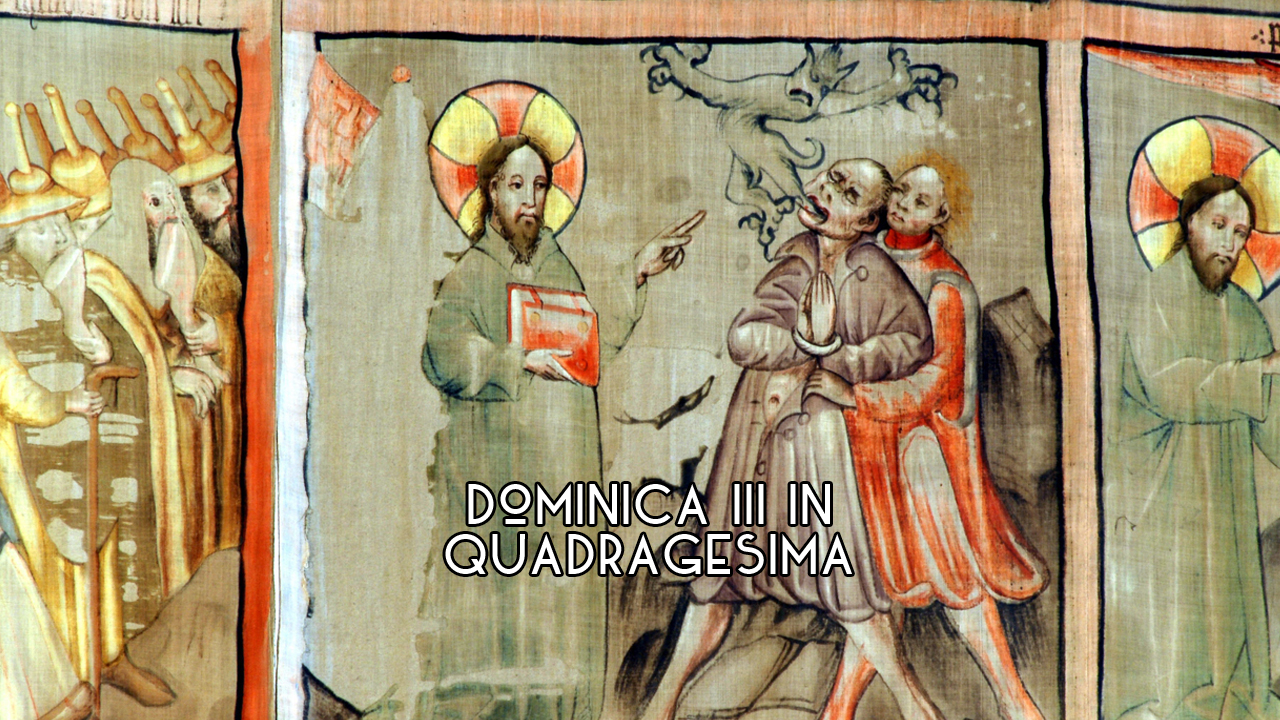
The first movement of the Gospel is the casting out of a demon and the Lord’s rebuttal of the charge that He works by infernal collusion. He then gives the brief parable: “When a strong man, fully armed, guards his own palace, his goods are in peace; but when one stronger than he assails him and overcomes him, he takes away his armor in which he trusted, and divides his spoil” (Luke 11:21-22). The twist in the parable is essential. One’s first instinct is to sympathize with the householder, whose peace is disturbed by a violent invader. Yet the “strong man” is the Enemy, the usurping prince of a fallen order. The “stronger man” is Christ, the rightful liberator, who despoils the despoiler.
The image can be read at several levels. The “house” may be the individual soul, or the visible Church under assault, or even the cosmos subjected to vanity through sin. In all these registers Christ is the stronger one. He comes to reclaim what had fallen under wrongful occupation. The devil is powerful, subtle, tireless, and of angelic nature. This Gospel has a useful hard edge to it because it reminds us that the supernatural order is real. Temptation is real. Demonic oppression is real. Christ’s victory is real. Our cooperation in that victory is also real. The ancient scrutinies of the catechumens at St. Lawrence remind us that the Church once presumed Christians would need to hear this bluntly.
The Epistle sharpens the point by turning to underscoring moral consequence. In Ephesians 5, Paul urges the faithful to abandon the works of darkness, above all impurity, greed, and the foolery that reveals a dissipated interior life. He links uncleanness and idolatry in a way modern ears often resist. Yet the apostolic mind sees no difficulty. Whatever enthrones itself in the heart against God becomes a rival lord. That lord is never benign. Sin does not merely leave a stain in memory. It disposes, habituates, enslaves. It weakens the will, darkens the intellect, and can render a person susceptible to further oppression. The Church’s moral teaching is therefore not a collection of arbitrary prohibitions, as some claim. It is a battle plan.
This leads into the most puzzling part of the pericope, the return of the unclean spirit: “When the unclean spirit has gone out of a man, he passes through waterless places seeking rest; and finding none he says, ‘I will return to my house from which I came.’ And when he comes he finds it swept and put in order. Then he goes and brings seven other spirits more evil than himself, and they enter and dwell there; and the last state of that man becomes worse than the first” (Luke 11:24-26).
The difficulty presents itself immediately. If the house is “swept and put in order,” how can it again become a habitation for demons? There are several levels on which this can be understood. One is moral and ascetical. A person may cease external sins and achieve a kind of superficial order while leaving untouched the roots of vanity, presumption, resentment, sensual memory, or spiritual laziness. The room looks better. The old claim has not been entirely expelled. The chairs were not moved. The corners remain unswept. What appears to be order may amount to tidiness without conversion.
Another reading, drawn by ancient commentators in different ways, sees a relapse after cleansing as especially grave. The old maxim applies: “corruptio optimi pessima…the corruption of the best is the worst kind of corruption.” If a soul has received grace, illumination, instruction, or deliverance, then a subsequent lapse can be more destructive than an earlier state of ignorance. St. Cyril of Alexandria, commenting on this passage in its broader context, sees in it a warning to those who, once liberated from older errors, make themselves again hospitable to what had been cast out. The tragedy lies partly in the misuse of grace already received. A healed man who returns willingly to the disease is in more peril than before.
That line of thought bears directly on Christian life after Baptism. The danger is not only relapse into former habits. There is also the morbidity of memory. Past sins, once forgiven, may remain vividly remembered. The devil is capable of using memories as a lever toward fresh ruin. He cannot recreate forgiven sin. He can tempt a man to brood over it, to doubt divine mercy, to suspect that absolution was nominal, to settle into a black and sterile discouragement. In that way one falls, not through honest contrition, which is healthy and salvific, but through a despairing self-fixation that ceases to look toward God. Faith may flicker on in some minimal sense, yet hope drains away and charity chills. A person in that state is vulnerable. He has his house in apparent order, yet he inhabits it without joy, gratitude, humility, or watchfulness.
That is one reason why the Church’s doctrine of sacramental absolution matters so much. Forgiveness is not a legal fiction. Mortal sins confessed with true contrition and a firm purpose of amendment are remitted. They are not merely passed over. They are not disguised by an external imputation while inward corruption remains untouched. They are forgiven, washed clean in the Blood of the Lamb. “Si fuerint peccata vestra ut coccinum, quasi nix dealbabuntur… If your sins be as scarlet, they shall be made white as snow” (Isaiah 1:18). The memory may remain, but the guilt does not. To deny that fact in practice, by clinging to sin as though Christ’s mercy were too weak to remove it, is its own spiritual disorder.
Here the traditional, millennial Lenten discipline is realistic. Examination of conscience must be thorough. Confession must be integral, sincere, concrete. Mortal sins are to be confessed in kind and number. Near occasions of sin must be shunned. Idleness must be resisted. Good practices such as prayer, fasting, works of mercy, and custody of the senses are practical means of maintaining the house in good order. Grace does not substitute for our effort. One might say that Lent teaches us to enlist elbow grease into the service of grace.
Then comes the brief Marian cry from the crowd: “‘Blessed is the womb that bore you, and the breasts that you sucked!’ But he said, ‘Blessed rather are those who hear the word of God and keep it!’” (Luke 11:27-28). The Greek particle here is menoûnge, commonly rendered “indeed rather,” “yes rather,” or “surely rather.” On a shallow reading, the Lord appears to redirect praise away from His Mother. Yet the verse means the opposite of a diminution of Mary. No one heard the word of God and kept it more perfectly than the Virgin. St. Augustine states the principle with splendid clarity:
Blessed Mary, who even before she gave birth to the Master, bore Him in her womb. … It was a greater thing for Mary to have been Christ’s disciple than to have been Christ’s mother (s. 72/A, 7; cf. also De sancta virginitate 3).
Augustine’s point is not anti-Marian. Quite the reverse. Mary’s biological maternity is already suffused with faith, obedience, and interior assent. She conceived in her mind through faith before she conceived in her womb, as several Fathers insist in different formulations. Thus Christ’s answer universalizes access to blessedness without in any way reducing Mary’s singular dignity. He opens kinship with Himself beyond bloodline, tribe, and physical proximity. The new family will be constituted through hearing and keeping the word. That lesson will matter greatly once the Gospel goes to all nations.
The resurrection narratives cast light backward on this saying. Mary Magdalene hears, “Noli me tangere” (John 20:17), often understood from the Greek nuance as “cease clinging to me.” The disciples at Emmaus recognize Him “in the breaking of bread” (Luke 24:35). He teaches His followers to receive His presence according to the new sacramental economy. Physical contact, ethnicity, and former modes of nearness yield to ecclesial and sacramental communion. This does not remove the bodily from the picture. Christianity never dissolves into pure interiority. It transfigures the bodily through sacrament, grace, and glorified presence. Mary therefore remains Mother, and far more than Mother according to flesh alone. She is the exemplar of the Church in hearing, receiving, bearing, and keeping the Word.
That same word from the crowd can also console those who grieve childlessness. The Lord identifies a fruitfulness deeper than mere biological extension, though without disparaging natural parenthood. Every Christian who hears the Word and keeps it becomes fruitful in Christ. Through works of mercy, patient instruction, invitation to the lapsed, admonition of sinners, counsel of the doubtful, and steadfast charity, one may truly beget spiritual sons and daughters. One may even reclaim prodigals. A timely invitation to confession, to Mass, to prayer, to a serious conversation, has altered destinies before now. The Enemy surely howls when a long-absent Catholic crosses the threshold of a confessional after years away.
All of this returns us to St. Lawrence and to Lent’s present turning point. The Station church gives us martyrdom, scrutiny, exorcism, Marian resonance, catholicity, and a summons to seriousness. The Gospel gives us Christ the stronger man, the danger of relapse, and the true meaning of blessedness. The Epistle gives us moral application. The season itself urges decision. For many souls, the real obstacle is neither ignorance nor malice, but a half-hearted spiritual housekeeping. One sweeps around the furniture. One leaves untouched the concealed habits, the digital occasions of sin, the compensatory vanities, the grievance carefully nursed, the presumption that tomorrow will suffice.
Better, then, to begin now with what the Church places before us. Look into the corners. Move the chairs. Open the dark places at the back. Make a good confession. Trust the sacrament more than your shame. Trust Christ’s promise more than the persistence of memory. There is no sin so monstrous that the mercy of God cannot forgive it to the penitent who asks. The story of your life, so long as breath remains and grace is offered, is still being written. Past failures may become part of the tapestry through which divine providence displays a mercy all the more radiant because it entered darkness and overcame it.
With this Third Sunday in Lent, gently now, let us go on the attack. We are in the Church Militant. The stronger man has already entered the field. He strips the Enemy of the armor in which he trusted. He divides the spoils. He gives back freedom. He teaches us how to keep the house. He teaches us, through His Mother’s blessedness, how to hear and keep the Word. And He waits for our cooperation: plain, honest, sacramental, courageous.