In the older Roman calendar, the Sundays after Pentecost have a way of placing us again and again before the same immense fact: the whole Christian life is lived between two waters. At the beginning, “the earth was without form and void, and darkness was upon the face of the deep; and the Spirit of God was moving over the face of the waters” (Gen 1:2). At the Sea of Galilee, that same ordering Word stood in Simon’s boat and commanded that the nets be let down into the deep. At the end, according to St. Paul, the whole ktísis (κτίσις) created order, groans and travails, awaiting the apokálypsis (ἀποκάλυψις) revelation of the sons of God. From chaos to creation, from the lake to the Barque of Peter, from entropy to glory, the Lord orders what sin has disordered and gives to trembling men a share in His work.
Entropy, in physics, describes the measure of disorder. Heat dissipates. Energy redistributes. An ice cube melts because heat passes into the ice, loosening the tight order of its molecules into liquid and then, with even more heat, into vapor. At every scale, galactic and infinitesimally small, the created universe tends by entropy towards a state in which energy is so evenly distributed that nothing can be further moved, changed, warmed, cooled. This has been called the “heat death” of the universe. Time can be described as the measure of change. If nothing changes, then in terms of physics there is an “end time.”
But we are Christians.
We know the cosmos is not merely a mechanism running down to silence. “Come, Lord Jesus!” (Rev 22:20), we say. We know that the Lord will return. Until that hour, every blink of the eye, every click of a mouse, every breath, every thought, every act of adoration or sin, takes place in a universe wounded by disorder and still upheld by the Logos. To tweak the environmentalist extremists, by breathing and thinking you are killing the universe and venerating the demon Pachamama in the Vatican Gardens cannot stop it.
Genesis gives us no laboratory manual about creation. It tells us who created, why He created, and what kind of order He imposed. The Hebrew phrase tohu wa-bohu, describing the earth “without form and void,” can suggest emptiness, vanity, bewilderment, astonishment, or even an undifferentiated “everything as one.” Tohu appears in Isaiah in the sense of vanity. In some rabbinic thought the state is almost personified as mental disarray. In Kabbalistic terms it can be imagined as everything together without differentiation. That is a striking theological counterpart to the end imagined by physics, a total redistribution without further potency for change. The end, in fallen nature, looks uncannily like the beginning.
Then the Spirit moves. Ruach, wind, breath, Spirit. Order begins, not as an accident, and not as the victory of brute force, but according to divine wisdom. The Word speaks, and things are differentiated, named, measured, separated, filled: light from darkness, waters above from waters below, sea from land. Living things were established according to their kinds. Man, the summit of visible creation, was then placed in the garden to serve and guard.
Sin broke that order. Original Sin did not disorder only the soul. It wounded the entire material order in which man, its head beneath God, had been placed. Hence St. Paul can speak of creation as if it were personal, indeed almost maternal: “the whole creation has been groaning in travail together until now” (Rom 8:22). The κτίσις waits, not for annihilation, but for liberation from bondage to decay. It longs for “the revealing of the sons of God,” not what the sons reveal, but the unveiling of what they are in Christ. The old creation and the new creation are not two unrelated universes, one thrown away and another brought in as replacement. They meet in the flesh of the risen Christ. He is the hinge, the crossing point, the place where created nature is taken into indestructible union with uncreated divinity.
Dom Guéranger saw the matter with magnificent breadth:
When the Spirit moved over chaos, he adapted the informal matter to the designs of infinite love. Thereby, the various elements, and the countless atoms, of the world that was in preparation, really derived from this infinite love the principle of their future development and power; they received it as their one single mission to cooperate, each in its own way, with the Holy Spirit; that is, cooperate in leading man, the creature chosen by Eternal Wisdom, to the proposed glorious end – union with God. Sin broke the alliance; and would have destroyed the world… A violent state – the state of struggle and expiation has now been substituted for what, in the primal design of the Creator, was to be the effortless advance of the king of creation to his grand destiny, the spontaneous growth of, what someone has called man, the god in the bud. Divine union is still offered to the world – but, at what a cost of trouble and travail! We may still enjoy the eternal music of triumph, and all the joys of the divine nuptial banquet; but oh! what a long prelude of sighs and sobs must precede!
The “countless atoms” have a vocation. The cosmos itself was made to cooperate in leading man to union with God.
The Collect of the 3rd Sunday after Pentecost, in the 1962 Missale Romanum, places this cosmic and moral drama into the compact genius of Roman prayer:
Protector in te sperantium, Deus,
sine quo nihil est validum, nihil sanctum:
multiplica super nos misericordiam tuam;
ut, te rectore, te duce,
sic transeamus per bona temporalia,
ut non amittamus aeterna.
O God, protector of those hoping in You,
without whom nothing is efficacious, nothing holy,
multiply Your mercy upon us,
so that, You being our guide and leader,
we may pass through temporal goods in such a way
that we do not lose the eternal.
There is pleasant force in the pairs, nihil validum, nihil sanctum, (a rare asyndetic epanaphora! like spotting a… a… Ivory-billed Woodpecker Campephilus principalis!) nothing efficacious, nothing holy, and in the ablative absolutes, te rectore, te duce, (are you kidding me? another one?!? and they are back-to-back ablative absolutes too – this is like spotting your Ivory-billed Woodpecker and turning around and finding a … a… Yellow-Faced Flame-Backed Woodpecker Chrysocolaptes xanthocephalus!) You being ruler, You being leader. Protector comes from protego, “to cover in front, to shield, to roof over.” We ask God to cover us with mercy as soldiers ask for a shield and pilgrims ask for shelter. Dux is “leader, commander, guide.” Rector can be “ruler, helmsman, governor.” We are not strolling through neutral country. We are the Church Militant, moving through enemy-held territory, in a world whose prince is identified by the Lord. Jesus has broken the devil’s dominion, yet we live in the already and the not yet. We need a shield before us, a roof above us, our rudder in the hands of God.
The reworked form in the modern, Novus Ordo Missal says: “ut, te rectore, te duce, sic bonis transeuntibus nunc utamur, ut iam possimus inhaerere mansuris,” “so that, You being our ruler and guide, we may so use things that pass away as to be able even now to cling to those that endure.” The emphasis shifts slightly toward the use of temporal goods. They are bona, good things, because creation is good. Yet they are transeuntia, passing things. The older prayer more sharply asks that we pass through temporal goods without losing eternal goods. Both prayers know that temporal things can help or hinder. Both know that man must be governed, guided, shielded, and sobered.
That is why St. Peter’s warning, included nightly at Compline in the Vetus Ordo, is so bracing:
Humble yourselves therefore under the mighty hand of God, that in due time he may exalt you. Cast all your anxieties on him, for he cares about you. Be sober, be watchful. Your adversary the devil prowls around like a roaring lion, seeking some one to devour. Resist him, firm in your faith (1 Pet 5:6-9).
In Greek the command is népsate (νήψατε): “Be sober,” an aorist imperative. It has urgency. Do this now. Keep the mind clear. Watch. The lion is near.
The historical setting matters. The context in which Peter wrote gives us greater insight into its importance. Peter was writing to communities suffering in a time of serious persecution.
I just returned to the States after a long stay in Rome, where summer arrived well ahead of schedule. Hence, I can once again affirm that Rome, in summer, can burn. In more ways than one. On 18 July 64, fire broke out near the Circus Maximus. The Roman historian Tacitus says the heat and wind drove the flames through the city for six days and seven nights, damaging or destroying ten of Rome’s fourteen regions. Nero was away at Antium and returned to organize relief, but afterwards he made himself vulnerable by building a lavish palace complex where housing had been destroyed. His enemies fastened upon him the legend that he had burned Rome and sung of Troy’s destruction while doing it. The Flavian successors had every motive to blacken the last Julio-Claudian.
Nero needed scapegoats. Christians were convenient. They would not honor the pax deorum, the contractual peace with the gods upon which Roman civic prosperity was thought to depend. They worshiped in private. They refused sacrifice to the gods. They called one another brother and sister. They ate flesh and drank blood, so the pagans imagined cannibalism. Tacitus writes in Annales 15.44:
Nero substituted as culprits, and punished with the utmost refinements of cruelty, a class of men, loathed for their vices, whom the crowd styled Christians. Christus, the founder of the name, had undergone the death penalty in the reign of Tiberius, by sentence of the procurator Pontius Pilatus, and the pernicious superstition was checked for a moment, only to break out once more, not merely in Judaea, the home of the disease, but in the capital itself, where all things horrible or shameful in the world collect and find a vogue.
Even though Peter wrote to Christians in Asia Minor, he wrote into that world, or a world close enough to it that the words burn: “do not be surprised at the fiery ordeal that has come upon you to prove you” (1 Pet 4:12).
The same Apostle who denied the Lord by a charcoal fire tells Christians not to be astonished by fire. Peter knew the devil prowls. Peter knew fear and shame. He knew well the mighty hand of our merciful God.
Gospel passages about Peter shows us Peter-in-part and Peter-in-full, in metaphysical and physical terms, going from potency to act. For example, at the lake of Gennesaret Christ enters Simon’s boat. There were other boats, but He chose Simon’s. He taught from that barque, held at a distance by a line, the first “online” ministry if you get what I mean. The Fathers saw the significance. Christ still teaches from Peter’s Barque, the Holy Catholic Church. Then Christ commanded the exhausted fishermen to put out into the deep. The professional men had labored all night and caught nothing in darkness and futile waters: a practical echo of tohu wa-bohu.
Simon answers, “At your word I will let down the nets.” He calls Jesus epistáta (ἐπιστάτα), “Master or Overseer,” perhaps with the tone of “Whatever you say, Chief.” But when the superabundant catch came, when the fish were reordered into the nets at the command of the Word through whom all things were made, Simon fell down saying, “Depart from me, for I am a sinful man, O Lord.” Now Jesus is kýrie (kύριε) “Lord,” the term echoing the divine Name as spoken reverently in Hebrew. Peter recognized that he was in the presence of God. He knew, as Israel knew, that the unclean cannot simply stroll into the Holy of Holies. “Man shall not see me and live” (Exod 33:20).
He sees his own inner tohu wa-bohu and trembles.
The Lord’s answer is mercy and vocation: “Do not be afraid; henceforth you will be fishers of men.” John gives the renaming: “You shall be called Cephas” (John 1:42).
When God renames someone, He reorders his life. Abram becomes Abraham. Jacob becomes Israel. Simon is reordered into Peter. The old energies are redistributed according to divine purpose, not indifferent entropy. Left to ourselves, our plans run toward dissipation. In Christ, they are gathered into mission.
St. Augustine preached of Christ and Peter: “once I have taken possession of him, it will be obvious that it is I who am at work in him” (s. 43.5-7). That is the strange consolation of Peter. Christ does not choose only the already impressive. He calls whom He wills. He takes possession, heals, steadies, strengthens, and then works through and in frail men so that the result cannot finally be credited to them. This applies also to the visible Church. In his Decameron, Boccaccio tells of the Jew Abraham, urged for years by a Christian friend to receive baptism. Abraham went to Rome, and the friend despaired, certain that the corruption and incompetence he would see there would ruin everything. Abraham returned ready to be baptized, judging that something so wretched as the clerics of the Church in Rome could never have endured unless it were truly from God.
The Gospel has other figures in it. Zebedee & Sons, Co., the partners, the hired men, the second boat, all help haul the miraculous catch. Peter receives the decisive shock of grace, but others contribute to the concrete moment in which he recognizes God. Works of mercy do that. They can be the net, the second boat, the hand on the rope, the steadying hand when one falls before the Lord. They can trigger in another soul the sensation of God’s love.
Let us not pass over the fact that Christ once again re-ordered Peter by the water on the shore with His three-fold healing questions. That’s when Peter-in-part because Peter-a-little-more. Upside down on a cross is when he was finally Peter-in-full.
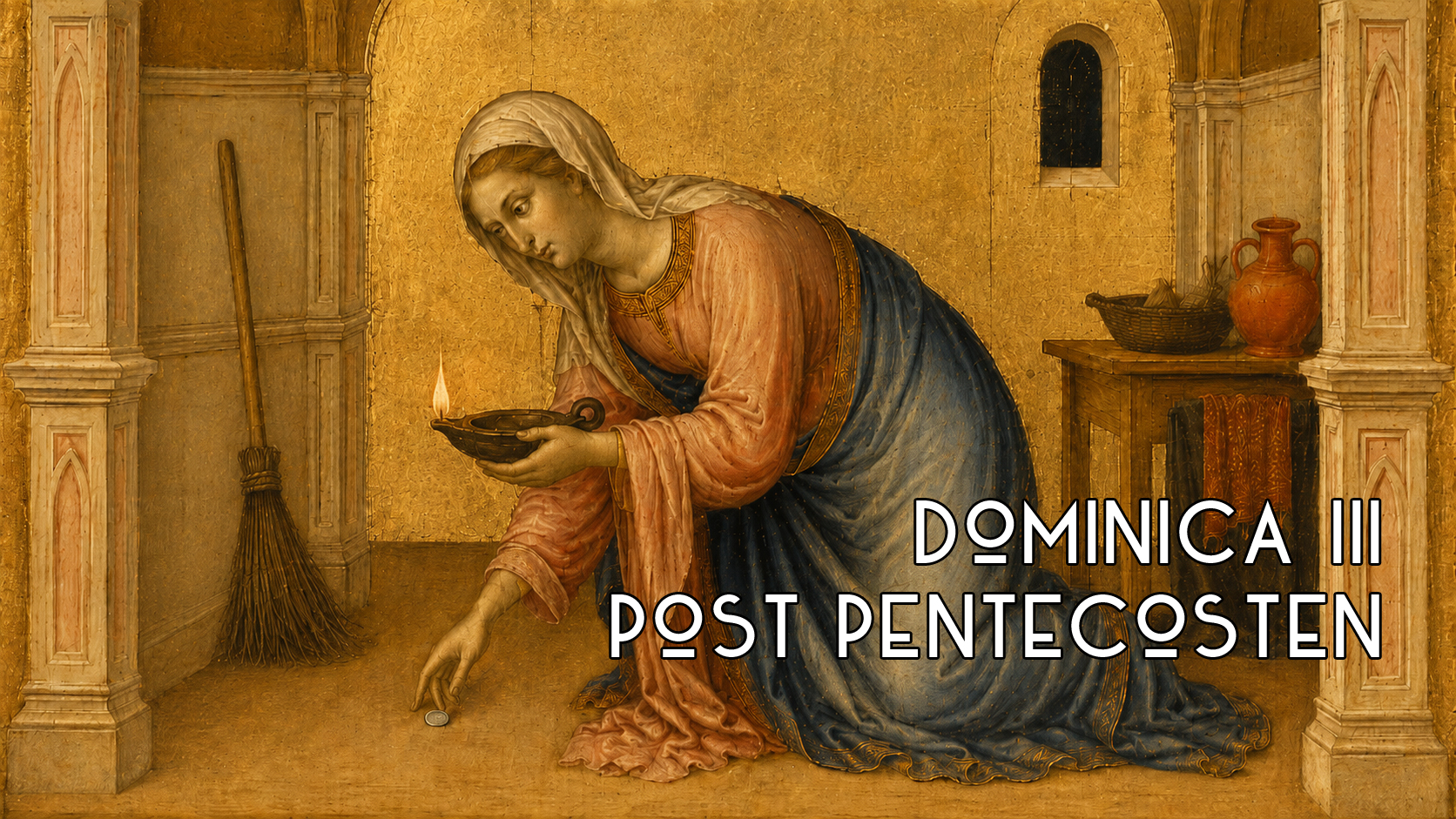
The parables of Luke 15 complete the picture. A woman loses one of ten drachmas. She lights a lamp, sweeps the house, moves through the dark corners, searches until she finds it. Christ says there is joy before the angels of God over one sinner who repents. The lost coin is the soul’s salvation through repentance. The lamp and broom are the examination of conscience. The chairs must be moved. The dust must be disturbed. Disorder and loss must be returned to order and gain. We must get down on our knees and look where we usually refuse to look.
Νήψατε. Be sober. Be clear-headed. The verb appears six times in the New Testament, never in the Septuagint. Paul uses it with the vigilance of soldiers. Peter uses it with the urgency of the end: “The end of all things is at hand; therefore keep sane and sober for your prayers” (1 Pet 4:7). Today, the intoxications are not limited to wine. The glowing little telescreens in our hands pour evil, idiocy, vanity, rage, and addictive images into the mind like hot and old running cocaine.
The roaring lion is not out there. He is in here. He is in the distracted imagination, in the unexamined memory, in the appetites trained by flickering filth.
The Christian answer to entropy, persecution, temptation, and interior disorder is not panic. It is tranquilla devotio, is tranquil devotion, the calm application of the whole person to one’s present state before God. Peter was a fisherman. At the decisive moment he did the work at hand. He did not neglect his net while dreaming of something else. Through obedience in the present task, he was brought to his deeper calling. When we wonder about our state in life, we must not carry out our present state poorly.
Creation groans. Rome burns. The devil prowls. The woman sweeps. Peter kneels. Christ commands. The Barque holds. The Spirit moves over the waters still. The God without whom nothing is validum and nothing sanctum multiplies mercy upon us, shields us, steers us, and leads us through temporal goods so that we do not lose the eternal. One day every disorder will be healed, every tear wiped away, every scattered bit of energy gathered into the risen Christ. The heat death of the universe and the disorderly lives of the fallen are entirely negated and in the ordered, expanding, perfect, dynamic, infinitely love-charged heavenly liturgy as unending Sanctus, Sanctus, Sanctus change-rings before the throne of God.