This year we enjoy a rather brief span of Epiphanytide, that verdant stretch of the liturgical year in which Holy Church lingers over the manifestations of the Lord’s divinity before the purple veil of Septuagesima descends. The calendar itself catechizes. Some years Epiphanytide is fleeting, almost abrupt, curtailed by an early Easter. In some years it unfolds more amply, carrying us through the Third, Fourth, and Fifth Sundays after Epiphany. The Church marks these weeks by repetition. The Introit remains unchanged across these Sundays, a deliberate liturgical insistence that invites the attentive listener to discern a unifying theme. Repetition in the Roman Rite is not usually accidental. It presses meaning into memory. Here, the theme is manifestation, “epiphany”, disclosed through deeds of power, mercy, and authority that only God can perform.
The Gospels assigned to these Sundays do not follow a strict chronological sequence. Instead, they are arranged theologically. The Church continues to set before us signs of the Lord’s divinity, especially through His miracles. On this Sunday, Christ is revealed with particular clarity as Christus Medicus, the Divine Physician.
The context: Matthew situates these miracles immediately after the Sermon on the Mount (ch. 5-7), the great promulgation of the law of the Kingdom. As Moses once descended Sinai bearing the Law, Christ now comes down the mountain with authority that astonishes the crowds. They follow Him in great numbers. What they then witness confirms that the One who teaches as no scribe ever taught also acts with the prerogatives of God Himself.
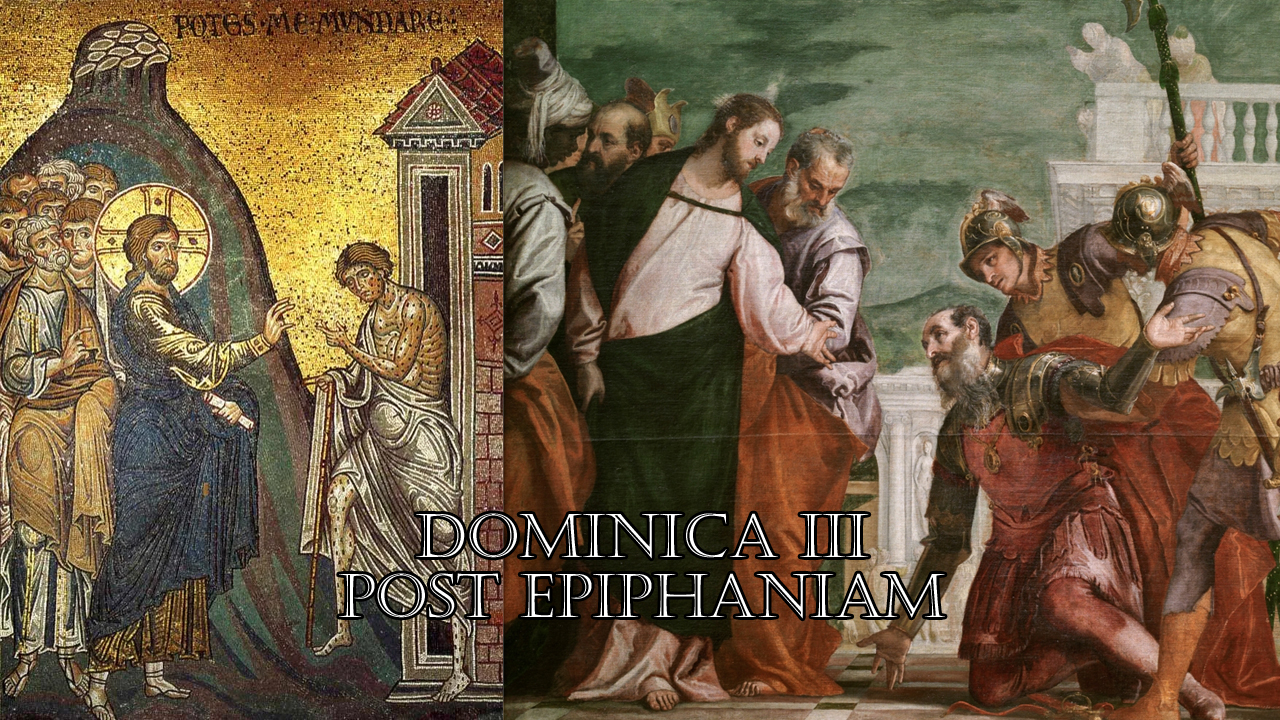
The first encounter is with a leper in Matthew 8. Luke’s parallel account sharpens the image with the phrase pléres lépras, “full of leprosy.” He is overwhelmed by his disease, disfigured, isolated, and burdened not only by physical suffering but by the crushing social and religious consequences imposed by the Law. Leviticus legislates with severity regarding skin diseases. The leper is declared unclean, excluded from worship, separated from the community. In theory, ritual impurity was not confused with moral impurity. However, given human nature, there was surely a good deal of unjust overlap. This wretched leper bears a stigma that marks him as untouchable and yet he approaches Jesus. He kneels. He worships. He addresses Him not as Rabbi, but as Lord. His faith is professed.
One may reasonably ask whether he would have sought the Lord so urgently had he not been afflicted so grievously. Comfort rarely drives us to our knees. Affliction often does. This is not an argument that suffering is good in itself, but it is a sober recognition that God, in His providence, permits suffering to awaken faith. The leper’s misery becomes the occasion of grace. His words are spare and filled with trust: “Lord, if you will, you can make me clean.” He does not doubt Christ’s power. He submits himself to Christ’s will.
Jesus responds in a way that would have stunned every observer. He stretches out His hand and touches him. He does not recoil. He does not command from a distance. He touches ritual impurity without being defiled, because purity itself has drawn near. In 2 Kings 5 the King of Israel once cried out in exasperation when Naaman the Syrian sought healing, “Am I God, to kill and to make alive?” Only God could cleanse a leper. Here, before their eyes, Jesus does precisely what only God can do. He does more. Elisha instructed Naaman from afar. Jesus touches. The implication is unmistakable. The divine right hand is at work.
The command that follows seems almost paradoxical. The healed man is told to tell no one, but to go and show himself to the priest and offer the prescribed sacrifice. Christ submits to the Law even as He fulfills it. He honors the Torah He Himself gave. The instruction ensures that the healing is recognized within the covenantal order of Israel. Yet the command to silence is almost ironic. The crowd has seen everything. Word will spread. Epiphany cannot be contained.
No sooner has this occurred than Matthew shifts the scene (vv. 5-13) to Capernaum and to a man who stands at the opposite end of the social spectrum. A Roman centurion approaches. Luke tells us that he sends Jewish elders as intermediaries, men whose trust he has earned. He is a Gentile, an officer of the occupying force, ritually unclean and socially suspect. Yet he, too, comes in faith. His concern is not for himself, but for his pais, his servant, described as paralytikos and deinos basanizomenos, paralyzed, grievously tormented. The centurion suffers with the suffering of another. His authority does not insulate him from compassion.
By the way, I like to fantasize that it was he, the same man, who had duty at Calvary on Good Friday and exclaimed, “Truly this man was the son of God”, exactly like John Wayne said it.
The centurion’s humility is as striking as the leper’s desperation. He understands authority. He recognizes it in Jesus. He does not presume to demand. He confesses unworthiness. Seriously, one gets the sense that he, being a man of discipline, would have humbly accepted from the Lord that He would not come. “Dómine, non sum dignus, ut intres sub tectum meum: sed tantum dic verbo, et sanábitur puer meus.” These words, drawn from Scripture, have become woven into the fabric of the Roman Rite. By the eleventh century they were already in use before Holy Communion, at the moment when the Host was shown to the faithful. The triple repetition, fixed in the Vetus Ordo, is not a superfluous repetition. It is insistence. More than one commentator (e.g., Croegaert, Gihr) suggests that the priest repeats the phrase while striking his breast in a final effort to purge even the last traces of venial sin before approaching the altar of the Lamb.
The centurion believes without seeing. He understands that Christ’s word suffices. Jesus marvels (v. 10). This is one of the rare moments in the Gospels where the Lord is said to marvel, and it is at the faith of a Gentile. The messianic promise is unfolding. The nations are coming. The leper and the centurion, each in his own way unclean and excluded, stand as figures of Israel and the Gentiles alike, both healed by the same divine mercy.
The Epistle to the Romans reinforces this Gospel by pressing its implications into moral life. St. Paul exhorts the Romans not to repay evil with evil, but to overcome evil with good. He cites Proverbs: “If your enemy is hungry, give him bread to eat; if he is thirsty, give him water to drink; for by so doing you will heap burning coals upon his head” (12:20) The image of heaping coals of fire on one’s enemy’s head is not a suggestion of cruelty but rather of mercy. Fire and water are the essentials of life. To provide them is to restore what exile denies. For the Romans a sentence of exile was given with a decree of aquae et ignis interdictio… privation of water and fire. You were to be denied the essentials of life precisely so that you were forced to leave the area or die. The reverse of this is how on the day of her marriage a bride would be received by her husband with fire and water, which represented that he would care for her needs. The Prophet Isaiah (47:14) presaged image. Augustine explains (Exp. Prop. Rom. 63.71) that coal kindness burns away hatred. Jerome echoes in a sermon on Ps 41.
Charity is medicinal. The Divine Physician heals not only bodies but the diseased will. Sometimes the cure is tough. St. Augustine In his commentary (exp. 2) on Ps 33:16 (“A king is not saved by his great army; a warrior is not delivered by his great strength”) explains that sometimes one (even God) will be cruel to be kind.
- The eyes of the Lord are upon the righteous. Don’t worry, go on trying; the Lord’s eyes are on you. And his ears are open to their prayers. What more could you wish? If in some great house the master did not hear the complaints of a servant, the servant would protest, “What a lot we have to put up with here, and nobody listens to us!” You cannot say that of God—”What a lot I have to put up with, and nobody listens to me”—now can you? Perhaps you may say. “But if he heard me he would take my trouble away; I appeal to him, but I still have the trouble.” Just hold steady and keep to his ways, and when you are in trouble he hears you. But he is a physician, and there is still some diseased tissue in you. You cry out, but he goes on cutting, and he does not stay his hand until he has done all the cutting he knows to be necessary. In fact it is a cruel doctor who listens to the patient’s cries, and leaves the festering wound untouched. And think how mothers rub their children down vigorously in the bath, for their own good. The little ones cry out in their mothers’ hands, don’t they? Does that mean the mothers are cruel in not sparing them, in ignoring their tears? Are they not really full of tender love? All the same, the children cry, and they are not let off. So too our God is full of charity, but he seems to be deaf to our entreaty because he means to heal us and spare us for all eternity.
This medicinal theme permeates the Mass formulary. The Offertory Antiphon from Psalm 117(118) proclaims the victory of the Lord’s right hand: “16The right hand of the Lord is exalted, the right hand of the Lord does valiantly!” 17 I shall not die, but I shall live,
and recount the deeds of the Lord.” The triple insistence on the right hand resounds with Trinitarian fullness. The Collect gathers this imagery into a concentrated plea:
Omnipotens sempiterne Deus,
infirmitatem nostram propitius respice:
atque ad protegendum nos,
dexteram tuae maiestatis extende.
The prayer is ancient, preserved in the Veronese and Gelasian Sacramentaries, a distillation of Roman liturgical genius.
Almighty eternal God,
look graciously upon our feebleness,
and, in order to protect us,
stretch forth the right hand of Your majesty.
Its rhetoric serves its theology. The asyndeton of Omnipotens sempiterne Deus propels the prayer forward. God’s omnipotence and eternity are invoked without pause, because urgency admits no delay. The petition places our infirmitas before God’s gaze: “Respice! Look upon us! Be mindful!” The word order presses our weakness up against God’s mercy. The second imperative mirrors the first: “Extende! Stretch forth your right hand!” The structure of the prayer enacts what it asks, namely, that divine power stoop toward human frailty.
This movement from weakness to mercy is enacted sacramentally at every Mass. The rites before Communion form both priest and people. The beating of the breast, reported by Augustine as thunderous in his congregations, is not empty gesture. Exterior acts shape interior dispositions. Repetition engraves humility into the body. The priest’s careful preparation of the chalice, the wiping away of anything unworthy, out of place, becomes a silent catechesis. Nothing unclean may remain where Christ is to dwell.
The triple Domine, non sum dignus before Communion gathers all of this into a single act. The priest confesses what the centurion knew. Of his own, he brings only sin. All goodness comes from God. Yet Christ desires to enter nonetheless. Augustine observes that the Lord wished to go to the centurion’s house because He wished to enter his heart. So too, He seeks entrance into ours. Each blow to the breast is a knocking from within, a plea that the door be opened.
Although both the leper and centurion are under watching hostile eyes, each steps forward. Both the leper and the centurion display courage. Each acts from faith made urgent by suffering love. Their approach teaches us how to come to Christ: with the leper’s lowliness and with the centurion’s trust. Paul’s exhortation to persevere in prayer, to give thanks in all circumstances, to overcome evil with good presses this lesson upon us before the Church turns toward the austere path of Lent. The Divine Physician has extended His hand, inviting us to pull down our dirty bandages and show Him our wounds, to beat open our suffering hearts, and to receive His healing word.