The 3rd Sunday after Easter in the Vetus Ordo draws us into that peculiar Christian experience of living between gift and fulfillment, between consolation remembered and consummation promised, between the joy of Easter already given and the greater joy that still presses toward Ascension and Pentecost. The whole formulary has a tensile quality. Expectancy. Movement. One feels that familiar law of endings, motus in fine velocior, that acceleration as a thing nears its appointed term. In these days the Church seems to gather herself and move with greater swiftness toward the completion of what the Lord set in motion in His Passion, Resurrection, Ascension, and the sending of the Holy Spirit.
Pius Parsch observed that the seven weeks of Easter may be understood in two stages. The first turns our attention especially to Resurrection, Baptism, and Eucharist. The second inclines our gaze toward the Ascension of the Lord and the Pentecost event. That distinction is useful here, because this Sunday marks the transition. The Church has not ceased to sing the victory of Christ over death. She has not set aside the great baptismal and Eucharistic themes of Paschaltide. Yet now she begins, more insistently, to school us in absence, longing, and transformation. The Lord who rose and showed Himself to His disciples will ascend to the Father. His disciples, and we with them, must learn a new mode of presence, a new mode of fidelity, a new mode of love.
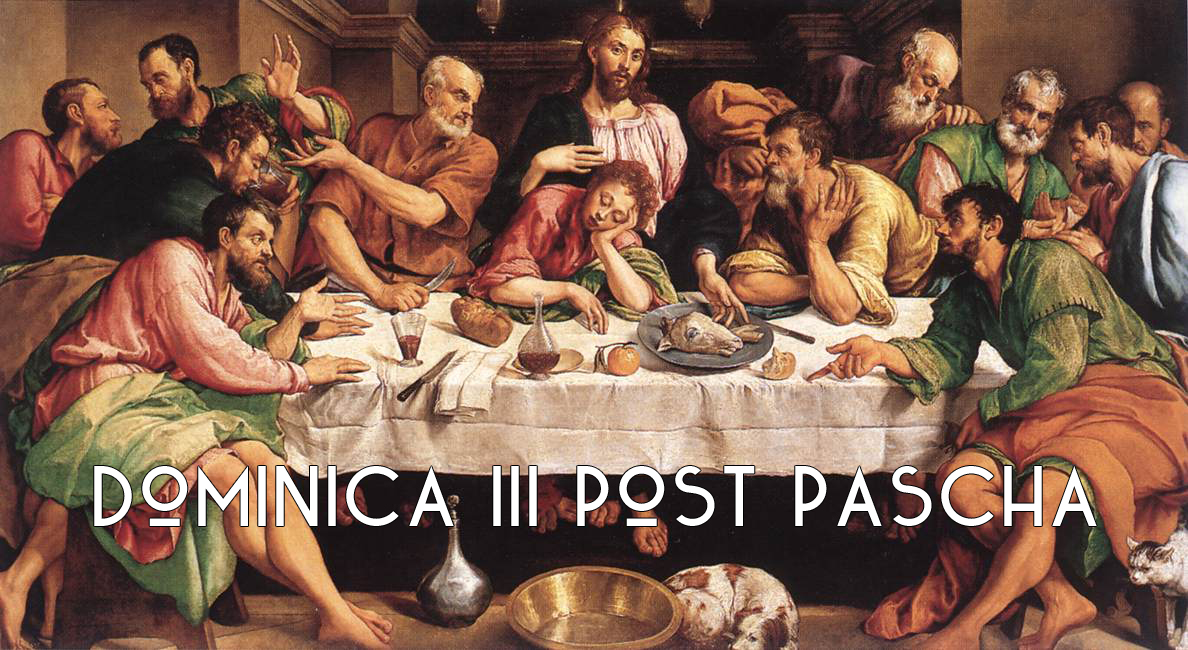
We have the Gospel from John 16, the Farewell Discourse in the Upper Room. Bl. Ildefonso Schuster aptly calls it the “testament of the Sacred Heart.” Christ holds before the Apostles one continuous mystery: Passion, Death, Resurrection, Ascension, and the Descent of the Holy Spirit belong together. They are not isolated acts laid side by side. They are facets of one saving movement by which the Son glorifies the Father and draws His own into the divine life. Hence the repeated words that ring through the pericope like bells answering one another: “A little while, and you will see me no more; again a little while, and you will see me.” The Apostles hear the words, repeat the words, puzzle over the words. The phrase passes back and forth until the Lord gives the image of childbirth. A woman labors in sorrow. Then the child is born. Sorrow is not merely interrupted. It is transfigured by joy. The anguish is swallowed up in fruitfulness. So too the disciples will grieve, and then rejoice, and their joy no man shall take from them.
This movement from deprivation to renewal governs the Sunday as a whole. Loss becomes gain. Waiting becomes fulfillment. Uncertainty gives way to clarity. Pain opens into joy. The Lord is preparing the Apostles for a deprivation that will be real. He trains them for a severance from His ordinary bodily proximity. During His earthly ministry they knew Him through voice, gesture, touch, shared roads, shared meals, familiar places. After the Resurrection He begins already to educate them beyond that mode of knowledge. To Mary Magdalen He says, “Mé mou háptou…Do not cling to me” or “Do not keep holding me” (John 20:17). On the road to Emmaus the disciples know Him in the breaking of the bread, and at that very moment He vanishes from their sight. The lesson is dramatic and decisive. They are to cease relying on an encounter conditioned by ordinary physical nearness. They are to learn Eucharistic recognition, spiritual adhesion. They are to learn that the Lord’s absence according to one mode is bound up with a deeper, wider, more universal presence according to another.
Therefore, this Sunday is not about mere sadness over departure. It is about purification of attachment. The first disciples had to shed a physical attachment to the Lord in order to spiritualize their faith. That does not mean their earlier love was false, nor that the Lord’s bodily reality was somehow secondary. Quite the contrary. It is precisely because the Incarnate Lord truly took flesh, truly died, truly rose, and truly ascended that His disciples must be elevated into a communion no longer confined to one locale in Galilee or Judea. Bodily presence as they had known it belonged to a particular economy. Eucharistic presence and the indwelling of the Holy Spirit open a mode of communion for the whole Church in every place and time.
The Epistle from 1 Peter deepens the same mystery from another angle. Christians are addressed as “pároikoi kaì parepídemoi, advenae et peregrini …strangers and pilgrims,” “aliens and exiles.” You know the book, perhaps, by Michael O’Brien, in the Children of the Last Days series, Strangers and Sojourners. The phrase tells us where we stand in history and how we must live while we stand there. We belong here and we do not. We have work to do here, given by God Himself. Yet our final belonging is elsewhere, or rather above, in that patria where Christ has gone before us. This earthly life is charged with purpose precisely because it is provisional. The unfinished quality of our present existence, the sense that things remain unrealized, even the ache of incompletion, all of that belongs to Christian consciousness. We know there will be a recapitulation of all things in Christ, their submission to the Father, “that God may be all in all” (1 Cor 15:28). For that reason our time here is real and urgent, yet not terminal.
Peter accordingly exhorts us about our conversatio among the Gentiles. That is a salutary point. In older English one may hear, “having your conversation good among the Gentiles.” Modern ears can stumble over that. Conversatio in Latin here does not mean conversation in the sense of talk or dialogue. It means conduct, manner of life, the entire shape of one’s comportment. This matters greatly, because pilgrims are never excused from holiness by the claim that the world is passing. Exiles do not earn license by saying that the fatherland lies elsewhere. Christians must live well in the sight of the nations, even amid abuse, suspicion, or persecution. Peter wrote to communities that knew what it was to be misunderstood and pressed upon by a pagan environment. Baptism set them apart. They could not return to the old ways as though Christ had not claimed them. Thus, their sojourning is moral as well as mystical. Longing for heaven demands earthly fidelity.
At this point Augustine helps us with one of his most famous lines: “fecisti nos ad te et inquietum est cor nostrum donec requiescat in te …You have made us for yourself, and our hearts are restless until they rest in you” (Confessiones 1.1).
Restlessness is not an embarrassing defect in the Christian life. It belongs to grace. Once Christ has laid hold of a soul, the soul begins to seek its true weight, pondus, its proper place, its ordained rest. In ancient physics, “weight…pondus” results from things trying to go to where they belong. Thus, our hearts: amor meus, pondus meum. Augustine can therefore speak of Christ as both via and patria, the road and the fatherland. He is the way by which we go, and He Himself is the homeland toward which we go. The entire Christian life is gathered into that double truth. We do not merely follow Christ toward something else. In Him we travel toward Him.
That Augustinian insight also casts light on the Church’s doctrine of incorporation into Christ. We are not attached to Him externally, as one might enroll in an association or maintain dues in a club. The Pauline language of body and members presses harder than that. The Greek tó mélos means limb, member, organ, part belonging to a whole. To be a member of Christ is to be bound into a living totality, to be claimed in one’s body as well as soul for communion with the Divine Persons through grace. The branch severed from the vine withers. The member cut off from the body dies. To belong to Christ is personal, living, sacramental, and irreversible in character, even though one may refuse grace and lose the fruit of that bond. This Sunday’s Epistle and Gospel together show what sort of members we are: incorporated persons still on pilgrimage, limbs of the Mystical Body moving through time toward the unveiled joy of the Head.
Hence the poignancy of modicum. “Modicum, et iam non videbitis me: et iterum modicum, et videbitis me.” Greek míkron, Latin modicum, a little while. The phrase is simple, and yet one can hardly exhaust it. The source text lingers over the English word “while,” and the meditation is worth preserving, because it helps us hear Christ’s words with fresh resonance. A while is an interval. It marks duration, though often vaguely. It may suggest “as long as,” or “during the time that,” or “until.” As a verb “while” means to pass time, even pleasantly. Think of the song of the Cowardly Lion in The Wizard of Oz. So one may ask, not trivially, what we are to do in this little while. We are in a brief span between sight and sight, between one mode of Christ’s presence and another, between the liturgical now and the eschatological fulfillment. Are we merely enduring? Are we drifting? Or are we sanctifying time, transfiguring it, offering it back to God?
The answer given in the texts is practical and monastic at once, active and contemplative, lived in the world, and apart. Even those whose vocation is stability must keep moving. Religious who remain in one monastery are nevertheless ceaselessly at work through the opus Dei, the sanctification of the hours, the offering of psalmody and praise that stretches prayer across the day. They transfigure time in anticipation of the day that will never end. Those of us in the noise and clutter of the world are called to do analogously in our own duties what the monk does in choir: to sanctify our tasks, to order time toward God, to refuse dispersion, to move as pilgrims even while apparently stationary. In this sense every Christian must learn how to “while” the while. The point is not amusement. The point is fidelity within transience, the conversion of passing hours into matter for sanctity.
That perspective also clarifies the mysterious speeding-up many people feel in our own lives. The source text speaks of summers that seemed endless in youth and now flash by; it cites the adage motus in finem velocior; it even glances at social and ecclesial devolution that appears to gather pace in recent years and months. Whatever one makes of those wider judgments, the spiritual truth remains. The Christian must never imagine that there will be unlimited time for repentance, amendment, sacrifice, recollection, prayer. “You do not know about tomorrow. What is your life? For you are a mist that appears for a little time and then vanishes” (James 4:14). The liturgy here does not produce panic. It produces sobriety. It teaches us to feel time truly. Easter joy does not erase urgency. Paschal peace does not dissolve vigilance.
There is also a corporate dimension that must not be neglected. One text speaks strikingly of Holy Church being drawn ever more swiftly toward her Passion, and of the Mystical Person of Christ undergoing, in His members, a kind of self-emptying. This deserves careful hearing. The Church is not the risen Christ in the sense of a new incarnation, nor does she add to the sufficiency of His redemptive suffering. Yet the members of Christ truly participate in His life, and therefore also in the pattern by which glory comes through suffering. The history of the Church militant after the Resurrection, as Schuster says, symbolizes our own life. The Risen Lord’s appearances before the Ascension form a kind of icon of ecclesial existence: moments of consolation, moments of obscurity, instruction amid perplexity, joy shot through with yearning, and all of it ordered toward a fullness still to come.
For that reason consolations may be withdrawn. God sometimes hides Himself. Prayer can become arid. The senses find no sweetness. The mind groans in mist. The pilgrim way is full of such intervals. Yet the Gospel for this Sunday forbids us to interpret them as abandonment. They are pedagogy, purgation, strengthening. The Apostles themselves had to endure the Lord’s “little while” of disappearance. They had to be re-fashioned from men who loved the Rabbi beside them into men who would preach the ascended Christ and live by the gift of the Spirit. So too for us. Sufferings are permitted, trials come, and our faith is proved. The Christian endures these things neither stoically nor sentimentally, but in hope of seeing Jesus. That final phrase in the source texts deserves to stand near the end, because it gathers the whole meditation: our trials will ultimately be advantageous for us, for we will see Jesus, to our sweetest and everlasting consolation.
So then, on this 3rd Sunday after Easter, Holy Church instructs us in the art of Christian longing. We stand in the Easter light, yet that light now falls across the road to Ascension and Pentecost. We are pároikoi kaì parepídemoi, strangers and pilgrims. Our conversatio must be holy in the midst of a hostile world. We learn from Augustine that our hearts have a weight drawing them toward their true rest, and that Christ is both the via beneath our feet and the patria set before our eyes. The pilgrimage will end. The Fatherland is real. And when the little “while” is over, we shall see Him.