You have certainly noticed that Gospel readings in Latin begin, “In illo tempore … in that time.” What time is that? The phrase invites questions. What sort of “time” can hold together a mountain in Galilee, a cloud that is more than weather, a voice that is more than sound? The old rhetorical questions still serve us well: “Quis, quid, ubi, quibus auxiliis, cur, quomodo, quando… Who, what, where, by what means, why, how, when.” Aristotle articulated them, Cicero cast them in verse, St. Thomas Aquinas employed them in his treatment of circumstances (STh Ia IIae, q. 7, a. 3), and the Fourth Lateran Council placed them into the hands of confessors. Kipling simplified them for children:
I keep six honest serving-men
(They taught me all I knew);
Their names are What and Why and When
And How and Where and Who.
On the 2nd Sunday in Lent in the Vetus Ordo, these questions converge upon Matthew’s account of the Transfiguration. Holy Church gathers catechumens and faithful alike and directs us up a mountain. In fact, were we in Rome and on the move like ancient aspirants to baptism, we would literally be going uphill to the Station church, St. Peter’s Basilica, to the tomb of the Apostle.
Who in the Gospel ascends today? Our Lord, and with Him Peter, James, and John. The selection is deliberate. Six days earlier, in the region of Caesarea Philippi, Christ had asked, “Who do men say that the Son of man is?” (Mt 16:13). Peter confessed Our Lord as the Christ, the Son of the living God. Christ promised Him the “keys”. He then foretold His Passion, but Peter rebuked Him (Greek ἐπιτιμάω – epitimáo, to rebuke, to censure). The Lord answered with severity, “Get behind me, Satan” (Mt 16:23). Six days later, He leads Peter and the sons of Zebedee up a high mountain.
The mountain matters. Turning points in salvation history unfold on mountains. Eden is depicted as a mountain sanctuary. Noah’s ark rests on a mountain. Abraham takes Isaac up a mountain. Moses ascends Sinai. Elijah goes to Horeb and encounters the Lord in the “still small voice” (1 Kgs 19:12). In Exodus 24 on a mountain Moses seals the covenant in blood and ascends with three principal leaders: Aaron and the brothers Nadab and Abihu. They behold a vision of God and heaven. A cloud covers the mountain. After six days the Lord calls Moses into the cloud, and he remains forty days while the mountain appears as devouring fire.
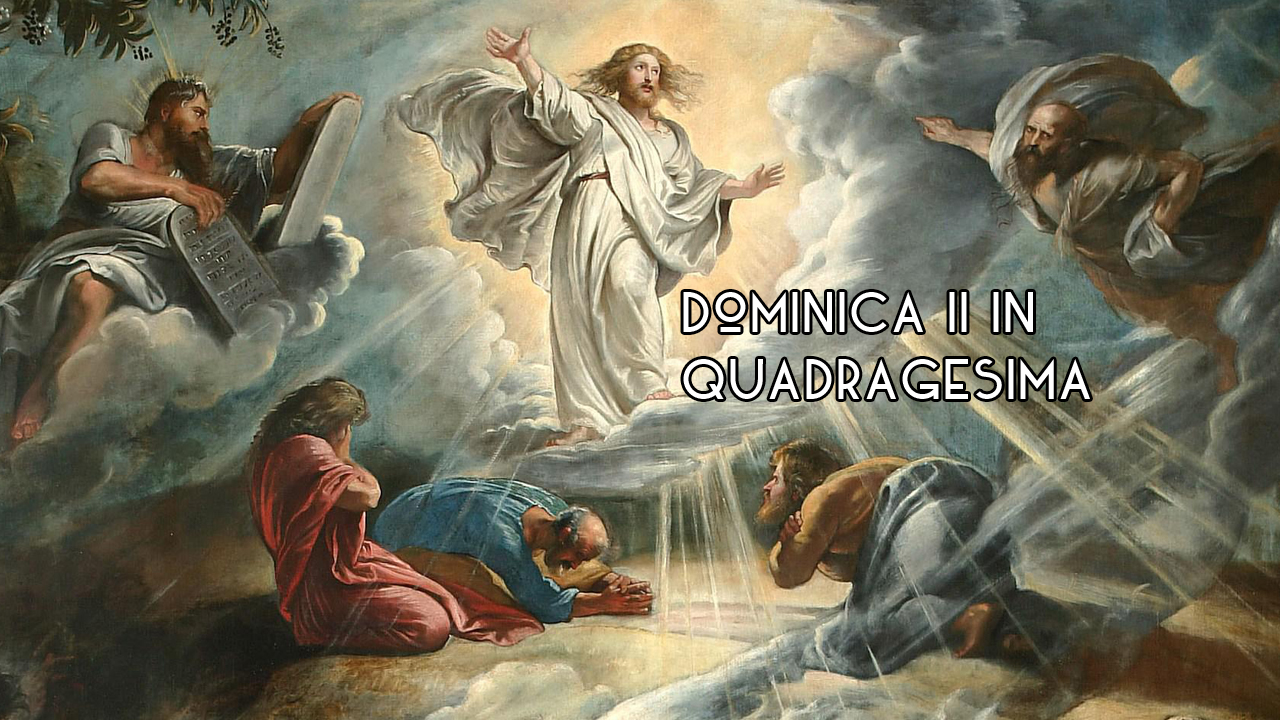
Matthew’s narrative echoes this pattern. Time, the when, matters. Matthew is careful to anchor it: six days after the previous chapter, after Peter’s confession and after the first explicit prediction of the Passion and the promise of glory. Christ, the New Moses, ascends with His three closest disciples. Moses and Elijah appear, representing the Law and the Prophets, conversing with Him (Mt 17:3). The cloud overshadows them and the voice of the Father is heard. In this moment continuity between Old Covenant and New is revealed. Moses once saw the Promised Land from Nebo and did not enter (Deut 34). Now he stands within the true Promised Land, the Son of God incarnate.
Where precisely this occurred remains debated. Scripture refrains from naming the peak. Close to Caesarea Philippi is Mount Hermon. At 7336 feet is an arduous climb, but it is right there on the southwestern base of Caesarea Philippi. Some situate the Transfiguration on Mount Tabor in lower Galilee, 575 feet high, a strange isolated bubble of a hill on the plain some 90 km from Caesarea Philippi. However in those days Tabor had a fortress on top of it, so it seems unlikely. Perhaps it is best that Matthew didn’t name the place specifically so we can focus on the significance of what happened rather than get bogged down in the merely physical coordinates.
What happened? Matthew records: “his face shone like the sun, and his garments became white as light” (Mt 17:2). When Moses descended from Sinai after speaking with the Lord, “the skin of his face shone” (Ex 34:29). His radiance was a reflection of glory he had encountered. By contrast, Christ’s radiance belongs to Himself. He does not acquire brightness or merely reflect it. He is brightness. He permits something of His divinity to shine forth through His humanity. Even that partial unveiling overwhelms the three.
The Greek verb for transfiguration is μεταμορφόω – metamorphóo. It signifies transformation. The event discloses visible brilliance that corresponds to invisible reality. The cloud descends, recalling the shekinah, the cloud of the divine Presence in the Tabernacle of the Israelites in the wilderness and then in the Temple. From the cloud comes the voice: “This is my beloved Son, with whom I am well pleased; listen to him” (Mt 17:5). The apostles fall and are described with stark precision: ἐφοβήθησαν σφόδρα – ephobéthesan sphódra, they were exceedingly afraid (Mt 17:6).
Fear and awe over come the disciples. An encounter with mystery, with the transcendent, has been described by Rudolf Otto as “tremendum et fascinans… frightening and alluring”. In fact, this is the effect our sacred liturgical worship should bring us to: a transformation in a moment wherein the transcendent and immanent intersect. Alas, too often what passes as liturgy in some places produces boredom and even sometimes nausea. I digress.
Peter’s spontaneous exclamation precedes the cloud: “Lord, it is well that we are here; if you wish, I will make three booths” (Mt 17:4; cf. Lk 9:33). Luke adds that he did not know what he was saying (Luke 9:33). The proposal reflects Jewish liturgical memory. After Exodus 34 the instructions for constructing the Tabernacle follow.
Speaking of Tabernacles, the Feast of Tabernacles, Sukkoth, is the eight-day commemoration of Israel’s dwelling in booths in the wilderness and anticipation of the return some day of the divine Presence to the Temple. Jewish feasts looked back to something that happened and also forward to something to be fulfilled. Pope Benedict XVI, in Jesus of Nazareth: From the Baptism in the Jordan to the Transfiguration, observes that the timing of the Transfiguration aligns with Sukkoth. The “Great Day” of Sukkoth, Hoshanah Rabbah, included a water and wine pouring ceremony. It was during such a hushed moment in the Temple that the Lord cried, “If anyone thirst, let him come to me and drink” (Jn 7:37). During Sukkoth enormous candelabra were lit at the gold-laminated Temple so bright that the city was illuminated. At the close of Sukkoth when the lights were extinguished, Christ proclaimed, “I am the light of the world” (Jn 8:12). Sukkoth indeed saw the return of the divine to the Temple.
Why the Transfiguration? Several reasons harmonize. It purifies their imagination of worldly messianism, confirms Peter’s confession, manifests the Trinity, and strengthens the apostles for the Passion. Catechism of the Catholic Church states:
555 For a moment Jesus discloses his divine glory, confirming Peter’s confession. He also reveals that he will have to go by the way of the cross at Jerusalem in order to “enter into his glory”. Moses and Elijah had seen God’s glory on the Mountain; the Law and the Prophets had announced the Messiah’s sufferings. Christ’s Passion is the will of the Father: the Son acts as God’s servant; the cloud indicates the presence of the Holy Spirit. “The whole Trinity appeared: the Father in the voice; the Son in the man; the Spirit in the shining cloud.”
Pope St. Leo the Great, preaching on this Gospel, taught that the purpose was to remove the offense of the Cross from the apostles’ hearts, lest they lose faith when they beheld His degradation: those condemned to crucifixion were stripped bare. The memory of glory was placed within them before the spectacle of shame confronted them. Even so, Peter denied Jesus, James fled the garden, and only John returned to stand near the Cross. Grace does not erase human frailty. It fortifies it. One shudders to consider what their collapse might have been without the Transfiguration.
The Epistle this Sunday is a call to interior vigilance. St. Paul urges the Thessalonians to live according to what they had received “through the Lord Jesus” (1 Thess 4:2). God has called them “not for uncleanness, but in holiness” (v. 7). The Lord is an avenger in matters of impurity (v. 6). The exhortation roots holiness in continuity with apostolic Tradition. Without continuity the faithful drift back into the surrounding pagan culture. The first century knew such pressures. The twenty-first century seems to have nearly entirely caved in to them.
The Roman liturgy gathers these strands in its Collect:
Deus, qui conspicis omni nos virtute destitui:
interius exteriusque custodi;
ut ab omnibus adversitatibus muniamur in corpore,
et a pravis cogitationibus mundemur in mente.
O God, who see that we are destitute of any strength,
guard us within and without;
so that in body we may be fortified against all adversities,
and in mind we may be purified from wicked thoughts.
The protasis confesses weakness: apart from Christ we can do nothing (Jn 15:5). The apodosis petitions protection and purification. Interius exteriusque encompasses the whole person. Muniamur in corpore seeks fortification against external adversity. Mundemur in mente asks cleansing from interior corruption. The prayer’s structure mirrors the Gospel’s revelation. Christ’s exterior radiance expresses interior divine life. The Collect asks that our exterior conduct and interior thought be ordered to that life.
The Roman Church placed Transfiguration before ancient catechumens – and us – amid a severe liturgical climate. The station churches mostly commemorate martyrdom. The antiphons of the Mass plead for mercy. The pedagogy pressed into them holy fear, the “beginning of wisdom” (Prov 9:10). Fear in this sense has as its object, again, the tremendum et fascinans, the mystery both terrifying and alluring. The apostles’ reaction embodies both. Peter is elated, then he falls on his face.
Theosis, man’s “divinization”, shines within this mystery. Patristic voices consistently teach that the Word became man so that man might share in divine life. The Transfiguration anticipates humanity’s final transformation. Contact with divine glory does not annihilate human nature. It elevates it. The mountain displays what grace intends to accomplish in every saint.
As said before, liturgical participation should be participation in this metamorphosis. Exterior rites shape interior disposition. Interior conversion expresses itself in exterior fidelity. We are our rites. The Eucharist is an encounter with transforming mystery. The apostles saw Christ radiant. Later they, as we do now, would have something greater: receive Him sacramentally, Body, Blood, Soul, and Divinity. Each worthy Communion becomes a moment of transfiguration within the communicant’s soul.
The mountain also instructs through ascent. Spiritual growth demands effort. Mortification and prayer resemble climbing. One must leave the plain of complacency. Lent interrupts complacency. The descent from the mountain leads toward Jerusalem and Golgotha. Glory precedes suffering and suffering clarifies glory. In the Prologue to the Gospel of John, read at the end of Mass, we conclude, “we have beheld his glory, glory as of the only Son from the Father” (John 1:14). What John means by Christ’s glory is His crucifixion.
Paul articulates the paradox:
My grace is sufficient for you, for my power is made perfect in weakness. I will all the more gladly boast of my weaknesses, that the power of Christ may rest upon me. For the sake of Christ, then, I am content with weaknesses, insults, hardships, persecutions, and calamities; for when I am weak, then I am strong. (2 Cor 12:9–10)
This promise interprets the Collect’s confession of destitution. Divine strength fortifies body and purifies mind. The faithful ascend the mountain in liturgy, behold the Son in faith, hear the Father’s command to listen, and descend prepared to endure.
In sum, the time of “In illo tempore” becomes sacramental time. The events of salvation history enter the present through the Church’s worship. This Sunday the mountain is present in the liturgy, the cloud overshadows us, the voice resounds in the Gospel proclaimed, Calvary is received in Communion. Lent situates us between ascent and descent. Lent teaches the Church to listen, to climb, to endure, and to await the glory promised beyond the Passion.