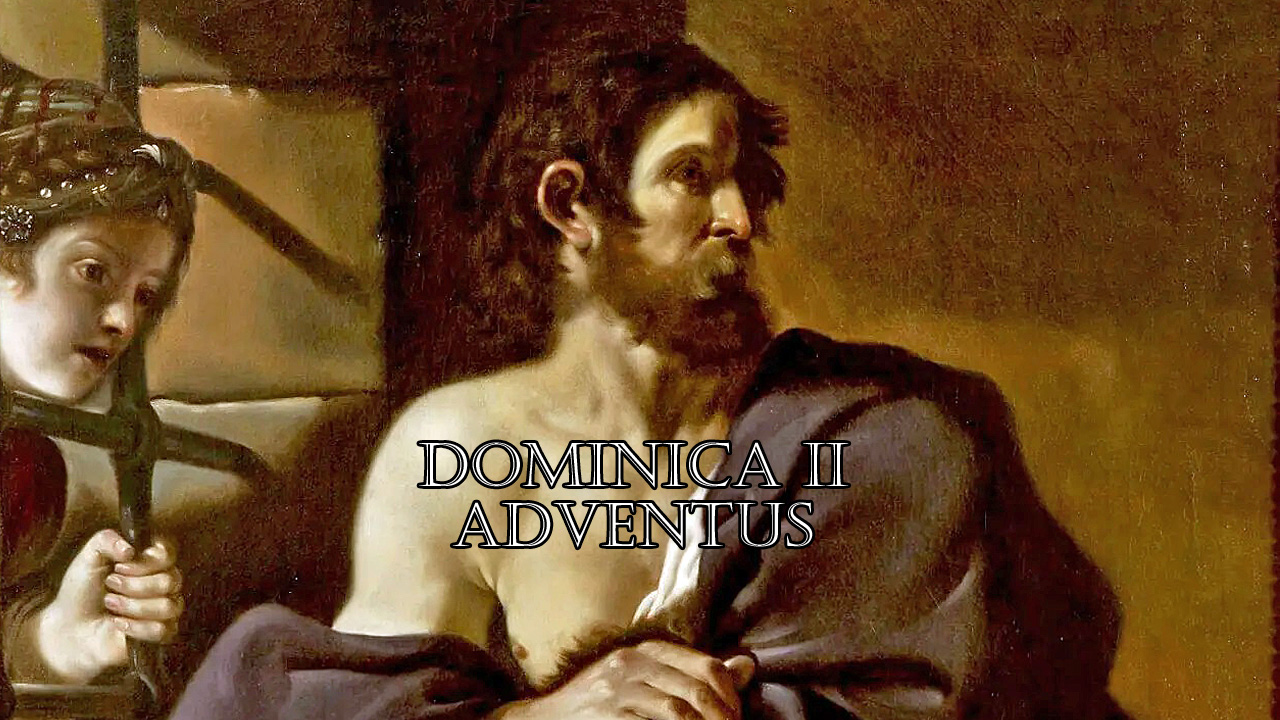
The Church places before us on the 2nd Sunday of Advent a Gospel passage from Matthew 11:2-10 whose two movements mirror each other like the ends of a well bound book. The first concerns the identity of Christ as sought by the imprisoned Forerunner. The second concerns the identity of the Forerunner as confirmed by Christ.
John the Baptist, confined for his fearless denunciation of Herod’s unlawful union, sends his disciples to the Lord with a question that reverberates across salvation history. “Are you he who is to come, or shall we look for another?” (v.2) In the stark dungeon of Machaerus, John awaits the outcome not only of his ministry but of God’s long promised visitation. Christ’s answer at first hearing sounds evasive to modern ears, yet to those schooled in the Scriptures of Israel it rang with unmistakable clarity. The Lord replied with a catalogue of signs that the prophet Isaiah had long ago associated with the coming of God among His people. “Go and tell John what you hear and see,” Our Lord says. “The blind receive their sight and the lame walk, lepers are cleansed and the deaf hear, and the dead are raised up, and the poor have good news preached to them. And blessed is he who takes no offense at me.”
These were not random marvels. They were prophetic proofs. In Isaiah 35 the prophet proclaimed that when God Himself came to save His people the desert would bloom with joy and the weak be strengthened. “Then the eyes of the blind shall be opened, and the ears of the deaf unstopped. Then shall the lame man leap like a hart, and the tongue of the dumb sing for joy” (Is 35:5 6 RSV). Again, in Isaiah 61, the Servant anointed by the Spirit proclaims liberation and glad tidings to the poor. These signs are the very works Christ performed and are the very texts He applied to Himself in the synagogue of Nazareth. John’s question, “Are you he who is to come,” did not ask about the Messiah in the abstract. When Isaiah spoke of the One who is to come, he spoke of God.
“Behold, your God will come with vengeance, with the recompense of God. He will come and save you” (Is 35:4).
The Messiah may work wonders, but only God cleanses lepers and raises the dead. The king of Israel once tore his garments when told to cure Naman, crying, “Am I God, to kill and to make alive?” (2 Kgs 5:7). Christ had already healed leprosy and restored life to the widow’s son at Nain. His works declared not only that He was the Anointed One but that in Him God had visited His people.
Small wonder, then, that after responding thusly to John’s messengers Jesus added for the sake of the surrounding crowds, “Blessed is he who takes no offense at me” (v.6) His listeners would have understood the implications of His answer: Jesus had made a divinity claim. Some would not endure that claim. Yet those with the humility of John could accept that God had drawn near in human flesh.
Once the messengers departed, Christ challenged the crowd. He asked them what they expected to see in John? Not a “reed shaken by the wind”, for John never bent to the whims of rulers or crowds. Not a man “clad in soft garments”, for such adornment belongs to the courts of kings, not to prophets. Christ reveals John as the promised messenger of Malachi. “Behold, I send my messenger before thy face, who shall prepare thy way before thee.”
In Malachi’s oracle the Lord of hosts declares that He Himself will come to His Temple, preceded by His messenger. Thus, just as Christ’s answer to John confirmed His divinity, so His description of John confirmed the divine identity of the One whose way John prepared. John is not merely a prophet but more than a prophet (v.9), the greatest among those born of women (v.11), the Elijah who heralds the day of the Lord (cf. Mal 4:5).
The Forerunner’s question, however, has long raised perplexity. Did John doubt? How could the one who leapt in the womb at the presence of Christ, who baptized Him and pointed to Him as the Lamb of God, now falter? St. Gregory the Great resolved this by considering the order of events. When free beside the Jordan John proclaimed Christ boldly. Yet once he had been cast into prison, Gregory says, John desired to know whether Christ would enter personally into the realm of the dead. Gregory writes,
Ad Jordanis enim fluenta positus, quia ipse Redemptor mundi esset asseruit; missus vero in carcerem, an ipse veniat requirit, non quia ipsum esse mundi Redemptorem dubitet, sed quaerit, ut sciat si is qui per se in mundum venerat per se etiam ad inferni claustra descendat. Quem enim praecurrens mundo nuntiaverat, hunc moriendo et ad inferos praecurrebat.
For when he was placed at the banks of the Jordan, he asserted that he himself was the Redeemer of the world; but when he was sent into prison, he asked whether he himself would come, not because he doubted that he himself was the Redeemer of the world, but he sought to know whether he who had come into the world by himself would also descend by himself to the prisons of hell. For him whom he had proclaimed by running ahead into the world, he was also running ahead to hell by dying. (Hom. in Evang. 6.1).
The Baptist, having gone before Christ into this life, would also go before Him into death. He desired assurance that he might in the underworld announce the coming of the One he had already heralded in Israel. Gregory imagines John saying in effect, “Since you thought it worthy of yourself to be born for humanity, say whether you will also think it worthy of yourself to die for humanity.” In this Gregory offers not only an interpretation of John’s inquiry but a luminous insight into Christian suffering.
From our own prisons of anxiety or affliction we do not doubt Christ’s identity. Rather, like John, we ask how He will come to us in the darkness and whether the saving nearness we have known in the light will follow us into the shadows.
Along with the Gospel pericope, Holy Church also offers us the passage from St. Paul’s Letter to the Romans. This epistle, written about AD 57, addresses a Christian community in Rome composed of both Jews and Gentiles whose relations were strained. Emperor Claudius had expelled Jews from Rome in AD 49 because of disturbances in their synagogues “at the instigation of Chrestus” (Suetonius, Claudius, 25.4). When they returned after Claudius’s death they found a predominantly Gentile Church. Some Jewish Christians looked down on their Gentile brethren, prizing their heritage. Some Gentiles viewed themselves as replacing Israel, forgetting that Paul warns the Gentile branches not to boast against the root (Rom 11:18). Into this tension Paul speaks, appealing to the three sections of the Scriptures, the Torah, Prophets, and Psalms, to prove that Christ came both for the circumcised as well as for the nations. His exhortation rings with pastoral urgency.
“Welcome one another, therefore, as Christ has welcomed you, for the glory of God” (Rom 15:7).
The divisions in Rome find echoes in our own time. The Church is no stranger to factions. They stretch from the disputes of the Apostles to the quarrels that beset communities today. We are witnessing pressures from both without and within. In the first world, civil authorities, under the previous presidential administration, viewed traditional Catholics with suspicion, as in the recent congressional reports have revealed. In some places people are arrested by “thought police” for praying in silence. Inside the Church, some pastors of souls speak chilling words about tradition and advocate repression. Strife has arisen among Catholics themselves, particularly among those who strive to uphold traditional doctrine and worship. Old prejudices and rivalries sap strength at the very moment unity is most needed. Paul’s admonition remains not a polite suggestion but a demand of the Gospel. If Christ welcomed us, sinners all, then we must welcome one another. Without that charity, every faction becomes vulnerable and the entire Body suffers.
The Mass formulary of this 2nd Sunday of Advent provides a remedy by lifting our eyes from our own disputes to “Jerusalem,” the city and the mystery toward which Scripture and liturgy beckon us as soldier pilgrims. The chants of the Mass echo the pilgrim’s longing. The Introit proclaims, “Populus Sion, ecce, Dominus veniet… People of Zion, behold the Lord shall come”. The Gradual sings, “Ex Zion species decoris eius: Deus manifeste veniet… From Zion, the perfection of beauty: God shines forth clearly”. God shall come manifestly, not hidden in gentleness as at Bethlehem but in the full brilliance of His glory. The Communion antiphon calls, “Ierusalem, surge et sta in excelso, et vide iucunditatem, quae veniet tibi a Deo tuo… Up, Jerusalem! stand upon the heights; and behold the joy that comes to you from your God” (Bar 5:5). Jerusalem becomes for us a sacramental symbol of the Church’s life.
When we worship according to the Church’s venerable rites, we are morally in Jerusalem, the place where Christ instituted the Eucharist, suffered, died, rose, and ascended. Our liturgy stretches backward to the earthly Jerusalem and forward to the heavenly Jerusalem that shall descend from God. Advent intensifies this double vision. We prepare for the humility of Bethlehem and for the majesty of the Parousia.
The Forerunner stands before us again and cries, “Prepare the way of the Lord.” The valleys of our tepidity must be filled and the mountains of our pride leveled. If we fail to prepare, the Lord who comes will straighten all things in His own time, yet it is our joy and duty to make ready the paths of our hearts.
The Collect of this Sunday gathers the themes of longing, preparation, and grace into a single ancient prayer.
Excita, Domine, corda nostra
ad praeparandas Unigeniti tui vias;
ut, per eius adventum,
purificatis tibi mentibus servire mereamur.
This ancient prayer was in the Gelasian and Gregorian Sacramentaries. Our exciting Lewis & Short Dictionary informs us that excito is, in the first place, “to call out or forth, to wake or rouse up”. It is also, “to raise up, comfort; to awaken, enliven”. Praeparo, “to make ready beforehand”, is compound of prae and paro “to make ready”. At the end of the Gospel, Jesus speaks of John with the words of Malachi: “Behold, I send my messenger before thy face, who shall prepare (praeparabit) the way before thee”.
LITERAL VERSION:
Rouse up our hearts, O Lord,
to make ready the paths for Your Only-Begotten Son,
so that through His Coming
we may be worthy to serve You with minds made pure.
Here we have the companion of the opening oration last week. In the Collect last week, we asked God to rouse up His might (Excita … potentiam tuam). Today we ask him to stir our hearts (excita… corda nostra); to comfort yes, but mainly to enliven and arouse. Last week in the Lesson we were told by Paul that it was time to awaken from sleep (cf. Rom 13). This week we ask the Father to make our hearts worthy paths (viae) for the feet of Our Lord by rousing, and comforting them. Our hearts, our interior life (mens) must reflect His beauty. In the Gradual the Church sings: “Out of Sion the loveliness of his beauty: God shall come manifestly.” This “manifest” Advent/Coming is not only at the end of the world, in glory and might, as we hear Jesus describe on the 1st Sunday of Advent: it is also in the life of grace, which is manifest in our words and deeds.
The prayer continues, “ut, per eius adventum, purificatis tibi mentibus servire mereamur.” Through His Coming we are made worthy to serve God with minds made pure. Such purity calls to mind the penitential summons of the previous Sunday and our need for confession. The service we render is not abstract but concrete. Grace must express itself in good works, as the Collect implies. Christ’s manifest Coming is not only at the end of time but also in the life of grace that shines forth in our words and deeds. The Gradual’s declaration that God shall come “manifeste” applies not only to the eschaton but to the holiness that becomes visible when grace works in us.
In this season the Church, our wise Mother, sets before us the mighty figure of John the Baptist, the prophet who spans both advents of Christ. He leaped for joy in the womb when the Incarnate Word drew near in humility. He heralds the glorious Coming when the Son of Man shall judge the nations. Christ’s own testimony to John forms a fitting bridge between the ancient prophets and the Gospel proclamation. John prepared the way for the Lord who is both Messiah and God. So too we must prepare. Like John, we may feel confined in the prisons of circumstance. Like the Roman Christians, we may face divisions and pressures. Yet the answer Christ gave to the Forerunner He gives also to us. Look at what you hear and see. The blind recover sight. The lame walk. Souls are healed by grace. The dead in sin are raised. The poor have the Gospel preached to them. God has come. God still comes. God will come.
Therefore Advent becomes a school of patience taught by Paul and an arena of expectancy guided by John. Every generation of Christians has felt the tension between longing for the Lord and bearing the delays of time. The young feel it as the slow arrival of Christmas. The afflicted feel it in their desire for deliverance. The Church feels it in her desire for unity and renewal. Patience is not passivity but a form of perseverance born from the Latin patior, to suffer. It is the endurance that allows expectation to ripen into hope. Paul calls this steadfastness. Isaiah calls it seeing the glory of the Lord. Gregory calls it the certainty that Christ will come even into the realm of death.
Thus, in the unfolding of the Sunday formulary for Holy Mass in the Usus Antiquior we move from the warning of judgment to the promise of joy. Penance remains necessary, yet joy is promised to those who await the Lord with purified hearts.
Advent is a privileged time in which the Church places into our hands the compass of Scripture, the star of prophecy, the cry of the Baptist, and the ancient prayers that have shaped the hearts of countless saints. Through all these means God comforts and rouses us. He draws us toward the Jerusalem below, the Jerusalem above, and the interior Jerusalem where He desires to reign. The blooming desert, the opened eyes, the raised dead, the straightened paths, the purified minds, and the manifest Coming all converge in the One whose identity John sought from prison and whose way John prepared with his life.