We have made a firm move into Epiphanytide, that brief but densely charged stretch of the liturgical year which carries us from the great Feast itself toward the threshold of Septuagesima. Even as the calendar advances, there remains a strong magnetic pull back toward Epiphany, as though the Church, having once beheld the manifestation of Christ’s glory, cannot easily look away. The Second Sunday after Epiphany stands within this field of attraction. It is not an isolated Sunday but one that still resonates with the light first revealed on 6 January, a date which, it bears repeating, Epiphany always held, regardless of later accommodations and transfers.
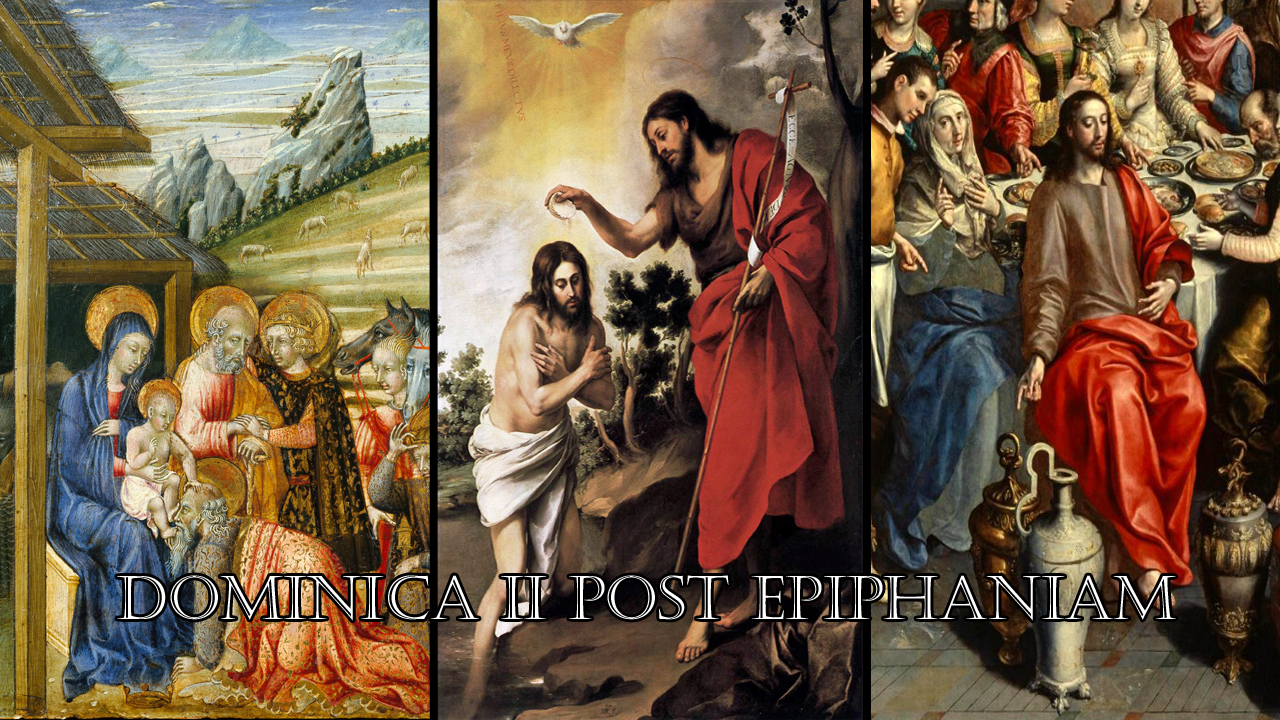
Epiphany once possessed its own Octave, regrettably abolished in 1955, and the Octave Day, always 13 January, now survives in the Vetus Ordo calendar as the Commemoration of the Baptism of the Lord. This placement is not accidental. At the Jordan, as Christ submitted Himself to John’s baptism, the heavens were opened and the voice of the Father declared Him to be the beloved Son. The Baptism is therefore a theophany, a manifestation of divinity, no less than the adoration of the Magi, whose gifts of gold, frankincense, and myrrh confessed the identity of the Child they adored. The liturgy, with its instinct for theological symmetry, has always recognized that these events belong together.
On this Second Sunday after Epiphany, the Gospel places before us the account of the Wedding at Cana, where the Lord worked His first public miracle and changed water into wine. Here again, His divine identity is revealed through a sign that heralds the feast of the heavenly banquet (cf. Is 25:6). Epiphany, the Baptism, and Cana are thus powerfully oriented toward one another, like loadstones charged with the same force. The ancient Church gave explicit voice to this unity in the Magnificat antiphon sung at Vespers on Epiphany and its former Octave:
Tribus miráculis ornátum diem sanctum cólimus: hódie stella Magos duxit ad praesépium: hódie vinum ex aqua factum est ad núptias: hódie in Iordáne a Ioánne Christus baptizári vóluit, ut salváret nos, allelúia.
We revere this holy day, adorned with three miracles: today a star led the Magi to the manger; today at the marriage water was made wine; today for our salvation Christ desired to be baptized by John in the Jordan. Alleluia.
Holy Church, knowing that a single day cannot suffice for contemplation of so great a mystery as the manifestation of the Son of God, unfolds these events across a sequence of related feasts. The sequence remains in the Novus Ordo, though it is greatly obscured by the shifting of Epiphany to a Sunday, the truncation of the season of Christmas, and the abrupt replacement of Epiphanytide with so called Ordinary Time. The Wedding at Cana appears only in Year C of the modern Lectionary, severed from its liturgical companions. There is an undeniable sense of fragmentation, a sterile and clinical atmosphere, in which the organic rhythm of sacred time has been flattened. Joseph Ratzinger diagnosed this problem with clarity in The Feast of Faith:
One of the weaknesses of the post-Conciliar liturgical reform can doubtless be traced to the armchair strategy of academics, drawing up things on paper which, in fact, would presuppose years of organic growth. The most blatant example of this is the reform of the Calendar: those responsible simply did not realize how much the various annual feasts had influenced Christian people’s relation to time […] they ignored a fundamental law of religious life.
As Epiphanytide unfolds in green vestments, we draw closer to another year marker which has been tragically excised from the post-Conciliar calendar, Septuagesima and pre-Lent. Whether its elimination truly served the good of the faithful remains an open question, particularly in light of Sacrosanctum Concilium 23, which states that “there must be no innovations unless the good of the Church genuinely and certainly requires them; and care must be taken that any new forms adopted should in some way grow organically from forms already existing.” The removal of Epiphany’s Octave and of the pre-Lenten season raises serious questions about fidelity to those principles.
Turning again to the Gospel of Cana, the evangelist himself invites us to attend carefully to time. John tells us that the wedding took place “on the third day.” Third day after what? Tracing the days marked repeatedly by the phrase “the next day,” we are led back to the Baptism of the Lord. The Wedding at Cana thus fell on the octave of the Lord’s Baptism, completing a liturgical week charged with sacramental meaning. At Cana the setting is nuptial. In Genesis, on the seventh day of creation, humanity enters into nuptial fullness with the nuptial creation of Eve from Adam’s side. In John’s Gospel, creation themes resound from the Prologue onward, culminating in this wedding, to proclaim that Christ is the new Adam and Mary the new Eve. Baptism, where the Spirit moves upon the water as in Genesis 1:2, makes us new creations.
Jewish wedding celebrations commonly extended over several days, often seven, and the responsibility to provide wine rested with the bridegroom. The shortage at Cana is therefore both socially embarrassing and symbolically charged. Mary’s intervention is discreet and penetrating. She does not issue a command. She simply states a fact: “They have no wine” (2:4).
The Lord’s response, is rendered differently in different translations.
KJV: “Woman, what have I to do with thee? mine hour is not yet come.”
RSV: “O woman, what have you to do with me? My hour has not yet come.”
Knox: “Nay, woman, why dost thou trouble me with that? My time has not come yet.”
The Knox has a footnote which says, “The Greek here is ambiguous; some would interpret it, ‘What concern is that of mine or of thine?’, but it is more probably to be understood as a Hebrew idiom, “What have I to do with thee?’, that is ‘Leave me alone, do not interfere with me’, as in Mt. 8.29…”. Matthew 8:29 is where the demons shriek at Jesus before He sends them into the swine.
Douay-Rheims Version (DRA): “Woman, what is that to me and to thee? my hour is not yet come.”
The DRA preserves the Greek idiom and avoids any suggestion of discourtesy. By addressing His Mother as “woman,” Christ evokes the first Eve and anticipates the woman clothed with the sun in Revelation 12. The title gathers together both beginning of things and the end, creation and consummation.
The reference to “my hour” propels the narrative forward to the Passion.
Throughout John’s Gospel, hour language functions as a theological thread. At the well in Samaria, Christ declares, “Woman, believe me, the hour is coming when neither on this mountain nor in Jerusalem will you worship the Father….The hour is coming, and now is, when the true worshipers will worship the Father in spirit and truth” (John 4:21 to 23). In Jerusalem, He announces, “Truly, truly, I say to you, the hour is coming, and now is, when the dead will hear the voice of the Son of God, and those who hear will live” (John 5:25). When Greek speakers approach Philip seeking Jesus, He proclaims, “The hour has come for the Son of man to be glorified” (John 12:23). The glory He foresees is the same glory of which John spoke in the Prologue: “we beheld his glory, the glory as of the only begotten of the Father” (John 1:14), revealed supremely in suffering and death.
At Cana, Christ transforms an extraordinary quantity of water into wine, some 180 gallons, a superabundance that surpasses practical need. The prophets had foretold that the day of salvation would be marked by a feast of rich food and choice wines. Isaiah proclaims that on that day the Lord “will swallow up death forever” and “wipe away tears from all faces” (Isaiah 25:8). By supplying the wine, Christ assumes the role of the bridegroom, revealing Himself as the divine Spouse long promised by the prophets: “as the bridegroom rejoices over the bride, so shall your God rejoice over you” (Isaiah 62:5). Hosea records the Lord’s pledge, “I will betroth you to me forever” (Hosea 2:19).
St. Augustine perceived the Eucharistic depth of this imagery. In his Tractates on the First Letter of John, he writes: “Every celebration is a celebration of Marriage; the Church’s nuptials are celebrated. The King’s Son is about to marry a wife, and the King’s Son is himself a King; and the guests frequenting the marriage are themselves the Bride” (In Epist. Io. ad Parthos, tr. 2.2). Each Mass is thus a wedding banquet in which Christ unites Himself to His Church.
Bl. Ildefonso Schuster, reflecting on this Gospel, discerned an even deeper petition within Mary’s words. He wrote:
The whole scene described in today’s Gospel, besides recording our Lord’s first miracle, veils a deep meaning into which the human mind can with difficulty penetrate. How sweet and consoling it is for the children of Mary to know that Jesus, at her bidding, hastens the hour of his manifestation to the world. Quid mihi et tibi est, mulier? nondum venit hora mea. Whatever explanation may be given to these words with which the Saviour, in the truthfulness of his human nature, asserts his own divine perfection, it is certain that they are to be understood in an affirmative and sympathetic sense, as Mary herself understood them. She asked for wine, not merely for the needs of the wedding feast, but also for that other wine of which the miraculous draught at Cana was but a symbol, that is, for the Holy Eucharist.
Schuster continues by noting that three years would elapse before the type was fulfilled in the antitype, and that the water changed into wine at Cana announced the Eucharistic mystery – wine changed into Blood – whose hour had not yet come.
This Eucharistic trajectory continues through the Passion. At the Last Supper, Christ does not drink the customary fourth cup of the Passover. Instead, He goes to Gethsemane and speaks of the chalice He must drink. On the Cross, He says, “I thirst” (John 19:28), and is given oxos, sour wine mixed with water, the drink of Roman soldiers. Only then does He declare consummatum est (John 19:30 – tetélestai). The nuptial mystery reaches its consummation.
Wine appears in John’s Gospel only at Cana and at the Cross, binding beginning and end into a single sacrificial offering.
The Epistle for this Sunday, Romans 12:6 to 16, brings these mysteries into the texture of Christian life. Paul exhorts the faithful to exercise their gifts with humility, generosity, and perseverance. At the heart of his counsel stands the exhortation: “Rejoice in your hope, be patient in tribulation, be constant in prayer” (Romans 12:12). These words – which could be applied to Mary’s demeanor at the wedding banquet – were addressed to a community small in number and vulnerable to misunderstanding and persecution. They remain apt wherever fidelity to Christ entails suffering.
Within the Church herself, trials are not absent. Many of the faithful experience deprivation in matters that touch the heart of worship. The image of the empty wine jars at Cana has become a poignant symbol. For those who desire the Traditional Latin Mass, the Eucharistic banquet may feel diminished or distant. Access may be limited, reduced, or removed altogether. In recent days we saw how the Prefect of Divine Worship distributed an anti-tradition essay to cardinals gathered for a consistory. It was a banal, on-the-spot product which, when carefully examined, is more manipulative than truly persuasive. Yet it is yet another sign that, if certain people still have their way, the persecution will continue.
As far as the naysayers are concerned, I respond: “If it is of God, you will not be able to overthrow them. You might even be found opposing God!” (Acts 5:39)
In such moments, the Gospel directs us to Mary. She notices the lack. She intercedes.
Out of lack and loss, blessings can arise. Augustine’s insight that every Mass is a wedding banquet reminds us that Christ remains faithful to His Bride even when circumstances are difficult. Paul’s exhortation does not promise exemption from tribulation, yet it insists upon hope, patience, and prayer. Joy and charity, lived in the shadow of the Cross, have always been the Church’s most persuasive witness. The Cross, where the Bridegroom gives Himself entirely, stands at the center of history. From that consummated sacrifice flows the wine of the Kingdom, poured out in superabundance for the life of the world.