
All good things come to their end, with the exceptions of God’s loving mercy and the eternal joy of Heaven. This series comes to its end on the 24th and Last Sunday after Pentecost, which this year is numerically the 26th. The 5th and 6th Sundays after Epiphany, left over when Septuagesima arrived, supplied the intervening Sunday Mass formulas. Now we come to the Mass always reserved for the Last Sunday before Advent. In a few short, and in the Northern Hemisphere steadily shortening, days a new liturgical year begins. The two years fit together like dovetail joints. Listen to the Gospel at the end of the one and you can already hear the opening of the other.
In Matthew 24:15–35 the Lord speaks of the abomination of desolation foretold by Daniel. Those in Judaea are to flee to the mountains. The man on the housetop is to leave whatever he might have fetched from the house, and the man in the field is to forget his cloak. The destruction of Jerusalem is interwoven with the shaking of the heavens and the coming of the Son of Man. Meanwhile, there are people peddling reports that Christ is out in the desert or hidden away indoors. His coming will be as evident as lightning flashing from east to west. Even the fig tree has something to teach us: its tender branches tell us that summer is near. The Lord tells us that He is at the door (v.33).
Death, Judgment, Heaven and Hell have been much on the Church’s mind in her Mass and Office these last weeks. Come Advent, we shall prepare with prayer and penance for the birth of the Word made flesh. We fast before our feasts. The Child who came in humility at Bethlehem will come again in majesty, and the Church gives us the whole stretch of that history to contemplate while we still have time to do something about the state of our souls. With that in mind, here is the first thing she asks of God today in the Collect. The prayer is attested in the 9th century Liber sacramentorum Augustodunensis, the Sacramentary of Autun, a witness to the Gelasian tradition in which Roman and Gallican elements came together.
Excita, quaesumus, Domine, tuorum fidelium voluntates:
ut, divini operis fructum propensius exsequentes;
pietatis tuae remedia maiora percipiant.
LITERAL VERSION
Rouse up, we beseech You, O Lord,
the wills of Your faithful, that, pursuing more earnestly the fruit of the divine work, they may receive greater remedies of Your mercy.
On this Last Sunday we pray that we may reap the harvest (fructum) which has God has tended in us over the last year.
In British climes the opening of its English counterpart in the Book of Common Prayer, “Stir up, we beseech thee, O Lord,” gave us “Stir-Up Sunday,” with the agreeable custom of stirring up the Christmas pudding mixture.
Our trusty Lewis and Short Dictionary shows that excita, from excito, means “rouse up, awaken, set in motion.” Exsequor has the force of pursuing something through to its completion, and percipio is to receive or obtain. In pietatis tuae, “of Your mercy,” pietas is God’s loving kindness toward His own. We also have two comparatives: propensius means “more eagerly, with a readier inclination”. Maiora qualifies the remedies. The Collect asks that, as the faithful pursue the fruit more eagerly, they may receive greater healing. The first word tells us whence comes the very eagerness with which we do the pursuing. God moves the will, and the will thus moved really does will and work. Then we ask Him to heal us further. Paul gives us both halves of “excita” in a single verse: “God is at work in you, both to will and to work for his good pleasure” (Phil 2:13, RSV).
There is the connection with our Epistle, Colossians 1:9–14. Writing in chains during what is traditionally thought to be his imprisonment in Rome, Paul has heard from Epaphras how the Gospel has taken hold in Colossae, a city of Phrygia in what is now Turkey. The community was largely Gentile. Paul’s letter indicates that ritual observances, ascetical practices and claims about spiritual powers were troubling their grasp of what they had received (Col 1:21, 27; 2:13–23). The doctrinal teaching about Christ in the first part of the letter supplies the ground for the moral life Paul describes later. Those who are to put on the new man must know Whose life they have been given to live.
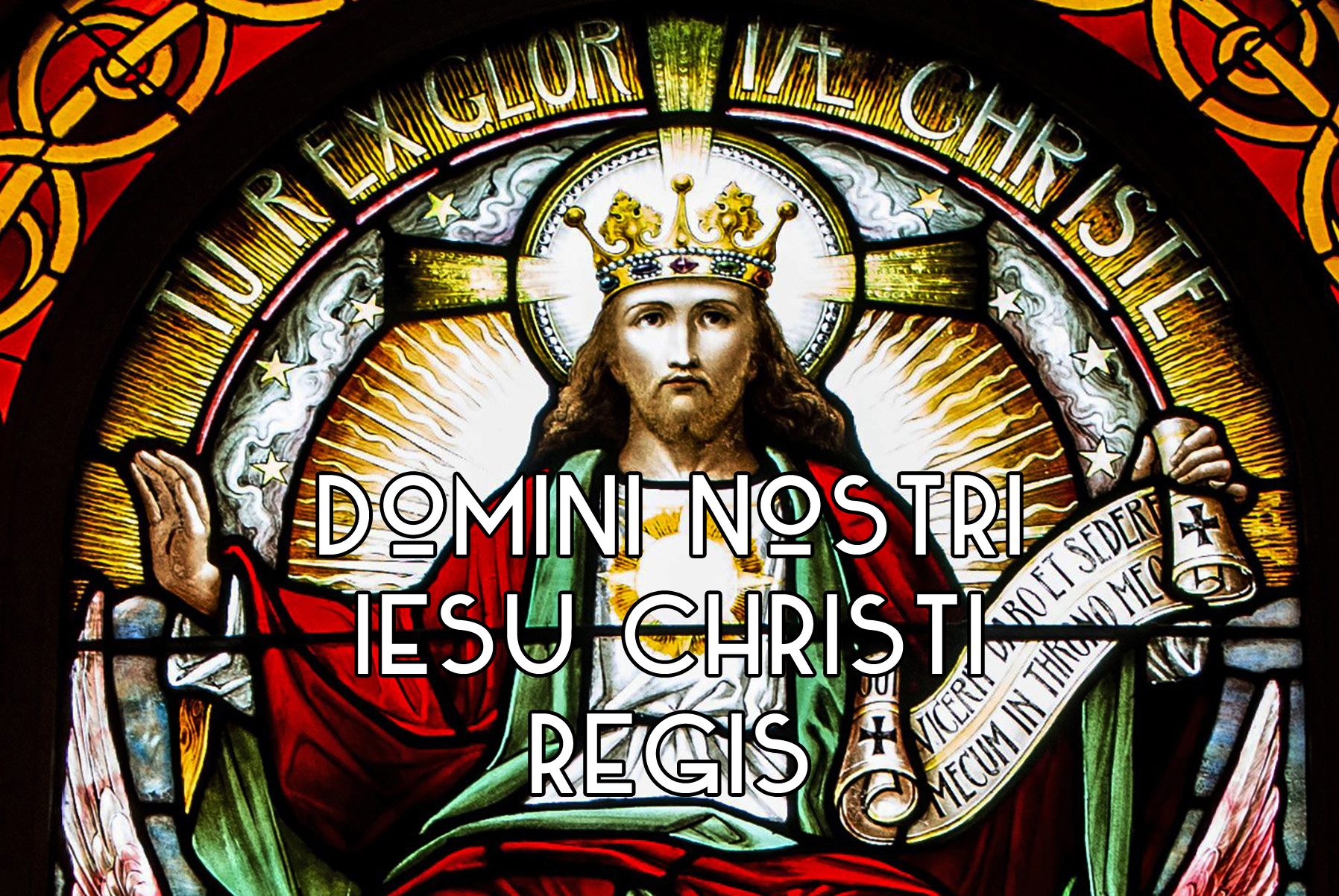
We heard part of this very chapter, Colossians 1:12-20, on the Feast of Christ the King at the end of October in the Vetus Ordo. In the Novus Ordo Christ the King is celebrated today. In the Epistle for our Last Sunday the kingship is already a fact of the Colossians’ own history.
[The Father] has delivered us from the dominion of darkness and transferred us to the kingdom of his beloved Son, in whom we have redemption, the forgiveness of sins. (Col 1:13–14, RSV)
From the day he heard of their growth Paul has prayed that they might know God’s will, live in a manner worthy of the Lord and have strength for endurance and patience with joy. Bl. Ildefonso Schuster, the Benedictine Abbot and later Archbishop of Milan, puts his finger on what Paul expects of people thus rescued:
He dwells insistently on the idea that Christianity is life, and, as such, needs development, boldness, energy….
I think of Paul singing in his imprisonment in Rome just as he and Silas sang at midnight in the prison at Philippi (Acts 16:25). Can you hear Paul in the chants between the readings? First comes the Gradual (Ps 43[44]:8–9):
You have saved us from those who afflicted us, O Lord, and put to shame those who hated us.
In God we shall glory all the day, and we shall give thanks to Your name forever.
Then comes the Alleluia, from the De profundis (Ps 129[130]:1–2).
Out of the depths I have cried to You, O Lord.
O Lord, hear my prayer.
Here’s a little hook between the Epistle and Gospel. I’ve quoted only a little of the readings this time. Take out your Missal or Bible and read through both (Colossians 1:9–14 and Matthew 24:15–35). In apocalyptic language sounding like the end of the world Our Lord warns those in Judaea to flee to the mountains. The man out in the field is to leave his cloak behind (Matt 24:18). Why such haste? After all, if it is the end of the world, what does it matter even to flee? The Lord is prophesying the Romans. In A.D. 70 they took Jerusalem and destroyed the Temple, which was tantamount to the end of the Jewish cosmos. St. John Chrysostom observes that Our Lord shows how intolerable the war would be “by the things that seem to be small” (Homilies on Matthew 76.1). A cloak is a small thing until you have to decide whether to go back for it. For that man in the field, the fall of Jerusalem was the end of the world he knew. Our Lord speaks of that calamity in the same discourse in which He tells us of His coming in glory. Read St. Paul alongside it. The Father has already brought us out of darkness into the kingdom of His beloved Son. Paul will go on to tell us to put on another kind of cloak, the new man (Col 3:10).
The news from Colossae must have been like a long quaff of cool water, though he still bore cold chains. The joy Paul asks for his converts is a joy which can endure affliction. And when we get to the Offertory the Church gives us the De profundis again, so that the cry which carried us into the Gospel now accompanies our offerings to the altar.
Paul wrote “bearing fruit in every good work… in omni opere bono fructificantes”. That omni, “every,” could us some inconvenience if we take it seriously. We might have a favorite apostolate as well a talent for it, but someone who needs our attention here and now has managed to present himself at precisely the wrong moment for us.
Paul connects this “bearing fruit” to an increase in the knowledge (scientia) of God. There is the fides quae, the faith which we believe, whose content can be studied and taught, and the fides qua, the faith by which we believe, the infused virtue. Get out the Catechism. Learn well what the Church teaches. That sort of knowledge is real power.
There is also a knowledge that comes in doing the Father’s will, as Our Lord says in John 7:17. To serve a man made in God’s image is to come into contact with a mystery which we see, for now, as in a mirror dimly (cf 1 Cor 13:12). Think of Moses coming from his encounter with the Lord with his face radiant. The work of mercy can change the one who performs it, even when the person who receives it never knows what it cost. The deeper content of our study and the One whom we encounter in charity is the same divine Person, the Logos, the Word. In both, we are busy doing the Lord’s work.
That said, one can be exceedingly busy and, at the same time in another sense, idle. St. Gregory the Great (+604), preaching on the laborers in the vineyard, takes the hours at which the men are hired as the ages at which we are called to labor for God. He has a word for the man who spends his day on himself.
Nam qui sibi vivit, qui carnis suae voluptatibus pascitur, recte otiosus redarguitur, quia fructum diuini operis non sectatur. …For the man who lives for himself and feeds on the pleasures of his flesh is rightly rebuked as idle, because he does not pursue the fruit of the divine work. (Homiliae in Evangelia, I, hom. 19, §2, on Matt 20:1–16.)
As for us, who have heard the call to work now and know something of what needs doing, there is a reason the Collect asks the Lord to stir us up. Nevertheless, the man at the 11th hour still has a place in the vineyard. Gregory points to the Good Thief, who had just time enough to confess the Lord from his cross and was promised Paradise that very day. We should not presume to have that last minute chance. It’s time to get ready now.
The Secret prayer asks that, freed from earthly cupiditates, “disordered desires,” we may pass over to heavenly desires. The Postcommunion asks for medicatio, “healing,” for whatever is vicious in our minds. There are the Collect’s remedia maiora, “greater remedies,” in the Sacrifice offered and the Sacraments received. Sacred worship is the work of the virtue of Religion and the theologia prima, “first theology,” in which Holy Church professes the Faith as she offers the Sacrifice. The clever boots can devise programs until the cows come home. If we want reform that will last, our works must begin in worthy worship and return there to be offered to the Father. We are our rites.
On that note, I write on the day that the US Bishops voted to make the last Sunday of October into the “Day of Prayer for Radical Justice” to serve as a transition between Black History Month and Native American Heritage Month. That’s the new nuance for the parishes using the Novus Ordo. Meanwhile, up the street at the chapel with the Vetus Ordo, they will be celebrating the Feast of Christ the King… celebrated today in the Novus Ordo.
Our Christian forebears cried maranatha, “Come, Lord!” (1 Cor 16:22; cf. Didache 10.6 and Rev 22:20). The medieval Christian knew how to pray for that coming with ashes in his heart. The Dies Irae, “Day of Wrath,” of the Requiem has this plea.
My prayers are unworthy, but You, who are good, grant in Your kindness that I may not burn in everlasting fire.
We are in that liminal period which transitions from one liturgical year to the next, and our prayers are informed by the Four Last Things.
Pius Parsch writes in The Church’s Year of Grace that in our time, we neither long for nor fear the Lord’s return, which in wider society is surely true. Parsch writes: “We lack both the childlike enthusiasm for the ancient Church and the naïve realism of the Middle Ages. What is left for us to do?”
What remains for us to do and answers in a sentence:
Be always prepared; live your days in the light of the Second Advent.
Pace Pius Parsch, with due respect to him, there is considerable wisdom in the “realism” of those medieval Christians. In the end everything will be straightened out, whether we have straightened up beforehand or no. The Lord will come by the straight path whether we have tried to straighten it beforehand or not. Judgment will come, collectively at the end of the world and individually when we die. At Mass the Lord who will judge us makes sacramentally present the Sacrifice in which He bore the punishment of sin. The Introit gives His mind toward us, in the words of Jeremiah (29:11), “I think thoughts of peace and not of affliction.” The One who chose the Cross is the One from whom we hope to hear, “Come, blessed of my Father” (Matt 25:34).
At the end of this liturgical year, I am glad to leave the last word on reading the Epistles to Johann Evangelist Zollner in The Pulpit Orator. In the peroration of his homily on this Sunday’s Epistle, he asks his hearers to read the apostolic letters together with the Gospels on Sundays and holy days, and to order their lives by what they have heard. He finishes with Our Lord’s words.
“Blessed are they who hear the word of God, and keep it.” (cf. Luke 11:28.)
In a few days, when Advent begins we shall ask the Lord again “Excita!” to stir up, this time to stir up His power and come. Today we ask Him to stir up our wills. By His grace there is good work to be done before Advent, perhaps even before supper.
Get ready.