

As October gives way to November, Holy Church chants in autumnal tones. The end (of the Church year) is near.
In the Vetus Ordo our remaining Sundays after Pentecost lead us toward our reckoning with the King, that is, the King of EVERYTHING and not just Heaven. The King will return, open the books, and settle accounts. The formulary for Holy Mass on this 21st Sunday after Pentecost places us in a household, on a battlefield and in a debtor’s prison, wherein we must respectively be guarded by God, armed by God, and merciful toward those who, like ourselves, are in need.
The Collect, found already in the ancient Liber Sacramentorum Gellonensis, prays:
Familiam tuam, quaesumus, Domine,
continua pietate custodi:
ut a cunctis adversitatibus, te protegente, sit libera;
et bonis actibus tuo nomini sit devota.
For the sound of this, there is strong assonance with s and alliteration with t. Right off the bat you will spot that, in the protasis (first part) familia tua leads the way, another way of saying “Your Church” and emphasizing it as the key term in the oration. Then in the thematic apodosis we have two parallel and symetrical ut clauses, wherein a cunctis adversitatibus is balanced by in bonis actis, and te protegente by tuo nomine. Both cola conclude with a pleasing homoteleuton (same ending trope).
A LITERAL RENDERING
Guard your family, we beseech You, O Lord,
with continual mercy,
so that, under Your protection, it may be free from every adversity
and be devoted to Your Name in good works.
The opening word, familiam, deserves attention. In Latin, familia embraced an entire household, including its servants and dependents. Last Sunday we heard about how the whole household believed after the healing of the officials son from afar. Since familia here also points to the Church, the Lord is Father and Master of the household as ought to be He of every human family, indeed, every human institution. These days that’s not much emphasized, the social kingship of Christ, but it ought to be. We are His dependents, purchased at a price, and His mercy (pietas) alone keeps us safe. The word custodi, “guard,” has the ring of a military sentry about it.
We should look a pietas briefly. In liturgical prayers in reference to us, pietas points to our ordered devotion. In reference to God, pietas signifies mercy. God’s continua pietas, His unfailing paternal goodness, precedes our every possible response. In turn, devota, from devoveo, “to dedicate by vow,” describes us bound to Him in active, grateful service.
A household, a familia, is featured in the Gospel from Matthew 18:23–35. A king calls his servants to account. One owes ten thousand talents, a ludicrously vast sum. The size of the sum is the strange “twist” in the parable that would have instantly hooked the 1st century listener. If a talent is reckoned at six thousand denarii, with a denarius representing a laborer’s daily wage, the debt totals some sixty million days of labor, roughly 164,000 years. The servant begs for patience. Astonishingly, the lord forgives the whole debt.
One mortal sin establishes a debt which we cannot discharge by our own strength. It opens a chasm between us and God which we cannot close on our own. God’s gift of forgiveness exceeds merely human calculations. Christ’s Precious Blood accomplished what no accumulation of our achievements could accomplish on their own. Remember this when you examine your conscience. In the confessional, we hear the forgiveness of the merciful King. Think about what you have been forgiven, perhaps again and again.
Moreover, keep this in mind whenever you wonder if the penance Father assigned was too little in your estimation. Every assigned penance is too little. Every assigned penance is arbitrary. It is good when the penance might help you to reflect on something which needs work, but there is no penance we can do that equates to the grace received.
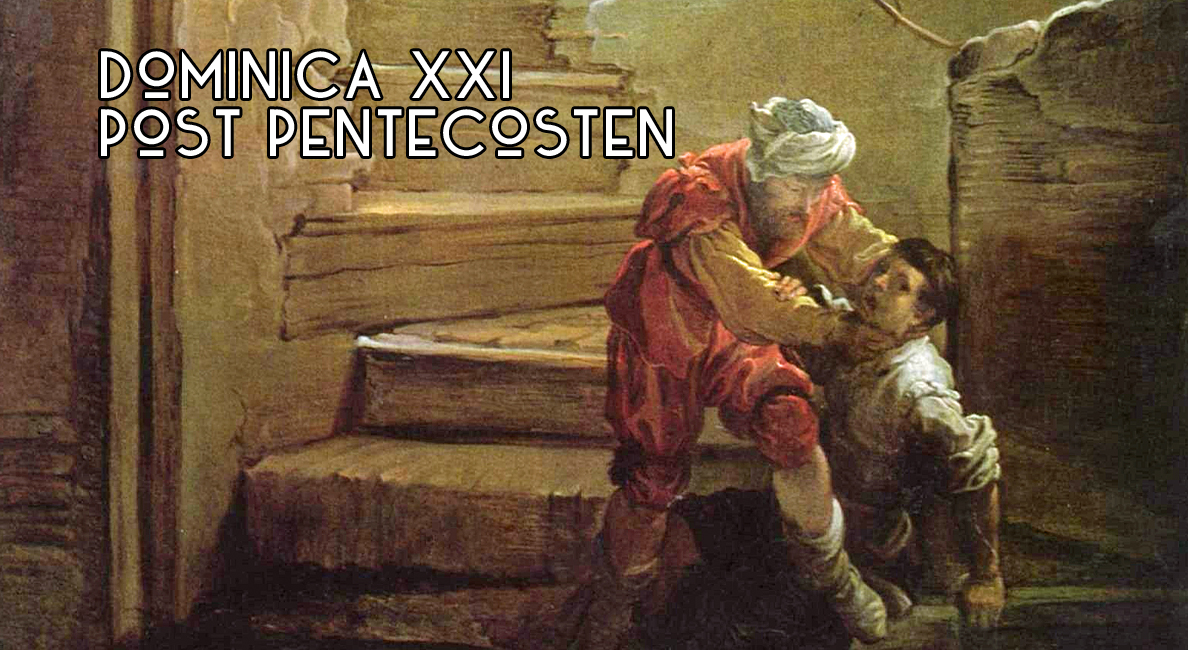
Back to the parable. The servant has received a magnificently lavish and undeserved grace of forgiveness. Then he goes out, seizes by the throat, particularly brutal, a fellow servant who owes a mere hundred denarii. The lavishly remitted ingrate, moments before an abject beggar, then strangles a fellow servant who begged for patience in identical words. News gets back to the master of the house and the ungrateful servant is handed him over to the torturers “till he should pay all his debt” (v.34), in other words, “forever”, in other words… his ingratitude and cruelty were his ticket to Hell. Christ concludes, “So also my heavenly Father will do to every one of you, if you do not forgive your brother from your heart” (v. 35).
St. Thomas Aquinas (+1274), in his Commentary on Matthew identifies five aggravating features of the wicked servant’s offense. First, there is the timing: immediately after being pardoned. Then, fakery, since his false humility before the king vanishes. After that, the relationship, because his victim is a fellow servant. Then, the smallness of the debt. Finally, the cruelty: he strangles his coworker.
How swiftly gratitude can evaporate. One can leave confessional or rise from Holy Communion and, almost before reaching the pew, slide into nursing some old grievance or pet peeve again.
Now we circle back to the Collect and that “et bonis actibus tuo nomini sit devota… and devoted to your name in good works.” Forgiveness of our neighbor is one of those works. Forgiveness is so important that it is the only point Christ returned to explain after He taught His disciples the Lord’s prayer (Matt 6:14). Moreover, the repair of injury, which is a matter of justice (i.e., what is owed to the other) is also a good work. God watches over His household and we members of that household have duties toward each another. Our common dependence upon divine mercy ought to make us merciful. The wicked servant forgot whose house he was in. He wound up in another “house”.
Since Christ repeated it, so will I. “For if you forgive men their trespasses, your heavenly Father also will forgive you; but if you do not forgive men their trespasses, neither will your Father forgive your trespasses” (vv. 14–15). This is serious business. We may protest that someone has gravely hurt us. We may even be right! Forgiveness doesn’t mean pretending that nothing happened. It doesn’t mean we have to be imprudent about someone with whom we have history or that we shouldn’t avoid further harm. It means relinquishing the desire for sinful vengeance (apart from justice) and willing the offender’s true good (a matter of charity), which includes his conversion.
Mercy does not abolish justice. The Lord says that if we remember at the altar that our brother has something against us, we should seek reconciliation before offering our gift (Matt 5:23–24). His warning about the judge, the guard, and the prison until the last penny underscores this with unmistakably vivid imagery. If we have stolen, defrauded, damaged another’s property, wounded someone’s reputation (how many bishops and chanceries do this to priests?), we must make restitution insofar as we can. When full restoration is impossible, we must at least sincerely will it and do what lies within our power. An examination of conscience on this point can be painful. Good! Better an neuralgic examen now than a terror-filled conclusive accounting with the King of Fearful Majesty.
In the Epistle reading from Ephesians 6:10–17, Paul prompts us to put just the bit and pieces of the “armor of God” that we prefer. No. Wait. That’s not it. Paul says the panoplía of God. Greek panoplía is a compound of pan (all) and hóplon (armor – think of the Greek soldier called a hoplite), hence “the whole armor” of God. There is no provision for choosing one attractive piece while leaving the rest behind.
By analogy someone professing to be a Catholic cannot claim the Church’s membership while rejecting her moral teaching on say, the intrinsic evil of abortion, the sinfulness of same-sex acts and Communion for adulterer or her theology about impossibility of the ordination of women or the distinction of the priesthood of baptism and that of the ordained. A chimeric seamless garment that prioritizes open borders over the right to be born isn’t seamless, its a tattered mess of rags.
Paul wanted for Christians the strength that comes from the full armor of God so we can withstand “the evil day” (which we also heard about last week). The Greek endynamousthe, “be strengthened,” is passive. Strengthening comes from the Lord.
In speaking of the armor, in order, the first thing Paul identifies is the belt of truth.
I hereby refer the patient reader back a few paragraphs to that part about really hard examinations of conscience.
We need the cincture of truth, the breastplate of righteousness, our feet to be shod with readiness for the Gospel of peace, the shield of faith, the helmet of salvation, and the sword of the Spirit, the word of God.
Isaiah had already furnished Paul with military imagery (Is 11:5; 52:7; 59:17). Wisdom 5:17–20 also depicts divine justice as armed for combat.
The armor is an appropriate image for those who belong to God and who are members of the Church Militant. This armor recalls the white garment of the new man put on in baptism. And for armor to be useful it must be worn and tended. We are at war. Decorative armor, hanging on the wall, won’t help when the Enemy breaks through your door.
Who is this Enemy? Against whom is our warfare? Paul says,
For we are not contending (Gr pále) against flesh and blood, but against the principalities, against the powers, against the world rulers of this present darkness (Eph 6:12).
Fallen angels, friends. Fallen angels as well as the world, the flesh and the Devil.
The Greek pále means wrestling, close physical engagement, the grappling of adversaries. Paul calls the rulers of this darkness kosmokrátoras, rendered in Latin as mundi rectores tenebrarum harum, “rulers of the world of this darkness.” Created things are good insofar as they come from God, but the Devil – whom Christ called “the prince of this world” (John 12:31 etc.) – exploits disordered attachments, lies, and human cooperation with evil. His wiles tunnel in sometimes through an angry word, a filthy joke, a malicious rumor, a grudge.
The ungrateful servant comes back to act as a warning. Delivered from an impossible debt, he emerges from the audience chamber spiritually disarmed. He cast aside truth, righteousness, the shield of faith which should have taught him to trust the King whose mercy he just received. In imposing his own merciless judgment, he left himself exposed to the blades of the Enemy and subsequent judgment. The Devil barely needed to work on such a one, or any of us, when we supply the opportunities on our own.
Some time ago, liberal whiners at a faithless publication usurping the name “Catholic” got worked about the use of military imagery as applied to the spiritual life. St. John Chrysostom (+407) makes a beautiful observation about the apparent contradiction between military equipment and the Gospel of peace. In his Homily 24 on Ephesians he says, “if we are at war with the devil, we are at peace with God.” He continues, “Fear not therefore, beloved; it is a ‘gospel,’ that is, a word of good news; already is the victory won.” Christ has conquered, and the Christian is summoned to remain in that victory. We fight temptations precisely so that we may persevere in friendship with God. To forgive someone who injured us, especially when pride cries out for retaliation, can be a formidable act of spiritual combat. The sword of the Spirit must first cut through our excuses.
The Epistle this week and last speaks of “evil days”. This Sunday the Introit antiphon sings with the voice of Esther and the peril of her people. But for her courage, bolstered by grace, Haman’s conspiracy would have destroyed the Jews. In the Offertory antiphon, with long crying melismas, Job is bereaved, afflicted, yet faithful. Both are dependent upon God. The Church puts these examples into our ears this Sunday as the liturgical year declines.
Ester and Job, with the image of armor and the Gospel urgent warning about humility and gratitude can help us to fight through these “evil days”. We daily face upheaval in civil society and ruptured confusion in the Church, weakened catechesis, banal preaching and liturgy while tried-by-test tradition is oppressed, celebration of theological nonsense through endless process in the guise of listening and discerning. The sum total can make the prospect of better days seem distant. Some of our shepherds seem determined to lead their flocks toward a zoo or even an abattoir, rather than toward green pastures. Nevertheless we have the sacraments. We know where to find the treasures of the Church’s authentic teaching, the Fathers, the saints, sound catechisms. It might take sometimes non-trivial sacrifices but we can frequent the inexhaustible riches of the sacred liturgy worthy of the name. And, how important this is for that et bonis actibus tuo nomini sit devota… and devoted to your name in good works” in the Collect, we ought to know them well enough to hand them to others.
The King’s accounting in the Gospel might be in the “fiction” of a parable, but Christ meant what He revealed. Hell is real. Christ’s warning about the torturers must not be smoothed into a harmless moral fable. The infinite Good for whom we were created can be lost forever. Today the King still offers mercy. Today restitution can still be made. Today an apology can be given, an old resentment relinquished, an injured neighbor treated justly. Today.