The sacred Forty Days open at Rome’s Cathedral, the Papal Archbasilica of the Most Holy Savior and of Saints John the Baptist and the Evangelist in the Lateran, the “Mother and Head of all the churches of the City and of the world.” The Roman Station anchors our Lent in a concrete place, as it has done for more than a millennium. On the weekdays of this season the faithful once gathered at a nearby ecclesia collecta and processed with litanies to the statio where the Sacrifice was offered. On Sundays there was no collect in Rome, for Sunday was not a fasting day. The Lateran, cathedral of the Bishop of Rome, stands as threshold and measure of our entry. We pass from the narthex of Ash Wednesday through Saturday into the body of the Church on this first Sunday. The word narthex, drawn from the Greek for a scourge, evokes that space where catechumens and penitents once stood. We enter the solemn anabasis of Lent with the memory that the Church purifies us by a yearly observance.
The Collect of the 1962 Missale Romanum prays with lapidary brevity:
Deus, qui Ecclesiam tuam
annua quadragesimali observatione purificas:
praesta familiae tuae;
ut, quod a te obtinere abstinendo nititur,
hoc bonis operibus exsequatur.
O God, who purify Your Church by means of the annual forty-day Lenten observance, grant to Your family that what it strives to obtain from You by abstaining, it may achieve by good works.
The Latin presses on the heart. Nitor can mean to lean upon, to rest against, and also to strive, to labor, to exert oneself. Our abstinence rests upon God and strains toward Him. Exsequatur, to follow through to the end, to carry out, to accomplish, indicates a perseverance that runs the race to its telos. Purificas and purgatos resound across the Sunday’s prayers. The Secret deepens the discipline:
Sacrificium quadragesimalis initii solemniter immolamus,
te, Domine, deprecantes:
ut, cum epularum restrictione carnalium,
a noxiis quoque voluptatibus temperemus.
We solemnly offer to Thee, O Lord, the Sacrifice of the beginning of Lent, beseeching Thee that while we curtail our eating of meat, we may abstain also from harmful pleasures.
The Sacrifice initiates the discipline. Restriction of epulae carnalium is a sign of a more searching temperantia from noxiae voluptates. The Postcommunion crowns the movement:
Tui nos, Domine, sacramenti libatio sancta restauret:
et, a vetustate purgatos,
in mysterii salutaris faciat transire consortium.
May the holy reception of Thy Sacrament, O Lord, so restore us that we may be purified from our former ways and join the company of the redeemed.
Restoration, purification, transition into the consortium of the saving mystery. The liturgy enacts what it petitions. We are our rites.
At the heart of the Mass sounds Psalm 90/91, intoned in the Introit and extended in the long Tract that replaces the Alleluia. Once entire psalms were sung; a few verses functioned as a hook for those who knew the whole. The Tract places on our lips words the Tempter will dare to cite against the Lord. The Psalm promises protection and victory: “You shall tread upon the asp and the viper; you shall trample the lion and the dragon.”
In a providential irony the Enemy invokes a psalm of deliverance. Divine Providence bends even the wiles of the devil toward our sanctification.
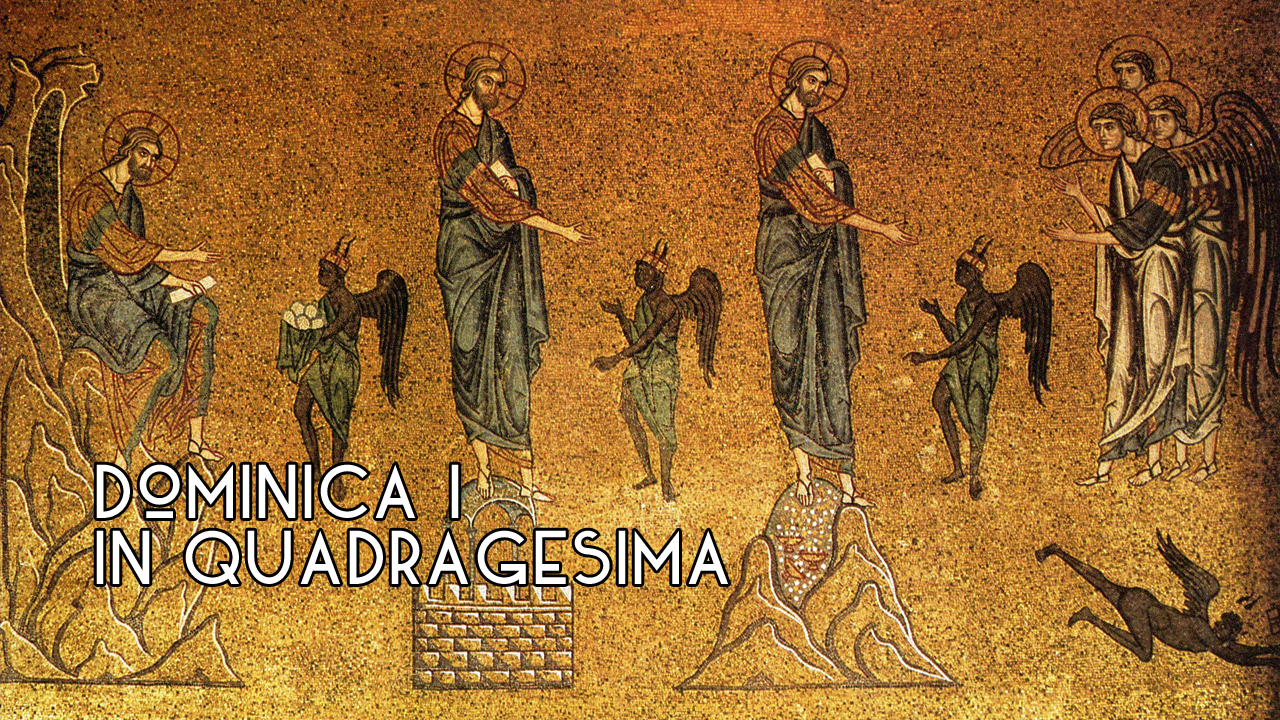
The Gospel from Matthew 4 opens after the Baptism in the Jordan. The heavens have been opened, the Spirit has descended, the Father’s voice has declared the Son. “Then Jesus was led up by the Spirit into the wilderness to be tempted by the devil.” The infinitive peirasthénai, aorist passive, carries the force of purpose, to have something done to Him. This is no accident of history. The confrontation is willed within the economy of salvation. The forty days and nights evoke the deluge and the covenant with Noah, the forty years of Israel’s probation, the ascent of Moses, the purification before promise. Christ is the New Adam, the New Moses, the New David, the New Solomon, the New Israel, the New Abraham. He gathers the types and recapitulates, puifies them.
Genesis recounts the serpent’s insinuation and Eve’s gaze: “vidit igitur mulier quod bonum esset lignum ad vescendum et pulchrum oculis aspectuque delectabile et desiderabile ad hoc quod scilicet prudentiam tribueret” (Gen 3:6). She saw that the tree was good for food, delightful to the eyes, desirable to make one wise. The Apostle names the triad: “quoniam omne, quod est in mundo, concupiscentia carnis est et concupiscentia oculorum et superbia vitae” (1 John 2:16). Lust of the flesh, lust of the eyes, pride of life. The Hebrew nahash beguiled the first Adam in an orchard, paradeisos. The New Adam confronts the Tempter in a desert.
The first assault touches hunger: stones to bread. The Greek ei can bear the sense since: since you are the Son of God, command these stones. The Lord answers with Deuteronomy 8:3: “Man does not live by bread alone, but by every word that proceeds from the mouth of God.” Fasting masters concupiscentia carnis. He who is hungry refuses to reduce sonship to appetite. He who will feed multitudes will not serve Himself.
The second assault presses spectacle and presumption. The devil cites Psalm 90/91 and urges a leap from the Temple’s pinnacle. A display would win acclaim. The Lord responds with Deuteronomy 6:16: “Non tentabis Dominum Deum tuum.” You shall not put the Lord your God to the test. Prayer cures superbia vitae. Sonship is received and obeyed; it is not flashed about for admiration.
The third assault opens the panorama of kingdoms and glory. “Haec omnia tibi dabo.” All these I will give you. Possessing all but without the Cross. The Lord answers with Deuteronomy 6:13: “Dominum Deum tuum adorabis et illi soli servies.” You shall worship the Lord your God and Him only shall you serve. Almsgiving alleviates concupiscentia oculorum. The eye is thus schooled to see goods as gifts to be shared, not spoils to be clutched.
The pattern extends beyond Adam. The Law for kings in Deuteronomy 17:14-17 warns against multiplying horses, wives, and gold. Solomon accumulated them and fell. Christ remains faithful. In Him the Davidic heir fulfills the Law without fracture. He is Priest, Prophet, and King in true obedience.
The Epistle from 2 Corinthians 6:1-10 places our struggle within realism: “We urge you not to receive the grace of God in vain.” Paul lists afflictions, labors, watchings, fastings, and the paradox of sorrowful yet always rejoicing. During Lent Mother Church trains us her children to receive grace fruitfully, gratefully. Recall that the Secret names restriction and temperance.
Bl. Ildefonso Schuster, reflecting on this very Sunday at the Lateran, wrote:
“The Fathers of the Church, and notably St Gregory [the Great +604], in a famous homily delivered on this day to the people assembled at the Lateran, ask why Christ consented to be tempted by Satan, and remark that he did so in order to partake of the infirmity of our nature, and in that nature to defeat and humble the tempter on our behalf and to obtain for us the grace of overcoming our temptations by the merits of his victory. … Our Lord also wished to teach us that there is no sin in being tempted, but only in giving way to the tempter. … The faithful should contemplate with special devotion this mystery of Christ tempted in the desert, for there is no other which shows more clearly how the divine Providence makes even the wiles of the devil serve to our sanctification by using temptation as a crucible in which to purify our virtue, and by causing it to be an occasion of greater grace and profit to the soul in its spiritual life.”
Temptation is itself not sin, unless you stupidly put yourself in the occasion of sin. Temptation overcome can be meritorious. The crucible refines. Providence turns trial into increase of grace. The Lateran Station, with Gregory’s voice echoing across centuries, situates our combat within the communion of saints. The Sacrifice offered at the beginning of Lent is the very victory of the New Adam made present.
Pope Benedict XVI, preaching on almsgiving, placed the discipline within ecclesial communion:
“… which represents a specific way to assist those in need and, at the same time, an exercise in self-denial to free us from attachment to worldly goods. The force of attraction to material riches and just how categorical our decision must be not to make of them an idol, Jesus confirms in a resolute way: ‘You cannot serve God and mammon’ (Lk 16,13). Almsgiving helps us to overcome this constant temptation, teaching us to respond to our neighbor’s needs and to share with others whatever we possess through divine goodness. This is the aim of the special collections in favor of the poor, which are promoted during Lent in many parts of the world. In this way, inward cleansing is accompanied by a gesture of ecclesial communion…”
Inward cleansing and ecclesial communion converge.
As pilgrims in spirit we accompany the ministers from the Collect to the Statio. We listen for the hook of the Psalm and pray the whole. We remember that the wilderness is not emptiness but arena. The New Adam has trampled the dragon. He has entered our infirmity emerged victorious on our behalf. We begin Lent with gratitude beneath the mantle of Mary, clothed in baptismal grace, strengthened by the Sacrifice. Prayer, fasting, and almsgiving become weapons and gifts. Our gifts of prayer, fasting, and almsgiving the Militant Church’s weapons in our Lenten discipline, our march upcountry.