The essence of a cliché is that it is unoriginal and often repeated, yet repetita iuvant because repetition forms and reforms us. Holy Mother Church, with maternal solicitude, gives us again the 1st Sunday of Advent, and again we say that with this day a new liturgical year begins. Perhaps this is not cliché at all, for the faithful need the reminder that the Church unfolds salvation history through a cycle that is centuries deep and millennia long, presenting ever anew the mysteries of the life of the Savior. Repetitio est mater studiorum, so we crowd together around the sacred mysteries and recapitulate the truths they contain. Liturgy is doctrine. We are our rites. To borrow from St. Thomas Aquinas, quidquid recipitur ad modum recipientis recipitur. The transformation worked in us by grace and doctrine depends on our receptivity. The mysteries do not change, but we do. The paper cup must become more like the swimming pool if it is to receive what is poured out with divine liberality.
Thus, at the threshold of a new liturgical year, we examine ourselves. Are we larger vessels than we were last Advent? Have victories, sufferings, temptations, and consolations widened the capacity of the heart? Advent presses that question upon us because it is the season in which the Church directs our gaze toward the Adventus of the Lord, the Parousía, both in glory at the end of time and in the many ways He comes to us now. He comes in the Eucharist when the priest speaks the Lord’s own words. He comes in Sacred Scripture, in the person of the priest who is alter Christus, in actual graces, in works of mercy, and in the poor to whom He said, “as you did it to one of the least of these my brethren, you did it to me” (Matt 25:40).
Since we are shaped by the orations and readings that the Church gives us, it is wise to meet them not as strangers but as companions. A few minutes a day beginning Thursday before a Sunday Mass can dispose the mind to receive what God wishes. Read the antiphons, the orations, the lessons. Let them take root. Review them on Sunday night, and again in the days that follow. This simple habit makes the soul more capacious in receiving grace. Then, when the Sunday cycle comes around the next week, begin again. Repetita iuvant.
Advent directs us to prepare for the encounter with the Just Judge and King, either at the end of time or at our death. The liturgy cries out with Isaiah and John the Baptist, “Make straight the paths.” The Latin adventus translates the Greek parousía. In Roman antiquity an adventus or visitatio meant the arrival of a ruler who came to inspect, judge, and reward. Those who had prepared fared well. Those unprepared trembled. Hence the old sense of “visit upon,” as in divine retribution. Therefore the Church, like a vigilant mother, bids her children not to treat this season lightly. She calls us back to confession, to vigilance, to readiness for the Coming of the Lord.
Her wisdom appears also in the choice of the Epistle from Romans, which admonishes us to “put on the armor of light.” This is the uniform of the day for soldiers of the Church Militant. The Latin prayers of the Roman Rite form us in these military images. Change the prayers over time and the people will be changed. We have seen what happens when these prayers are muted or reshaped. When the orations retain their clarity, the faithful remember who they are. To begin Advent, therefore, is to take up anew the armor of light.
The winds of change have long blown through the Church and the world, and they do not seem to be diminishing. Living in Rome as I did for years taught me that when a door or window is opened, the pressure in the house shifts and other door or winder slams violently. So it is in the spiritual order.
Holy Church deliberately opens the liturgical year with the unsettling eschatological discourse from Luke 21. It is as if Holy Mother is calling us back to reality from worldly distraction. She awakens, as the German commentator Joseph Zöllner wrote, Ernst (seriousness), Wachsamkeit (watchfulness) and Bußgesinnung (a penitential spirit). This is the proper interior disposition for Advent.
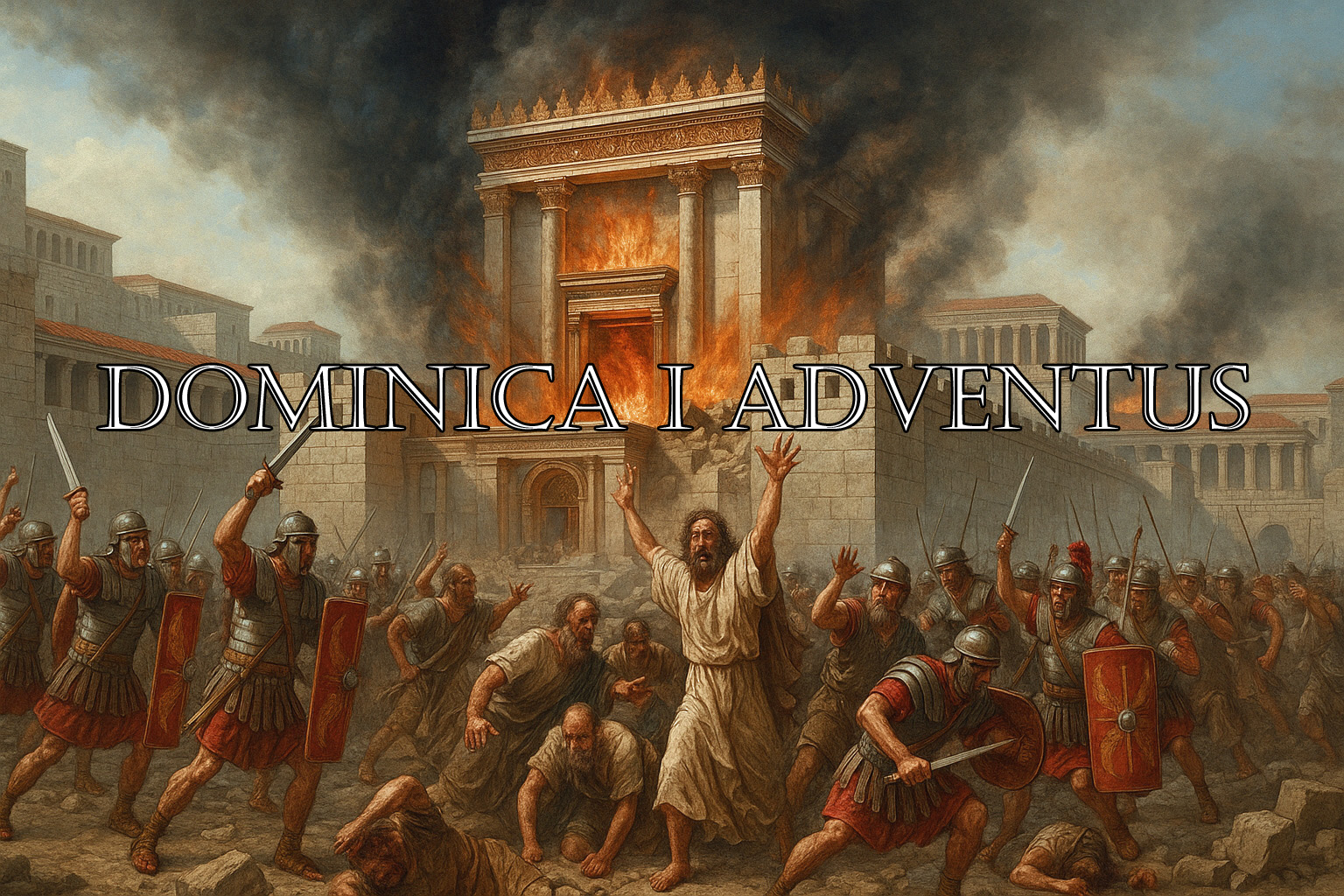
Our Lord spoke of the destruction of the Temple, so He prophesied signs that would make men’s hearts faint with fear. The Temple, decorated with constellations and with a bronze laver called the Ocean, was seen as a microcosm of the universe. When the Romans razed the Temple in 70 AD, they ravaged their cosmos. Josephus writes that five hundred Jews were crucified daily, and that a sword shaped comet hung over the city. The Lord was not speaking hyperbole about Jerusalem’s destruction, though He wove into that prophecy words that point to the final Coming of the Son of Man.
Luke’s Gospel, proclaiming signs in sun, moon, and stars, admonishes believers: “when these things begin to take place, look up and raise your heads, because your redemption is drawing near” (Luke 21:28). Men instinctively duck when something crashes down, but Christ commands us to lift our heads. The Church, like her Lord, must pass through her own Passion, for the disciple is not above the Master. Therefore winds rattle the house of God, and – BAM – doors slam in unexpected places. If by opening a door and windows slam, we recall also the Italian proverb “chiusa una porta, si apre un portone… close a door, a larger door is opened”.
We do not cower. Heaven and earth will pass away, but the words of Christ will not pass away.
Dom Prosper Guéranger described the beginning of Advent as the cry of the Church: “Come!” In The Liturgical Year he writes, “The whole world is in expectation of its Redeemer; come, dear Jesus, show Thyself to it by granting it salvation.” He places on the Church’s lips the solemn plea of a mother anxious for her children. The coming of Christ, Guéranger teaches, is the divine Sun rising on a darkened world. His citation of Psalm 84 and the rhythm of the liturgical year reminds us that the Church looks backward to Bethlehem and, simultaneously, forward to the day of the Lord, which St. Paul calls the epiphaneia of Christ’s glory.
The ancient sacramentaries began the liturgical year with Christmas. Only later, after the Christological controversies clarified the mystery of Christ’s two natures at Ephesus (431) and Chalcedon (451), did the Church shape Advent as a season of preparation. The lex orandi followed the lex credendi. As doctrinal clarity deepened, the liturgy came to include Sundays of expectancy. The Blessed Virgin, called theotokos – God-bearer – by the Council of Ephesus, stands at the head of Advent as the ultimate fulfillment of what Ark of the Covenant could only prefigure: in her the Word became flesh and dwelt among us. The faithful, longing for the First Coming, also long for His return and for every way He comes to the soul.
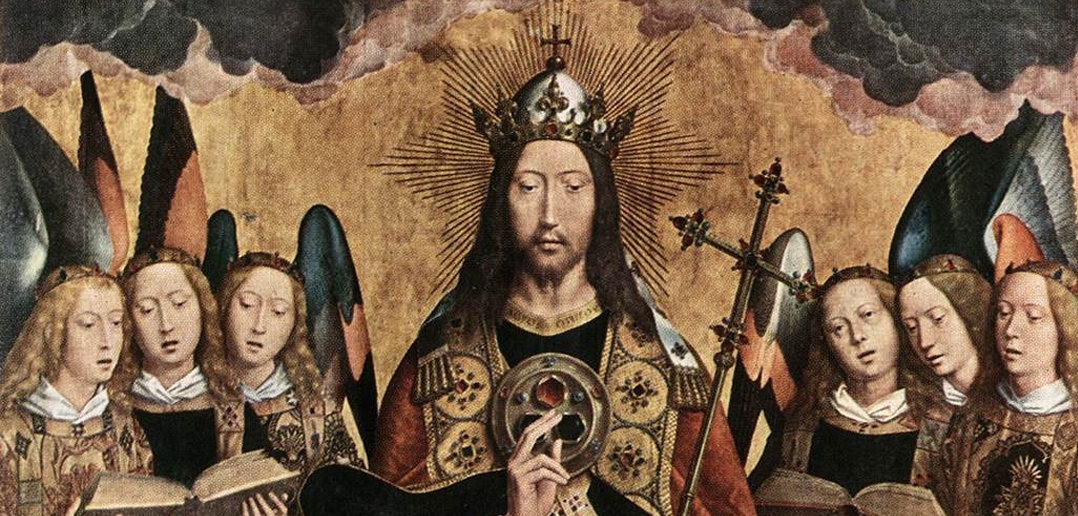
St. Bernard of Clairvaux famously preached that Christ comes in three ways in (Sermo 5 in Adventu Domini). The First Coming is in the flesh and in weakness. The Second Coming is in glory and majesty. The Third Coming is in spirit and power, when Christ visits the soul. Citing John 14:23, Bernard describes the Trinity making a dwelling in the heart of the believer. Upon this foundation one can reflect on the ways Christ comes in this Middle or spiritual Coming. He comes through Sacred Scripture, which the Church indulgences for those who read it devoutly. He comes in the poor and needy. He comes in the priest by ordination. He comes in the Eucharist at the consecration and Holy Communion. Pius XI explained this priestly mystery in Ad Catholici sacerdotii, saying
(12) … Thus the priest, as is said with good reason, is indeed “another Christ”; for, in some way, he is himself a continuation of Christ. “As the Father hath sent Me, I also send you,” is spoken to the priest, and hence the priest, like Christ, continues to give “glory to God in the highest and on earth peace to men of good will.”
Ven. Fulton Sheen taught in Life of Christ that Jesus is the only person ever born in order to die. The Cross cast its shadow across the Crib. The First Coming encompassed the whole arc of the Paschal Mystery and implicitly announced the Second Coming in glory. Advent therefore celebrates both Bethlehem and the final Day of the Lord. The Church, praying the Lukan Gospel of signs in the heavens, prepares for joy through penance.
The joyfully penitential faithful do not cower. We lift our heads toward Him who lifts us from sin.
The Introit for the 1st Sunday of Advent, Ad te levavi from Psalm 24/25, embodies this upward movement. “To thee, O Lord, I lift up my soul”. This is how we begin the year in our very first Mass. The believer, mindful that enemies lie in wait, entrusts his path to the Lord. Christ’s admonition in Luke 21 intensifies the message: when the signs arise, lift your head. The Introit’s cry and Christ’s command converge. Advent begins with raising not only the eyes but the soul to God.
One cannot raise the head if the soul is burdened with sin. Therefore, the call to confession resounds through these texts. In the confessional, though you physically go to Him, it is “advent … parousia… visitation”: Christ comes to you in the person of the priest, alter Christus. Christ liberates you, washing your soul whiter than snow in His Blood, the Blood of the Lamb. This is one of His Middle Comings. The ancient Collect for this Sunday from the Gregorian Sacramentary articulates this plea:
Excita, quaesumus, Domine, potentiam tuam, et veni,
ut, ab imminentibus peccatorum nostrorum periculis,
te mereamur protegente eripi,
te liberante salvari.
What a jewel.
Firstly, the earnestness of our petition rings in the two imperatives, excita (which is at the head of the sentence as it is in 12 other Collects) and veni (which is repeated on nearly every page of the liturgy of the Mass and the Office during the next weeks of expectation).
Immineo means “threaten” because it is “to project over… hang down over”. This of the “Sword of Damocles”, which was suspended by a single hair over the ruler’s head. That imminentibus and periculis go together, their separation in the sentence (hyperbaton) giving them greater force. Then we find a parallelism in the matching endings (homoioteleuton)
te (mereamur) protegente eripi
te liberatante salvari
The prayer dazzles from the four major facets of the gem, the first and then last two words of the first colon of the protasis, excita potentiam tuam, and the emphatic last words of the last two lines or cola, eripi… salvari.
A REALLY LITERAL VERSION:
Rouse up Your might, we beseech You, O Lord, and come,
that we may merit, as You are protecting us, to be snatched away
from the menacing dangers of our sins
and, as You are freeing us, to be saved.
When we pray this through the intermediary of the priest at the altar, we stand in our hearts with our forebearer patriarchs and prophets, the whole people before Christ’s birth, longing for the coming of the Messiah.
“Excita! Veni! Eripe nos! Salva nos!” With Your might, come and protect us, snatch us from the dangers of sin hanging over us, and save us.
The Collect becomes a pattern for the entire spiritual posture of Advent. The faithful ask the Lord to awaken His power in their regard. St. Thomas Aquinas reminds us (STh I, q. 75, a. 5; also I, q. 12, a. 4; III, q. 5, a. 1) that the effect is received according to the mode of the receiver. We ask that we may merit (mereamur) to be snatched away and saved, but merit is strengthened by receptivity. Receptivity increases by full, conscious and actual participation in the rites. Participation is not principally exterior activity but rather the active receptivity that the Fathers of Vatican II intended when they taught about actuosa participatio. We are our rites. To be baptized and present at the sacred mysteries is to be shaped by the words and gestures that the Church has lovingly, patiently, faithfully, prudently handed down for centuries through times tranquil and torrential, conditions serene and stormy.
As current winds shake the house of the Church, the faithful must remember that sudden slams are not signs of utter abandonment. They are reminders to lift the head.
The slamming of a door in your face may herald a door of grace opening elsewhere.
The Lord’s words do not pass away. He who promised to come will come. Our cry “Come!” is therefore not the voice of despair but of hopeful expectation. The Lord who came in weakness will come in glory. The same Christ who visits the soul in priest, sacrament, and Scripture will visit it again at the end. Thus the faithful begin the year with the psalmist’s prayer to know the Lord’s ways and learn His paths.
Advent gathers all these themes into a unity: vigilance, longing, judgment, mercy, readiness, and joy. The Church Militant buffs up her armor of light. She prepares her children to encounter the Lord in every Coming. She teaches them to stand upright when the signs appear. She opens before them the mysteries that repeat every year yet renew the soul each time.
In this repetition we find the paradox of Christian worship. The sameness of the liturgy, its consistency through the ages, is the instrument through which God changes us. Quidquid recipitur…. Repetita iuvant. The rites remain firm year in and year out, but each year we have changed. We grow into them as the cycle repeats and grace deepens.
Therefore on this 1st Sunday of Advent the Church says to her children what Christ said to His disciples. Lift up your heads. Lift up your souls. Lift up your hearts. Redemption is near. The Lord who comes in the humble Host will come in glory. The Lord who came in Bethlehem will come with His angels. The Lord who comes in Scripture speaks now as He spoke then. The Lord who comes in confession absolves now as He absolved the paralytic. Be watchful. The Lord who comes in the poor stands at the door seeking charity. The Lord who comes in the priest raises His hand in blessing. The Lord who comes in grace enlarges the heart to receive Him. All these Comings meet in the Adventus of Christ.
Prepare your soul vessel by the self-emptying of going to confession. Begin by lifting the soul in the words of the psalmist. Begin by opening the Scriptures. Begin by preparing the heart for Holy Communion. Begin by taking up the armor of light. The doors that slam in the world – even when they are slammed by their overseers – can open unexpected opportunities if the soul is alert and our eyes aren’t fixed on the dirt. Lift up your heads.