From the pre-Lent Sundays onward, Holy Mother Church has led us into a liturgical dying. First there was the silencing of the Alleluia and the Gloria. Violet appeared on Sundays as a herald of the coming fast. Then Lent itself deepened the deprivation day by day, save for the interruption of the greater feasts. Flowers disappeared. Instrumental music fell silent. Even Laetare Sunday, with its rosacea vestments and temporary softening of austerity, came as only a brief shaft of warmth through cold water, a glimpse of Easter from afar before the Church drew another breath and plunged again into the depths. Passiontide now begins the final descent.
This Sunday, the First Sunday of the Passion, carries us into that rough fortnight which stretches toward the Pasch, to the first Sunday after the first full moon of northern spring. The Roman Station is St. Peter’s on the Vatican Hill, sanctified not only by the Prince of the Apostles’ tomb but also by the ancient custom of ordinations after the all-night vigil. The liturgy narrows its gaze. The Church’s prayers, readings, and ceremonial gestures now gather around the innocent Christ persecuted, opposed, contradicted, and at last hidden from human sight. In this season the Church is not merely remembering the Passion as a distant historical sequence. She is conforming us to it sacramentally. She prunes us by deprivation so that, with Christ, we may pass through death into life.
The Gospel reading’s context: we are still in John 8, in the Temple precincts, in the treasury, in the charged atmosphere of Sukkoth, the feast of Tabernacles or Booths. Only shortly before, at the close of that great festal week, the towering candelabra of the Temple had blazed with such brilliance that their light was seen throughout the city. On that background Christ declared, “I am the light of the world” (John 8:12). During that same feast there had been the pouring of water and wine, prayers for rain, and longing for divine refreshment. There too the Lord cried out, “If any one thirst, let him come to me and drink” (John 7:37). John’s Gospel is saturated with light, and the ancient Church linked illumination with baptism. It is therefore fitting that, as Passiontide begins, the One who is Light should also become hidden, for divine light is not extinguished when veiled. It is sought more intensely.
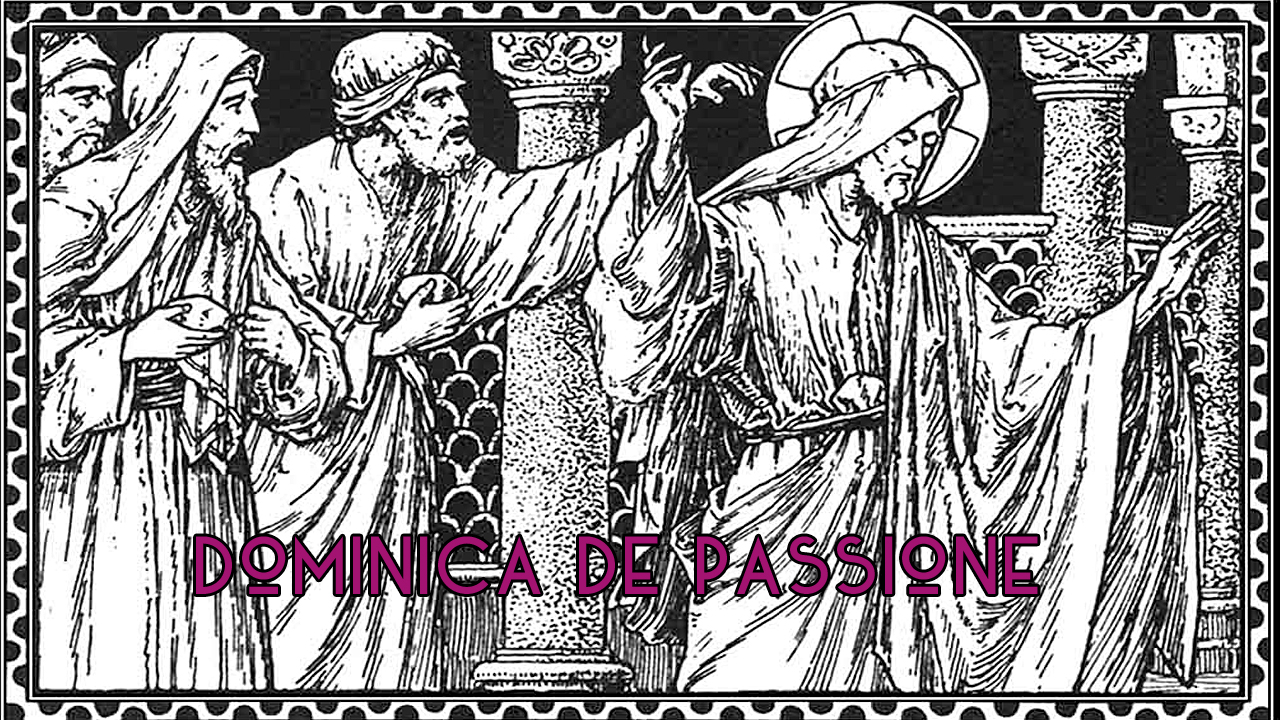
In this time, the Lord presses His hearers with the question: “Which of you shall convince me of sin?” He whom Hebrews presents as the sinless High Priest stands before men who are themselves bound by sin and enraged at truth. They accuse Him of having a devil. He answers with majestic calm and then utters the word that detonates the scene, “before Abraham came to be, I am” (John 8:58), that is, the claim of divine identity itself, sounding in Greek as ἐγώ εἰμι, “I am”, and reverberating with the dread majesty of the divine Name. They understand what He is claiming. They take up stones. Then comes the line which the Roman liturgical tradition seized and unfolded with genius: “Iesus autem abscondit se …but Jesus hid Himself” (John 8:59).
That brief verse has governed the Church’s custom for more than a millennium. Because “Iesus autem abscondit se”, crosses and sacred images are veiled from this day. Passiontide imposes a further deprivation upon sight itself. What the eye loves is hidden. What the heart loves must be sought in faith. Former centuries often knew the cross above all under the sign of triumph. Early crosses were frequently a crux gemmata, a jeweled cross, radiant with victory. The Church’s meditation on the Passion deepened, and so her rites deepened with it. Purple veils came to cover crucifixes, statues, and pietà scenes. The hidden Christ of the Gospel is echoed in the hidden Christ of the sanctuary. The saints are hidden with Him, as the members with their Head. The eye is made to hunger. The heart is prompted by loss.
Hearing too is pruned. In the older form of Holy Mass the Psalm Iudica disappears from the prayers at the foot of the altar. The priest passes from the Introibo antiphon to the Adiutorium nostrum and the Confiteor. Certain Gloria Patri conclusions fall away. The cuts are small in themselves, and for that reason they are effective. Death often announces itself by little absences before the final stillness. The liturgical organism yields signs of constriction, subtraction, restraint. Then the Triduum will intensify everything. After the Mass of Holy Thursday the Blessed Sacrament is removed from the main altar. The altar itself is stripped. Bells are silenced and replaced by wooden clappers. On Good Friday there is no Mass. All is still and dark. At the beginning of the Easter Vigil even light is absent, until a single spark struck from the flint kindles the new fire in the dark. The Church descends with Christ into the silence of the tomb so that she may rise with Him in glory.
As dramatic, even “theatrical” these rites might seem to the uninitiated, these are sacramenta, mysterious realities in which Christ the High Priest acts. The true Actor in the liturgy is Christ Himself, perpetually offering His Sacrifice in the heavenly sanctuary and drawing His members into that action. Sacramental reality is no less real than the sensible world around us. It is more penetrating, more determinative, more enduring. Yet it must be entered rightly. One must be baptized, incorporated into Christ and His Body, and one must strive to remain in the state of grace. Then, through full, conscious, and active participation, understood in the Church’s true sense as interior union expressed through the sacred rites and not mere exterior occupation, the faithful are conformed to the mysteries being renewed in the sacred liturgical rites. In Passiontide we do not stage grief. We undergo conversion. We are our rites.
The Lesson of Hebrews 9 stands in accord with the Gospel. St. Paul presents Christ as the High Priest of “a greater and more perfect tabernacle not made with hands, that is, not of this creation.” Every Hebrew would have recognized the allusion. The old tent of meeting, later the Temple, was tripartite: the outer court of sacrifice, the holy place with Bread of the Presence, Menorah, and altar of incense, and within all the Holy of Holies where the Ark stood and where only the high priest entered, and that only once a year, on the Day of Atonement, Yom Kippur. The old high priest entered with alien blood for the sins of the people. Christ enters the heavenly Holy of Holies with His own Blood. He is priest, victim, and oblation all together in His Person. He does this once for all, yet that once-for-all sacrifice is made present on our altars throughout the world because the heavenly sanctuary is beyond the prison of succession and locality. Historical Calvary is not repeated; it is renewed sacramentally.
This is the new covenant, and covenants in Scripture are ratified in height, sacrifice, and sacred meal. Sinai, Moriah, the upper room, Calvary, Olivet, the heavenly sanctuary: all these converge in the Eucharistic mystery. The ascent to Calvary and the Ascension into heaven belong together, and the Last Supper opens onto both. Because our High Priest stands in heaven, we can stand at the altar. Because He has entered the sanctuary not made with hands, the Church can renew here below what He offers there above. Passiontide therefore does not turn us inward through a merely private sadness. It opens before us the architecture of redemption. The hidden Christ of the veils is at the same time the unveiled Priest of the sanctuary above.
Hence Lent, and now Passiontide within Lent, retains a triumphal vector even amid the austerities. Older Christian piety knew well how to gaze upon the cross as a banner of victory. The crux gemmata testified that the Passion is already the beginning of conquest. The Church in recent centuries has stressed, and rightly, the bitter before the sweet. Yet the sweet is already present in promise. The combat with the devil begun in the first Sunday of Lent continues through the whole season and flowers in the kingship of Christ revealed upon the Cross. This battle did not end in Jerusalem in the first century. It continues in the mystical Christ, in His Church and in every member. Therefore, the faithful are not pious spectators of a sacred drama, but rather active combatants under the victorious sign.
Yet all of this raises a severe personal question. If Christ can say, “Which of you shall convince me of sin?”, can any one of us say the same? St. John answers with terrible clarity:
“If we say that we have no sin, we deceive ourselves, and the truth is not in us. If we confess our sins, he is faithful and just, to forgive us our sins, and to cleanse us from all iniquity. If we say that we have not sinned, we make him a liar, and his word is not in us” (1 John 1:8-10)
The verse in the middle is the hinge. “If we confess our sins.” The hidden Christ of Passiontide does not abolish confession. He draws it out of us. He hides His visible image in the Church so that we may cease hiding our sins from Him. What is veiled in the sanctuary should unveil what is concealed in the conscience.
The institution of the sacrament is plain. On the evening of the Resurrection the Lord breathed on the Apostles and said, “Receive ye the Holy Ghost, whose sins you shall forgive, they are forgiven them, and whose sins you shall retain, they are retained” (John 20:22-23). The Council of Trent, expounding this text, declared that Christ instituted the sacrament of Penance when, risen from the dead, He bestowed this power upon the Apostles and their lawful successors. Trent further taught that the faithful who knowingly withhold sins do not place them before the divine mercy for pardon through the priest, for “if the sick be ashamed to show his wound to the physician, his medical art cures not that which it knows not.”
This has practical consequences, severe and salutary. Mortal sins must be confessed in kind and number, with those circumstances that change the species of the sin. Confession is judicial-sacramental truthfulness before Christ the Judge who heals through the ministry of the priest. The priest acts as alter Christus, another Christ, by sacramental configuration and by the faculty granted for absolution. The penitent must examine conscience seriously, confess plainly, and hold back nothing deliberately. Deliberate concealment poisons the confession. Sins forgotten after careful examination are forgiven, yet when remembered later they ought to be brought to the next confession. The Church’s doctrine here is not cruel. On the contrary, It is profoundly merciful. But it isn’t gloss-over sloppiness. We, as self-prosecutors, remain precise in our judicial-sacramental truthfulness before Christ the Judge. The soul is too important for blur and approximation, sloppy sentiment, nebulous generalizations.
And there is urgency in this. “A subitanea et improvisa morte, libera nos, Domine…From a sudden and unprovided death, deliver us, O Lord.” This is one of the most important petitions the Church has ever sung. It is in the Litany of Saints. A sudden death may, in itself, be a mercy. A sudden and unprovided death is dreadful because it means death without sacramental provision, without confession, without anointing, without Viaticum, without the Apostolic Blessing. We do not know the day or the hour. Therefore, Passiontide’s stripping and veiling should be read as a memento.
See how quickly things are removed! Hear how quickly sounds cease! Watch how light itself is taken away!
So too a life can close.
The prudent Christian does not negotiate with that fact. He goes to confession.
The Church veils images because Christ “hid Himself”. The sinner goes to confession because he must cease hiding himself. Passiontide creates an austere pedagogy of the senses so that the soul may be brought into truth. The hidden crucifix tells us to look longer. The omitted prayers teach us to listen more carefully. The stripped altar teaches us that nothing created can finally sustain us. Then, in the darkness of the Vigil, a spark is struck. Fire spreads. Light returns. The Church springs to life because Christ is risen, and His life courses again through all the sacramental arteries of His Mystical Body. Those who have died with Him liturgically are ready to rise with Him sacramentally. Those who have pruned themselves by confession and penance are ready to receive Easter not as a date but as a deliverance.
Therefore spend time before the veils. Let them work on you. Let them sharpen desire. Ponder the paradox that now, when sacred images are hidden, is precisely the time when they should be most in view. Faith must learn to see through deprivation. Charity must learn to seek what the senses cannot possess. And because the High Priest has entered the heavenly sanctuary with His own Blood, do not linger outside in reluctance or shame. Enter the confessional. Open the wound. Tell the sins. Let the Precious Blood, applied in the sacrament Christ instituted, cleanse what you cannot cleanse yourself. Passiontide is not only about what is hidden from us. It is about the mercy that still stands open before us.
In these final days before the Pasch, Holy Church teaches by subtraction so that we may learn divine abundance. Veils, silence, stripped altars, darkness, and the hidden Christ all summon us to deeper sight, honest confession, and union with the High Priest who entered the heavenly Holy of Holies with His own Blood. If we die liturgically with Him through penance and grace, Easter will not arrive merely around us. It will rise within us.