September was the old “seventh month,” and at Rome the harvest stood in the background of the Church’s prayer. The fields are being gathered in, the year bends toward its close, and the liturgy begins to take on those autumnal notes which will become more insistent as the Sundays advance: judgment, perseverance, the end of the age, the gathering of God’s people. The 17th Sunday after Pentecost arrives in the traditional Roman calendar just after the autumn Ember Days, those ancient days of fasting, prayer, thanksgiving, and ordination which sanctify the turning of the season.
Against that background the Introit begins with Psalm 118: “Iustus es, Domine, et rectum iudicium tuum … Thou art just, O Lord, and Thy judgment is right,” and the psalm verse adds, “Beati immaculati in via … Blessed are the undefiled in the way.” A way is set before us. We are to walk it undefiled.
Then comes one of those terse Roman Collects which can open an entire theology in a handful of words:
Da, quaesumus, Domine, populo tuo
diabolica vitare contagia:
et te solum Deum pura mente sectari.
Grant, we beseech Thee, O Lord, unto Thy people
to shun diabolical contamination,
and with a pure mind to follow Thee, the only God.
So dense. So Roman.
The hinge is in those two opposed movements, vitare and sectari. Vitare means “to shun, evade, flee from”. Sectari, a deponent verb with active force, means “to follow eagerly, pursue, attend, accompany”. The Christian life therefore has direction. Something must be fled and someone must be followed. Between them stands the condition of the soul: contagia on one side, pura mente on the other.
Contagio can mean simple “contact”, then “infection, pollution, contamination”, even “corrupting companionship”. Purus is “clean, unmixed, undefiled”. Mens is richer than our English “mind”. According to the context, it can reach into “intellect, disposition, heart, soul, the interior man”. The petition asks God to make His people capable of avoiding whatever infects the interior life and of cleaving, whole and undivided, to Him alone.
That “alone” matters. Te solum Deum. The prayer has the ring of the First Commandment and of the Shema (cf. Deut 6). It also prepares us for the Gospel, where the lawyer asks Christ for the great commandment and hears: love God with your whole heart, soul, and mind, and love your neighbor as oneself.
The Collect has already put the issue before us in terms of fidelity. One God is to be followed with a pure mens. Every false god, rival allegiance, and diabolical infection must be avoided.
The biblical image of idolatry as adultery lurks nearby.
Israel’s going after strange gods is repeatedly described in the prophets with the language of marital infidelity. A covenant means belonging. The Lord claims His people for Himself. But sin pulls one toward other love. Thus, diabolica contagia includes more than spectacular demonic Hollywood assaults. The Enemy’s ordinary work is to draw the rational creature away from the Creator toward created things loved out of order. He does it through the old triad of enemies, mundus, caro et diabolus … the world, the flesh, and the devil. A medieval exposition of the Lord’s Prayer, transmitted under Abelard’s name, puts the formula crisply: “There are three things which tempt us: the flesh, the world, the devil”. The Council of Trent later gave the same trio a solemn place in its Decree on Justification when, treating perseverance, it warned the justified of “the combat that yet remains with the flesh, with the world and with the devil” (Session VI, ch. 13).
Perseverance. There is another key for this Sunday.
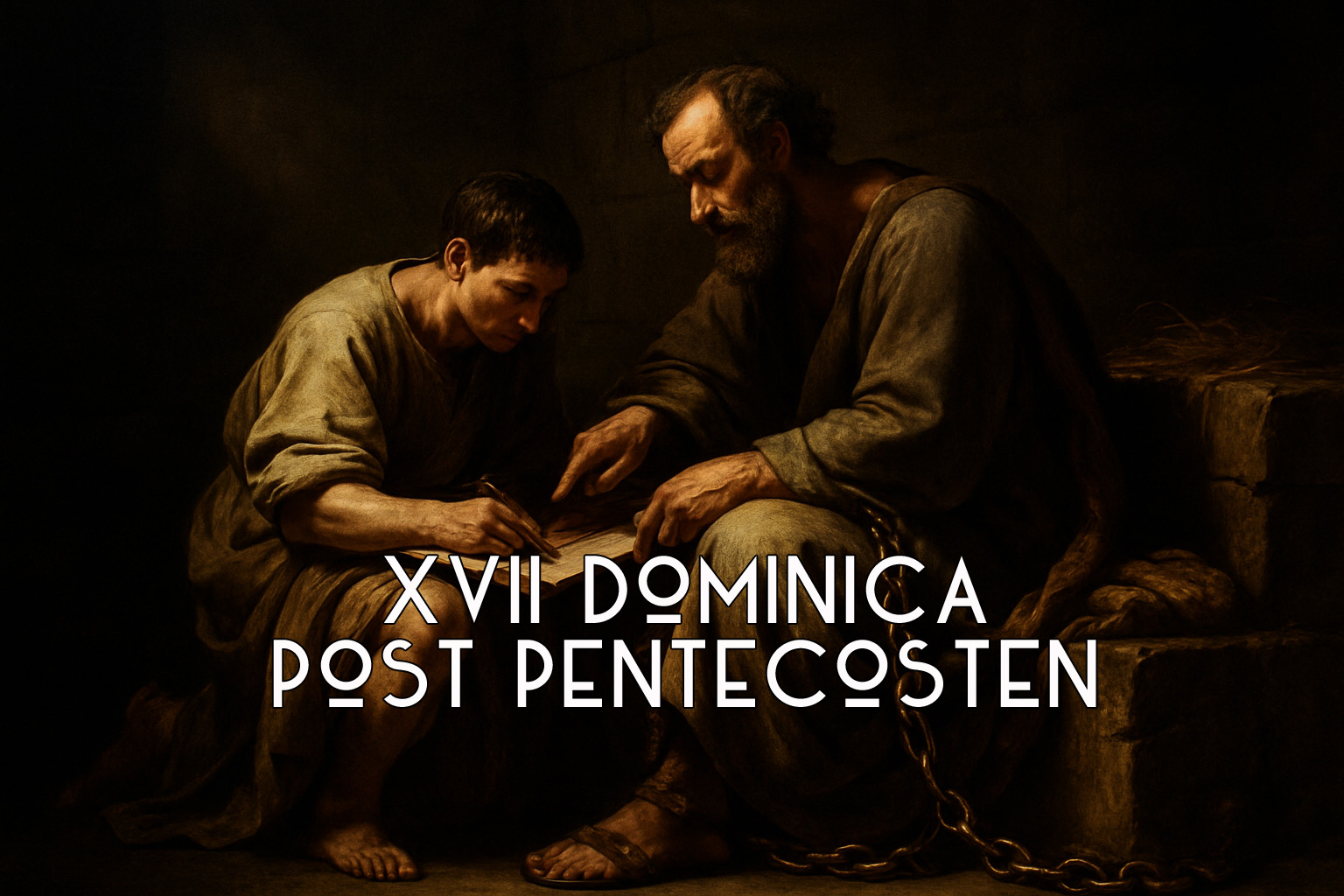
St. Paul writes from prison: “I therefore, a prisoner in the Lord, beseech you to walk worthily of the vocation in which you have been called” (Eph 4:1) The verb fits the Introit’s via. Walk. Keep to the road. Paul then tells us howthat is, “with all humility and meekness, with patience, bearing with one another in charity (v.2)”. The object “is servare unitatem spiritus in vinculo pacis… to preserve the unity of the Spirit in the bond of peace” (v.3).
Then the great hammer blows fall: one body, one Spirit, one hope, one Lord, one faith, one baptism, one God and Father of all.
The Collect’s te solum Deum and Paul’s unus Deus belong together. So do the Collect’s purity and Paul’s unity.
A divided heart cannot follow the one God purely. A divided ecclesial body cannot easily manifest the one Lord whom it confesses.
The Enemy, who tempts individuals by fragmentation, also works upon communities by division. The Greek διάβολος carries the sense of slanderer or accuser, and Christian experience knows well how his work proceeds through accusation, suspicion, rupture, and division. Hence, Paul roots it in realities received from God: one baptism, one faith, one Lord, one Spirit. Our task is servare, to keep, preserve, guard what the Spirit has made.
Paul calls this a vocation, κλῆσις, from καλέω, “to call.” To the Ephesians, “as you were called in the one hope of your calling.”
There is a tendency to narrow “vocation” to priesthood or the religious life. Paul goes deeper. Baptism itself – as we have since Vatican II heard until it comes out our noses – is a calling. Of course Paul knew it, the Fathers knew it, the medieval writers knew it…. Nihil novi sub sole. God calls us out of the old life, gives us a new name in Christ, and incorporates us into the ecclesia, ἐκκλησία, the assembly summoned by God. Before the priest or nun has a particular vocation, every Christian has the primordial call to holiness, fidelity, and communion in Christ.
This makes division among Christians especially bitter. Persecution from outside wounds the body. Fraternal hatred wounds from within. Paul knew both. Chains imposed by an emperor are visible. The lacerations caused by rivalry, pride, heresy, suspicion, and faction can sink deeper. Hence Paul’s insistence upon humility, meekness, patience, “ἀνεχόμενοι ἀλλήλων ἐν ἀγάπῃ … bearing with one another in love.” There is strength in that ἀνεχόμενοι. Christian forbearance is active endurance of the burdens that come with other people, other temperaments, other weaknesses, other wounds.
The bond of peace costs something because charity costs something.
The Gospel reading supplies the inner form of that bond.
Christ joins Deuteronomy 6:5 to Leviticus 19:18: love God wholly; love your neighbor as yourself. Charity has one divine source and reaches both upward and outward. The neighbor cannot be separated from God without becoming an idol, a faction, a tribe, a party. God cannot be loved while His image in the neighbor is treated with contempt. Here Paul’s ecclesiology and Christ’s commandment meet. The “one body” is held together by caritas because the members have been called into one Lord.
Then Our Lord turns the examination around. “What think you of the Christ? Whose son is he?” They answer: David’s.
Christ cites Psalm 109(110): “The Lord said to my Lord: Sit at my right hand.” The Hebrew begins Ne’um YHWH la-’doni… The oracle of the LORD to my lord.” The Messiah is David’s son, yet David calls Him Lord. The Church hears here the mystery of the divine Messiah, true man from David’s line and true Lord. The unity of the Church rests finally in the identity of Jesus Christ. He is the center toward whom the many members converge because He is their Head.
This is where an old Roman disturbance becomes unexpectedly useful. Bl. Ildefonso Schuster, commenting on Ephesians 4, recalled the crisis under Constantius. Pope Liberius (+366) had resisted imperial pressure during the Arian controversy and was exiled. Felix was installed in his place. When Constantius later proposed that Liberius and Felix govern together, the edict was read in the Circus. Theodoret records the Roman reaction. After mocking the idea that the two factions might now conveniently have two bishops, the crowd cried with one voice: “One God, one Christ, one bishop. Schuster saw in the episode a vivid historical echo of Paul’s insistence upon the unity of the Christian family.
There is something splendid in that acclamation and something sobering in the larger history. The Romans understood instinctively that ecclesial communion has visible shape. Yet fourth-century Rome also showed how quickly zeal for unity could curdle into factions. The disputes surrounding Liberius and Felix were followed, after Liberius’ death, by the violent rivalry of Ursinus and Damasus. Blood was shed in churches. Christian men who could confess one Lord proved fully capable of striking one another over who should occupy His episcopal throne.
The lesson cuts in two directions.
Truth matters enough to fight for, in the spiritual sense of the word.
Charity governs the manner of the fight.
Humility and meekness do not require doctrinal fog, and doctrinal clarity does not dispense us from patience and charity. The one faith of Ephesians 4 cannot be preserved by pretending that contradictory confessions are identical. The bond of peace cannot be preserved by treating brethren as enemies to be crushed. The history of the Church supplies abundant evidence for both errors.
The ancient Christians could become ferociously excited over theology. The difference between homoousios and homoiousios seemed to hang on an iota, and in one sense it did. “Of the same substance” and “of like substance” were not interchangeable formulas. The divinity of the Son was at stake. Yet the Nicene confession itself tells us why charity matters: if the Son is truly consubstantial with the Father, and if by baptism we are incorporated into the Son, then our communion has its source in the life of God. Ecclesial unity is therefore a supernatural reality before it is an administrative problem.
Here the Collect returns with greater force. Diabolica vitare contagia includes the poison of false doctrine, certainly, and also the passions by which a defender of truth can become infected: vanity, wrath, envy, ambition, contempt. One may speak an orthodox sentence with a disordered soul. One may win an argument and injure the bond of peace. One may also invoke “unity” to suppress legitimate differences, to demand silence where discussion is permitted, or to turn ecclesiastical authority into a partisan instrument.
The devil is content with either route, provided that charity dies.
Joseph Ratzinger saw the same difficulty in the years after the Council. In a 1966 lecture, published the following year as “Catholicism after the Council,” he wrote that liturgical reform required “a very generous measure of tolerance within the Church,” adding that this amounted to a great measure of Christian charity (The Furrow 18, no. 1 [January 1967], 13).
Robert Card. Sarah later returned to that passage precisely because Ratzinger had connected authentic liturgical renewal with Paul’s “bearing with one another.” Sarah’s point remains uncomfortable because it is simple: liturgical questions touch identity, memory, sacrifice, reverence, and the handing on of faith, so ecclesiastical action in this field can either strengthen peace or deepen wounds. In his 2022 essay “The Inexhaustible Reality: Joseph Ratzinger and the Sacred Liturgy,” Sarah lamented measures which, in his judgment, had disturbed the liturgical peace and might threaten the Church’s unity.
That question belongs organically to this Sunday. Paul does not demand sameness of temperament, spirituality, or legitimate expression. His catalogue of “ones” concerns the constitutive goods of the Church. One Lord. One faith. One baptism. One God and Father. Within that communion, patience and forbearance are requirements of charity, especially where lawful differences remain.
A useful old maxim therefore comes to mind:
In necessariis unitas, in dubiis libertas, in omnibus caritas.
“In necessary things, unity; in doubtful things, liberty; in all things, charity.”
Would that those who are actively suppressing the people who desire Traditional sacred worship today might come to know the wisdom of that.
This maxim, is regularly handed around as being from St. Augustine, but Augustine did not write it. The earliest known form of it appears in 1617 in Marco Antonio de Dominis, De republica ecclesiastica 4.8. The maxim sounds Augustinian because Augustine understood the ecclesial force of charity and confession so well. In his Enarratio in Psalmum 144, 13, commenting on confessio, he remarks on a bodily habit of his congregation:
Usque adeo enim hoc putatur, ut quando sonuerit de divinis eloquiis, continuo sit consuetudo pectora tundere.
For this is so commonly thought that, when the word is heard from the divine Scriptures, immediately there is the custom of striking the breast.
Augustine is explaining that confessio means praise as well as confession of sin. Yet the picture is wonderful: a congregation so habituated to penitence that the very word confessio sets hands moving to breasts. Imagine the sound. At one point, Augustine remarks that it was like thunder.
That gesture belongs to our Sunday too. Before Holy Communion the priest says three times, Domine, non sum dignus. Unity begins in confession because pride divides. Charity begins in the reception of mercy because no one can give what he refuses to receive. Purity of mind is God’s gift before it becomes our achievement. Perseverance depends upon grace, as Trent insists. The Christian is never invited to complacency.
The whole of this Sunday’s Mass seems to move along one line. The Introit places us on the undefiled way. The Collect tells us what to flee and Whom to pursue. The Epistle names our baptismal calling and the unity of the Spirit. The Gospel reveals charity as the heart of the Law and Christ as David’s Son and David’s Lord. At the altar we confess our unworthiness and receive the One who makes the Church one.
Holy Church gives us this Sunday also a practical rule for the road, starting with flee contamination. Then follow the one God with a pure heart. Thereafter, walk worthily of the calling, strike your breast before you point your finger, bear with one another in charity and guard the unity you did not create. At all times confess Christ as Lord.