We come now to the 15th Sunday after Pentecost, known in the older Roman reckoning as Quinta post Sancti Laurentii, the fifth Sunday after St. Lawrence. The Romans loved their deacon martyr, whose basilica stood beyond the walls along the Via Tiburtina. In the ancient arrangement, Sundays throughout the year had their station churches, not only the Sundays of Advent and the days of Lent. Blessed Ildefonso Schuster explains the old reckoning:
This is the last of the stations named after the Cross-bearer of the basilica on the Via Tiburtina [St. Lawrence outside-the-walls]. The cycle of the Sundays following the feast of St Lawrence was succeeded at Rome by those grouped around the feast of St Cyprian, and later around that of St Michael. These feasts really served in regard to the Sunday cycle as so many milestones, to mark the succession of the different weeks, and had no special connection with the saint whose name they bore.
There is something deeply human and thoroughly Catholic in measuring the march of the year by Lawrence, Cyprian, and Michael. The succession of saints keeps time for the Church militant. The long green season after Pentecost becomes Mother Church’s classroom. Her lessons grow more urgent as the natural year turns toward harvest and the liturgical year bends toward its final Sundays, with their gathering intimations of the Parousia, judgment, resurrection, and eternity.
Today she teaches by three great images. The Church is a field in which we sow, a mother who weeps beside the bier of her child, and a ship which can remain safe only while the Lord governs her course.
The Collect, ancient enough to be found, with a slight orthographical variation, in the eighth-century Gelasian Sacramentary, gives us the comprehensive image:
Ecclesiam tuam, Domine,
miseratio continuata mundet et muniat:
et quia sine te non potest salva consistere;
tuo semper munere gubernetur.
The prayer survived the long knives of the Consilium and appears in the post-Conciliar Missale Romanum on Monday of the Third Week of Lent. The sounds of mundet, muniat, and munere draw together cleansing, fortification, and favor. Munio, related to moenia, “walls,” means to fortify and defend. It can also mean to open a road, viam munire. God’s continuing mercy both walls about the Church and clears her way.
The word munus can mean a duty, service, office, favor, or gift. The meanings belong together. A Roman of rank might provide games or a public building as a munus, an offering prompted by civic duty. Here tuo munere is God’s favor, His gracious gift and beneficent action by which the Church is governed.
Then comes gubernetur. Cicero was fond of guberno, “to steer or pilot a ship,” and therefore “to direct, manage, guide, govern.” Behind it stands the Greek κυβερνάω, kubernáō, “to steer” or “act as pilot.”
LITERAL VERSION
Let Your unceasing compassion, O Lord,
cleanse and defend Your Church;
and because without You she cannot continue in safety,
may she always be governed by Your favor.
The Collect places us aboard the Barque of Peter. Reefs lie beneath the surface, shoals shift, and winds may force laborious tacking. Human steersmen can err. Christ’s hand remains upon the wheel. No contrary gale can frustrate His final purpose for Holy Church. She will make safe landfall in Him, because without Him she cannot salva consistere, stand secure, hold her course, or continue in safety.
The Epistle, Galatians 5:25-26 and 6:1-10, shows what life aboard that ship requires. The Church takes the closing verses of chapter 5 as the entrance into chapter 6: “If we live by the Spirit, let us also walk by the Spirit. Let us have no self-conceit, no provoking of one another, no envy of one another” (Gal 5:25-26).
St. Paul confronts interlopers who impose Judaizing observances, especially circumcision, as necessary for salvation. He appeals to freedom in Christ, freedom in the Spirit rather than slavery to the flesh. Christian freedom is humble, charitable, patient, generous, and fruitful in good works.
Fraternal correction belongs to life in the Spirit. “Brethren, if a man is overtaken in any trespass, you who are spiritual should restore him in a spirit of gentleness. Look to yourself, lest you too be tempted” (Gal 6:1). The spiritual man neither excuses sin nor delights in the sinner’s humiliation. He seeks restoration, conscious that he too can fall. A ship’s passengers do not drill holes beneath one another’s feet. “Bear one another’s burdens, and so fulfil the law of Christ” (v. 2).
The lex Christi is fulfilled when the strong stoop to the weak, the instructed assist the ignorant, the steadfast support the wavering, and the living help to carry those who seem spiritually dead.
Humility governs this mutual assistance: “For if any one thinks he is something, when he is nothing, he deceives himself” (v. 3). Paul’s verb δοκιμάζω, dokimázō, means to scrutinize something in order to determine whether it is genuine or worthy. The Christian examines the duties of his own state of life. Each bears his own φορτίον, phortíon, his appointed load, even while all bear one another’s burdens. Charity shares what can be shared.
Paul then turns to the relationship of the teacher and the taught: “Let him who is taught the word share all good things with him who teaches” (v. 6). κοινωνέω, koinōnéō, means to share or make another a partner. Those who receive ὁ λόγος, ho lógos, “the word,” owe support to those who faithfully teach it. “The Lord commanded that those who proclaim the gospel should get their living by the gospel” (1 Cor 9:14). The “word” received embraces Scripture, sound catechesis, doctrine embodied in sacred worship, and the Word sacramentally present in the Eucharist. Gratitude for supernatural goods should be concrete.
The obligation runs both ways. Sacred Orders are a munus, simultaneously gift, office, service, and duty. Bishops and priests must give the faithful the real thing. World-infected, flesh-redolent, ideology-laced, platitude-riddled, sentimentality-tainted gobbledygook will not sustain souls.
Invoking the Holy Spirit all the time cannot turn rupture into development or error into pastoral care.
Do not be deceived; God is not mocked (Gal 6:7).
Now the Apostle to the Gentiles opens before us two fields: “For whatever a man sows, that he will also reap. For he who sows to his own flesh will from the flesh reap corruption; but he who sows to the Spirit will from the Spirit reap eternal life” (vv. 7-8).
Exterior actions can look alike while their interior roots and eternal fruit differ. Two men may give alms. One seeks applause, influence, ideological advantage, or relief from an accusing conscience. The other has been infused with the love of Christ and recognizes Christ in the needy.
Benedict XVI, while explaining the Marxist objection to almsgiving, states it exactly:
Works of charity, almsgiving, are in effect a way for the rich to shirk their obligation to work for justice and a means of soothing their consciences, while preserving their own status and robbing the poor of their rights (Deus caritas est 26).
He then identifies the spirit proper to Catholic charitable work:
They must not be inspired by ideologies aimed at improving the world, but should rather be guided by the faith which works through love (cf. Gal 5:6). Consequently, more than anything, they must be persons moved by Christ’s love, persons whose hearts Christ has conquered with his love, awakening within them a love of neighbour (Deus caritas est 33).
Authentic justice and authentic charity cannot be enemies. Charity purifies the intention, sees the person, and raises the work onto the plane of grace.
The image of sowing stresses consequences and the incessant march of our limited time. “Let us not grow weary in well-doing, for in due season we shall reap, if we do not lose heart” (Gal 6:9). The due season is καιρός, kairós, the opportune, appointed, and limited time. “As we have opportunity, let us do good to all men, and especially to those who are of the household of faith” (v. 10). St. Thérèse of Lisieux said,
Je veux passer mon ciel à faire du bien sur la terre… I want to spend my heaven doing good on earth (Derniers Entretiens, 17 July 1897).
During our brief time on earth, we must do good for Heaven.
The Gospel reveals the Lord of the harvest entering the field of death. Context of the scene: Jesus has been at Capernaum, where He heals the centurion’s servant from a distance. Luke then writes, “And it happened on the next day” (Luke 7:11). The Vulgate has factum est deinceps, “it happened thereafter.” The expression strongly permits, and its use elsewhere favors, “the next day.” Capernaum lies beside the Sea of Galilee, roughly six hundred feet below sea level. The town of Nain is about thirty miles away and some seven hundred feet above it. This was a serious uphill journey, much of which may have been made in darkness if the Lord arrived the following day.
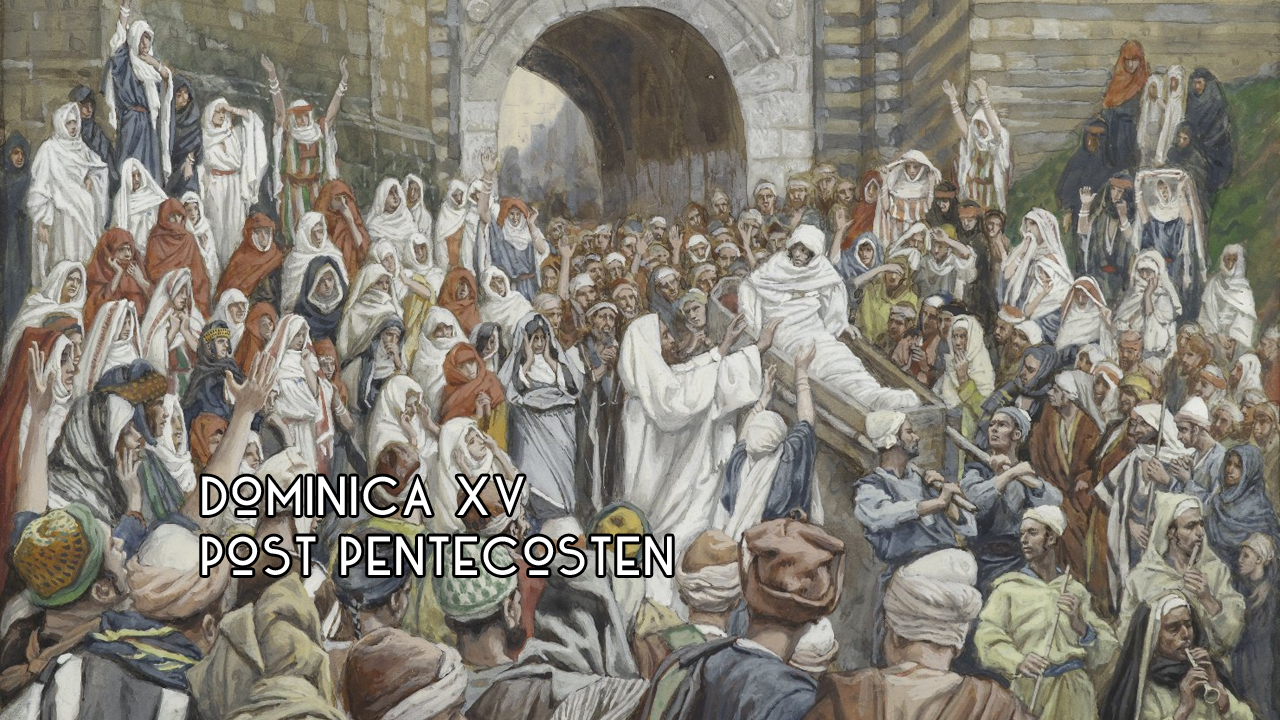
He intended to be at Nain’s gate when two processions met. One procession comes with Christ, His disciples, and a great crowd. The other comes out of the city carrying a dead man, “the only son of his mother, and she was a widow” (v. 12). Life and death meet at the gate. The woman has lost husband and μονογενής, monogenḗs, her “only-begotten” son, the word St. John uses of the Only-Begotten Son of the Father (John 1:14). She has become one of the anawim, the cast-down poor, left without the male protectors upon whom social and material security ordinarily depended.
Nain stands close to ancient Shunem, where Elisha raised the Shunammite woman’s son (2 Kings 4:8-37). Elijah had raised the son of the widow of Zarephath during the drought (1 Kings 17:17-24). Elijah tells that widow, “Fear not” (1 Kings 17:13).
At Nain the Lord sees the widow and a funeral procession bearing her only son. Jesus has compassion upon her, and says, “Do not weep” (Luke 7:13). Whereas the prophets prayed, pleaded, and stretched themselves upon the dead, Jesus merely touches the bier and commands by His own authority: “Young man, I say to you, arise” (v. 14). The dead man sits up and begins to speak. Christ “gave him to his mother” (v. 15), words recalling Elijah’s restoration of the living child to his mother (1 Kings 17:23), while revealing Himself as greater than Elijah.
The arduous approach from Capernaum gives this compassion a resolute quality. The widow does not call out to Jesus. No intermediary asks Him to intervene. Before her grief finds words, the Incarnate Word has already climbed toward her. He who possessed all things in His hands would open those hands upon the Cross. His uphill march to meet a dead only-son foreshadows His ascent to Calvary, where the Only-Begotten Son would enter death and break it from within.
St. Ambrose sees the bereaved widow as Mother Church lamenting children dead through sin:
And if your fault is so grave that you yourself cannot wash it away with the tears of your repentance, let Mother Church weep for you. Like a widowed mother, she intervenes for each as though for an only son, for she suffers, as it were, with a natural sorrow when she sees her own offspring driven toward death by deadly vices (Expositio Evangelii secundum Lucam 5.92).
Here the Church as mother, field, and ship converges. Mother Church weeps for the child who has sown in the flesh and reaped corruption. She bears his burden by prayer, penance, correction, teaching, and sacramental ministry. She cannot herself call the dead to life by native power. Her Lord approaches, touches the bier through His sacraments, and speaks the efficacious word. In Baptism and Penance especially, Christ addresses the spiritually dead: “I say to you, arise.” The Church receives her child alive again, as the widow received her son.
If you carry the bier of remembered and still unconfessed sins, bring it to Christ in the sacrament He instituted. If mourning, loneliness, fear, or concern for a loved one has cast you down, remember His determined tenderness toward the widow of Nain. He knew her road before she met Him upon it. If another staggers under grief or sin, help to bear his burden. You may be called to become an instrument of Christ’s visitation, even while making your own uphill way in darkness.
There remains the warning of harvest. Each of us will bear his own load before the judgment seat. Teachers who have substituted ideology for revelation and sentimentality for charity should impose silence upon themselves, examine their consciences strictly, correct their errors publicly when the error was public, and seek mercy while kairós remains. The faithful should support those who hand on ho lógos whole and uncorrupted.