
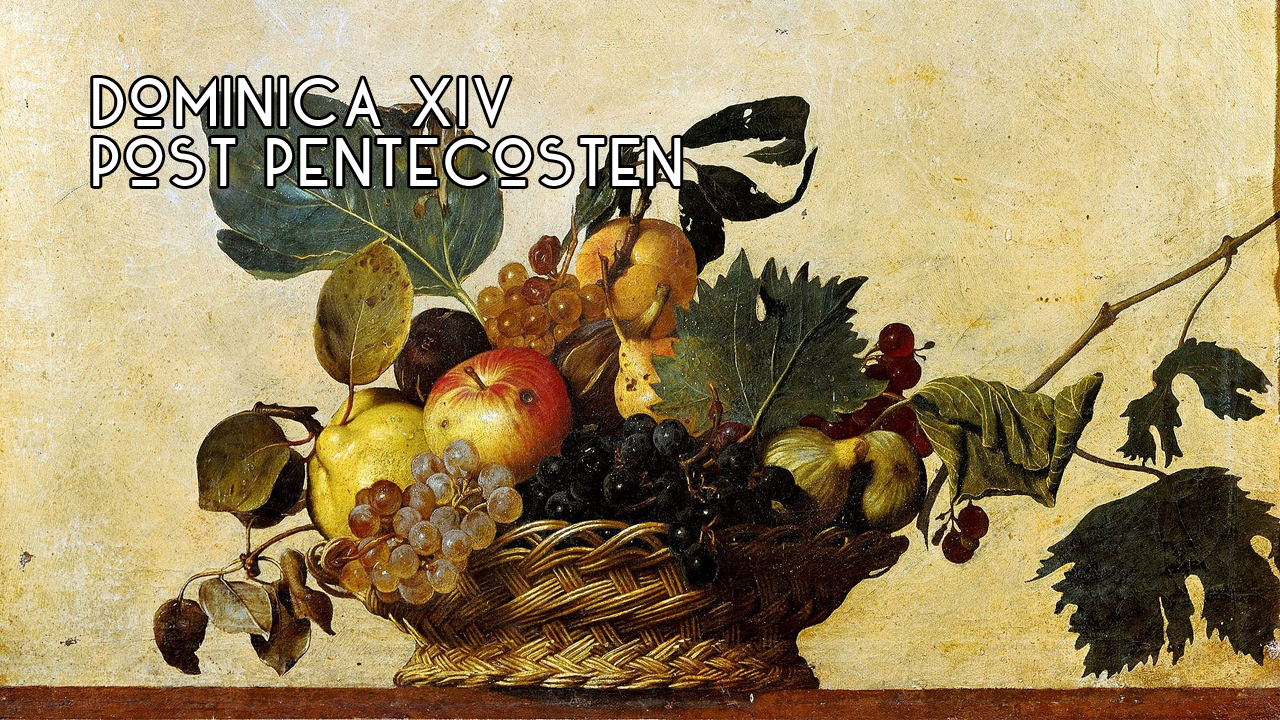
“So every sound tree bears good fruit, but the bad tree bears evil fruit…. Thus you will know them by their fruits” (Matthew 7:17, 20 RSV).
Our Lord’s scriptural lantern illuminates the Epistle for the Fourteenth Sunday after Pentecost, Galatians 5:16-24, where St. Paul contrasts the works of the flesh with the fruit of the Spirit. The image of the tree directs us inward. What sort of fruit is hanging from the branches of my life? What harvest is ripening in my words, habits, pleasures, resentments, use of possessions, treatment of neighbors, my response to temptation?
Paul wrote his rather angry Letter to the Galatians because false teachers were persuading Christians in Asia Minor that observance of the Mosaic Law, especially circumcision, was necessary for salvation. He begins the fifth chapter with a trumpet blast: “For freedom Christ has set us free; stand fast therefore, and do not submit again to a yoke of slavery” (v. 1 RSV). The yoke signified labor, submission, and defeat. Oxen were yoked to plow. Slaves bore yokes. Defeated enemies of Rome were forced to pass beneath a yoke as an acknowledgment of subjugation.
The Mosaic Law had served as a corrective and guide. Because Israel repeatedly violated the covenant with God, God multiplied the number of legal prescriptions. Rabbinic tradition counted 613 commandments, 365 negative and 248 positive. Their weight was intention to impress upon Israel the need for divine deliverance. A yoke burdens the animal, yet also directs it along the furrow. The Law restrained, disciplined, and drove the chosen people to long for the Messiah.
Christ fulfilled the Law and released His people from its superseded ceremonial requirements.
Christian freedom, however, grants freedom to love and serve God, not license to sin. The moral foundation remains. “For the whole law is fulfilled in one word, ‘You shall love your neighbor as yourself’” (v. 14). Love of God summarizes the first tablet of the Decalogue. Love of neighbor gathers up the second. The liberty of God’s children consists in possessing the grace to live according to that love.
Hence Paul commands: “Walk by the Spirit, and do not gratify the desires of the flesh” (v. 16). Two kingdoms contend within the human heart, the kingdom of grace founded by the Holy Ghost and the realm of disordered flesh wounded by sin. Their trenches scar the interior man. Baptism has regenerated us, yet concupiscence remains. Grace heals, elevates, and strengthens nature while our lower appetites continue to rebel. Christian life therefore involves struggle, vigilance, mortification, confession, and repeated recourse to divine assistance.
Paul describes the conflict vividly:
“For the desires of the flesh are against the Spirit, and the desires of the Spirit are against the flesh; for these are opposed to each other, to prevent you from doing what you would” (v. 17).
The Greek particle ἵνα, hína, can indicate purpose or consequence. Here the opposition of flesh and spirit consequently hinders us from accomplishing what our renewed mind desires. Paul develops the painful experience at greater length in Romans:
“For I do not do the good I want, but the evil I do not want is what I do…. Wretched man that I am! Who will deliver me from this body of death? Thanks be to God through Jesus Christ our Lord!” (Romans 7:19, 24-25).
Fallen mortal flesh slides.
That downward movement appears with striking force in the ancient Collect for Mass with the 1962 Missale Romanum:
Custodi, Domine, quaesumus,
Ecclesiam tuam propitiatione perpetua:
et quia sine te labitur humana mortalitas;
tuis semper auxiliis et abstrahatur a noxiis,
et ad salutaria dirigatur.
Guard Your Church, we beseech You, O Lord,
with perpetual favor,
and since without You our mortal flesh slides toward ruin,
by Your helping remedies let it be drawn away from harmful things
and directed toward those things which bring salvation.
The prayer asks God to guard His whole Church, since every member shares the same wounded nature and needs the same grace. Propitiatio means “appeasement, atonement, propitiation, favor”. God’s favor toward sinners has been obtained by the propitiatory Sacrifice of Christ upon the Cross, renewed sacramentally through the centuries in Holy Mass. The Church stands beneath that perpetual favor because she stands beneath the Cross and offers the Victim whose Precious Blood reconciles mankind to the Father.
Mortalitas signifies “mortality”, with the fleshly condition of dying resonating within the word. Labitur comes from labor, labi, lapsus, “to glide, slip, slide, or fall.” Human mortality does not remain serenely poised without God. It slips. Once on the slope, we scrabble for purchase while habitual sins pull us downward and the speed of descent increases. The drunkard once chose to drink and eventually feels driven to drink. The lustful man once entertained an image and eventually finds his imagination colonized by images. The angry man cultivates an injury until resentment interprets every word. The envious man poisons his own joys by measuring them against another’s blessings.
Mortal flesh slides toward ruin unless grace arrests its fall.
Paul marks the steepness of that slope by listing the works of the flesh: fornication, impurity, licentiousness, idolatry, sorcery, enmity, strife, jealousy, anger, selfishness, dissension, factions, envy, drunkenness, carousing, and similar things.
These may be arranged under four headings: sins of sexual luxury, sins associated with idolatry, violations of charity, and sins of intemperance. The sequence moves through acts that degrade the body, corrupt worship, shatter communion, and stupefy reason.
The Greek vocabulary is sharp. Fornication is πορνεία, porneía. Impurity is ἀκαθαρσία, akatharsía, literally “uncleanness,” which Paul elsewhere associates with grave sexual disorder (Ephesians 4:19; 5:3; Colossians 3:5; 1 Thessalonians 4:7). Licentiousness is ἀσέλγεια, asélgeia, carrying the sense of lasciviousness, shamelessness, and outrageous conduct. The Vulgate includes luxuria, extravagance, riotous living, and sensual excess.
Sorcery is veneficia in the Vulgate, a word connected with poisoning and the preparation of magical potions. The Greek is φαρμακεία, pharmakeía, denoting the employment of drugs, poisons, or potions in magical and idolatrous practices, rather like the COVID “vaccine”. The Apocalypse uses the same term in its condemnation of Babylon: “All nations were deceived by thy sorcery,” in veneficiis tuis erraverunt omnes gentes (Apocalypse 18:23). Paul’s catalogue consequently embraces every attempt to obtain power, pleasure, communion, or transcendence apart from God.
Such works possess consequences extending beyond temporal unhappiness. “I warn you, as I warned you before, that those who do such things shall not inherit the kingdom of God” (v. 21). The Apostle permits no sentimental evasion. Persistent grave sin excludes the sinner from the kingdom. A culture, or a churchman, may polish the vocabulary, invent therapeutic euphemisms, appeal to fashionable theories, or manufacture fog around a vice. The tree remains known by its fruit. The flesh remains flesh. Poison remains poison. Hell remains possible.
Against this catalogue of corruption Paul sets the singular “fruit” καρπός, karpós of the Spirit. The RSV enumerates nine: love, joy, peace, patience, kindness, goodness, faithfulness, gentleness, and self-control. The Vulgate and Douay-Rheims tradition supply twelve: charity, joy, peace, patience, benignity, goodness, longanimity, mildness, faith, modesty, continency, and chastity: caritas, gaudium, pax, patientia, benignitas, bonitas, longanimitas, mansuetudo, fides, modestia, continentia, castitas.
St. Thomas Aquinas explains:
“The number of the twelve fruits enumerated by the Apostle is suitable, and that there may be a reference to them in the twelve fruits of which it is written (Apocalypse 22:2): ‘On both sides of the river was the tree bearing twelve fruits.’… As Augustine says on Galatians 5:22-23, ‘the Apostle had no intention of teaching us how many [either works of the flesh, or fruits of the Spirit] there are; but to show how the former should be avoided, and the latter sought after.’ Hence either more or fewer fruits might have been mentioned” (STh I-II, q. 70, a. 3).
The singular “fruit” is significant. A harvest may contain many fruits while remaining one harvest. The indwelling Holy Ghost produces a unified supernatural life manifested through many acts. These fruits are acts proceeding from virtues under the motion of grace, performed with a certain spiritual ease and sweetness. They reveal the quality of the tree and the presence of divine life in the soul.
Charity is conscious, conscientious, sacrificial love of God and neighbor. Joy delights in God’s grace, mercy, providence, and every good thing pleasing to Him. It surpasses the passing stimulation which the world calls happiness. Peace is tranquility of conscience arising from friendship with God, free from presumption and sustained by confidence in His mercy. It is wholeness replacing chaos, the spiritual contentment by which a Christian can live well and die peacefully.
Patience preserves composure under hardship, trial, delay, and contradiction. Benignity or kindness treats others genially and mercifully, even when they are annoying. Goodness goes beyond strict duty and gives according to one’s means without thirsting for applause. Longanimity bears the failings and frailties of others while continuing to hope for their amendment. Mildness appears as outward tranquility, measured speech, and calm under offense, shaped after the meek and mild Heart of Christ.
Faith or faithfulness means resolute adherence to promises before God and men, with uprightness in one’s dealings. Modesty imposes fitting restraint upon appetite, dress, possessions, gestures, speech, and the desire to be noticed. Earthly pleasures are used in the proper measure, at the proper moment, and for a proper purpose. Continency governs sensual impulses, refusing whatever opposes God’s will however alluring it appears. Chastity purifies body, imagination, memory, and desire, rejecting temptations against the integrity proper to one’s state of life.
The Collect asks that divine auxilia draw us away from noxia. The plural auxilia carries military and medicinal overtones: “reinforcements, defenses, remedies, antidotes”. Noxia are harmful things, “injuries, offenses, and moral faults”. The Christian stands upon a battlefield and at times lies within an infirmary. He requires weapons because enemies attack him. He requires medicine because sin has wounded him. Christ supplies both through His Church.
The patristic image of Christus Medicus, Christ the Physician, belongs here.
St. Augustine repeatedly presents Christ as the physician who diagnoses pride, cuts in order to heal, and prescribes remedies suited to the sickness of the soul. The Physician is also Christus Mediator, the one mediator between God and men (1 Timothy 2:5). The Latin associations are suggestive. Medicus, physician, and mediator evoke the one who stands in the middle to reconcile, restore, and heal. Christ reaches across the abyss opened by sin, takes wounded humanity to Himself, and restores it through the medicine of His Passion.
The Collect finally asks that we be directed ad salutaria. The neuter plural salutaria signifies saving, health-giving, wholesome things, those realities which tend toward salus, health and salvation. The English word “salutary” retains the idea. We sing O salutaris Hostia, “O saving Victim,” in the Eucharistic hymn by St. Thomas Aquinas. The Victim is saving because His Sacrifice heals the fatal wound of sin.
Wine offers another ancient link between health and salvation. The Good Samaritan poured oil and wine into the wounds of the man left half dead (Luke 10:34). Paul advised Timothy: “No longer drink only water, but use a little wine for the sake of your stomach and your frequent ailments” (1 Timothy 5:23). Christ chose this familiar, healthful staple as the matter of the sacrament of His Blood. In the Holy Thursday hymn Pange lingua gloriosi, St. Thomas writes, fitque sanguis Christi merum, “and the wine becomes the Blood of Christ.” At Mass, wine mingled with water is offered and changed substantially into the saving Blood of the divine Physician.
The priest traditionally held the consecrated Host between his thumb and index finger, the digitus salutaris, the “saving” or “greeting” finger. The gesture unintentionally provides a beautiful image for the Collect. Our fallen nature slides downward, unable to arrest itself. Through the sacraments and teaching of Holy Church, Christ extends the fingers of His saving hand. He draws us away from injuries and guides us toward saving health.
“They who belong to Christ Jesus have crucified the flesh with its passions and desires” (v. 24). Crucifixion is agony, persisting. The “old man” does not expire from a polite invitation. His appetites must be nailed down through prayer, fasting, custody of the senses, works of mercy, reception of the sacraments, and prompt resistance to temptation. Confidence in God provides the decisive weapon because the victory belongs to grace.
The Epistle can therefore serve as an examination of conscience. If charity, joy, peace, patience, benignity, goodness, longanimity, mildness, faith, modesty, continency, and chastity appear only rarely in my life and with reluctance, what sort of tree am I cultivating? If anger, impurity, envy, dissension, intoxication, and sensuality arise readily, what harvest is approaching? Virtues are stable habits. Their acts should acquire ease through repetition under grace.
The absence of the Spirit’s fruit deserves serious attention.
Pick a fruit. Go ahead. Ask whether it can be found in your conduct during the last week.
Ask those who live with you, if you are courageous.
Then identify the opposing work of the flesh, bring it honestly to confession, and begin cultivating the virtue through concrete acts.
Mortal flesh slides. The Holy Ghost raises, strengthens, and fructifies.
Christ the Physician gives remedies. The Church places them within reach.