For some weeks the Sunday Epistles have been taken from St. Paul’s Letters to the Corinthians. With the 13th Sunday after Pentecost, which our ancient Roman forebears would have called the 3rd Sunday after St. Lawrence, we begin to hear from Galatians. That older Roman way of counting itself says something about the immense place Lawrence once held in the consciousness of the City.
Paul wrote to churches in Galatia composed largely of converts from paganism. After his departure, Judaizing teachers persuaded at least some of these Gentile Christians that the Mosaic Law remained obligatory for salvation, including circumcision and the other observances that marked Israel off from the nations. Hence the heat of the letter. “O foolish Galatians! Who has bewitched you?” he demands in 3:1, while still addressing them as “Brethren.” The question concerns the conditions of salvation. Is the inheritance secured by the Mosaic Law, or does it come through the promise of God fulfilled in Christ?
To make his point, Paul reaches back before Sinai to Abraham. God had promised that in Abraham’s “offspring,” Hebrew zera, Greek sperma, “seed” or “offspring,” all the nations would be blessed. Paul seizes on the singular. “It does not say, ‘And to offsprings,’ referring to many; but, referring to one, ‘And to your offspring,’ which is Christ” (Gal 3:16). The dative singular spérmati, “to the seed,” carries decisive theological weight for him. The covenant with Abraham precedes the Mosaic covenant by four hundred and thirty years. The later Law cannot annul the earlier promise. God had pledged His word, and His word reaches its appointed fulfillment in the Seed, Christ.
“Why then the law?” Paul asks. “It was added because of transgressions, till the offspring should come to whom the promise had been made” (Gal 3:19). The exposed transgression, disciplined Israel, and prepared a people to long for the Messiah. It could identify the wound and prescribe the treatment, but it could not impart the life whose source is Christ. Paul underscores the point: “if a law had been given which could make alive, then righteousness would indeed be by the law” (v. 21). Scripture “consigned all things to sin, that what was promised to faith in Jesus Christ might be given to those who believe” (v. 22).
That distinction is in the Gospel reading.
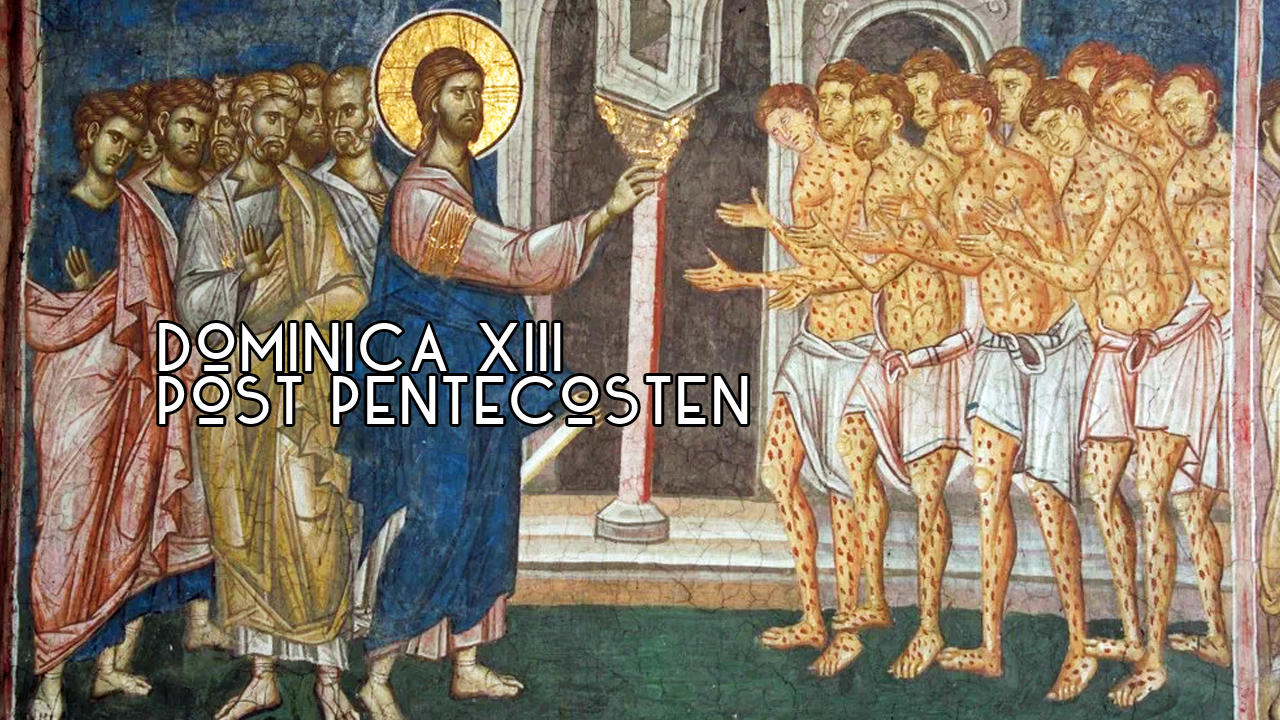
St. Luke places Jesus on the road to Jerusalem, “passing between Samaria and Galilee” (Luke 17:11). Ten lepers meet Him and remain at a distance, exactly the sort of distance Levitical uncleanness required. They cry, “Iesou epistáta, eléeson hemás … Jesus, Master, have mercy on us.” There is already something liturgical in the cry. It sounds very much like a Kyrie uttered from the margin of the community by men who cannot enter.
The word commonly rendered “leprosy,” Hebrew tsara’ath, covered a much broader range of conditions than modern Hansen’s Disease. Leviticus can apply the category to disorders of the skin, garments, and even mildew-like afflictions of walls. Because some forms of tsara’ath could disappear, Leviticus 13 and 14 regulate diagnosis and restoration. After a priest makes an examination and judgement, if the affliction is gone then rites of purification follow and the person can be restored to ordinary communal and religious life. True Hansen’s Disease – leprosy – was another matter. In the ancient world a genuine cure would have been astonishing.
The burden went beyond physical suffering. Leviticus 13:45-46 required the afflicted person to wear torn clothing, leave his hair disordered, cover the lower face, cry “Unclean! Unclean!” and dwell apart. Ritual uncleanness, tumah, was understood as transmissible. Contact with death brought the gravest form, avi avot hatumah, “father of the father of uncleanness.” Lesser sources were called avot hatumah, “fathers of uncleanness.” Bodily discharges, sores, corpses, objects touched by the impure, and many other conditions belonged to an intricate system of degrees and transmissions. Restoration to taharah, ritual cleanness, commonly involved washing in a mikveh and other prescribed rites. The system impressed upon Israel the distinction between holiness and death.
Here the Epistle and Gospel link. The priest could examine a leper and certify that cleansing had occurred. He could carry out the Law’s rites. He could not heal the disease. In Galatians, the Law can expose sin and regulate the sinner’s relation to the covenant. It cannot make one alive. In Luke, Christ does what the Law cannot do. Yet He honors the Law’s proper function. He says, “Go and show yourselves to the priests”. He came to fulfill the Law, and so the healed men are directed to the priest/judge established in Leviticus.
While on their way, they are miraculously healed. Obedience preceded healing. They acted upon Christ’s word before they possessed the visible evidence of the cure.
One of them, seeing himself healed, turns around.
Only one.
A Samaritan.
Last Sunday, in the Gospel a Samaritan appeared as the surprising righteous figure in a parable. This Sunday a flesh-and-blood Samaritan comes back down the road. Jews and Samaritans shared ancient roots and also centuries of religious hostility. Samaritans recognized the Pentateuch, worshipped on Mount Gerizim, and were treated by Judeans as religious outsiders. Yet leprosy had formed a miserable fraternity among these ten men. Their common uncleanness had temporarily done what ordinary society would not do. Once healing comes, the nine continue toward their priests. The Samaritan goes back to the source of the healing.
Jesus calls this healed Samaritan an allogenés, ἀλλογενής, “foreigner” or “stranger,” a word occurring nowhere else in the New Testament. The term is famous from the warning inscriptions that stood on the soreg, the balustrade in the Temple marking the boundary beyond which Gentiles could not pass. One surviving inscription warns, “Μηθένα ἀλλογενῆ εἰσπορεύεσθαι ἐντός … Let no foreigner enter within.” The foreigner of Luke 17, a man who belongs on the wrong side of boundaries, returns and falls at the feet of Jesus, the Temple which will be rebuilt in three days.
The details in the Gospel ring of liturgy. He returns “glorifying God,” and does it “with a loud voice.” He falls “with his face at the feet” of Jesus, and is “giving thanks.” Thanksgiving is precisely what eucharistia means. Then comes something like a dismissal: “Rise and go your way.” We have moved from the cry for mercy, through cleansing and obedience, into Gloria, prostration, thanksgiving, and dismissal.
Can we call the Samaritan the first “backwardist”? He is, after all, the man who goes back. The doubly disfavored man, Samaritan and leper, reverses direction because worship demands it. He goes back loudly, humbly, bodily, with his face at the feet of Christ, giving thanks. If that is backwardism, we could use more of it. Be a loud, kneeling, praising, God-worshipping, humble backwardist.
The nine received the benefit and continued on. The one returned to the Benefactor. The nine wanted cleansing, and they received it. The Samaritan sees beyond the gift to the Giver. Jesus therefore says something more to him: “Your faith has saved you.” The Greek can carry the sense of being saved or made whole. Bodily cleansing opened something greater.
This also illuminates Paul wrote. The Law directed the men to the priests. Christ gave the healing. The Law could say what cleanness required. Christ is the source of cleanness. The Law could mark the boundary of the sanctuary against the allogenés. Christ receives the allogenés at His feet and declares him saved through faith. The promise to Abraham was always ordered toward the blessing of the nations. Here in Luke one of those boundary-crossing figures appears in advance. The Samaritan becomes a small icon, a foreshadowing of the Gentile world entering the blessing promised to Abraham’s Seed.
The business about mediation in Galatians deepens the point. Paul says that the Law “was ordained by angels through an intermediary” (Gal 3:19). Jewish tradition associated angelic mediation with Sinai, an idea echoed in Acts 7:53 and Hebrews 2:2. The promise to Abraham, by contrast, is presented as God’s direct pledge. Paul’s purpose is to show the superiority of the promise fulfilled in Christ. In the New Covenant, “there is one mediator between God and men, the man Christ Jesus” (1 Tim 2:5). At Mass that one mediation is sacramentally present. The priest acts in persona Christi, “in the person of Christ,” and is traditionally described as alter Christus, “another Christ.” Christ’s once-for-all Sacrifice remains perfectly sufficient. Its saving reality is made sacramentally present wherever the Church obeys His command and offers the Eucharistic Sacrifice.
Now have a look at the Collect:
Omnipotens sempiterne Deus,
da nobis fidei, spei et caritatis augmentum:
et, ut mereamur assequi quod promittis,
fac nos amare quod praecipis.
Almighty everlasting God,
grant us an increase of faith, hope and charity,
and cause us to love what You command
so that we may merit to obtain what You promise.
This ancient prayer is found in the Veronese and Gelasian sacramentaries and survived the postconciliar redaction, appearing in the modern Roman Missal for the 30th Sunday in Ordinary Time.
Paul wrote of what God “promises.” The Gospel shows obedience to what Christ “commands”. The Collect asks that the command itself become lovable and that, through grace, we may assequi, “pursue so as to come up with, attain, obtain,” what God promises.
The divine title in the oration deserves attention. Sempiterne, “everlasting,” is related to aeternus, “eternal,” though the history of philosophical Latin taught Christians to hear subtle distinctions in the language of eternity. Boethius famously described eternity as the complete and simultaneous possession of unending life. Liturgical vocabulary grew in an intellectual world where words about time, permanence, change, and God’s unchanging life were carefully weighed. Such words belong to the patrimony handed down in Christian prayer, like gems polished by generations who prayed before us.
The prayer asks for augmentum, an “increase,” of faith, hope, and charity. These theological virtues are gifts of God, infused by grace, and they elevate the whole moral life. Faith receives what God reveals. Hope waits confidently for what God promises. Charity loves God known by faith and extends that love to neighbor. Augustine states their interdependence with admirable compression: “There is no love without hope, no hope without love, and neither love nor hope without faith” (Enchiridion de fide, spe et caritate 8). The three belong together because the Christian life is one movement toward God.
That movement is visible in the Samaritan. He believes the word of Christ and sets out. Faith obeys. He discovers the promised healing. Hope is vindicated. Then he returns in love and thanksgiving. Charity does what the Collect asks: it loves the One who commands and therefore comes more deeply into possession of what He promises. His return supplies what bare legal observance cannot provide. Obedience blossoms into worship.
Here we also see why Paul’s attack on Judaizing legalism never licenses contempt for commandments or good works. The problem is the attempt to make observance itself the saving principle, as though man could manufacture the inheritance by his performance. Grace comes first as promise came first. Christ comes as the promised Seed. The theological virtues themselves are gifts. Yet grace does not leave the will inert. We pray, in the mediating person of the priest celebrant, “Fac nos amare quod praecipis… cause us to love what You command.” God’s gift enables the obedience He asks from us. Augustine gives the principle a particularly apt formulation: “For faith obtains through prayer that which the law commands” (Enchiridion 117).
There is therefore a lovely paradox in the Sunday formulary. The Mosaic Law, which seems to be about burdens, boundaries, examinations, uncleanness, and commands, becomes in Christ the occasion for freedom and thanksgiving. The lepers obey the command to go. Their obedience places them on the road where healing is manifested. One then discovers the deepest end of every divine command: communion with God. He turns around because the command has led him to the Promiser.
“Go and show yourselves to the priests”, Christ said. The priest would examine a person who had problem and declare the result. In the sacrament of Penance, Christ gives His priests a ministerial role in a far greater cleansing. Hansen’s Disease can destroy sensation, flesh, sight, social standing, and bodily life. Mortal sin kills the supernatural life of the soul. A person can die physically disfigured and, in grace, be bound for Heaven. A person cannot die finally impenitent in mortal sin and possess the beatific vision. The cleansing of sin is therefore a greater miracle of mercy than the restoration of diseased flesh.
The Samaritan teaches us what to do after mercy: return, give glory to God, fall at the feet of Christ, give thanks. Eucharistôn, “giving thanks,” is the Christian posture before grace. At Mass we do this in the supreme act of the Church’s worship. In confession, after absolution, the priest may say, “Go… in peace.” The pattern is deeply Christian: mercy, cleansing, thanksgiving, mission.
There is also a sting in the question Jesus asks when the Samaritan returned. “Where are the nine?” We can receive gifts from God and immediately hurry away with them. Health, absolution, faith, the sacraments, the Mass itself can be treated in terms of utility. What did I get? What did this do for me? The Samaritan answers with his body. He returns because God deserves glory. Worship is right because God is God. The greatest fruit comes precisely when we cease measuring worship by immediate usefulness and surrender ourselves in gratitude. Ingratitude is a sin which deeply offends God.
This Sunday’s Collect ask the everlasting God, who cannot fail in His promise, to increase the very virtues by which we cling to Him. Faith recognizes the Seed. In the Gospel, the foreigner kneels at the feet of the Seed promised to Abraham. In the Epistle, Paul announces that the inheritance comes through that Seed. At the altar, the Church gives thanks through Him, with Him, and in Him.
This Sunday’s formula turns on movement. Israel’s Law points forward to Christ. The promise reaches its fulfillment in Christ. The Samaritan turns back to Christ. The Collect teaches the heart to pursue, assequi, what God promises by loving what He commands. If anything in us remains unclean, disordered, or spiritually diseased, the practical conclusion is wonderfully uncomplicated: “Go, show yourselves to the priests.”
Go to confession. Then come back to the feet of Christ and give thanks.