
In the green flow of the Vetus Ordo, “the old order,” Sundays, the Twelfth Sunday after Pentecost brings the last selection from St. Paul’s Letters to the Corinthians before the Epistles move on to Galatians. The order of these readings is exceedingly ancient, older than the developed form of the Divine Office. Our Roman forebears heard readings, chants, prayers, and antiphons within a network of scriptural memory. Hence the Epistle, 2 Corinthians 3:4–9, the Offertory from Exodus 32, and the Gospel, Luke 10:23–37 form a liturgical triptych. Moses intercedes for Israel. Paul intercedes for his Corinthians. Christ, the true Samaritan, comes to fallen man and commands those whom He heals to become neighbors in mercy. The movement is from stone to heart, from knowing the Law to doing in charity what the Law demands.
The context of Paul’s words is a painful situation. Detractors had followed him, presenting letters of recommendation and challenging his apostolic credentials. Paul had to defend himself because rejection of the apostle who brought the Corinthians the Gospel could lead to rejection of the Gospel itself. He turns his adversaries’ credentials against them: “You yourselves are our letter of recommendation, written on your hearts, to be known and read by all men; and you show that you are a letter from Christ delivered by us, written not with ink but with the Spirit of the living God, not on tablets of stone but on tablets of human hearts” (2 Cor 3:2–3). Their conversion is Paul’s defense, and the hand that wrote it is God’s.
Hence the humility embedded in Paul’s defense: “Not that we are competent of ourselves to claim anything as coming from us; our competence is from God” (2 Cor 3:5). Apostolic authority is real, yet its source is divine. Paul’s argument runs a minore ad maius, “from the lesser to the greater.” If visiting strangers can appeal to letters carried in their hands, how much more can Paul point to living letters written on hearts? If the covenant engraved on stone came with splendor, how much more splendid must be the covenant in which the living God writes by His Spirit within men? The Apostle does not demote Moses. He places Moses in the economy of promise and fulfillment. The glory shining in Moses’ face was real, yet reflected and fading. The glory of the Spirit belongs to the enduring covenant in Christ.
This is the force of Paul’s famous line: “the written code kills, but the Spirit gives life” (2 Cor 3:6). The contrast is not between a bad Old Testament and a good New Testament, nor between moral obligation and spiritual spontaneity. The Law is holy. Yet the commandment written externally exposes sin, accuses the sinner, and cannot by itself confer the interior power needed to fulfill what it commands. The Spirit changes the heart. Augustine develops precisely this Pauline theme in De spiritu et littera, “On the Spirit and the Letter,” a treatise explicitly devoted to the Apostle’s words that the letter kills and the Spirit gives life. The New Law reaches its proper effect when God works inwardly, healing and enabling the will.
Let’s shift to the Offertory, Precátus est Móyses, “Moses prayed,” from Exodus 32. Israel has made the Golden Calf. God’s anger burns, and Moses stands in the breach: “Remember thy servants, Abraham, Isaac, and Israel, to whom thou sworest by thine own self.” Blessed Ildefonso Schuster drew attention to the harmony between this Offertory and the Pauline Epistle. The Epistle says “tablets of stone” and the Offertory takes us back to the mountain from which Moses descended carrying them. Paul pled for the Corinthians as Moses pled for Israel.
The parallel is deeper. Israel has been seduced by idolatry. Paul fears that his Corinthians may be seduced by falsehood. Moses appeals to Abraham, Isaac, and Jacob. Paul appeals to the work God has accomplished in the Corinthians. Moses invokes holy men who have passed from this world. Paul invokes holy people still struggling through it. In both cases the argument rests upon God’s fidelity and grace. Here we glimpse something distinctly Catholic: the members of God’s people have a care for one another across the boundaries of life and death. Their holiness belongs to Christ’s Mystical Body, and invocation of them gives glory to the God whose grace made them holy.
The Gospel pericope from Luke 10 places the question of charity into the hands of a nomikos, a “lawyer,” a scholar of the Torah. Context: Christ has just rejoiced in the Holy Spirit and spoken with startling intimacy of the Father and the Son saying, “All things have been delivered to me by my Father; and no one knows who the Son is except the Father, or who the Father is except the Son and any one to whom the Son chooses to reveal him” (Lk 10:22). Then the lawyer stands up to test Him. Luke uses the verb ekpeirazō, “to put to the test, to tempt.” The word has a sharp biblical resonance. In the desert Christ had answered Satan, “You shall not put the Lord your God to the test” (Lk 4:12). The lawyer enters the conversation as an expert in the Law, but Luke’s vocabulary places a faint shadow of the wilderness temptation upon him.
“Teacher, what shall I do to inherit eternal life?”
Christ answers as a rabbi answering a rabbi. “What is written in the law? How do you read?” That second question matters. Ancient Hebrew writing lacked the later system of written vowel points, so vocalization belonged to interpretation. The consonants מלך can yield melech, “king,” while a different vocalization gives Moloch, the name associated with the abhorrent cult of child sacrifice. “How do you read?” therefore asks more than whether the lawyer can recite a verse. What text is he claiming, what meaning does he give it, and how will that reading judge him?
The lawyer answers well. He joins the Shema of Deuteronomy 6, “You shall love the Lord your God with all your heart, and with all your soul, and with all your strength, and with all your mind,” to Leviticus 19:18b, “you shall love your neighbor as yourself.” Christ responds, “You have answered right; do this, and you will live.” There precisely is the dangerous word for every professional religious talker: do. The lawyer verbalizes the answer, but Christ asks for action. The lawyer therefore seeks “to justify himself… dikaiōsai heauton… to vindicate himself,” to establish himself as guiltless and beyond reproach. He says, “And who is my neighbor?”
The lawyer had quoted Leviticus 19:18… the second half of verse 18. And the whole verse 18a and 18b? “You shall not take vengeance or bear any grudge against the sons of your own people, but you shall love your neighbor as yourself: I am the LORD.” “The sons of your own people” can tempt the reader to build a fence around “neighbor.” The lawyer knows the text. Christ knows that he knows it. The parable of the Good Samaritan, therefore, comes like a haymaker.
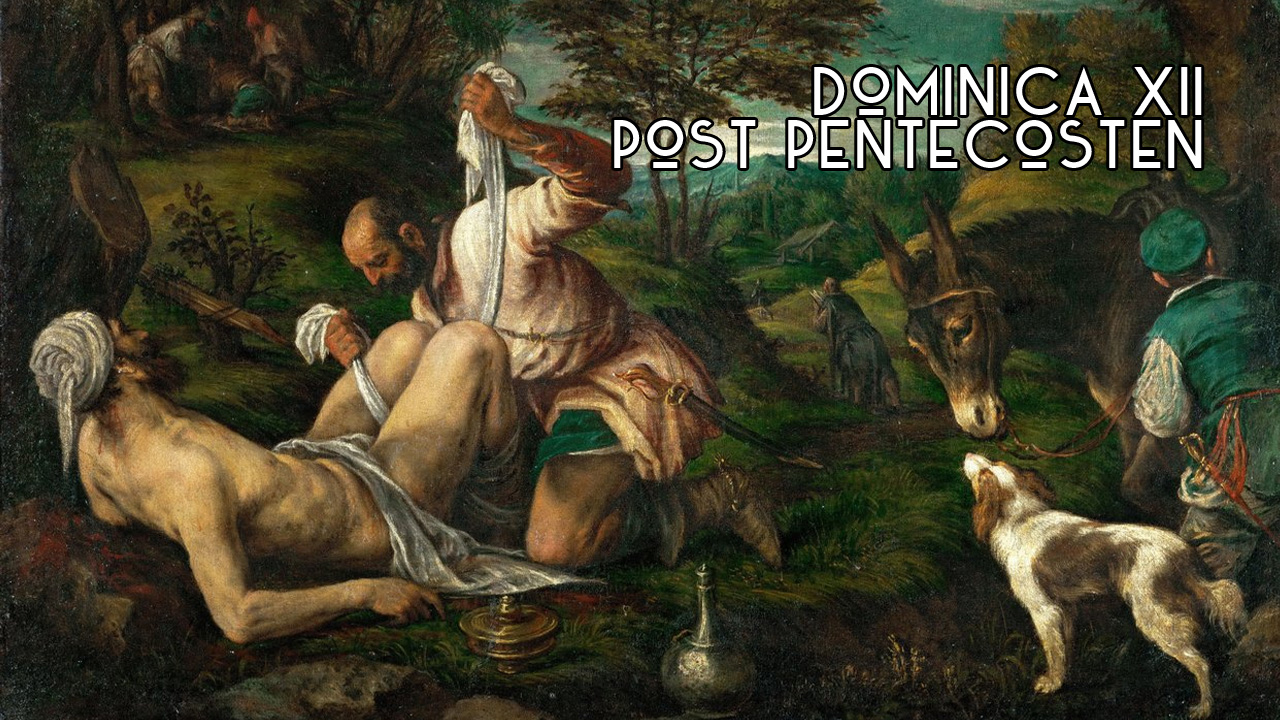
A man goes down from Jerusalem to Jericho, from the high holy city toward the deep Jordan valley. Robbers strip him, beat him, and leave him “hēmithanēs … half-dead.” A priest comes down the road. Then a Levite. Both see. Both cross over. Both go on their way.
A familiar explanation says that the priest and Levite avoided the victim because touching a corpse would make them ritually unclean. Christ’s details make that excuse difficult. They are traveling down from Jerusalem, and therefore away from Temple service. And the victim is visibly alive, only “half-dead.” Moreover, rabbinic concern for ritual purity itself required attention to an abandoned corpse, since leaving one in a public road risked defiling many others. Those who know the Law cannot hide behind the Law. Their sin of omission is their indictment. They saw enough to move away. They did not see to have mercy.
Then comes the nimshal, the unexpected twist that turns the whole parable inside out. A Samaritan approaches. Jews and Samaritans carried centuries of religious and ethnic hostility. Samaritans represented schism, disputed worship, and contamination in Jewish eyes. The 1st c. Jewish historian Josephus records an episode in which Samaritans scattered human bones in the Jerusalem Temple precincts around Passover, an act calculated to inflict ritual pollution at the most sensitive moment. Christ choses a Samaritan as the man who fulfills the commandment. The reprobated outsider became the moral instructor of the righteous experts. The enemy reveals the true “neighbor”.
Luke says that the Samaritan was “splagchnistheis … moved with compassion,” from “splagchnon … the inward parts” or “bowels,” the bodily seat of deeply felt emotion. Mercy is felt in the guts and enacted with the hands. The Samaritan binds the wounds, pours on oil and wine, puts the victim on his animal, takes him to an inn, pays for his care, and promises to return. He gives time, talent, and treasure. His compassion becomes costly.
Christ finally asks which of the three “proved neighbor” to the wounded man. The lawyer answered, “The one who showed mercy on him.” Perhaps he cannot even bring himself to say “the Samaritan.” Christ replied: “Go and do likewise.” The original question was “Who is my neighbor?” The answer forced a different question: To whom will you become neighbor? The lawyer wanted a boundary marking where his obligation ended. Christ gave him an enemy whose mercy crossed the boundary. Love of neighbor therefore reaches even toward those whom habit, grievance, ethnicity, religion, or history have taught us to regard with hostility. Sacrificial love finds its supreme pattern on the Cross, where Christ gives Himself for sinners and makes peace through His Blood.
St. Augustine (+430) reads the wounded traveler as Adam in the human race. Jerusalem signifies the heavenly city of peace from whose blessedness man fell. Jericho signifies mortality. The robbers are the devil and his angels. The priest and Levite signify the priesthood and ministry of the Old Testament, which could not restore fallen man to salvation. The Samaritan signifies the Lord. Augustine writes, “The inn is the Church, where travelers returning from their pilgrimage to the eternal fatherland are refreshed” (Quaestiones Evangeliorum II, 19). Elsewhere he condenses the identification: “perduxit ad stabulum, id est ad Ecclesiam … he brought him to the inn, that is, to the Church” (en. ps. 125, 15).
The allegory now opens directly into Paul’s Epistle. Fallen man lies half-dead under the condemnation revealed by the Law. The old priesthood passes by because it cannot give the life it signifies and promises. Christ comes as the true Samaritan. He binds the wounds. He applies oil and wine. He carries what cannot carry itself. He brings the wounded man into the Church, where the work of healing continues. Augustine’s interpretation even makes the beast of burden Christ’s own flesh, so that being placed upon it signifies faith in the Incarnation. The whole movement is from incapacity to grace. Paul says, “our competence is from God.” The wounded man cannot boast that he climbed onto the animal unaided. The Corinthians cannot boast that they wrote Christ’s letter upon their own hearts. The Samaritan acted and the Spirit wrote. Grace precedes, heals, carries, and makes subsequent action possible.
The parable carries a sharper warning. Jerusalem to Jericho can symbolize a descent from the life of grace into mortal sin. The robbers strip the soul of sanctifying grace and wounded both reason and will. The man becomes “half-dead,” unable to restore himself to supernatural life by his own power. Christ comes first with prevenient grace. The binding of wounds suggests examination, instruction, and contrition. The door of the inn suggests the confessional. Within, the recovering sinner is fed with the Eucharist and restored to the living communion of the Church.
That image bears urgency when Catholics, bewildered by scandal, confusion, bad leadership, or ecclesiastical folly, are tempted to walk away. The inn may contain incompetent servants, yet Christ still brought the wounded man there. The Church remains the place in which He entrusted the means of sacramental healing. Spiritual apathy, unconfessed grave sin, abandonment of prayer, and separation from sacramental life place the soul back on the road where robbers operate.
Whatever wicked or weird things some churchmen may do, Christ’s Church remains the place to which the Samaritan carried the wounded man.
Here the Epistle, Offertory, and Gospel finally lock together. Moses intercedes for the idolaters entrusted to him. Paul pleads for converts threatened by deception and recalls that God has written upon their hearts. The Samaritan spends himself for someone who belongs to a hostile people. Each scene concerns a person refusing to abandon another person in danger.
Mercy may take the form of pleading before God, defending apostolic truth, binding wounds, spending money, losing time, correcting error, hearing confession, teaching the ignorant, or simply refusing to walk past someone whom Providence has placed in our path. The saints in heaven intercede for us. Should not the “saints” on earth intercede? Christians become neighbors. All of it flows from Christ, the Mediator whose own charity gives content and power to every Christian act of mercy.
Therefore honor the saints, our neighbors in Heaven, and invoke their prayers. Love the neighbors encountered on the road, including the difficult neighbor and even the enemy. If you are wounded, let Christ carry you into the inn. If you have wandered, return. If you have been restored, look for someone else lying along the road. Paul told the Corinthians that they were a letter from Christ, written by the Spirit upon human hearts. Christ told the lawyer, “Go and do likewise.” The two meet in the Christian life. Let the mercy shown to you be written into what you do for another. You are Christ’s love letter to your neighbor, and by grace even to your enemy.
Be ever more legible.