Deep in the green season after Pentecost, when the Church has passed through the great mysteries of Advent, Christmas, Lent, Easter, Ascension, and Pentecost, the Roman liturgy turns our attention toward the harvesting of what has been planted.
Pius Parsch observed that the 11th, 12th, and 13th Sundays after Pentecost form a kind of triad concerned with sacramental grace: Baptism, healing, and gratitude for purification. The image fits the season. Blessed Ildefonso Schuster looked upon this Sunday against the Roman countryside and wrote that “now the heavy clusters are taking on luscious color upon the smiling hills of the Roman Campagna”. The grapes are ripening. So should we. Holy Church, Mater et Magistra, Mother and Teacher, has given us the mysteries. Now she teaches us how to live from them.
We are also in the dies caniculares, the Dog Days, when Rome swelters and Ferragosto approaches, eventually crowned on 15 August by the Assumption of the Blessed Virgin. Gardens of the northern hemisphere are unruly, zucchini appear in absurd quantities that suggest superabundant grace, and the Church wears green.
The Epistle gives us the deposit of faith upon which the Christian stands. The Gospel shows Christ opening the human person so that this faith may be heard, confessed, lived, and communicated.
St. Paul begins with something received and handed on. “I would remind you, brethren, in what terms I preached to you the gospel, which you received, in which you stand” (1 Cor 15:1). The Greek is tò euaggélion, “the Gospel,” the “good news” with definite content. Paul indicates that the Corinthians stand upon something, they must hold fast to something. If they let it go, they fall into emptiness, into the “vain” of which Paul speaks. Hence his famous formula: tradidi quod et accepi, “I handed on what I also received” (1 Cor 15:3). Tradition here has almost its physical meaning. Something has been placed into Paul’s hands, and he has placed it into theirs… and into ours.
What he hands on is at once concise and immense. Christ died for our sins according to the Scriptures, He was buried, He rose on the third day according to the Scriptures, and He appeared to witnesses. Cephas, the Twelve, more than five hundred brethren, James, the Apostles, and finally Paul himself stand in the line of testimony. Paul presses the point with brutal clarity: “if Christ has not been raised, then our preaching is in vain and your faith is in vain” (1 Cor 15:14). With the Resurrection everything locks into place: redemption, Baptism, moral conversion, judgment, hope, and the resurrection of our own bodies.
The Pauline scholar Ferdinand Prat recognized in this passage the compact structure of primitive catechesis. That helps us to understand Paul’s language elsewhere. To the Romans he speaks of the túpos, the “pattern” or “form” of teaching to which Christians had been committed (Rom 6:17). In 1 Corinthians he adds: Sive enim ego, sive illi, sic praedicamus et sic credidistis… Whether it was I or they, thus we preach and thus you believed” (1 Cor 15:11). There is recognizable content and recognizable proclamation.
Hebrews 6 gives another glimpse of the same formation: repentance from dead works, faith in God, washings, laying on of hands, resurrection of the dead, and eternal judgment. The expression is t?s arch?s tou Christou, the elementary beginning concerning Christ. Baptism presupposes the Trinity, sin, redemption, grace, Christ, and the Church. Confirmation presupposes the Holy Ghost. Resurrection presupposes creation, redemption, victory over death, and judgment. The ancient catechism was concise in headings. Souls must formed and lives conformed to what was handed down and received.
Schuster sees precisely this in the Sunday Epistle. He calls it a sketch “in strong concise strokes of the primitive Christian catechesis” and insists that faith must be fruitful in works. Paul himself is the proof. Saul had persecuted the Church. Paul can say, “Gratia autem Dei sum id quod sum… By the grace of God I am what I am,” and then, “abundantius illis omnibus laboravi …I labored more abundantly than all of them” (1 Cor 15:10). Grace did not leave him inert. Grace took informed intellect, will, memory, body, time, energy, travel, suffering, preaching, imprisonment, and finally blood.
Here the Epistle passage leans toward the Gospel. Paul had to be opened. On the road to Damascus he was struck down, blinded, instructed, baptized, and sent. He who had threatened Christ’s disciples became the mouthpiece of the Gospel. His life became an Ephphatha. Grace entered the closed man, opened him, and sent him. Thus, the doctrinal túpos of the Epistle joins the sacramental gestures of Mark 7. Doctrine enters through hearing. St. Thomas Aquinas sang in his Adoro te, “sed auditu solo tuo creditur… but hearing suffices firmly to believe”.
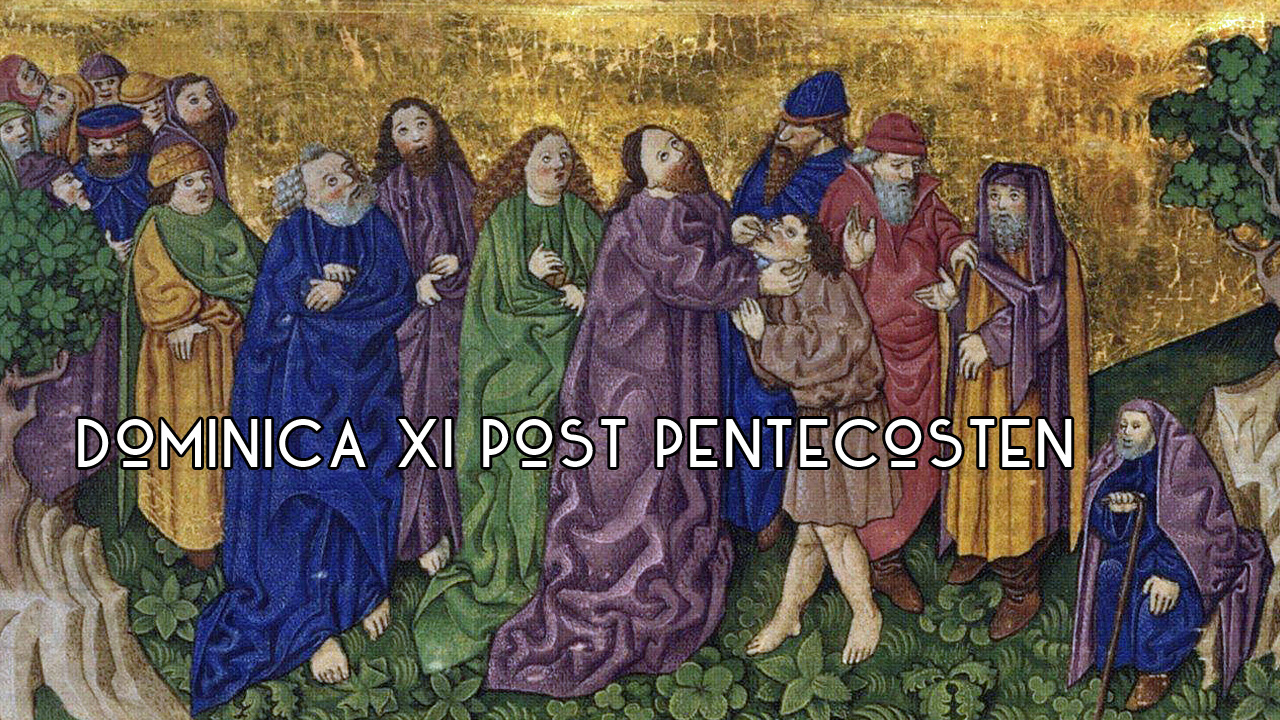
The Gospel context is set after Christ has moved through Gentile territory. He has fed the multitude, crossed the waters, healed the sick, and answered the Syrophoenician woman. Now they bring Him a man who is deaf and has a speech impediment, in Greek mogilálos, one who speaks with difficulty. They ask Jesus simply to lay His hand upon him. He does more. He takes the man aside from the crowd, puts His fingers into the man’s ears, spits and touches his tongue. He looks up to heaven and sighs. Then comes the preserved Aramaic word: Ephphatha. Mark translates it, “dianoíxtheti, … be opened,” more literally, “let yourself be opened.” This is an aorist passive imperative, second person singular. Christ addresses the man: “You, be opened.” Then “his ears were opened, his tongue was released, and he spoke plainly” (Mark 7:35). The elements of the episode startlingly incarnational and concrete: fingers, saliva, tongue, ears, breath. The Word through whom all things were made works through created matter and bodily contact. He who formed Adam from dust refashioned a son of Adam. This healing is a kind of re-creation.
Mark tells us that Jesus “sighed,” Greek esténaxen from stenáz?, “to groan or sigh deeply”. No spoken prayer of words is recorded at that moment. There is instead a rush of breath. One cannot miss the biblical resonance of ruach, breath, wind, spirit. The Spirit of God hovered over the primordial waters. God breathed life into the man formed from earth. Here the Incarnate Word breathes out in compassion before opening a man closed within himself. Pope Benedict XVI observed that through Baptism the human person begins, “so to speak, to ‘breathe’ the Holy Spirit” (Angelus, 9 September 2012). The Gospel miracle and the sacramental life of the Church therefore belong naturally together. Cornelius a Lapide wrote, “when Christ opened the ears and unloosed the tongue of the body, He opened also the ears and tongue of the soul” (Commentaria in Scripturam Sacram). The healing reaches inward. Hearing sound is good but hearing truth is greater. Speaking fluently is good, but confessing the faith, praising God, teaching truth, consoling the afflicted, correcting with charity, and defending the innocent are greater uses of the tongue. Christ restored the man’s capacity for communion with others. He could enter human society more fully. Greater still, on the supernatural plane he became an icon of the sinner opened to God.
Pope Benedict XVI captured this in the aforementioned Angelus address: “He became man so that man, made inwardly deaf and dumb by sin, would become able to hear the voice of God.” He spoke of learning “the language of love” and said Ephphatha “sums up Christ’s entire mission.” Sin, pride, resentment, lust, greed, envy, vanity, and distraction makes a person spiritually hard of hearing. Christ opens the cor hominis, the human heart, so that divine speech can enter and a redeemed word come forth. Our baptismal rites makes this connection visible. In the traditional rite, among the preparatory ceremonies, the priest touches the ears and nostrils of the catechumen with saliva and says:
Ephpheta, quod est adaperire, in odorem suavitatis. Tu autem, diabole, effugare; appropinquabit enim iudicium Dei. … Ephpheta, which is: Be opened, unto an odor of sweetness. But you, devil, flee away, for the judgment of God draws near.
The rite is earthy, biblical. The Church takes the gesture of Christ and places it upon the body of the person being prepared for Baptism. The catechumen is to hear the word, profess the faith, receive grace, and live henceforth as one opened to God.
Now the Epistle and Gospel converge closely. Paul says, tradidi quod et accepi, “I handed on what I received.” For a “handing on” to take place, someone must speak and someone must hear. The preacher’s tongue must be loosed by truth and the hearer’s ears must be opened by grace. The hearer then becomes in turn the speaker, a witness, perhaps as a catechist, a parent teaching children, a priest preaching to his people, a friend correcting a friend, a Christian answering a question about the hope that is within him (cf. 1 Peter 5). Apostolic tradition has an auditory and vocal character. Fides ex auditu, “faith comes from hearing” (Rom 10:17). In her profoundly Marian dimension,the Church listens before she speaks, receives before she hands on, and guards what she has received so that her speech remains faithful.
At least that is how it worked for a couple of millennia. It is harder to discern the pattern today, but we believe it is still there because we trust God and the indefectibility of His Church.
We should circle back to that important and sometimes pesky organ, the tongue. St. James calls it “a fire” and “a world of iniquity” (Jas 3:6). St. Alphonsus Liguori warns that “the greater number of sins arise from speaking than from listening to others. He advises the talkative soul to recollect himself and discover faults arising “by the multitude of your words.” Almost everyone has both a tongue and an audience somewhere, and, therefore, opportunities to complain, gossip, exaggerate, flatter, wound, insinuate, or repeat what ought to have died unheard.
Nature itself supplies the old joke attributed to Epictetus: two ears, one mouth, hence, listen twice as much (at least) as you speak. That advice now has a penitential – even punitive – quality in an age in which everyone can publish instantly. A thought occurs, the thumbs move, and the thing is out in the world before prudence has put on its socks and shoes. An Italian aphorism I learned in seminary in Rome puts the matter neatly:
Prima pensa, poi parla, perché parole poco pensate portano pena… First think, then speak, because words little thought through bring punishment.
There are times when duty requires speech, even vigorous speech. Silence at times can in fact wind up being cowardice or complicity. Yet most of our daily speech concerns no such heroic obligations. Moreover, depending on the habits of speech we have formed, or neglected to foster, it offers irritation, vanity, curiosity, scoring points, and the intoxicating pleasure of having the last word.
The Christian tongue has higher work. The Christian tongue has been “baptized”. It was loosed to say Credo, “I believe.” It was loosed in the Roman Latin Church to say “Confiteor… I confess”, to chant “Gloria, Sanctus, Agnus Dei”. It was loosed to answer Amen before receiving the Body of the Lord. It was loosed to teach children their prayers, console mourners, ask forgiveness, pronounce blessings where appropriate, defend reputations, and tell the truth.
A tongue sanctified by Baptism should increasingly speak the lingua caritatis, the language/tongue of charity. This requires first that the ears be schooled. We cannot hand on what we have never received. Nemo dat quod non habet … no one gives what he does not have. Or, if one permits a barbarous bit of fun Latin, Nemo dat quod non “got.”
Hence the practical urgency of catechesis. Some Catholics have not seriously reviewed the fundamentals of the Faith since school or marriage preparation. Memory fades, vocabulary thins, and errors enter by environmental osmosis. One cannot hold fast to what one no longer knows or communicate what has become vague. Paul’s túpos, the pattern of doctrine, is deeply pastoral. Review the Creed, Commandments, sacraments, our teaching on grace, sin, redemption, the Four Last Things, virtues, prayer, and Holy Mass. Deepening the Faith is lifelong because the mysteries are inexhaustible. It is less daunting to undertake knowing that, despite the bad examples being given even by some who are “high atop the thing”, the basic structure remains stable enough to stand upon, to hold tight too even in the tempests which assail us from without the Church and, sadly, from within.
There is encouragement for the sinner who looks back on wasted years. Saul became Paul. The persecutor became an instrument by which Christ’s name reached the nations. “By the grace of God I am what I am” (1 Cor 15:10). While life remains, grace can open what has been closed and make former failures material for humility, vigilance, gratitude, and apostolic zeal. Paul remembers that he persecuted the Church. Memories can be purified. Our memory can focus and drive labor. “Abundantius illis omnibus laboravi … I labored more abundantly than all of them.” Under grace, the past becomes fuel for fidelity rather than paralysis.
Our sacred liturgical worship trains us in this openness. Participation and benefit from sacred liturgy requires an active receptivity before it requires anything else. Listen to the Introit. Hear the Collect. Receive the Epistle as doctrine handed on. Attend to the Gospel as Christ’s living word. Let the Canon draw the mind inward. At the consecration, adore. At Communion, receive. Each stage is of Mass is prepared for by and asks for again an interior Ephphatha. Our traditional approach to worship emphasizes how to be opened to what the Church gives rather than the more world-informed approach that demands that liturgy mirror what we already think and feel. The Mass is full of words, but its words should school us in our silence of active receptivity. It is full of sound, but its sound trains us to hear the Word who is beyond the sounds. It gives us speech so that, purified, our speech may become praise and outward action according to our vocations.
A simple exercise suggests itself. Enter the church and take holy water, remembering Baptism. Say quietly, Ephphatha. Before the readings, Ephphatha. At the Gospel, Ephphatha. When the bell sounds at the consecration, Ephphatha. Before Holy Communion, Ephphatha. Let the word become a request that Christ open my whole person. Open my ears to doctrine, my mind to truth, my heart to grace, my tongue for praise and necessary speech and close all against detraction, rash judgment, cruelty, idle curiosity, and vanity. Ephphatha my hands for good works, Ephphatha my life so that what I’ve been offered does not remain vacua, empty, but bears fruit.
Returning to the green season image, heavy clusters are ripening for the harvest. The Church places the apostolic tradition into our hands and tells us to hold it fast. Christ, speaking and acting in every word and gesture of Holy Mass, again and again puts His fingers into our ears and commands, Ephphatha.