We have come to the Tenth Sunday after Pentecost in the Usus Antiquior, the Vetus Ordo. Pius Parsch (+1954) saw in the Sundays after Pentecost a progressive schooling in Christian life. The earlier Sundays dwell frequently upon healing, the middle portion upon the conflict between God’s reign and the dominion of sin, and the later Sundays upon judgment and the Parousia. The present Mass stands within that middle contest. Two kingdoms confront one another, and their frontier passes through the human heart.
The Epistle begins with a warning easily hurried past in the fascination of what follows. Saint Paul reminds the Corinthians: “When you were heathen, you were led astray to dumb idols, however you may have been moved” (1 Cor 12:2). Before he speaks of wisdom, knowledge, faith, healing, miracles, prophecy, discernment, tongues, and interpretation, he recalls their former slavery. They had been borne along toward voiceless images, moved by powers that could neither reveal God nor confer life. Idolatry is the dark background against which the gifts of the Holy Ghost appear. “No one speaking by the Spirit of God ever says ‘Jesus be cursed!’ and no one can say ‘Jesus is Lord’ except by the Holy Spirit” (1 Cor 12:3). The decisive question concerns worship. Quis sedet super thronum cordis mei? Who sits upon the throne of my heart?
The passage is profoundly Trinitarian. Paul names “varieties of gifts, but the same Spirit,” “varieties of service, but the same Lord,” and “varieties of working, but the same God” (1 Cor 12:4-6). The Persons are distinct, while the divine operation remains indivisible. The charismata, diakoniai, and energēmata, gifts, ministries, and workings, reveal an ordered richness in which diverse graces serve one supernatural end.
The Greek word διαίρεσις, repeated in the passage, can indicate “division, distribution, or apportionment”. Wisdom is not healing, prophecy is not interpretation, and administration is not the working of miracles. These differences establish no rival sovereignties within the Church. The Holy Ghost distributes His gifts as the soul animates the members of a living body. Paul continues beyond the liturgical pericope: “For just as the body is one and has many members, and all the members of the body, though many, are one body, so it is with Christ” (1 Cor 12:12). The eye does not become more ocular by despising the hand. Each member has its place, function, and vitality within the whole.
A pericope at Mass usually spills over its edges. The antiphons, Collect, Epistle, Gospel, and chants form a single act, and the reading carries us into its wider context. Your own preparation for Sunday Mass as the week moves along might include checking the upcoming readings and then opening the Bible beforehand. This week you would find that Paul’s catalogue in 1 Cor 12 is ordered toward the higher way. The chapter concludes with, “Earnestly desire the higher gifts,” followed by, “I will show you a still more excellent way” (1 Cor 12:31).
That way is ἀγάπη, agape, caritas, sacrificial love. First Corinthians 13 judges every charism and gives every gift its proper form. “If I speak in the tongues of men and of angels, but have not love, I am a noisy gong or a clanging cymbal” (1 Cor 13:1). Prophecy, knowledge, wonder-working faith, almsgiving, and even bodily surrender become spiritually empty when charity is absent. The gifts are given “for the common good” (1 Cor 12:7), and charity prevents their recipient from treating them as private trophies. Caritas turns wisdom outward in service, purifies knowledge of vanity, makes authority pastoral, and binds the many members into the one Mystical Body of Christ.
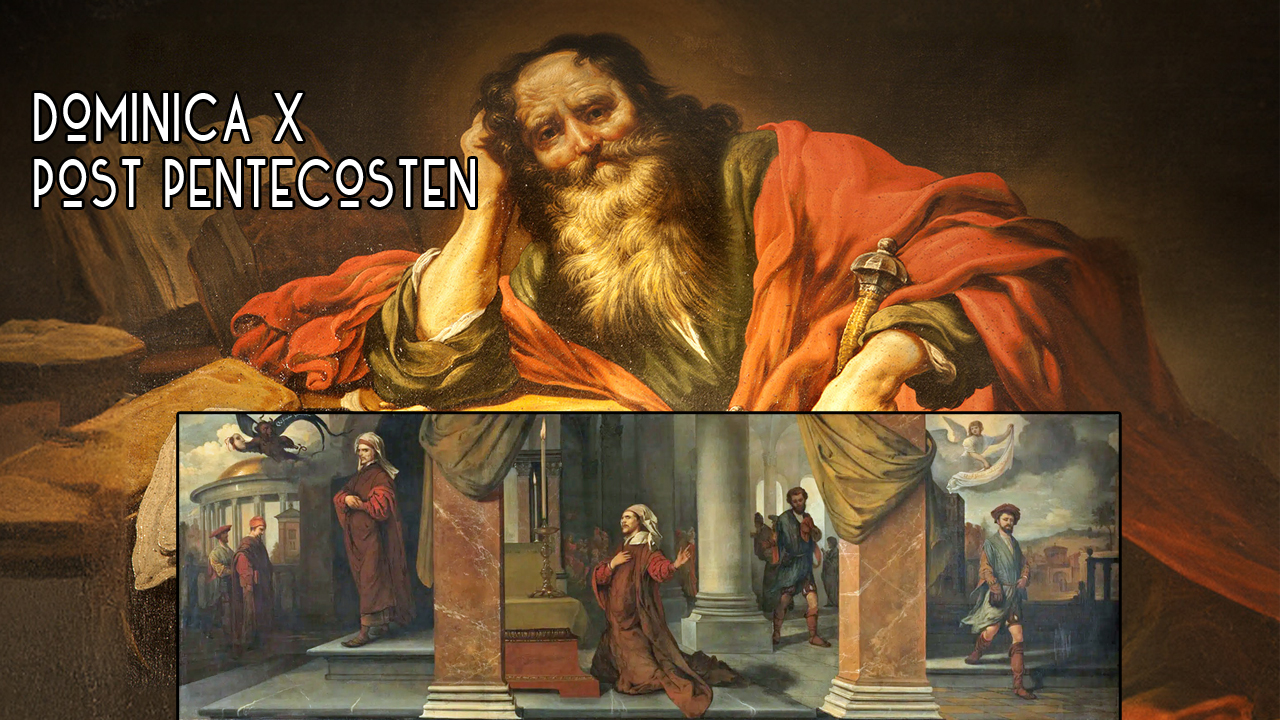
The Gospel of the Pharisee and the Publican exposes the same issue within prayer. Two men enter the Temple, and the expectation of the hearers is reversed. The Pharisee possesses the recognizable marks of religious seriousness. He fasts twice a week, pays tithes, and avoids extortion, injustice, and adultery. These acts are good. Christ does not condemn fasting, tithing, moral discipline, or public worship. The catastrophe lies in the direction of his prayer. Saint Luke writes that he stood and prayed πρὸς ἑαυτόν, “toward himself” (Luke 18:11). The Vulgate says apud se, “with himself.” His words travel in a closed circle. They begin with God’s name, pass through his achievements, name the Publican as an object of contempt, and return as praise offered to the speaker.
Here Saint Paul’s warning about idolatry enters the Temple. An idol need not be carved from wood or cast in bronze. The self can become an image before which the heart burns incense. The Pharisee does not deny God verbally. He renders God functionally unnecessary. Grace has no work to perform, mercy has no abyss to cross, and the Holy Ghost has no gift to bestow. His thanksgiving is grammatically addressed to God, while its spiritual object is himself. He has changed the Temple into a hall of mirrors. His prayer is a confession of self-sufficiency, and self-sufficiency is practical idolatry.
The Publican stands afar off, will not lift his eyes toward heaven, strikes his breast, and says, “Deus, propitius esto mihi peccatori… O God, be merciful to me, a sinner” (Luke 18:13). He offers no comparison, excuse, mitigating circumstance, or bargain. He presents the truth of his condition to the truth of God’s mercy. His poverty becomes an opening. Because he claims nothing as autonomous possession, he can receive everything as gift. The Pharisee speaks at length and remains enclosed. The Publican utters one petition and departs justified.
St. John Chrysostom (+407) described the Pharisee’s ruin with the image of a ship lost at the entrance of safety: “After having undergone the labors of the fasting, and of all the rest of his virtue, since he did not master his tongue, in the very harbor underwent shipwreck of his cargo” (Homily Concerning Lowliness of Mind, 1). Pride took the helm as the voyage ended and drove the laden vessel against the rock. Gross vice often announces itself. Spiritual pride can feed upon genuine ascetic labor, orthodox language, liturgical exactitude, learning, and generosity. The better the cargo, the more terrible the shipwreck when prayer becomes the occasion of contempt.
The traditional Roman Mass places priest and people beside the Publican before the altar is ascended. During the prayers at the foot of the altar, sin is confessed and the breast is struck. Kneeling, bowing, and lowering the eyes teach the flesh to accompany the soul in humility. The priest then approaches the altar praying:
Aufer a nobis, quaesumus, Domine, iniquitates nostras: ut ad Sancta sanctorum puris mereamur mentibus introire.
“Take away from us our iniquities, we beseech Thee, O Lord, that we may be worthy to enter with pure minds into the Holy of Holies.”
The priest does not ascend to the altar because he has declared himself pure. He asks God to take away what makes him unfit to enter. After the confession below, he approaches above “ad Deum qui laetificat iuventutem meam … unto God who gives joy to my youth.” Every worthy ascent begins with mercy.
Saint Augustine’s (+430) theology of the totus Christus clarifies what Christian prayer becomes once the circle of self is broken. Commenting on Psalm 85, he writes:
“Thus, when we speak to God in prayer, let us not separate the Son from Him; and when the body of the Son prays, let it not separate its Head from itself. Let the one Savior of His Body be our Lord Jesus Christ, the Son of God, who prays for us, prays in us, and is prayed to by us” (en ps 85, 1).
The Pharisee’s apud se is solitary. The Publican’s cry is gathered into the voice of the Mystical Body.
Paul’s distribution of charisms and Christ’s praise of humility illuminate one another. The Pharisee treats his religious works as self-originating endowments. The Publican knows that justification must be received. Paul teaches that every gift comes from the same Spirit, serves the same Lord, manifests the working of the same God, and is given for the common good. No member of Christ’s Body can say, “I generated this grace for myself.” The proper question is, “How must this gift be returned to God through service of His Body?” Pride isolates the recipient from the source and purpose of grace. Humility restores circulation within the Body.
The Collect gathers the mystery into a masterpiece of Roman sobriety:
Deus, qui omnipotentiam tuam
parcendo maxime et miserando manifestas:
multiplica super nos misericordiam tuam;
ut, ad tua promissa currentes,
caelestium bonorum facias esse consortes.
O God, who manifest Thy omnipotence
especially by sparing and showing mercy,
multiply Thy mercy upon us,
so that Thou mayest make us, running toward the things Thou hast promised,
partakers of heavenly goods.
Divine omnipotence shines maxime, most especially, in parcendo et miserando, in sparing and showing mercy. Sin opens a chasm the sinner cannot close. God crosses it without ceasing to be just, heals the will without violating it, restores the dead soul, and makes an enemy into a son.
Saint Thomas Aquinas takes up the Collect’s language: “Unde et misereri ponitur proprium Deo, et in hoc maxime dicitur eius omnipotentia manifestari … Hence mercy is regarded as proper to God, and in this His omnipotence is said especially to be manifested” (STh II-II, q. 30, a. 4, corpus). God’s mercy is a manifestation of His omnipotence. Mercy pours forth from infinite fullness and raises the creature beyond every created capacity.
The petition “multiplica super nos misericordiam tuam… multiply Thy mercy upon us,” answers both Epistle and Gospel. Paul enumerates a multiplicity of gifts. The Collect asks for a multiplication of mercy. The gifts differ, their source is one, and their purpose is our incorporation into the heavenly inheritance. The verb currentes gives the prayer urgency. We are running toward God’s promises. Christian maturation is movement. First Corinthians 13 compares present incompleteness with adulthood: “When I was a child, I spoke like a child, I thought like a child, I reasoned like a child; when I became a man, I gave up childish ways” (1 Cor 13:11). Grace does not leave us where it finds us.
The destination is expressed by consortes, those who share a sors, a lot, portion, condition, or destiny. God makes us caelestium bonorum consortes, sharers in heavenly goods. The Publican enters conscious that he deserves condemnation and leaves carrying a share in justification. The Corinthians had once been carried toward dumb idols and are now carried into Christ’s living Body. The Spirit’s gifts are anticipations of the promised inheritance, while charity already participates in the life that will remain when partial knowledge and prophecy pass away. “Faith, hope, love abide, these three; but the greatest of these is love” (1 Cor 13:13).
The Eucharistic Sacrifice completes the lesson sacramentally. We confess beside the Publican, hear that gifts are distributed for the Body, learn that self-exaltation destroys prayer, and ask for multiplied mercy. At the altar Christ gathers these themes into Himself. He is the Gift of the Father, offered through the Holy Ghost, and the Head who gives Himself to His members. Holy Communion deepens the unity signified by the one Bread and binds us more urgently to His worship, Church, poor, and Cross.
We should examine both sins of commission and sins of omission. Neglect of prayer, fasting, worship, and works of mercy can be as self-referential as boastful observance. One man performs religious works and treats God as an audience. Another omits them and lives as though God were unnecessary. Both remain apud se. One man builds an idol from his virtues, another from his autonomy. The Publican breaks the enclosure by addressing God in truth. His humility is accurate creaturely knowledge before the Creator and accurate moral knowledge before the Judge who desires to save.
Mother Church places these texts before us while the liturgical year moves toward its consummation. The green vestments signify growth, and growth requires the death of self-sufficiency. The Spirit has not delivered us from dumb idols so that we may enthrone a more articulate idol within. He has brought us into the confession “Jesus is Lord.” He distributes His gifts so that Christ’s Body may be built up. He forms within us the charity that prays, serves, suffers, and perseveres. He teaches us to stand far off in compunction and then, purified by mercy, to draw near with confidence. The Pharisee came bearing achievements and left with nothing added. The Publican came bearing his misery and went home justified.
Deus, propitius esto mihi peccatori. O God, be merciful to me, a sinner.
Multiplica super nos misericordiam tuam. Multiply Thy mercy upon us.
Go to confession.