

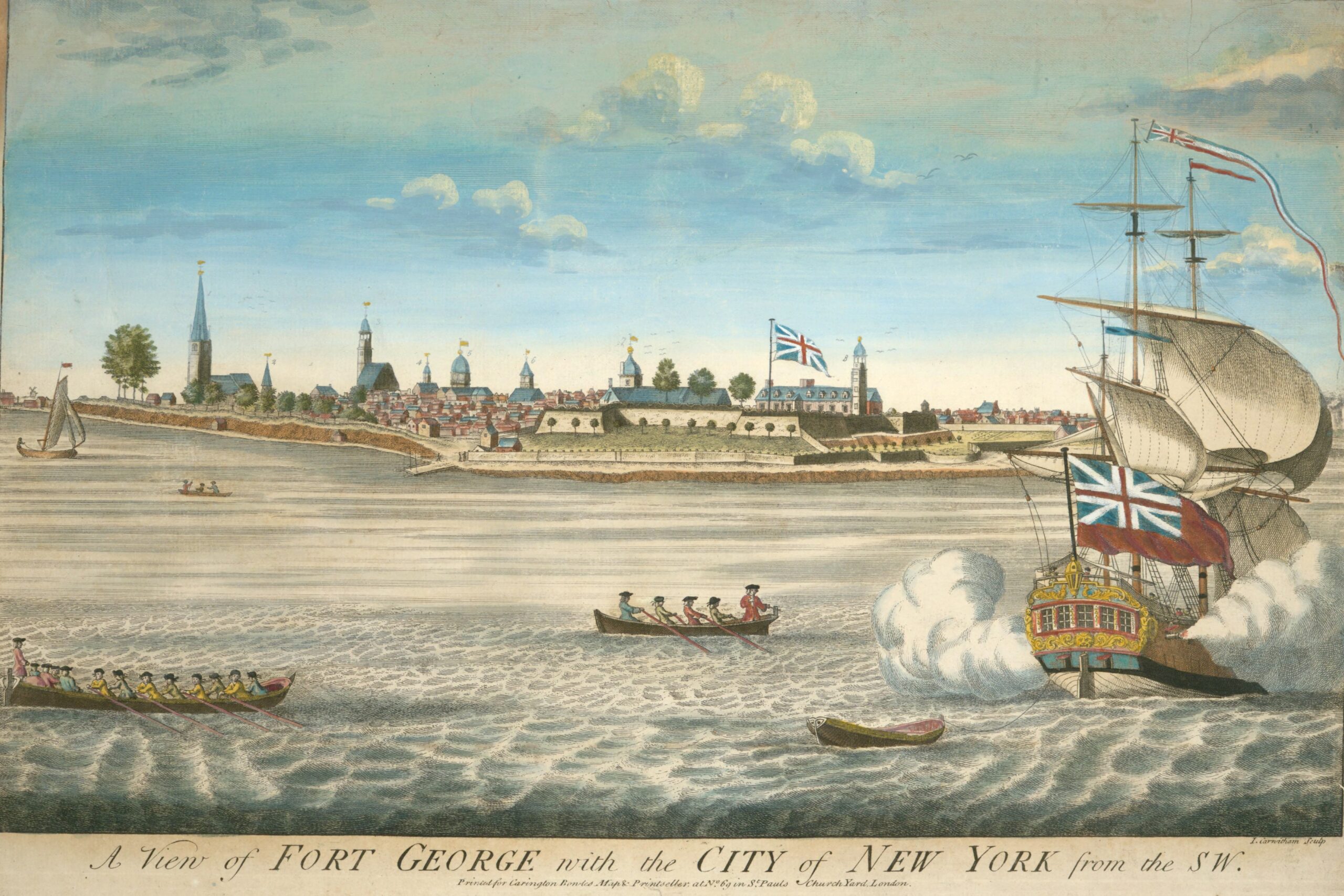
Above: Fort George and New York City in 1731.
In the Good Old Colony Days,
When we lived under the King,
Lived a miller, and a weaver, and a little tailor,
Three jolly rogues of Lynn.
—Anon., “Three Jolly Rogues of Lynn.”
I have seen the good old day,
The day of pride and chieftain’s glory;
When Royal Stuart bore the sway,
And nae heard tell of Whig or Tory.
—Lady Mary Drummond, “Lady Keith’s Lament.”
As 2026 crawls toward its end, we see also the end of this strangely quiet 250th year since the Declaration of Independence and – thanks to the Midterms – the end of the Republican-dominated Congress. But I want to take you away from all of this hubbub and pain. The Thanksgiving holiday will help. It is the only holiday in which we celebrate not the governmental instruments which seem to be failing us, but the colonial past – upon which sturdy foundations were laid so much of what we still enjoy in religion, culture, local government, law, and indeed, everyday life.
Unfortunately, we use Thanksgiving to celebrate the least pleasant part of that colonial past – the Calvinist settlers of the Plymouth Colony. They banned Christmas and Easter, and a great many other pleasantries. Four years after their arrival, they snuffed out a rival colony that offered an alternative way of being English and American. As Nathaniel Hawthorne puts it in his Maypole of Merrymount,
Bright were the days at Merry Mount, when the Maypole was the banner staff of that gay colony! They who reared it, should their banner be triumphant, were to pour sunshine over New England’s rugged hills, and scatter flower seeds throughout the soil. Jollity and gloom were contending for an empire.
The Pilgrims having triumphed over their opponents, as Hawthorne ends his tale,
…Endicott, the severest Puritan of all who laid the rock foundation of New England, lifted the wreath of roses from the ruin of the Maypole, and threw it, with his own gauntleted hand, over the heads of the Lord and Lady of the May. It was a deed of prophecy. As the moral gloom of the world overpowers all systematic gayety, even so was their home of wild mirth made desolate amid the sad forest. They returned to it no more.
The memory and influence of the Puritans – albeit shed of most of their specific religious beliefs and reduced to their attitudes – has dominated our history ever since. So we forget the histories of the other English colonies – for all that Virginia was older – in which Anglicanism, and in some places even Catholicism – were stronger, and Christmas and Easter, at the very least, duly observed. Even further obliterated are the memories of the French and Spanish colonies in the Continental United States. Part of this forgetting process included the change in spelling spearheaded by Noah Webster, and opposed in vain by Washington Irving, Nathaniel Hawthorne, and Edgar Allam Poe – collectively the greatest American literary minds of the era.
In any case, I’m going to take you on a quick tour of colonial America, via the colonial capitals, and the remaining building that housed colonial government or governors. There will be a lot of hyperlinkage, so you can stop and tour around. Each of them have a lot to offer from their origins to the present. If you find yourself in any of those places in the real world – I promise all of them will offer you a lot to see. So for this next little while, clear you mind of the midterms, Democrats and Republicans, and the Revolution, sit back, and prepare to enjoy.
We begin our tour in the Province of New Hampshire, in the northernmost colonial capital, Portsmouth. The Old State House that was on the central Market Square in colonial times is now in pieces in a trailer by the current State Capitol in Concord. But the palatial mansion built by the penultimate Royal Governor, Benning Wentworth survives. His nephew, Sir John Wentworth, Bt., first lived in the rented Macpheadris Warner House, and then built a home of his own – which oddly enough, is now part of an old age home, although well preserved. Fort William and Mary (although now called Fort Constitution) provided royal protection to the harbour – although in the event it was not effective against the rebellion.
We’ll now set out on the old King’s Highway. Originally running from Boston to Charleston, by 1776 it ran from Portland in the District of Maine (then part of Massachusetts) to St. Augustine in the Province of East Florida. We’ll take it from Portsmouth to Boston, the seat of the Province of Massachusetts Bay. Unfortunately, the Governor’s official residence, the Province House (scene of Hawthorne’s Legends of the Province House) was razed in the 1920s. All that remains are the Province House Steps. But the Old State House, the seat of colonial government, is very much with us. Governor William Shirley’s country residence is still extant, in what was then suburban Roxbury. Out in Milton all that remains of Governor Thomas Hutchinson’s estate is the Hutchinson Field. But Castle William (now Fort Independence) still mounts guard over Boston Harbour.
The King’s Highway now brings us south, into the Colony of Rhode Island and Providence Plantations – so called because it is the merger of Rhode Island, centred at Newport and founded by a group of anti-Puritan dissenters – among whom was Thomas Hutchinson’s Great Grandmother Anne – Providence Plantations, founded by Baptist Minister Roger Williams. It is a self-governing colony, so instead of a Governor appointed from London, the legislature elects one of their own number for the job. Because of the merger, there are two legislative buildings; because the colony was self-governing, there is no governor’s palace. In Providence is the Old State House. Newport boasts the Colony House.
Back on the mainland, the King’s Highway brings us into the Colony of Connecticut – a self-governing colony like Rhode Island, and like Rhode Island originally two colonies founded by religious dissenters from Massachusetts. Hartford was the site of the First State House; this having burned in 1783, it was replaced what is now the “Old State House,” dating to 1792. Although built after independence, it is still a model of 18th century architecture. There is no governor’s residence – as with Rhode Island, the local governors were elected by the Assembly rather than appointed by London – and Connecticut’s joined the rebels. Like Rhode Island also, as a product of a merger, Connecticut had two capitals, New Haven being the second. The last colonial State House in New Haven was demolished in 1828, and replaced with a new one, itself demolished in 1889 after Hartford became the sole capital.
From New Haven, the King’s Highway takes you into the Province of New-York. A spur of the road takes you down through the Bronx over the King’s Bridge (which gives its name to the adjoining section of the Borough) down to the provincial capital of New York City, on the lower end of Manhattan Island. Fittingly, the road ends at Bowling Green, where until pulled down in 1776 a fine equestrian statue of King George III stood; the fence dates from that time, all the crowns formerly atop its posts were all cut off at the same time the statue crashed to the ground. St. Paul’s Chapel is the only colonial-era public building still standing. On the site of Fort George, where the Royal Governors down to the last one, William Tryon, lived is the Museum of the American Indian – once the Alexander Hamilton Customs House. The site of the second City Hall, built from 1699 to 1703, seat of both the City council, colonial Assembly, the Federal Congress, and Washington’s first inauguration, and demolished in 1812 is now Federal Hall.
Whether one retraces ones steps to the main road of the King’s Highway, or just takes a boat, our next two stops are in the Province of New Jersey. Itself a 1702 merger of East and West Jersey, it too had two colonial capitals. The seat of East Jerey was Perth Amboy, not far from New York. There we find the Proprietary House, the residence of New Jersey’s last Royal Governor, William Franklin (loyal son of rebel Ben), and the City Hall, where the Provincial Assembly met until 1775. Taking the King’s Highway toward Philadelphia, we come to the other capital, Burlington. Unfortunately both the Courthouse, where the Assembly met, and Green Bank, Governor Franklin’s home, are gone.
Taking the King’s Highway across the Delaware, we arrive in the Province of Pennsylvania, which was a Proprietary rather than a Royal colony – its governors were appointed by the Penn Family, and were seated with the Provincial Government at Philadelphia. The last Governor appointed by the family was one of its members, John Penn. Rather than an official town home, he rented a house at 242 South 3rd Street; although the address remains unchanged, it is not the same house. The Assembly and Council met at the State House, now called Independence Hall. Several country residences of the Governors remain or have been rebuilt, such as Pennsbury Manor and Graeme Park.
The Penns also owned The Three Counties on the Delaware River, our current State of Delaware. Although sharing a Governor with Pennsylvania, the area had its own Assembly. This met at the Court House in New Castle, further south along the King’s Highway. When crossing into Delaware we also passed the Mason-Dixon Line, laid out by the astronomers Charles Mason and Jeremiah Dixon between 1763 and 1767. We are now in the South!
The Province of Maryland, named for Charles I’s Catholic Queen, Henrietta Maria, was founded as a refuge for Catholics by the Lords Baltimore, who would be – like the Penns in Pennsylvania – Lords Proprietary under the Crown for most of its history. There was a period of direct Royal rule from 1688 until 1715, when the 5th Lord Baltimore apostatised, and so received his inheritance back. In any case, the seat of government was moved from the remoter original capital of St. Mary’s City (which to this day is at the heart of the primarily Catholic southern counties of Maryland) to Annapolis in 1695. The State House, built and opened in 1772, was dedicated by the last Proprietary Governor, Sir Robert Eden, and is the oldest in continual use in the United States, being the home of the State legislature to-day. An earlier governor had built the Jennings Mansion as an official residence; after Eden left, this would be given to the nascent United States Naval Academy. It was demolished in 1901, and Dahlgren Hall occupies the site. But the intricately carved marble fireplace from the governor’s office in the old Jennings Mansion was saved from demolition and installed in what is now the governor’s study in the State House. Ironically, the current governor’s mansion in Annapolis is called “Government House,” which is the usual name given to Viceregal residences in the British Commonwealth to-day.
The King’s Highway now takes us over the Potomac River to the Province of Virginia, which takes its name from Elizabeth I, the “Virgin Queen.” There is very little left of the original capital of the colony at Jamestown; in 1699, the government of the Province moved to the more central Williamsburg – which has been entirely rebuilt. The Governor’s Palace – home of the last Governor, Lord Dunmore, is as it was, as are the Capitol, the Courthouse, and the Powder Magazine – thus constituting the only intact group of government buildings in British America.
We now travel south on the King’s Highway into the Province of North Carolina, named after Charles II. The seat of government of the colony shifted several times – Bath, Edenton, and Brunswick, before coming to settle at New Bern. This was done at the instance of Royal Governor William Tryon, whom we first saw governing the Province of New York. He built Tryon Palace here in 1770; it symbolised his putting the often chaotic affairs of the colony into working order – for which accomplishment he was rewarded the following year with what appeared a plum assignment at the time. It was left to his successor, Josiah Martin, to deal with the revolution. Afterwards, all but one wing of the Palace burned – but it was restored to its current beautiful state in the 1950s.
We now pass south along the King’s Highway to the Province of South Carolina, likewise named after its Royal founder. Charleston had been the capital of the colony since 1672. In 1753, an impressive State House was built to house the colonial assembly. Unfortunately, after the revolution, it burned during the 1788 State Constitutional Convention. But the walls and foundations were intact, and so it was rebuilt – but the decision had already been made to move the state capital upcountry to Columbia, so it was demoted to Charleston County Courthouse which it remains to this day. There was no official governor’s residence, so the last Royal Governor, Lord William Campbell, had to make do with a rented house, which still stands to-day, until he was driven into exile in 1776. But the other major government building, the Customs House – now known as the Old Exchange and Provost Dungeon, was erected in 1771 to bring in His Majesty’s Revenues from the port.
The King’s Highway now takes us through the Province of Georgia. Founded as late as 1732 as a prison reform colony, it was named after George II. Its capital, Savannah, was thus the newest of the British colonial seats. The Assembly House stood in what is now an open space at the southeast corner of to-day’s Reynolds Square. An official historic marker reading “Savannah: Colonial Capital and Birthplace of Representative Government in Georgia” stands there to indicate where the Commons House of Assembly met starting around 1770. Just to the northwest is the iconic Olde Pink House. The last Royal Governor, James Wright, lived at Government House, on the site of what is now Telfair Academy.
The King’s Highway originally ended at Savannah. Until 1763, the territory beyond an ill-defined border was Spanish Florida. The oldest European Colony on the North American Mainland, its capital was St. Augustine, the oldest continuously inhabited European settlement in the Continental United States – founded by Pedro Menendez at the order of King Felipe II of Spain in 1565. There was on again, off again warfare between the British and the Spanish, beginning with the settlement of Charleston in the 17rh century, and increasing with the founding of Georgia. Try as they might, the British were always defeated when they attacked St. Augustine. They did manage, however, to conquer Havana during the Seven Years War. Seeing Cuba as more important, the Spanish gave the British Florida to get Cuba back – and when the British took over, all the Spanish inhabitants (and the Catholic Indians) left.
The new owners reorganised the territory into the Provinces of East Florida (the present State up to the Apalachicola) and West Florida – all the rest of the current panhandle westwards. To avoid giving Louisiana (which was what we call the Louisiana Purchase) to the British, Louis XV gave the territory to his cousin, Carlos III of Spain. But he surrendered the part of Louisiana east of the Mississippi – coastal Alabama (including Louisiana’s first capital at Mobile), Mississippi, and the present-day “Florida Parishes” of the State of Louisiana to the British, who incorporated them into West Florida. Starting in 1763, they extended the King’s Highway to St. Augustine. Although the new inhabitants remained loyal to the British Crown in the revolution, Spain got both Floridas back in return for the Bahamas, which they had conquered in 1782. After buying Louisiana in 1803, the United States turned their attention to their former ally’s territories. They began nibbling at West Florida in 1810, taking the Florida parishes, then Mobile and environs in 1813, and last the beleaguered Spanish sold what was left in 1819, although it would be two years before the Yankees took possession..
We’ll take the King’s Highway down to St. Augustine. The first remnant of colonial rule is Government House, home to Spanish, British, and Spanish Governors once again, all the way down to Jose Mara Coppinger, who presided over the turnover. St. Francis Barracks was built during the first Spanish regime as a Franciscan Monastery; the British used it to house troops, the Spanish kept it that way, and it is now the headquarters of the Florida National Guard. When soldiers of the garrison took sick, they were sent off to the Spanish Military Hospital to recover. The Castillo de San Marcos, built in 1672, is the primary reason St. Augustine was never conquered. As a parish, the Cathedral-Basilica of St. Augustine was founded in 1565, making it the oldest Catholic parish – indeed, the oldest Christian congregation of any kind – in the United States; as such it was the church of the Royal Governor.
In St. Augustine we take our leave of our old friend, the King’s Highway, and set off to the West. In colonial times, no land road went further than the Mission of San Luis de Apalachee, near present-day Tallahassee – this too was called the King’s Highway, albeit in Spanish – El Camino Real. Communications and trade between St. Augustine and Pensacola was carried on primarily by ship, so we will be taking the highway from Tallahassee westwards that was first pioneered by the new American owners in 1826. This will take us overland to Pensacola.
So remote was the West Floridian capital from St. Augustine that when the inhabitants left in 1763, they did not go to Cuba, but to Yucatan, Mexico. During the revolution, the Spanish did retake the city, with French assistance. The last Spanish Governor was Jose Maria Callava; the British-built Government House, erected in the 1770s, burned – on the site is the Lear-Rocheblave House. But Plaza Ferdinand VII remains, a public square named in honour of the last Spanish King to rule over Florida, Texas, New Mexico, Arizona, and California – while he was still reigning. Although the building that houses St. Michael’s Basilica only dated from 1886, the parish was established in 1781, and was the church of the Royal Governor in its earlier incarnations for four decades.
Our next destination is the Province of Louisiana, which as we have seen was successively French and Spanish, before being purchased by the United States in 1803. The colony’s western extent was enormous, and its eastern frontier was the Mississippi up as far as to what is now Minnesota. Both it and the Old Northwest woud be dotted with French settlements. Its first capital, starting in 1702, was Mobile, succeeded by Biloxi in 1720, and at last New Orleans in 1722. The biggest remnants of Mobile’s brief day in the sun are the partially rebuilt Fort Conde (known as Fort Charlotte during Britain’s day in West Florida), and the Cathedral-Basilica of the Immaculate Conception. Although the present building was only dedicated in 1850, the parish goes back to 1703; it was the Church of the Royal Governor before the capital shifted.
New Orleans is, of course, the City that Care famously Forgot. When the French founded it in 1718, they laid out the Place d’Armes – the current Jackson Square. Adjoining it was the Maison du Gouvernement – Government House – where the Royal Governors lived and worked. But the wooden city of the French was burned out by fires in 1788 and 1794. In 1795, on the site of the old French Government House and next door to the church, the Spanish built the Cabildo. From this building areas as far away as Minnesota and Iowa were administered by successive Governors. This came to end on November 30, 1803, when the last of them, Juan Manuel de Salcedo, handed control of the colony over to incoming French Governor Pierre-Clement de Laussat, who in turn ceded rulership to the Americans in accordance with the Louisiana purchase twenty days later. Next to the Cabildo on Jackson Square where all this drama occurred is St. Louis Cathedral. As is the pattern in Catholic Colonial America, the parish – founded in 1718 – is far older than the current building which, while incorporating parts of earlier structures, only reached its current state in 1850. It was, of course, the church of the Royal Governors.
In colonial times, travel between New Orleans and the Spanish Province of Texas meant traveling up the Mississippi to Natchez, then over land to Natchitoches, the last French post in this part of Louisiana – far more like Southern Louisiana than the surrounding north. Here one can take El Camino Real de los Tejas down to the final colonial capital at San Antonio. Here too, we find the usual pattern. There is the Spanish Governor’s Palace – surmounted by the Habsburg Double Eagle, in token of the House of Bourbon’s predecessors on the throne of Spain and inhabited by their representatives until the last of them, Antonio Maria Martinez, surrendered control to the nascent Mexican Empire in 1821. Not too far away is San Fernando Cathedral, named after St. Ferdinand III, King of Castile – who also gave his name to Mission San Fernando and the San Fernando Valley in faraway California. Founded in 1731, it was expanded continuously until reaching its current size and shape in 1874. It too was founded as the church of the Royal governors.
Travel between Spanish Texas and the adjoining Province of Santa Fe de Nuevo Mexico took a bit of doing, thanks to the extent of the frontier and hostile Indians. One had to take El Camino Real de los Tejas all the way south to Torreon in what is now Mexico and then set out northwesterly on El Camino Real de Tierra Adentro north to El Paso (then part of New Mexico). The path then took one up the valley of the Rio Grande to the colonial capital at Santa Fe. Of course, one may drive far more directly to-day. Here is the Palace of the Governors, built in 1610, in which they alL lived until Facundo Melgares very reluctantly swore allegiance to the new Mexican Empire in 1822. The Cathedral Basilica of St. Francis of Assisi, was originally built in in 1714. In 1850, the new Bishop, the Frenchman, Jean Baptiste Lamy, ordered a new one built on the site of the old church; construction began in 1869 and continued until 1887, although one chapel remains from the original.
The Old Spanish Trail leads from Santa Fe into the neighbouring Spanish Province of Alta California, terminating at what was El Pueblo de Nuestra Senora de Los Angeles de Porciuncula – to-day’s Los Angeles. To reach the capital at Monterey, one had to travel up El Camino Real de las Californias, which stretched south as far as Loreto in Baja California, and as far north as Sonoma, beyond the Bay Area. There one finds the Customs House – the sole civic building remaining from Spanish days, and whose flagpole saw the successive raising of Spanish, Mexican, and American flags – and the Presidio where dwelt the Royal Governors until 1822, when Pablo Vicente de Sola swore allegiance to the Mexican Empire. After 1848, the Americans moved the title “Presidio of Monterey” to their new barracks at their current location. But the Royal Presidio Chapel of San Carlos de Borromeo, where the King’s representative attended Mass remains in the spot where it has been since 1794; it is now the cathedral of the Diocese of Monterey.
So at last, our journey ends on the shores of the Blue Pacific; we have travelled a very long way from Portsmouth, over four Royal Roads. But the truth is, even in the many places we have seen, we have just scratched the surface of America’s colonial heritage. There are at least ten to twenty thousand colonial-era structures remaining in the 48 States; if we add institutions like churches, schools, universities and national guard/militia units, the number soars even higher. If we extended our survey to include the states and possessions outside the lower 48 State, we would have a lot more to include – the Spanish in Puerto Rico, Guam, and the Northern Marianas; the Danish in the U.S. Virgin Islands, the Russians in Alaska and Hawaii; and native kings and chiefs in Hawaii and American Samoa. But what should be apparent is that beginning over two centuries before 1776, the Kings of Spain, France, and Great Britain were laying the foundations of this wonderful country of ours – Felipe II, Louis XIII, and James I and VI should be considered at least as much our Founding Fathers as any who gathered at Philadelphia. This is an important point; our country long predates its current Federal political arrangements. Should (which God forbid!) they falter, the country shall continue in some manner or other – as the land in which God willed we should be born, to which He pushed us to immigrate. It is ours to enjoy, to love, to defend – and above all, if we are Catholics – to evangelise.