
At OnePeterFive, we try our best to cover the news coming out of the Vatican. This means telling the truth – the whole, ugly truth, whatever it is, as well as any good news, like the good things Pope Francis did – but with the utmost charity possible. (I’m constantly pained in my conscience when I try to tell the truth with Erasmian humour, as best I can, because I never want to provoke any soul to harden their hearts against their spiritual fathers, and especially the Holy Father – say a Hail Mary for me!).
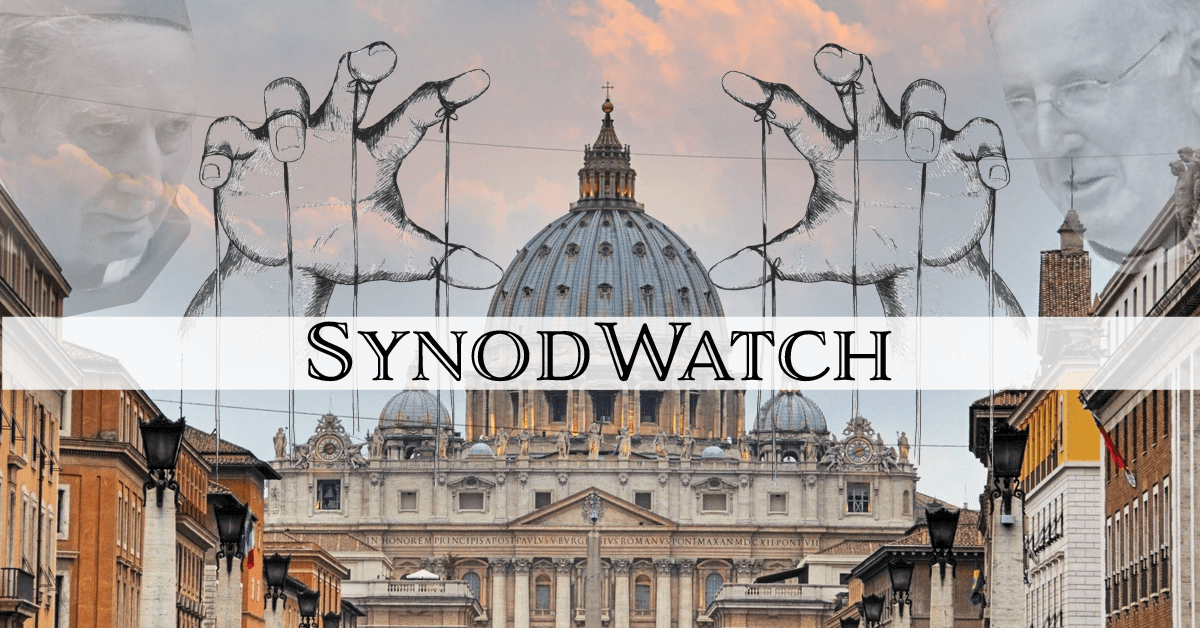
So we’ve been following the Neo-Modernist dream of the St. Gallen Mafia, aka “Synodality,” for the past few years. None of us has any illusions about this, and “mainstream” Bishops and Cardinals (like Müller, the erstwhile head of the Office Formerly Known as Holy), have denounced “Synodality” as a “hostile takeover of the Church.”
But what we really want to do at OnePeterFive is point the way toward a solution. Let’s talk about the reality of the situation, let’s reverence our (bad) bishops, yes, but then let’s get off the internet and on our knees.
We’ve got the traditional Faith, now let’s conquer in the Name of His Majesty.
We’ve founded our sodalities for this reason (Crusade, the Fast, and the Fatima Icon). But something new occurred to me while I was reading the latest document on the Meeting about Meeting about Meeting about Meetings from the Vatican and that is this:
We can use this against them.
First of all, let’s not kid ourselves: we know that Synodality is the plot of the Neo-Modernists to overthrow the Church. But what would our forefathers say, who by faith conquered kingdoms, wrought justice, obtained promises, stopped the mouths of lions, quenched the violence of fire, escaped the edge of the sword, recovered strength from weakness, became valiant in battle, put to flight the armies of foreigners (Heb. xi. 33-34)?
We don’t know yet whether Pope Leo is “Francis 2.0” or trying to salvage Synodality on behalf of orthodoxy. But let’s assume for the moment, the worst possible scenario that some Trads are saying right now: Pope Leo is Francis II in the worst possible sense.
So again: what would our forefathers say? What would our Trad Godfathers say, who faced a much worse situation?
Bring it on.
So let’s survey the battlefield here: what is this new document? It’s the guide for your local diocese to execute the “implementation phase” of synodality – this means to put into practice the “final document” that was released last year. So we know the plot of the Marxists: they want to do the steps we just outlined last week:
- Form an elite conspiracy of power hungry heretics (the St. Gallen Mafia)
- Find an emotional grievance that many people have (i.e. females excluded from the priesthood, etc.)
- Whip up the mob using emotional rhetoric about this grievance (“female dignity”)
- Tell everyone that this mob represents “the people” (i.e. “synodality” surveying the masses)
- Impose your minority will on the majority “in the name of the people” (“implementation phase”)
OK, that’s the bad news. Let’s have the good news: most bishops do not want to suppress the Latin Mass. Some of them genuinely care about the principles of Summorum Pontificum, others only care about the status quo – and the TLM parishes are paying their bills and not causing the bishop any more headaches. Further, other bishops are already drowning in a priest shortage and a budget crisis, closing churches left and right – and literally cannot afford to spend more money on the bureaucratic nightmare that is Synodality. As Bishop Schneider says in Christus Vincit:
Is this the “Church of the poor,” which was so stressed during the Second Vatican Council and afterwards? The continuous meetings and assemblies of bishops: they are spending so much money, it’s incredible. If we would reduce drastically the frequency of these meetings, we could give millions of dollars every year to the poor around the world. To me, this is a sin that churchmen are committing today. Even setting to the side for a moment the problems with these excessive meetings, which are ultimately a manifestation of Pelagianism and undermine the supernatural—to say nothing of the problem of the almost continuous stream of doctrinally ambiguous documents they produce — I believe it is sinful to spend so much money, which we could give to the poor in our world. We have to stop this. But it seems that the frequency of synods and meetings is only going to increase under the pretext of a so-called “synodality.”
So here’s what you do:
- Form an elite group of pious traditionalists – only choose men and women who are zealous for mental prayer, fasting and Eucharistic reparation. In other words, they are abounding in holiness and charity. “Cranky Mad Trads” should not be chosen for this group, who will do more harm than good.
- Begin Eucharistic reparation regularly at your parish.
- Surrender to the will of God in line with what Our Lady of Fatima asked the shepherds: “Are you willing to offer yourselves to God and bear all the suffering He wills to send you, as an act of reparation for the sins by which He is offended, and of supplication for the conversion of sinners?” How did they respond? “Yes, we are willing.” And Our Lady said this to them: “Then you will have much to suffer, but the grace of God will be your comfort.” Only if we abandon ourselves to this way of the cross will we make any progress for Tradition – both in our souls and in society.
- If this spiritual grounding is truly established among pious souls, then go to the bishop and ask for “dialogue and synodality.” Meet with him in person. Tell him your “faith experience” and “faith journey.” Tell him how you encountered the “Paschal mystery” at the Latin Mass.
- Remind him of all the numbers for your parish’s contribution to the diocesan budget – convince him that he is your father and you are not going to harden your heart against him, but contribute all the fair share of the money which is yours.
- Think of some “act of synodality” that your parish can do to lighten his burden for souls in his diocese.
- Be sincere. You can literally make synodality into a filial act of reverence, which is entirely traditional. An elder man rebuke not, but entreat him as a father (I Tim. v. 1).
- Take the “implementation phase” of synodality seriously in your diocese. Do this process again and again if necessary.
After you do this for the next few years up to the climax of the “Ecclesial Assembly” in 2028, the bishop will do one of three things:
- He will reject you, in which case you give thanks to suffer in line with Fatima, the same way the Apostles reacted to “synodality”: And they indeed went from the presence of the council [synodality], rejoicing that they were accounted worthy to suffer reproach for the name of Jesus (Acts v. 41).
- He will do nothing, in which case your status quo is secure – continue to hear the Latin Mass or build it up where you can!
- He will defend and support your Latin Mass, in which case, go further and spread the Crusade of Eucharistic reparation to other good Catholic parishes as best you can. Start a chapter of St. Paul Street Evangelization and welcome more souls into your parish! Keep on going and do more for the greater glory of God and the salvation of souls! Jesus is King!
Either which way your “Trad synodality implementation phase” pans out with your bishop – Jesus wins.
T. S. Flanders
Editor
St. Elizabeth of Portugal