
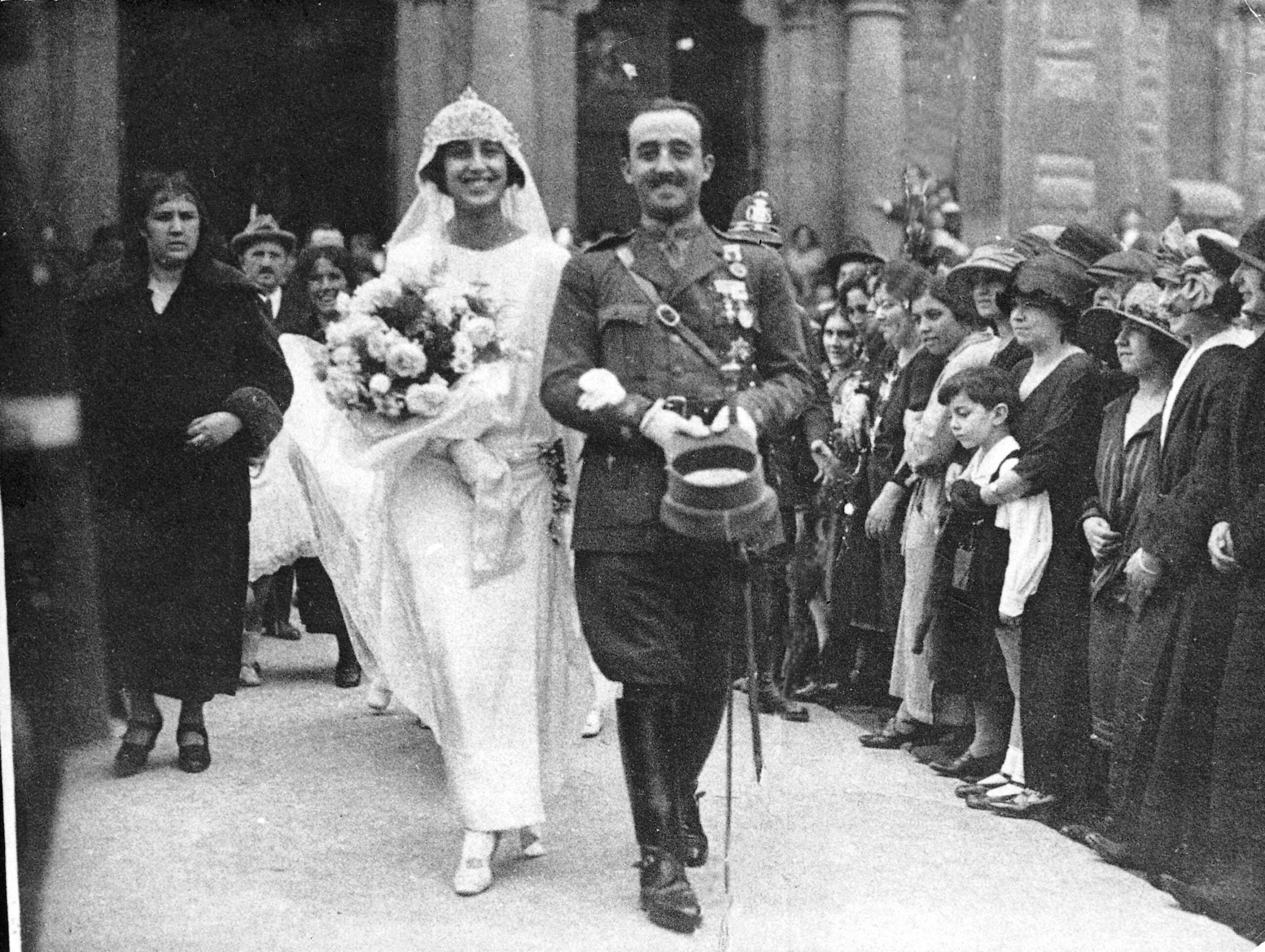
Above: the wedding of Franco and Carmen Polo, Oviedo, 22 October 1923.
In the summer of 1936, as the Spanish Civil War erupted, a wave of anticlerical violence known as the Red Terror swept through the Republican-controlled zones. Between 1936 and 1937, this persecution targeted the Catholic Church with particular ferocity. Thirteen bishops were murdered, along with thousands of priests, religious brothers and sisters, and countless lay Catholics. Reliable historical tallies place the number of clergy killed at approximately 6,832: 13 bishops, more than 4,180 diocesan priests and seminarians, over 2,360 male religious, and nearly 300 nuns. Many suffered torture, humiliation, and desecration before death. Hundreds of churches, convents, and monasteries were burned, looted, or converted into warehouses, stables, or political headquarters. Sacred images were smashed, tabernacles emptied, and liturgical objects melted down or publicly mocked.
The scale and intensity of the attacks marked one of the most severe episodes of religious persecution in modern Western history. In some dioceses, the death toll among the clergy reached catastrophic levels—nearly 90 percent in Barbastro, for example. The violence was not limited to the ordained; thousands of ordinary Catholic laypeople were also executed, often for their faith or for assisting priests and religious. Churches that had stood for centuries as centers of Spanish community life were reduced to ruins or emptied of their religious purpose.
Against this background of chaos and bloodshed, the Nationalist forces under General Francisco Franco eventually prevailed. By 1939, the war had ended and Franco’s government restored public order across Spain. The Catholic Church, both in Spain and at the Vatican, recognized the significance of this outcome. Spanish bishops had already described the conflict in terms of a defensive struggle for the Faith.
The Holy See’s response was particularly significant. On April 1, 1939, Pope Pius XII sent a telegram directly to Generalísimo Franco, congratulating him on what the Pope described as the “deseada victoria católica [de] España” (the long-desired Catholic victory in Spain). The Pope expressed his hope that Spain, having attained peace, would renew its historic Christian traditions, and concluded by imparting his Apostolic Blessing upon Franco and the Spanish people.[1]
Fifteen days later, on April 16, 1939, Pius XII delivered his radio message “Con Immenso Gozo” to the faithful of Spain.
With great joy We address you, most dear children of Catholic Spain, to express to you our fatherly congratulations for the gift of peace and of victory, with which God has deemed worthy to crown the Christian heroism of your faith and charity, tried in so many and so generous sufferings.[2]
He further acknowledged the Christian sentiments demonstrated by the Head of State and explicitly referred to the principles of pacification proclaimed by the Generalísimo.² The Spanish hierarchy viewed the end of the Republican zone’s anticlerical campaign as the lifting of an existential threat to the Church.
Franco himself publicly identified Spain’s national identity with its Catholic inheritance. This was not merely a political expression. On May 30, 1969, at Cerro de los Ángeles, he personally renewed Spain’s consecration to the Sacred Heart of Jesus, marking the fiftieth anniversary of the original consecration by King Alfonso XIII in 1919.
In the prayer he delivered on that occasion, Franco addressed Christ as “Rey de reyes y Señor de los que dominan” (King of kings and Lord of those who rule). He subsequently declared:
España, pueblo de tu herencia y de tus predilecciones, se postra hoy reverente ante este Trono de tus bondades (Spain, the people of Your inheritance and predilection, prostrates itself today in reverence before this throne of Your goodness).[3]
The significance of this declaration is unmistakable: Franco publicly placed Spain’s national life, its governing institutions, and its historic Catholic identity within the framework of Christ’s universal kingship.
That tradition reached back to the Visigothic king Reccared (Recaredo), who in 589 formally renounced Arianism and embraced Catholicism at the Third Council of Toledo, uniting the kingdom under the Catholic faith. From that moment, the Church and the Spanish people were bound together through the Reconquista, the Golden Age, and the centuries that followed. Franco sought to recover and reaffirm this inheritance after the upheavals of the Second Republic and the Civil War.
Throughout his long tenure, he acted as a determined defender of traditional Spanish Catholicism. Religious education returned to the schools. The Church regained legal privileges and a central role in public life. Civil marriage and divorce laws introduced under the Republic were reversed. Seminaries were rebuilt and expanded. Public processions, feast days, and the visible presence of the Church were restored. Franco’s regime promoted a vision of Spain as a Catholic nation whose historic mission and cultural continuity rested on the faith that Reccared had made official more than thirteen centuries earlier.
The Red Terror had demonstrated how quickly that heritage could be attacked when revolutionary forces held power. The restoration that followed the Nationalist victory halted the destruction, returned stability to religious life, and allowed the Church to recover. For the Spanish hierarchy and for many Catholics who had lived through the persecutions of 1936–37, Franco’s victory represented not only a military success but the recovery of the Catholic order that had defined Spain since the days of Reccared.
In the decades that followed, that restored relationship between Church and state shaped the country’s public life, education, and national self-understanding. The events of those years remain a stark reminder of the vulnerability of religious institutions in times of ideological upheaval and of the determination required to rebuild what had been nearly erased.
[1] Pius XII, telegram to Generalísimo Francisco Franco, April 1, 1939, “Telegramas de Su Santidad el Papa Pío XII y el Generalísimo Franco con motivo del fin de la guerra,” Boletín Eclesiástico del Arzobispado de Toledo 95, no. 4 (April 1, 1939): 129.
[2] Pius XII, Radio Message “Con Immenso Gozo,” To the Spanish Faithful “Radiomensaje de Su Santidad Pío XII a los fieles de España,” April 16, 1939, Acta Apostolicae Sedis 31 (1939): 151–54.
[3] Francisco Franco, “Oración de renovación de la consagración de España al Sagrado Corazón de Jesús,” delivered at Cerro de los Ángeles, Getafe, May 30, 1969, transcript reproduced in Fundación Nacional Francisco Franco, “Oración de la Consagración de España al Corazón de Jesús (30-V-1919).