
NOTICE TO READERS: The text below was transcribed from the original text of the lecture given at the 30th Annual Roman Forum Summer Symposium, in Gardone Riviera, Italy, July 6 – 17, 2023. The original text of the lecture is available for
download here. The text below was neither checked nor proofread by the author. In case of differences the original text prevails. A video version of the lecture is available here:
AD MAIOREM DEI GLORIAM
I. Christianity and Paganism: Old and New
What is paganism?
Saint Paul explains the roots and the fruits of paganism in Rom 1, 18-32 (see Appendix A). Modern paganism is a vivid illustration of that.
What is pagan cosmogony?
In this lecture, «pagan cosmogony» means the standard model of physical cosmology.
What is physical cosmology?
The study of cosmological models in modern physics, i.e. based on general relativity.
What is general relativity?
A theory of gravitation in physics.
What does it mean that theory X «follows from» theory Y in the title?
In physics, it means that theory X is a special case of theory Y. If theory Y holds true, then also theory X must hold true by necessity (or theory Y implies theory X). Examples:
- special relativity «follows from» (is a special case of) general relativity,
- celestial mechanics (Newton’s theory of gravitation) «follows from» (is a special case of) general relativity (Einstein’s theory of gravitation),
- classical mechanics «follows from» (is a special case of) quantum mechanics.
What is the motivation behind the question in the title?
There are two motivations.
- Countless catholic priests believe in, and therefore preach, pagan cosmogony. They are in good company, because on November 22nd, 1951, Pius XII. addressed these words to the Pontifical Academy of Sciences:*
Modern science «has followed the course and the direction of cosmic developments, and just as it has envisaged the fatal termination,** so it has indicated their beginning in time at a period five billion years ago, confirming with the concreteness of physical proofs the contingency of the universe and the well-founded deduction that about that time the cosmos issued from the hand of the Creator.
The argument is: Because general relativity holds true, and physical cosmology is based on general relativity, also cosmology holds true, and there must have been a big-bang five billion years ago.
- Numerous faithful Catholics reject general relativity, because they believe that pagan cosmogony follows from it in the sense just given. Their argument is: Because pagan cosmogony contradicts Christian cosmogony, general relativity as its premise must be flawed. The pious rejection of general relativity is then somtimes generalized to doubt physics and natural science summarily, as recently expressed by Benedikt XVI in his spiritual testament:***
It often seems as if science – on the one hand the natural sciences, on the other hand historical sciences (in particular exegesis of Holy Scripture) had irrefutable insights that stand against the Catholic faith. I have been able to experience and witness from a distance the changes of natural science, how apparent certitudes against the faith melted away, proving themselves not to be (natural) science but philosophical interpretations that only gave the appearance of belonging to (natural) science.
II. Objective of this lecture
The purpose of this lecture is
- to summarize basic facts and ideas of general relativity and physical cosmology in a non-mathematical manner, and thereby
- to help you answer the title question for yourself.
III. General Relativity (see Appendix B for terms)
What is general relativity (GR)?
General relativity, more precisely the “general theory of relativity,” is Einstein’s theory of gravitation in physics.
The fundamental insight of GR is the identification of gravitational force differences with the curvature of spacetime.
The fundamental equation of GR (Einstein’s equation) states (up to constant factors)
The unknown quantity in this equation is «spacetime». It has to be computed as the solution of the equation, provided the non-gravitational energies on the right hand side are known and given as parameters.
Energy (or force) is a fundamental concept of physics, while curvature is a concept from geometry. In this way, GR links physics with geometry, a beautiful insight!
If GR is about gravitation, force and curvature, why call it (General) “Relativity”?
Because Einstein’s theory is inspired by an idea called “(general) principle of relativity.”
Is relativity in physics related to relativism in philosophy ?
It depends on what is meant with relativism. Relativism in philosophy seems ill-defined in the sense that philosophers do not seem to agree on a definition. The rough idea seems to be that there is no objective truth, or that truth cannot be asserted without providing a context. In this sense truth is held to be “relative” to that context.
Relativity in physics, however, is clear and well defined. It simply means that a certain quantity, fact or assertion is coordinate dependent. It does not imply that all quantities, facts or assertions in physics are coordinate dependent.
Why is GR extraordinary in physics?
General relativity is a most extraordinary theory of physics, because:
- GR is the only theory in physics that does not presuppose that physical quantities are functions of space and time coordinates.
- GR is the only theory in all of physics that does not presuppose as input a definition of “distance” in space or time between physical bodies or events.
- Instead of requiring geometrical “distance” as an input, GR yields the definition of “distance” as an output.
In what sense is distance an output?
The fundamental equation of GR (Einstein’s equation) is
In this equation, “spacetime,” more precisely its “metric,” is the unknown. Solving the equation for given parameters means to find a metric such that the equation holds true. The metric defines a distance function, which assigns to any pair of points the distance between them. Thus, distance is the output of GR in the sense that it is obtained from a solution of Einstein’s equation.
IV. Physical Cosmology
Physical cosmology is the study of cosmological models based on general relativity.
What is a cosmological model based on general relativity ?
A solution of Einstein’s equations «which is supposed to represent the whole past, present, and future of our universe.»
Why is such a solution / model impossible from the start?
A solution of Einstein’s equations for the whole past, present, and future of our universe would require knowledge of the energy content (the parameters on the right hand side of Einstein’s equation) for the whole past, present, and future of our universe. Such knowledge is absent.
V. Result
General relativity is a theory of gravitation. The solution of Einstein’s equations requires knowledge of all parameter data, in particular the non-gravitational energies on the right hand side of the equation.
In cases, where these parameter data are available, e.g. in the solar system, the solutions of Einstein’s equations have been confirmed experimentally. Examples of experimental confirmations are the anomalous precession of the perihelion of the planet Mercury, the bending of light in gravitational fields (gravitational lensing) and gravitational time dilation. Gravitational time dilation is routinely needed and used in synchronizing GPS clocks for proper operation. Using GPS location (on your mobile or in your car) confirms the truth in Einstein’s general relativity theory.
However, non-gravitational energies for the whole past, present and future of the universe are not available. As a consequence, solutions of Einstein’s equations for the whole past, present and future of our universe do not exist.
Due to the lack of parameter data for Einstein’s equations cosmologists make guesses. Cosmological guess work is based on personal philosophical, theological or mathematical prejudices and desires.
A common mathematical desire is to simplify the equations mathematically, because otherwise they are difficult to solve. Many simplifying assumptions have been made in physical cosmology. Einstein originally assumed a static universe. The «Standard Model of Physical Cosmology» has frequently changed since Einstein. Today, the standard model is the «Λ-CDM-model» (CDM = cold dark matter, Λ = cosmological constant).
VI. The Standard Model of Physical Cosmology (Big-Bang)
Narrative
The narrative of the standard big-bang model can be found on NASA websites and in many textbooks. It starts by asserting that the portion of the universe, that we can see today, seems to be expanding. Therefore, it must have been smaller in the past. 12 to 14 billion years ago, it was supposedly only a few millimeters across. And it was in a hot dense state. Since then it has undergone an expansion, that produced the now very cold cosmic microwave background radiation plus hydrogen, helium and a few other light elements. Even more astonishingly, the narrative postulates an immediate ultrashort epoch of accelerated expansion, called «inflation», that produced an imprint of primordial quantum fluctuations on the cosmic microwave background anisotropy which is supposed to account for large scale sctructure in the presently visible portion of the universe.
Illustration
Illustrations of the narrative can be found at
- https://universe.nasa.gov/resources/251/history-of-the-universe
- https://map.gsfc.nasa.gov/media/060915/index.html
Such illustrations typically display a time axis that remains unexplained.
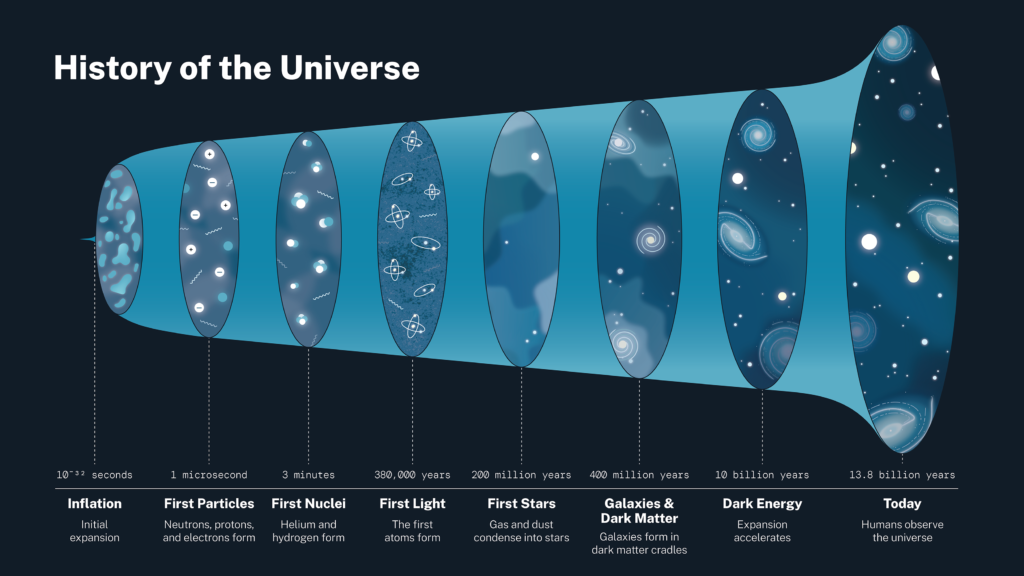
The time coordinate is referred to as «cosmic time». Cosmic time is defined as the proper time measured by clocks attached to some sort of “average flow” of galaxies or galaxy clusters. Therefore, cosmic time becomes ill-defined when there are no galaxies. Even when galaxies exist, it is not clear how to transform between cosmic time and UTC on earth. The cosmic time scale of inflation is placed at unobservable 10−34 “seconds.” There is no observational or experimental evidence for “dark matter.” There is no observational or experimental evidence for “dark energy.”
Criticism
On May 22nd, 2004, a group of thirty scientists lead by E. Lerner and including H. Bondi, a renowned cosmologist, published a scathing critique of the standard model under the title «Bucking the big bang». (see Appendix C).
An incomplete list of typical assumptions for cosmological models
- The universe as a whole is a meaningful physical system.
- The geometry of the universe as a whole is determined only by gravitational forces.
- A solution of Einstein’s equation can represent the universe as a whole.
- There is a privileged global time coordinate, called cosmic time.
- There exists a family of privileged coordinate systems (“fundamental observers”).
- Cosmic time is the proper time of fundamental observers.
- The universe is homogeneous (looks the same to every fundamental observer).
- The universe is isotropic (looks the same in all directions to every fundamental observer).
- There is a fundamental observer at every point in spacetime
- The worldlines of fundamental observers do not cross each other.
- The worldlines of fundamental observers are orthogonal to space sections.
- Spacetime is a product of cosmic time and a threedimensional spaces (foliation).
- There is a flow of cosmic time
- The fundamental constants of physics are the same at every point of spacetime.
- There exists a “present state” of the universe, although it cannot be observed.
- The energy of normal matter is that of a perfect fluid with zero pressure
- The energy content of radiation is that of a perfect photon fluid (its pressure equals one third of its enery density).
- There exists an unknown type of energy called “dark matter.” It has never been observed or measured.
- The energy content of “dark matter” is that of a perfect fluid with zero pressure.
- There exists an unknown form of energy, called “dark energy.” It has never been observed and no one knows what it should be.
- The redshift of spectral lines is cosmological not Doppler redshift.
- The redshift is the same everywhere throughout the universe.
- The redshift applies between galaxies, but does not apply within galaxies.
- The universe as a whole is expanding.
- The assumed expansion is not uniform.
- For a short period the expansion was faster than the speed of light (inflation).
- The assumed expansion of the universe as a whole can be extrapolated.
- The extrapolation implies a spacetime singularity (big bang).
Assumptions 7 and 8 are known as the «cosmological principle».
Assumptions 10 and 11 are somtimes called Weyl’s postulate.
The list of assumptions is not complete. Additional assumptions are needed, e.g. to interpret the observation data for redshifts self-consistently in terms of an expansion of space.
VII Conclusion
General relativity is an established, experimentally tested and verified theory of gravitation in physics. It has remained unchanged ever since its invention in 1915.
The standard model of physical cosmology is an extremely speculative, untested and unverified extrapolation. It has evolved from Einstein’s static model to todays Λ-CDM-model and is expected to keep changing in the future.
Therefore, when answering the title question for yourself, heed the advice given by Saint Paul in 1 Thess 5,21: «omnia autem probate, quod bonum est tenete», «Prove all things, hold fast that which is good».
Appendix A : Rom 1, 18–32
Revelatur enim ira Dei de caelo super omnem impietatem, et injustitiam hominum eorum, qui veritatem Dei in injustitia detinent:
quia quod notum est Dei, manifestum est in illis. Deus enim illis manifestavit.
Invisibilia enim ipsius, a creatura mundi, per ea quae facta sunt, intellecta, conspiciuntur : sempiterna quoque ejus virtus, et divinitas : ita ut sint inexcusabiles.
Quia cum cognovissent Deum, non sicut Deum glorificaverunt, aut gratias egerunt : sed evanuerunt in cogitationibus suis, et obscuratum est insipiens cor eorum:
dicentes enim se esse sapientes, stulti facti sunt.
Et mutaverunt gloriam incorruptibilis Dei in similitudinem imaginis corruptibilis hominis, et volucrum, et quadrupedum, et serpentium.
Propter quod tradidit illos Deus in desideria cordis eorum, in immunditiam, ut contumeliis afficiant corpora sua in semetipsis:
qui commutaverunt veritatem Dei in mendacium: et coluerunt, et servierunt creaturæ potius quam Creatori, qui est benedictus in saecula. Amen.
Propterea tradidit illos Deus in passiones ignominiæ: nam feminae eorum immutaverunt naturalem usum in eum usum qui est contra naturam.
Similiter autem et masculi, relicto naturali usu feminæ, exarserunt in desideriis suis in invicem, masculi in masculos turpitudinem operantes, et mercedem, quam oportuit, erroris sui in semetipsis recipientes.
Et sicut non probaverunt Deum habere in notitia, tradidit illos Deus in reprobum sensum, ut faciant ea quae non conveniunt,
repletos omni iniquitate, malitia, fornicatione, avaritia, nequitia, plenos invidia, homicidio, contentione, dolo, malignitate: susurrones,
detractores, Deo odibiles, contumeliosos, superbos, elatos, inventores malorum, parentibus non obedientes,
insipientes, incompositos, sine affectione, absque foedere, sine misericordia.
Qui cum justitiam Dei cognovissent, non intellexerunt quoniam qui talia agunt, digni sunt morte : et non solum qui ea faciunt, sed etiam qui consentiunt facientibus.
Translation (Douay-Rheims)
For the wrath of God is revealed from heaven against all ungodliness and injustice of those men that detain the truth of God in injustice:
Because that which is known of God is manifest in them. For God hath manifested it unto them.
For the invisible things of him, from the creation of the world, are clearly seen, being understood by the things that are made; his eternal power also, and divinity: so that they are inexcusable.
Because that, when they knew God, they have not glorified him as God or given thanks: but became vain in their thoughts. And their foolish heart was darkened.
For, professing themselves to be wise, they became fools.
And they changed the glory of the incorruptible God into the likeness of the image of a corruptible man and of birds, and of fourfooted beasts and of creeping things.
Wherefore, God gave them up to the desires of their heart, unto uncleanness: to dishonour their own bodies among themselves.
Who changed the truth of God into a lie and worshipped and served the creature rather than the Creator, who is blessed for ever. Amen.
For this cause, God delivered them up to shameful affections. For their women have changed the natural use into that use which is against nature.
And, in like manner, the men also, leaving the natural use of the women, have burned in their lusts, one towards another: men with men, working that which is filthy and receiving in themselves the recompense which was due to their error.
And as they liked not to have God in their knowledge, God delivered them up to a reprobate sense, to do those things which are not convenient.
Being filled with all iniquity, malice, fornication, avarice, wickedness: full of envy, murder, contention, deceit, malignity: whisperers,
Detractors, hateful to God, contumelious, proud, haughty, inventors of evil things, disobedient to parents,
Foolish, dissolute: without affection, without fidelity, without mercy.
Who, having known the justice of God, did not understand that they who do such things, are worthy of death: and not only they that do them, but they also that consent to them that do them
Appendix B: Glossary of terms
Gravitational force differences
Gravitational force differences are differences in strength and/or orientation of the gravitational force from point to point in spacetime.
The gravitational force is the only universal force noticeable by everyone always and everywhere. It pulls on every thing and and every body, including (natural) light. It is known since creation, and distinguishes “up” from “down,” heaven from earth.
Newton’s law of gravtity holds that the gravitational force between two massive bodies is proportional to the product of their masses and inversely proportional to the square of the distance between them. Newton’s law is in very good agreement with experiments on earth. It predicts the motion of celestial bodies (e.g. lunar or solar eclipses). Note that Newtons law of gravity requires two concepts, “mass” and “distance.”
The adjective “relative” in physics
Quantities and “laws” (formulas, equations) used in the description of physical phenomena, (e.g. Newton’s law of gravity, the equations of motion etc.) have different expressions in different reference frames. They are “relative” to a frame (or body) of reference. Location and motion are two simple examples.
Location
Specifying the location of an event in space uses a rigid reference body. Consider a lecture given here at this symposim as the event of interest. One rigid reference body could be planet earth, another the building of “Villa Sofia” in Gardone. With respect to planet earth one could specify the radius of the events geoid, the polar angle and the azimuthal angle. With respect to “Villa Sofia” one could use multiples of the building height to specify distances to the event, and the buidlings edges to specify directions.
Motion
To assert that a body is “in motion” or “at rest” also requires a frame of reference, or a “reference body.” If you sit in a train, the landscape outside moves relative to your body (has nonvanishing velocity), while the train is at rest (has velocity zero). If you sit in the landscape, the train moves relative to your body, while the landscape is at rest.
The technical term for “reference body” is “coordinate system.” The law, e.g. the velocity, is “coordinate dependent.”
Theory of relativity
The “theory of relativity” is concerned with how physical quantities, equations and formulas change when the reference frame is changed.
The term was coined by Planck in 1906 to emphasize the importance of the principle of relativity. The term is unfortunate, because the general principle of relativity holds that physical phenomena themselves do not depend on the reference frame in which their laws are expressed. They do not change when the reference frame is changed. Accordingly, it must be possible to find formulas or equations for these laws that are the same in all reference frames. Such formuals are absolute or “coordinate independent.” Thus, paradoxically, the general principle of relativity is the principle of “absoluteness of physical phenomena” and in this sense the “theory of relativity” is a “theory of absoluteness.”
Mass
Mass is an intrinsic property of material bodies. It has two effects. Firstly, it makes massive bodies resist accelerations (inertial mass), and secondly, it makes them attract other massive bodies (gravitational mass). The equality of inertial and gravitational mass, called the “principle of equivalence,” is the basis of GR. It has been tested and confirmed experimentally to high accuracy.
Distance
The distance in space between two points is the length of the shortest path between them. In Euclidean geometry the shortest path is a straight line. Accordingly, distances were for millenia measured using straight and rigid rulers or yardsticks.
In 1960 yardsticks were abandoned, because they were not accurate enough. Length was defined as a multiple of the wavelength of a certain light wave emitted by krypton atoms. In October 1983 (17th GCWM) this definition was again changed by fixing the velocity of light. Multiplying velocity (m/s) by time (s) gives length (m). Therefore, the meter is defined as the distance that light travels in vacuum in 1/299792458 seconds. Thus, one meter is approximately 3.3 lightnanoseconds.
Curvature
Curvature is a measure for how much a one-dimensional curve deviates from a straight line or how much a two-dimensional surface deviates from a plane (similarly for higher dimensions).
Spacetime
Spacetime is the four-dimensional space obtained by combining the three space coordinates for the location of a physical event with its time coordinate. More generally, a spacetime is a set of abstract points representing bodies or events in space and time plus a set of definitions of “distance” between neighbouring points (assuming it is known what neighbouring means). Points are identified locally by numerical labels (tags, markers). A local label (tag, marker) consists of four numbers giving the coordinates of the point in space and time.
Coordinates
Coordinates are one or more numbers that systematically and uniquely identify, label or mark a point in space or time. A “system” of coordinates means a method or rule for finding a point from its numerical coordinates. For example, in a rectangular coordinate system, the rule is to interpret the numbers as the distances along rectangular directions from a fixed reference point, called “origin.” (Example; hydrant marker plates in Germany). Of course, the origin has to have coordinates zero, because it has zero distance from itself. In spherical coordinates, the first number is the linear distance from the origin, while the two remaining numbers are angular distances.
A coordinate system is often called “observer,” because the origin of the coordinate system can be imagined to coincide with the eye (or body) of an observer.
Non-gravitational energy
Energy is the ability to do work. It is the product of force and length or power and time. Non-gravitational energies are electrical energy, magnetic energy, elastic energy, mechanical energy, heat, chemical energy, nuclear energy, kinetic energy and more.
Appendix C: Bucking the Big Bang
from: “Bucking the Big Bang,” New Scientist, issue 2448, 22 May 2004, p. 20 (re-published with signatories here).
«The big bang today relies on a growing number of hypothetical entities, things that we have never observed – inflation, dark matter and dark energy are the most prominent examples. Without them, there would be a fatal contradiction between the observations made by astronomers and the predictions of the big bang theory. In no other field of physics would this continual recourse to new hypothetical objects be accepted as a way of bridging the gap between theory and observation. It would, at the least, raise serious questions about the validity of the underlying theory.
But the big bang theory can’t survive without these fudge factors. Without the hypothetical inflation field, the big bang does not predict the smooth, isotropic cosmic background radiation that is observed, because there would be no way for parts of the universe that are now more than a few degrees away in the sky to come to the same temperature and thus emit the same amount of microwave radiation.
Without some kind of dark matter, unlike any that we have observed on Earth despite 20 years of experiments, big-bang theory makes contradictory predictions for the density of matter in the universe. Inflation requires a density 20 times larger than that implied by big bang nucleosynthesis, the theory’s explanation of the origin of the light elements. And without dark energy, the theory predicts that the universe is only about 8 billion years old, which is billions of years younger than the age of many stars in our galaxy.
What is more, the big bang theory can boast of no quantitative predictions that have subsequently been validated by observation. The successes claimed by the theory’s supporters consist of its ability to retrospectively fit observations with a steadily increasing array of adjustable parameters, just as the old Earth-centered cosmology of Ptolemy needed layer upon layer of epicycles.
Yet the big bang is not the only framework available for understanding the history of the universe. Plasma cosmology and the steady-state model both hypothesize an evolving universe without beginning or end. These and other alternative approaches can also explain the basic phenomena of the cosmos, including the abundances of light elements, the generation of large-scale structure, the cosmic background radiation, and how the redshift of far-away galaxies increases with distance. They have even predicted new phenomena that were subsequently observed, something the big bang has failed to do.
Supporters of the big bang theory may retort that these theories do not explain every cosmological observation. But that is scarcely surprising, as their development has been severely hampered by a complete lack of funding. Indeed, such questions and alternatives cannot even now be freely discussed and examined. An open exchange of ideas is lacking in most mainstream conferences. Whereas Richard Feynman could say that “science is the culture of doubt,” in cosmology today doubt and dissent are not tolerated, and young scientists learn to remain silent if they have something negative to say about the standard big bang model. Those who doubt the big bang fear that saying so will cost them their funding.
Even observations are now interpreted through this biased filter, judged right or wrong depending on whether or not they support the big bang. So discordant data on red shifts, lithium and helium abundances, and galaxy distribution, among other topics, are ignored or ridiculed. This reflects a growing dogmatic mindset that is alien to the spirit of free scientific inquiry.
Today, virtually all financial and experimental resources in cosmology are devoted to big bang studies. Funding comes from only a few sources, and all the peer-review committees that control them are dominated by supporters of the big bang. As a result, the dominance of the big bang within the field has become self-sustaining, irrespective of the scientific validity of the theory.
Giving support only to projects within the big bang framework undermines a fundamental element of the scientific method – the constant testing of theory against observation. Such a restriction makes unbiased discussion and research impossible. To redress this, we urge those agencies that fund work in cosmology to set aside a significant fraction of their funding for investigations into alternative theories and observational contradictions of the big bang. To avoid bias, the peer review committee that allocates such funds could be composed of astronomers and physicists from outside the field of cosmology.
Allocating funding to investigations into the big bang’s validity, and its alternatives, would allow the scientific process to determine our most accurate model of the history of the universe».
*Acta Apostolicae Sedis Commentarium Officiale, Annus XXXXIV – Series II – Vol. XIX (1952), p. 42 «Inoltre essa ha seguito il corso e la direzione degli sviluppi cosmici, e come ne ha intravisto il termine fatale, così ha additato il loro inizio in un tempo di circa 5 miliardi di anni fa, confermando con la concretezza propria delle prove fìsiche la contingenza dell’universo e la fondata deduzione che verso quell’epoca il cosmo sia uscito dalla mano del Creatore.»
**Here Pius XII. refers to the so called “Wärmetod” (heat death).
***Bolletino N. 0966 de la Oficina de Prensa de la Santa Sede from 31.12.2022, “Testamento spirituale del Papa Emerito Benedetto XVI (29.8.2006)” «Oft sieht es aus, als ob die Wissenschaft – auf der einen Seite die Naturwissenschaften, auf der anderen Seite die Geschichtsforschung (besonders die Exegese der Heiligen Schriften) – unwiderlegliche Einsichten vorzuweisen hätten, die dem katholischen Glauben entgegenstünden. Ich habe von weitem die Wandlungen der Naturwissenschaft miterlebt und sehen können, wie scheinbare GewiSSheiten gegen den Glauben dahinschmolzen, sich nicht als Wissenschaft, sondern als nur scheinbar der Wissenschaft zugehörige philosophische Interpretationen erwiesen.»
Photo by Bozhin Karaivanov on Unsplash