In one of his most significant monographs, titled Les Origines intellectuelles du léninisme (1977 – The intellectual origins of Leninism), the French scholar of Russian Communism Alain Besançon observed that ideologies always produce what can be called “langue de bois” (“wooden language”). A specific characteristic of this type of language is the semantic ‘mutation’ to which words are subjected. Consequently, besides their usual meanings, words receive significations that signal both an erroneous understanding and a tendency to impose certain social reforms that enforce the hidden ideology at the practical level. In this article, I will provide a single example—yet a very serious one, with terrible consequences for us all: the use of the adjective “supreme.”
In recent years I have heard it quite frequently associated with the name of Pope Francis. Especially when it came to his controversial “reforms,” such as the change in sacramental discipline regarding the divorced and remarried, or the teaching concerning the death penalty, those who supported such dangerous innovations invoked his “supreme” authority. There is no need to give examples: those who proceeded in this way are well known for the “liberalism” of their ideas.
Whenever I heard such statements, I thought of the answers Saint Robert Bellarmine (1542–1621) gave to the Protestants. For one of the constant accusations the reformers of his time hurled against the Sovereign Pontiffs was precisely that they acted arbitrarily, as if they were supreme and absolute rulers of the Church—that is, not representatives, but substitutes of God. To dismantle their sophisms, Saint Robert patiently showed that popes are not truly “supreme.” There are many things they can never change: for example, the discipline of the sacraments, the “form” and the “matter” of the sacraments, the biblical canon, the Eucharistic canon, and so on.
And yet, despite the energetic interventions of a theological genius of catechesis such as Saint Robert, it seems that those who abuse the adjective “supreme” in association with the papal office are just as active today as they were in the seventeenth century. And, like the Protestants of that time—though for entirely different reasons—they consider the Pope to be “supreme” in an absolute sense. Which, as we shall see immediately, is an error just as great as that of those who claim the pope can do anything he wishes in the Church.
But so as not to make those with little time for reading wait, I will state from the very beginning the axiom that guides me: superlative attributes such as “supreme,” “great,” “majestic,” and so on never apply to human beings except in a relative sense, never in an absolute one. For such attributes truly belong only to God. Otherwise, no man—be he Pope, King, or Emperor—can bear them except in strict and relative subordination to the One who bears them essentially and by nature. As I have said in other articles in recent years, human authority is dependent on the intrinsic and supreme authority of God. Any excess in attributing such qualifications to human beings leads to idolatry, just as an excess of the supernatural leads to the very dangerous sin of superstition.
Both the 1917 Code of Canon Law and that of 1983 use the adjective “supreme” in association with the authority of the Sovereign Pontiff. Here are two canons from the first:
Canon 218: “The Supreme Pontiff [Pontifex Summus] possesses not only ordinary and immediate, but also supreme, full, and universal power in the Church, which he can always freely exercise.”
Canon 229: “To the Supreme Pontiff [Summo Pontifici] belongs the fullness of legislative, executive, and judicial power.”
Probably no Catholic questions such statements. Like any authentic monarch, the Pope has full and real authority over the “territory” he governs—which, in the pope’s case, does not refer only to a country, the Vatican State, but to the Church spread throughout all corners of the earth. The 1983 Code of Canon Law reiterates the same teaching:
Canon 331: “The bishop of the Roman Church, in whom continues the office given by the Lord uniquely to Peter… is the head of the college of bishops, the Vicar of Christ, and the pastor of the universal Church on earth. He possesses, by divine institution, supreme, full, immediate, and universal ordinary power in the Church, which he is always able to exercise freely.”
Canon 1404: “The Supreme Pontiff [Summus Pontifex] is the judge in the last instance.”
All these canons postulate the pope’s authority as being “supreme.” Here, however, an essential clarification is necessary, which I will provide through an example. Let us say that I state before my seven children that the eldest brother is “the greatest”—“supreme.” Am I using this word in an absolute sense? Not at all. The attribute merely indicates superiority in relation to those younger than he. Or, in the parish to which I belong, I say that Father Q has “supreme” authority. Does this mean that he is “supreme” in an absolute sense? Certainly not. The bishop, the metropolitan, and ultimately the Holy Father are superior to a parish priest. I am sure you grasp the idea: in relation to subordinates, the authority of a superior is always “supreme.” Similarly, in the Church, the Pope has supreme authority in relation to other bishops, to cardinals, priests, and the laity of the Church. But at the same time, he would not have it if it had not been given to him.
These words were used by Our Lord Jesus Christ Himself when Pilate boasted about his power to give or take life. The reply with which He confronted him was perfect:
“You would have no power over me unless it had been given to you from above” (John 19:11).
There is no legitimate power on the face of the earth—and all the more so that of the Sovereign Pontiff—that does not come from “above.” This is true even in the case of the Pope, or especially in his case. Why? Because it is absolutely clear that his authority derives from the absolute authority of the King of Kings and Lord of Lords: God. But God did not institute only the authority that He first gave to Peter; He also instituted the Holy Sacraments, the Holy Liturgy, Holy Scripture with all the Revelation contained in the sacred texts, the symbolic language of sacred architecture, icons, sacred vestments, and the Ten Commandments of the Decalogue. No man on earth, regardless of the authority with which he has been endowed, can modify any of these. And yet no one ever thought of modifying them—except the infamous Martin Luther and others like him—without first denying the authority of God exercised through His servants.
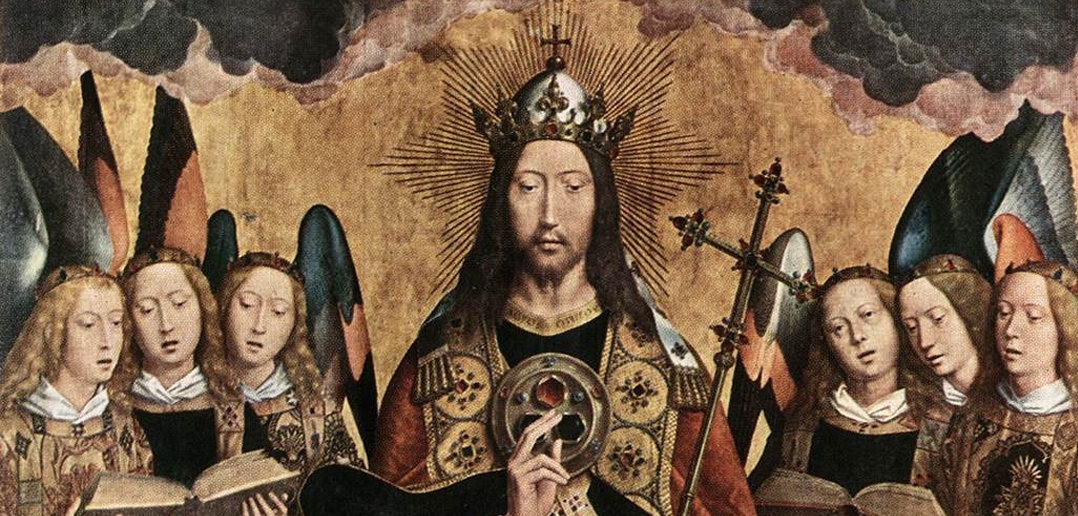
The most terrible trick of heresiarchs has always been the same: to invoke the authority of God while denying derived authority, such as that of the Pope, bishops, and priests. The same thing is done today by those who, invoking the “supreme” authority of the pope, wish to change the morality, sacraments, and doctrine of faith instituted by God in His Church. Confronted with such “reformers,” it is always good to reflect and to remind ourselves—by contemplating the three Magi kneeling before the divine Child—Who is the one and only supreme King of creation.
Photo by Joshua Hoehne on Unsplash