A principal reason for participating fully, consciously, actively, with interior receptivity in our sacred liturgical worship is precisely because one day we are going to die.
Does the sacred worship where you are aid you to prepare for death?
Or does it ready you for a warm feeling of togetherness when you can sing songs and get the white thing as a sign that you belong and you are okay just as you are.
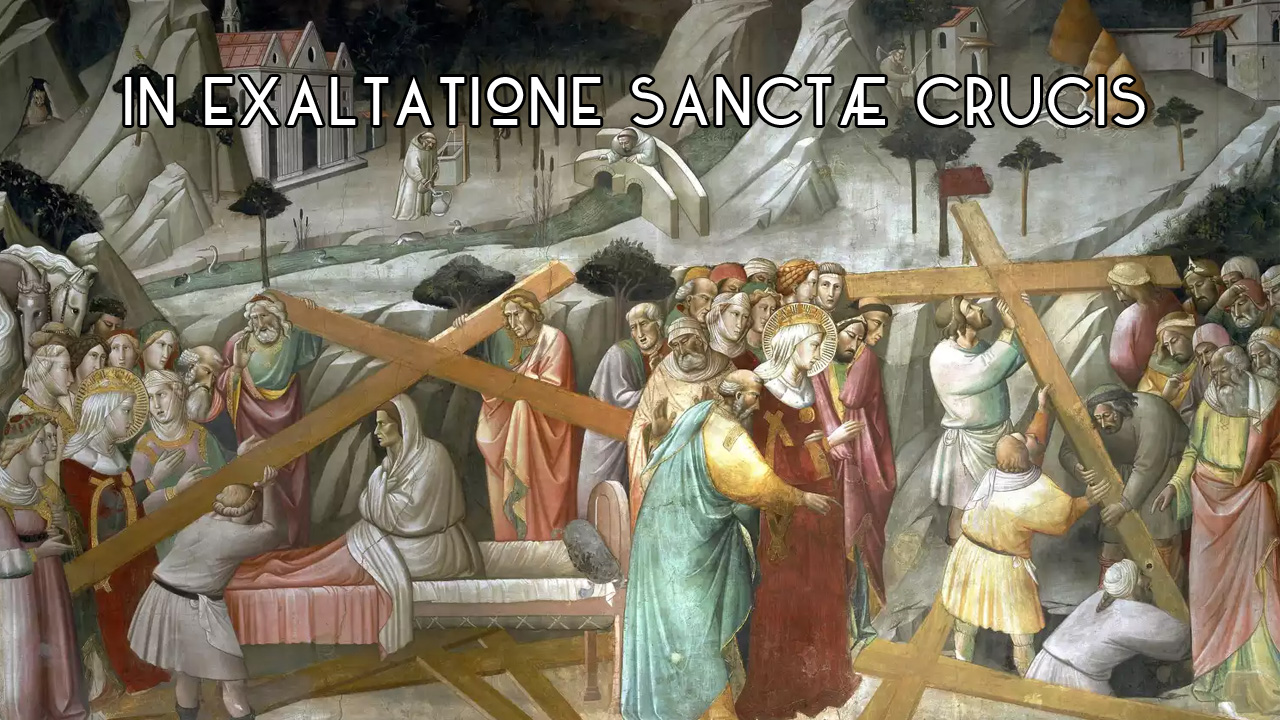
For today’s Sunday Mass the Feast of the Exaltation of the Cross replaces the 14th Sunday after Pentecost. Bl. Ildefonso Schuster remarks that today’s feast had its origin in the dedication of Constantine’s basilica on Calvary, called the Martyrium, whose altar was consecrated with the wood of the Holy Cross. From there this solemnity first took its rise.
Historically, then, the feast commemorates the rediscovery of the Holy Cross by St. Helena, mother of Constantine, in Jerusalem in A.D. 325, and the dedication of Constantine’s basilica of the Holy Sepulcher on 13 September 335. On the following day, 14 September, the relic of the Cross was solemnly shown to the people for veneration. The Cross did not remain there undisturbed. In 614, the Persians sacked Jerusalem and carried it off, only for it to be triumphantly returned in 628 by Emperor Heraclius. The liturgical texts preserve not only theological meaning but also concrete history. The wood of the Cross enshrined in a basilica was the axis of worship. The annual celebration keeps alive the memory of that historic dedication, but transforms it into something universal.
The Collect for the Exaltation of the Holy Cross is found in the 7th c. Gelasian Sacramentary. It was later transmitted in the Gregorian tradition, which carried it into the Roman Missal. Its antiquity reflects the early Jerusalem celebration of the Inventio and veneration of the relic of the Cross.
Deus, qui hodierna die Exaltationis sanctae Crucis annua solemnitate laetificas: praesta, quaesumus; ut, cuius mysterium in terra cognovimus, eius redemptionis praemia in caelo mereamur.
Literal Rendering:
O God, who on this day gladden (us) by the yearly solemnity of the Exaltation of the Holy Cross: grant, we beg, that we, whose mystery of it we have known on earth, may deserve the rewards of its redemption in heaven.
Rhetorically, the prayer is built in two movements. The protasis addresses God as the One who annually laetificas, gladdens the Church with this feast. The apodosis petitions: praesta, quaesumus; ut…grant that those who know the Cross’s mysterium on earth may merit its heavenly praemia. The structure contrasts the antitheses terra and caelum and creates a paronomasia with mysterium and praemia, knowledge and merit.
The Cross itself subtly embedded in the Collect. Note the chiasmus (X shape) of the internal structure. There is an invocation, “Deus, qui” (A), petition, “praesta, quaesumus” (B), purpose “ut” (A1), and fulfilment “eius redemptionis praemis…mereamur” (B1).
A (opening): God gladdens us today (hodierna die… laetificas).
B (petition): Grant, we beg (praesta, quaesumus).
A1 (earth): We have known the mystery on earth (in terra cognovimus).
B1 (heaven): May we merit the rewards in heaven (in caelo mereamur).
Rhetorically, we have the vertical axis of terra-caelum and the horizontal axis of mysterium-praemia. They intersect in Christ’s redeeming sacrifice.
The internal cross-pattern fittingly, for this feast, reinforces theological symmetry.
So prays the Collect of the feast of the Exaltation of the Holy Cross in the Missale Romanum of 1962. It begins with joy. It progresses with petition: that those who know the mystery of the Cross on earth may come to merit its reward in heaven. This prayer, elegant in its economy, gathers up centuries of Christian memory and devotion, inspired by the events of the distant past.
It should go without saying that Catholics who prefer our deep, tried-by-test tradition do not celebrate archaeological digs. The feast is not about Helena’s excavation techniques, nor is it simply about a relic.
Speaking of relics the Windy Prelate of the Lake opined in his archdiocesan newspaper that you – you, dear reader – are seeking after “dead faith” in your desire for the Traditional Latin Mass. He cited the tired old chestnut of Jaroslav Pelikan – Lutheran turned Orthodox – waved about by every liturgical demolition crew with Sacrosanctum Concilium in one hand and a sledge-hammer in the other. “Tradition is the living faith of the dead, traditionalism is the dead faith of the living” is trotted out as if it were a papal decree to justify every banal novelty from blessing after Mass with a guitar to wafting out giant soap-bubbles (2022 – Holy Family Catholic Community in Inverness, IL). He cited St. Vincent of Lérins about growth and development with the analogy of a child growing to be a man and still being the same person. But St. Vincent meant growth, not grotesque deformation. Sacrosanctum Concilium 23 required that in the liturgical reform desired by the Council Fathers,
Innovationes, demum, ne fiant nisi vera et certa utilitas Ecclesiae id exigat, et adhibita cautela ut novae formae ex formis iam exstantibus organice quodammodo crescant.… [T]here must be no innovations unless the good of the Church genuinely and certainly requires them; and care must be taken that any new forms adopted should in some way grow organically from forms already existing.
Is that what we got? The Novus Ordo’s dramatic departure from the previous forms shocked those who first saw it before its promulgation. It continues to shock today, in many places. In the unfortunate windy opinion piece’s narrative, the Carolingians and the baroque are the villains and centuries of reverence and beauty are dismissed as “spectacle”: “The liturgy then became more of a spectacle rather than the active participation of all the baptized…”. He fails to grasp that rites he labels “clerical, complex and dramatic” enhanced the authentic “active participation” of the faithful in the Faith. Faith lived. After the repression of “spectacle” (aka beauty and reverence) what have we in most places now? The “active participation” he seems to elevate is hardly more in most places than mumbled responses to Father Just-Call-Me-Bob’s performance up front before people march up to get the white thing. Perhaps we can call this the “dead faith of progressivism”, embalmed in committee notes, felt banners, electric pianos and Hosts left in missalettes.
But I digress.
Schuster’s observations point out that the material relic of wood became a living center of the Church’s prayer because of what it represented: the mystery of Christ’s redeeming death.
Pius Parsch’s words cut to the heart.
On earth we have known the mystery of the Cross, in heaven we shall receive its fruit. This is the path which today’s liturgy sets before us: by embracing the Cross we come to glory.
The liturgical texts today unite earthly knowledge of mystery with heavenly fruit.
The Cross, therefore, has a double force: it is real, historical, a piece of wood; and it is symbolic, the universal sign of suffering transformed into glory. It points us to what Rudolf Otto called the mysterium tremendum et fascinans: the mystery that both terrifies and allures. Christ’s death is such a mystery. It both draws us in and repels us. It reveals something hidden, something outside ordinary experience, and yet it forces upon us the inevitability of our own death. The Cross does not allow us to flee from this. It insists that death is unavoidable, uncontrollable, unknown, and therefore frightening. Augustine said it starkly: “Mors cotidiana nostra hiems est… death is our daily winter.”
The Cross is at once will, glory, exultation, praise, and confusion, all realities intersecting. The Cross of Christ is the will of the Father, the glory of the Son, the exultation of the Holy Spirit. The Cross is the praise of the angels and the confusion of the demons. In a paean to the Cross attributed to St. John Chrysostom:
[T]hough the Lord’s Cross sounds sad and bitter, it is in reality full of joy and radiance. For the Cross is the salvation of the Church; the Cross is the boast of those who hope in it; the Cross is reconciliation of enemies to God and conversion of sinners to Christ. For through the Cross we have been delivered from enmity, and through the Cross we have been joined in friendship to God. Through the Cross we have been freed from the tyranny of the devil, and through the Cross we have been delivered from death and destruction. … The Cross is proclaimed, and faith in God is confessed and truth prevails in the whole inhabited world. The Cross is proclaimed, and martyrs are revealed and confession of Christ prevails. The Cross is proclaimed, and the resurrection is revealed, life is made manifest, the kingdom of heaven is assured. The Cross has become the cause of all these things, and through the Cross we have been taught to sing. What then is more precious than the Cross? What more profitable for our souls? So let us not be ashamed to name the Cross, but let us confess it with total confidence.
Christ is hung upon the Cross, and the devil has become a corpse. Christ has been stretched on the Cross, and a standard of salvation has been given to the world. Christ has been nailed to the Cross, and every soul has been released from bonds. Christ has been fixed to the Cross, and all creation has been set free from the slavery of corruption. Christ has breathed his last on the Cross, and a new marvel has been shown to the world.
The Mass is the Cross sacramentally present.
It is itself a mystery, awesome yet alluring. Like the Cross, the Mass confronts us with death. To remove the Cross from Mass whether literally in architecture or figuratively in emphasis, is a vain attempt to dodge death. It is to escape confrontation with what looms before us: the Four Last Things. When the Cross and Crucifix are deemphasized or morphed into a figure on a diving board or a referee signaling a touchdown, what should be worship really does become spectacle. It is a distraction.
When Benedict XVI chose precisely the feast of the Exaltation of the Cross for the coming into force of Summorum Pontificum in 2007, he taught that the Cross is central to the Roman Rite. The older form of the Mass is, in its very structure, an exaltation of the Cross. It orients us toward the Crucified, stripping away the illusions of control, compelling us to stand with Moses in the cleft of the rock, permitting a glimpse of the divine majesty which explains our “daily winter”.
The modern age, with its insatiable demand for immediacy, instant gratification and transparency, finds this difficult. Our culture expects every word to be heard, every gesture to be seen, every detail made intelligible. Anything that challenges must be dumbed down. The debates about liturgical translation revealed this impatience. They are bubbling up again from the same mostly geriatric corners… and Jesuits. The elements of traditional sacred worship which challenge modern man: the Latin language, the silence of the Canon, the priest turned toward the altar. These are (pace windy prelate) not defects. They are advantages. They train the soul for mystery. They teach deprivation, which is the condition of an encounter with mystery. Before things can be unveiled, they must be veiled.
The Fathers knew this deprivation. When Moses begged to see God, he was permitted only a fleeting glance from the cleft of the rock (Exod. 33:23). In the Mass, too, we earnestly seek but fleetingly glimpse. The Canon’s silence, the hidden gestures, the veiled words, all these prepare us for the final unveiling in Heaven.
William James called religion “awe at transcendence.” Proper sacred liturgy deliberately frustrates our hunger for immediacy so that awe may be born, the transcendent can break through the distractions and resistance, and one can encounter the mystery which transforms.
The deprivation demanded by the traditional Roman rite is not cruelty but pedagogy. Just as in the East the iconostasis hides, so in the West the silent Canon denies, in order to teach receptivity. This deprivation mirrors death itself. We cannot control death. We cannot fully see or understand it. The liturgy makes us practice this helplessness, so that at our last hour we may surrender trustingly. If death is our “daily winter”, only by dying in and with and for Christ can we pass into spring.
To embrace the mystery of the Cross is to embrace life eternal. This is precisely what the Collect asks: “ut… eius redemptionis praemia in caelo mereamur.”
The feast of the Exaltation of the Cross is not about nostalgia, nor about relics, nor about archaeology. It is about mystery, the mystery of Christ’s death and our own. What prelates like those of the windy, motor and queen city will not grasp, is that Benedict’s Summorum Pontificum was not about conserving a museum-piece liturgy, but about restoring orientation to the Cross. To reduce the traditional Mass to “spectacle” or the even stupider “backward” is to miss the point. As Chrysostom insists, the Cross is “glory” and “confusion,” “praise” and “awe.” Only in this paradox does true worship happen.
Where you are, does your sacred liturgical worship help you to prepare for death?
The liturgy’s goal is holiness. That holiness is nothing else than conformity to Christ crucified. The Collect dares to ask that what we have known only in mystery here we may one day possess as reward in heaven. But the path is clear: only by the Cross. Troadec reminds us: “Refuser la Croix, c’est refuser la vie éternelle… To refuse the Cross is to refuse eternal life.”
Thus, today we stand where Helena once stood, where Heraclius once triumphed, where Jerusalem once gathered. We stand at the altar. We see not a fragment of wood but rather in and through the wood we glimpse the mystery made present to us. We are made present to the transforming mystery. We see death, yet also redemption. We glimpse, as Moses, only the fleeting glory. We know by faith that if we cling to the Cross, then what we have known only in a mirror darkly here we will one day inherit in glory.
Crucem amplectendo ad gloriam perveniemus.
Crucem amplexi ad gloriam pervenimus.