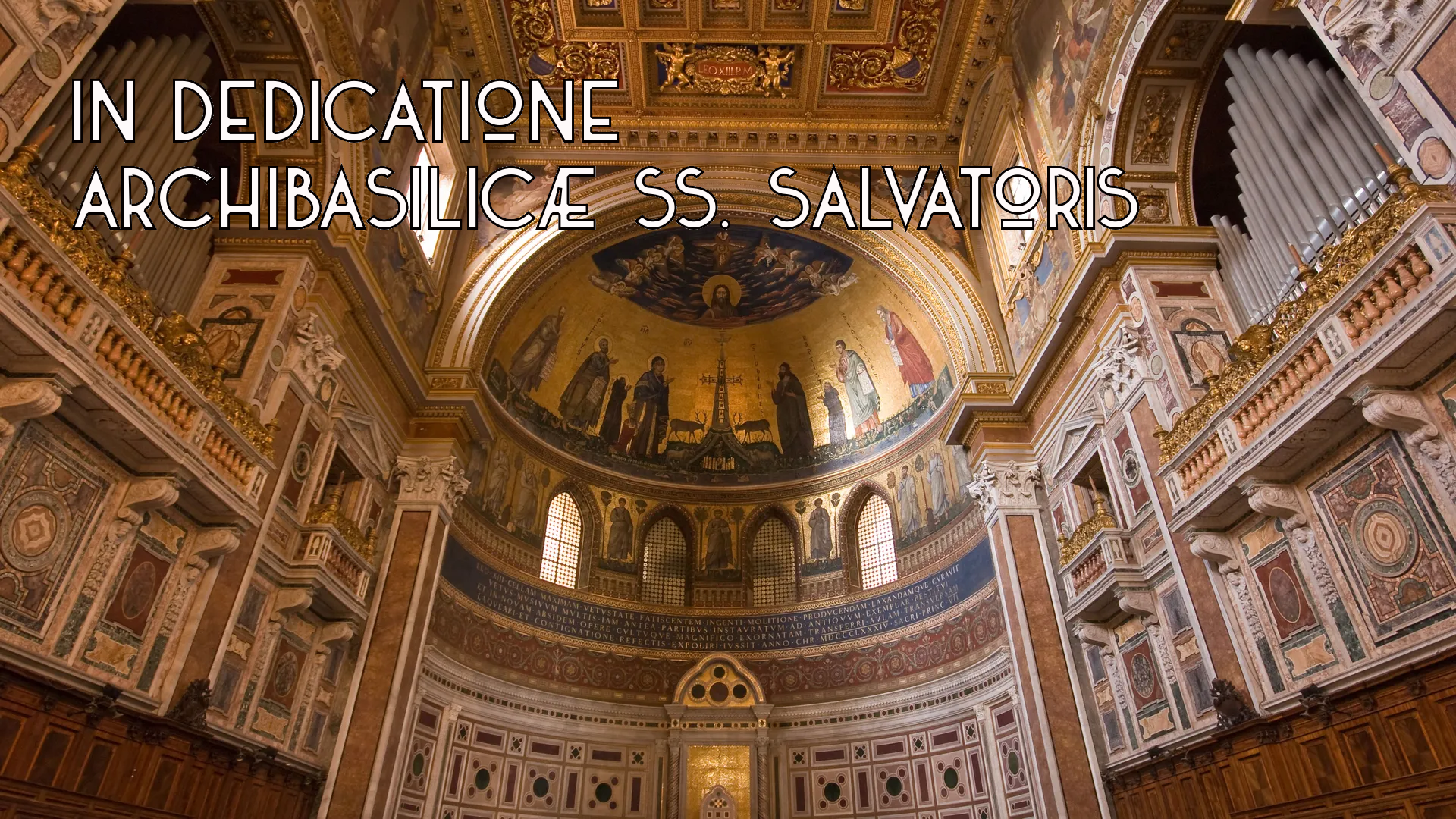
Sunday the Feast of the Dedication of the Papal Archbasilica of the Most Holy Savior and St John the Baptist and St John the Evangelist, which we call St John Lateran.
Pope Benedict XVI, in a homily for this feast, wrote:
In this temple of stone we see reflected the spiritual temple which is the Church, made up of living stones, men and women sanctified by the grace of Christ… The dedication of a church is a feast of faith par excellence; it reminds us that God’s house is not merely a building, but that we ourselves are the temple of the Holy Spirit.
Rome’s Cathedral was solemnly consecrated on 9 November 324.
The Lateran Basilica is “omnium urbis et orbis ecclesiarum mater et caput… the Mother and Head of all the Churches of the City and the World.”
The original basilica was constructed by the Emperor Constantine. The Bishop of Rome’s cathedra, or throne, is there, the symbol of his teaching authority. The nearby baptistery is the ancient place of Christian initiation for the Church of Rome.
We are not sure why 9 November was chosen for the dedication. Perhaps the date was chosen to bring its dedication within 10 days to other Roman basilicas, Sts. Peter and Paul (18 Nov). The Romans had a “thing” about their dead and a nine-day period called a “novendialis.” In fact, this observance is still an important part of the death of a Pope and the preparations for a Conclave.
Also, a death day is known in Latin as “dies natalis… birthday (into Heaven).”
On the dedication of a church, the day itself or anniversary, we celebrate solemnly the day a church is “born.”
Every person has a “name day” and a “birthday.” So too a church. Our churches are dedicated or consecrated in honor of saints or mysteries of the Faith. The celebration of the dedication recalls the sanctity of the place which, as a consecrated building, has been removed from the temporal order and given entirely to God.
Church buildings should be rich in sacred symbols. This includes a sanctuary with its altar, the sacred space within the sacred space mirroring the Holy of Holies in the Temple of Jerusalem. The prayers for the solemn consecration of a church, especially in the older, traditional Roman Rite, connect the earthly church building to the heavenly Jerusalem of the life to come, described in Scriptures especially in the Book of Revelation.
There are parallels in the rites of the consecration of a church and the rites of Baptism. There are exorcisms. The is washing with water, anointing with Chrism and naming. Alphabets are given in the church as the “opening rites” are given in baptism. And so forth. More on this below.
The rite of consecration and the annual feast of its dedication reflect that the church building is a house of prayer and the place of sacrifice. It is a foreshadowing of the heavenly Jerusalem. It is the microcosm of the Church Universal, the nuptial chamber of the Spouse and the Bride, the way to Calvary and the Garden of the Tomb.
In the beautiful Mass formulary for the dedication, the Gospel reading starts out curiously with the reading in Luke 19 about the rich short guy Zacchaeus climbing a tree to see the Lord. Christ spots him and says that he is going to go to his house: “Today salvation has come to this house,” says the Lord. That’s why this reading was chosen, for sure.
A church’s design, features and appearance must reflect its awesome purpose. It is a place where a soul peers through the cleft in the rock at God’s back as He passes by (Exodus 33), where he searches for the beloved in the palace (Song of Songs), where he gazes through the dark mirror (1 Cor 13).
This is where the soul simultaneously expands in worship and shrinks down in awe at mystery’s encounter.
When Pope Sylvester dedicated the Lateran Basilica he called it the “Domus Dei … House of God.” A church building reflects that we are to be like the “living stones” who build up a holy spiritual Church (1 Peter 2:5). In Genesis 28, Jacob awakes from his vision of the angels ascending and descending the ladder betwixt heaven and earth. Trembling, Jacob says: “How terrible is this place! This is no other but the house of God, and the gate of heaven.” “Terribilis est locus iste!” is the opening chant for the Mass of the Dedication of a Church. Over the doors of many old churches you find the phrase “House of God and Gate of Heaven.”
The rite of consecration and texts of the dedication feast recall that, not just the building, but the Christian’s soul belongs to God and is to be holy.
The consecration of the church building is much like a baptism. In the traditional Roman rite there is an exorcism with “Gregorian Water,” a mixture of ash, salt, water, wine used exclusively for special purifications of churches and altars. The altar is “clothed” as with baptismal robes. Its walls are anointed with chrism, as we were in baptism and confirmation. There is the lighting of candles and their solemn placement at the points where the walls were anointed. At the beginning of the traditional rite of baptism, the one to be baptized is interrogated, “What do you seek?” He responds, “Faith” (not “Baptism” as in the post-Conciliar ritual). Then, “What will Faith give you?” “Eternal life”, he says. A church must reflect in every way not only the splendor of God’s gift of Faith, enabling us to embrace what is mysterious, but also the goal of Faith: eternal life. A church should reflect the splendors of our Catholic Faith and give us a foretaste of heaven.
Let’s see the first of the two Collects in the Novus Ordo:
Deus, qui de vivis et electis lapidibus aeternum habitaculum tuae praeparas maiestati, multiplica in Ecclesia tua spiritum gratiae, quem dedisti, ut fidelis tibi populus in caelestis aedificationem Ierusalem semper accrescat.
O God, who from living and chosen stones prepare an eternal dwelling for your majesty, increase in your Church the spirit of grace you have bestowed, so that by new growth your faithful people may build up the heavenly Jerusalem.
We are conscious of this world, but our prayer directs us to heaven, not to an earthly utopia.
In the Vetus Ordo:
Deus, qui nobis per síngulos annos huius sancti templi tui consecratiónis réparas diem, et sacris semper mystériis repaeséntas incólumes: exáudi preces pópuli tui, et praesta; ut, quisquis hoc templum benefícia petitúrus ingréditur, cuncta se impetrásse lætétur.
O God, who for us bring each year the day of consecration of this Your holy temple, and always bring us back safely into the sacred mysteries, hear the prayers of Your people and grant that whoever enters this temple to pray for blessings, may rejoice in all he had sought.
The Epistle for the feast, taken from the Apocalypse 21:2–5, directs our gaze upward to the “holy city, new Jerusalem, coming down out of heaven from God, prepared as a bride adorned for her husband.” This vision of the glorified Church reveals the eschatological end of all temple worship. The earthly sanctuary anticipates the heavenly.
The basilica in Rome is the pledge of that eternal dwelling where “the dwelling of God is with men.”
St. Augustine, preaching on the dedication of a church, saw this connection:
When we celebrate the dedication of a church, we must remember that we ourselves are dedicated. The house of our soul is being built for God; when it is finished, He will dwell in it (s. 336, 1).
For Augustine, the visible stones of the basilica remind the faithful that they are living stones. “Let each of you,” he said, “be a living stone in God’s building, that you may be found within the walls of His temple.”
St. Gregory the Great, another Roman bishop whose sermons often treated the sanctification of places, wrote:
The Church of the elect is now built through faith on earth, that it may one day shine in heavenly glory; now it is hewn from rough stones, that then it may be made glorious with polished splendor (Homilia in Evangelia, 36).
Gregory’s contrast between the roughness of the present and the perfection of the future illumines the prayer of the Collect: year by year the feast renews in us the hope that we, too, may be polished stones fit for the heavenly Jerusalem.
Dom Guéranger, in The Liturgical Year, echoed this patristic vision:
Every church consecrated to God is a figure of the Church triumphant; and the day of its dedication recalls to us that day when the great Church of Heaven will be filled with the elect.
The temporal anniversary thus becomes a “sacrament” of the eternal.
The Gospel for the feast, Luke 19:1–10, recounts the encounter of Jesus with Zacchaeus, the rich tax collector of Jericho. At first sight, the episode may seem distant from the theme of a church’s dedication, yet it is a perfect illustration of the deeper mystery. Christ comes to dwell not merely in stone temples but in human hearts. When He says to Zacchaeus, “Make haste and come down, for today I must stay at your house,” He expresses the divine initiative that underlies all sanctification. The divine Guest transforms the sinner’s home into a sanctuary.
St. Ambrose, commenting on this passage, remarked:
He saw the man in the tree, and being merciful, He called him; He who once had said to Adam, ‘Where art thou?’ now said to Zacchaeus, ‘Come down.’ To the first He spoke in punishment, to the second in mercy. He would not remain in heaven when man was lost; He will not remain on the road when man desires to be saved (Exp. Lucam,8. 84).
Zacchaeus’s conversion thus prefigures the very purpose of the Church: the house visited by Christ becomes a house of salvation. In the same way, when a church is dedicated, the Lord takes possession of that place and of the souls who will pray there. Christ’s words, “Today salvation has come to this house,” are mystically fulfilled each time the Eucharist is celebrated upon the altar of that temple.
St. Peter’s first epistle gave enduring expression to the theology of the temple:
You also, as living stones, are built up, a spiritual house, a holy priesthood, to offer up spiritual sacrifices acceptable to God through Jesus Christ (1 Pet 2:5).
The Fathers repeatedly returned to this image. St. John Chrysostom urged his hearers:
Do not adorn the church building while neglecting your brother in need, for he is more truly the temple of Christ than any structure of stone (Homilia in II Corinthios, 20).
This same balance appears in the homilies of St. Leo the Great. Preaching at the dedication of a basilica, he said:
The house of prayer which has been built by divine aid should be consecrated to the Lord by the sanctity of its worshippers. The living temple of God is composed of holy souls (s. 85).
For Leo, the physical structure depends upon the moral structure of the faithful. Holiness, not marble, is the true adornment of God’s dwelling.
Modern writers continue this patristic line. Scott Hahn, in The Lamb’s Supper, explains that
every Mass is a participation in the heavenly liturgy revealed in the Apocalypse; the church building is the sacramental threshold where heaven touches earth.
The reading from Revelation at this feast discloses what every consecrated church anticipates, that is, the nuptial communion of the Bride and the Lamb. A church is, and ought visibly to appear so, “prepared as a bride adorned for her husband.” The Apocalypse here presents the Church as the Bride of Christ. The Fathers saw this nuptial imagery as the key to understanding consecration. The dedication of a church is therefore a liturgical wedding.
The Collect’s petition that “whosoever enters this temple to ask Thy benefits may rejoice in obtaining all that he seeks” presupposes this bridal intimacy. In the dedicated temple, the Bride speaks freely with her Spouse. Her petitions are heard because they are born of communion. The faithful enter to ask benefits, but the deepest benefit is the indwelling of God Himself. Dom Prosper Guéranger wrote:
The consecration of a church is one of the grandest ceremonies of the Church. It is the espousal of the Bride, the Church militant, with her heavenly Bridegroom. The Bishop, as the representative of Christ, takes possession of the house and delivers it forever to divine worship.
The Epistle reading ends with the stunning declaration: “Behold I make all things new.” This renewal implies purification. Through this lens we can look again at the figure of Zacchaeus. Zacchaeus comes down from his height of pride and wealth, just as the Church humbles herself before the Lord who comes to dwell in her.
Every altar is a sycamore tree from which the soul descends to meet Christ.
Ultimately, the meaning of this feast is summed up in Revelation 21:3: “Behold, the dwelling of God is with men.” In the Incarnation, God Himself became the true temple. In the Church, He continues to dwell sacramentally among us. St. Cyril of Jerusalem expressed this mystery:
When the Holy Spirit descends upon you, He makes you another Christ. Then truly God dwells with men, for He dwells in you (Catechesis Mystagogica 3, 1).
Thus the Lateran Basilica, mother and head of all churches, is not merely a monument of Christian antiquity but the visible assurance that God has chosen to pitch His tent among us. Each Mass celebrated within its walls, and within every consecrated church throughout the world, renews the words of the Apocalypse: “Behold, I make all things new.”
As St. Augustine concluded one of his sermons for a church dedication:
Let us rejoice, dearly beloved, not in the walls but in our souls. Let us adorn the temple of God by our good works, that the Lord may deign to dwell in us (s. 336, 2).