The treasury of Holy Church’s sacred worship truly overflows with inexhaustible wealth, as the 20th-century commentator Pius Parsch reflects in The Church’s Year of Grace, dividing the Sundays after Pentecost into three stages: first, those that highlight the Lord’s miraculous healings pointing ultimately to the salvation of souls; second, from the 7th to the 14th Sundays, the emphasis shifts to the kingdom of God in contrast with the kingdom of the world; and third, from the 15th Sunday to the end of the liturgical year, the focus intensifies on the Parousia, the Second Coming. Of course, he notes, other lenses could be brought, such as grouping them by the theological virtues, and so the riches of the Church’s liturgical year remain inexhaustible indeed.
This particular 9th Sunday after Pentecost opens before us the startling image of the Lord weeping. As Passover approached, Jesus remained for a time in Bethany, an hour’s journey from Jerusalem, with Mary, Martha, and Lazarus—whom He had raised from the tomb just weeks before. On that first Palm Sunday, as He processed toward Jerusalem, He wept while gazing upon the city and its Temple from across the valley, foreseeing the “hell” that would soon engulf both.
Fulton Sheen, in his Life of Christ, observes that because Jesus wished to share the sorrows of those He came to save, Christ wept three times. Sheen says that each time the Greek verb is klaío, κλαίω, which Sheen says (pace Liddell-Scott) “implies a calm shedding of tears.” I am uncertain where Sheen derived that nuance about klaío, and he is not quite right about that being the verb used three times. We might drill briefly into this image of the Lord, weeping. In John 11:35, when Jesus was at the tomb of Lazarus, we have the incredibly short verse: “Jesus wept… κλαίω”. The verb is δακρύω, dakrúo not klaío. Dakrúo is, according to Liddell and Scott , “weep, shed tears” and to have runny eyes. In Luke 19:41, when Christ weeps over Jerusalem, the verb is ἔκλαυσεν, indeed from κλαίω, which L-S says means “cry, wail, lament, of any loud expression of pain or sorrow”. Thayer’s Greek Lexicon says this is “bewail” and Strong’s has “to sob, i.e., to wail aloud”. Thirdly, Paul says in Hebrews 5:7 that Jesus wept in the Garden of Gethsemane “with loud cries and tears” (RSV- κραυγῆς ἰσχυρᾶς καὶ δακρύων). There is no specific weeping verb, but it is implied in dakrúon. I don’t want to push on this very hard, but the verbs δακρύω and κλαίω, though related, carry distinct shades of sorrow. In effect, κλαίω involves audible, demonstrative weeping, crying out with emotion while δακρύω emphasizes the physical act of shedding tears. Δακρύω is more contained. Peter’s bitter weeping after his denial is κλαίω (cf Matthew 26:75).
Back to Sheen who, like Homer, slightly nodded. Christ demonstrated His compassion outwardly in different modes of weeping, perhaps being explained by a intimate moment contrasted to a more public and prophetic expression about sin and judgment.
There is no question that the Lord wept. However, He could never have lost the least control over His emotions. Nor did the Blessed Virgin, even at the foot of the Cross. This is a flaw in movie and television depictions of Our Lord and His Mother. I have in mind, for example, in the popular and ongoing series Chosen: the Christ character is far too distraught at Lazarus’ tomb. I’m sure the producers chose to stress His humanity, but they erred. Also, in the Zeffirelli video about Christ, Mary is pretty much unhinged after the Deposition. Nope. Much better was Mary in Mel Gibson’s Passion. But I digress. Back on track.
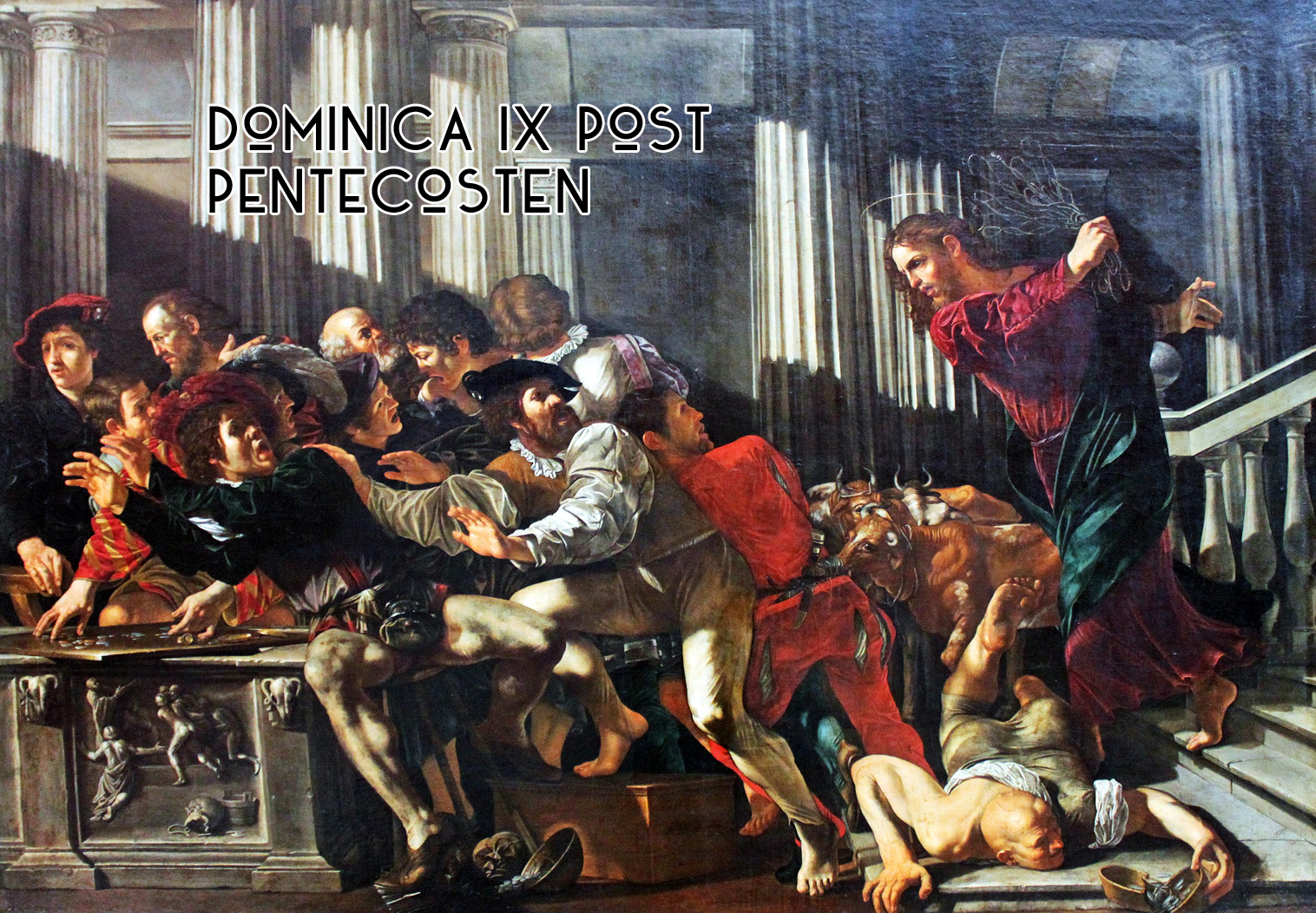
On that same Palm Sunday, Jesus entered the Temple. People anticipated that He would assume His messianic role as Davidic priest-king. Instead, He discovered the Court of the Gentiles suffused with vendors of sacrificial animals and moneychangers, necessary because coins bearing images could not serve for sacrifices. With a whip of cords He drove them out, partly to make properly sacred space for the Gentiles to worship. St. Jerome (+420) describes this as perhaps the Lord’s greatest miracle, given the overwhelming numbers arrayed against Him, and says that “something of His divine authority must have shined forth in that moment which could not be withstood.” To quote Jerome’s words in full:
To me, among all the other [miracles], it seems more wonderful that, as one Man, and He at the time contemptible and so vile as to be subsequently crucified, with the Scribes and Pharisees raging against Him, and seeing their gains destroyed, He could by the stripes of His single scourge cast out so great a multitude, overthrow the tables, break the seats, and do other things, which a whole army could not have done. For something of fire and of the sidereal flashed from His eyes, and the majesty of His Divinity shone in His face.
The evangelist St. Gregory the Great (+604) preached on this very Gospel in Sermon 39 in the Lateran Basilica, drawing out a profound irony: Christ both predicted the Temple’s destruction and immediately cleansed it, a cleansing of the very priests whose carelessness contributed to ruin. He says in Latin: “Qui enim narravit mala ventura, et protinus templum ingressus est, ut de illo vendentes et ementes eiiceret, profecto innutuit, quia ruina populi maxime ex culpa sacerdotes fuit…” demonstrating that the blame for a people’s destruction ultimately lies at the feet of the clergy. He goes further: doves were sold in the temple, symbolizing the Holy Spirit, and thus Jesus chased away those who sold and bought, condemning those who believe the gift of the Spirit can be paid for.
Such a dramatic purging invites reflection on our own times. Have we not seen those who connive within sacred spaces to elevate unworthy persons to positions of authority? The Temple’s desecration warns us that harm begins within, and that the visible Temple of our soul may mirror the state of the visible Church.
When the Ark of the Covenant stood in the tent of meeting and in the First Temple, the shekinah, the glory cloud, bore witness to God’s Presence. Afterward, the Second Temple lacked this tangible sign… that is, until Jesus entered. The Temple remained a symbol of divine presence. So too our soul, cleansed by baptism, is meant to be the temple of the Holy Spirit, God’s dwelling place.
How beautiful is the Christian soul in the state of grace, adorned with virtues, works of mercy, study, and the fides quae creditur striving for understanding.
Yet negligence can transform that soul into a spelunca latronum, a den of thieves, rather than a domus orationis, a house of prayer.
No merits accrue to a soul in mortal sin. What we need is the grace-cords that whip us back to awareness and drive us to examine consciences honestly, make our confession, and resume meritorious action.
Bl. Ildefonso Schuster compared the distress of the beleaguered city of Jerusalem to that of the soul, which, surrounded by evil spirits, struggles with death and is already at the threshold of eternity. Though Jesus at the Last Supper could say, “The prince of this world cometh, but hath nothing in me” (John 14:30), yet all the saints have trembled at the thought of that supreme hour. “The surest way of preparing ourselves for death is the constant practice of good works, so that our adversary may not be able to boast of any hold over us.” That is Schuster’s own accurate reflection. It echoes our need on this 9th Sunday after Pentecost.
In the Vetus Ordo we hear St Paul’s warning in 1 Corinthians 10:6–13. He recalls Israel’s idolatry, grumbling, and how they were punished by the “destroyer,” supplying a warning “for our instruction” (v.?11).
6 Now these things are warnings for us, not to desire evil as they did. 7 Do not be idolaters as some of them were; as it is written, “The people sat down to eat and drink and rose up to dance.” 8 We must not indulge in immorality as some of them did, and twenty-three thousand fell in a single day. 9 We must not put the Lord to the test, as some of them did and were destroyed by serpents; 10 nor grumble, as some of them did and were destroyed by the Destroyer. 11 Now these things happened to them as a warning, but they were written down for our instruction, upon whom the end of the ages has come. 12 Therefore let any one who thinks that he stands take heed lest he fall. 13 No temptation has overtaken you that is not common to man. God is faithful, and he will not let you be tempted beyond your strength, but with the temptation will also provide the way of escape, that you may be able to endure it.
Christ weeps over such sins today, as He wept over Jerusalem’s, yet His love never abandons us in suffering and temptation, if only our heart-temple remains open and clean.
The Novus Ordo suppresses much of this reading, offering it only in Lent of Year C. The Vetus confronts us firmly with our human frailty and God’s faithful provision. Paul recounts that after the Golden Calf episode (Exodus 32:6), the people “sat down to eat and drink and rose up to dance”, a euphemism for lascivious revelry. The Greek porneúo used there, and elsewhere in Scripture (e.g., Rev 17:2 with epórneusan and porneía), connote both sexual and spiritual fornication, idolatry itself.
When Moses came down from the mountain, he had the Levites slay the idolatrous, inaugurating Aaron’s priesthood and the Law. In Numbers 21, the people’s complaint invoked God’s judgment by fiery serpents. When in Numbers 25:9 the people grumbled against God a plague struck down 23,000. Christ’s crucifixion is hinted in the bronze serpent lifted up, a type of Him bearing our sins upon the wood of the Cross.
Are our times truly different? Sadly not. We witness perversity, sometimes propagated by priests. Demon idols are brought into sacred precincts—even within Vatican Gardens. Core teachings on faith and morals face erasure from the highest levels. Faithful priests who speak the truth are marginalized. The rites that formed generations are suppressed or restricted. Such chaos must grieve the heart of Christ—as He wept for Jerusalem.
Furthermore, studies in recent years revealed that a shocking seven out of ten who self-identify as Catholic do not accept what the Church teaches about the Eucharist and this includes frequent Mass-goers. Neglect, poor catechesis, and misguided liturgies filled with pablum or sentimentalism have normalized a banal Communion: “here’s the white thing, now let’s sing.” Our rites are our identity, and their erosion wounds the Church profoundly. Moreover, a study by the Cultural Research Center at Arizona Christian University found that only 11% of American adults, and only 16% of self-proclaimed Christians believe in the Trinity.
These realities are enough to make one weep—just as Christ wept over Jerusalem and lament the demographic void looming in the Church, the consequences of infidelity, malicious or negligent.
God will not be mocked, and Scripture warns that the lukewarm will be spat out (Rev 3:16).
Yet we must not despair; we must help the confused. Gently instructing and correcting is a work of mercy, our Christian duty. Paul’s warning to the Corinthians echoes to us now: temptations are real, but no temptation exceeds our strength, and with temptation God provides the “way out.” In reflecting on that promise, we recall Scott Hahn’s insight: “If we do not fill our mind with prayer, it will fill itself with anxieties, worries, temptations, resentments, and unwelcome memories.” Such clarity from Hahn reminds us that prayer reorients temptation into peace.
That “way out” given by God is Christ Himself, our Way, Truth, and Life. Especially in Chapter 11 of First Corinthians, Paul recounts the institution of the Eucharist at the Last Supper, words we have prayed and offered ever since at Holy Mass. He warns that receiving unworthily incurs sin against the Body and Blood of the Lord, judgment on oneself. Some had fallen sick. Some died.
In practice, when temptation strikes, one might ask: what is the nature of the act, its prompting, whether it pleases God—and crucially, “If I do this, can I honestly receive Communion?” That question may be a true “way out” of sin. Let us renew our devotion to the Most Holy Eucharist, the Body, Blood, Soul, and Divinity of Christ, the great gift of the Eternal High Priest. To be faithful to the Eucharistic Person of Christ is to stand firm. That is why Paul’s warnings in Corinth resonate so strongly: irresponsible Communion hurts the soul and brings harm.
Hence, let each of us recommit to fundamentals. Study sound catechism because “you can’t give what you don’t have”. We must examine our hearts, prepare well for Sunday Mass, go to confession, and become invitations to others, especially the fallen-away or the seekers yearning for something more.
Let our wakeful, upright Christian witness draw them into the Church.
Christ weeps out of love, for Jerusalem then, for every Temple of His Spirit now. He foresees ruin, yet provides mercy, a way of escape, a cleansing of Temple and soul. Let us heed His tears, purify our temples, live prayerfully, and stand steadfast, trusting that in the Eucharist, in prayer, and in virtue, we find our “way out” and our enduring life in Him.