This 8th Sunday after Pentecost in the Vetus Ordo of the Roman Rite offers us a Gospel passage which is challenging to interpret: the Parable of the Unjust Steward (Luke 16:1–9). The Epistle from Romans 8:12–17 unfolds the mystery of our divine adoption and the contrast between life according to the flesh and life according to the Spirit. The liturgy sets before us a tension and a synthesis: on one hand, the perplexing commendation of a dishonest steward and on the other, the lofty dignity of our sonship in Christ and the moral demands it entails.
Luke tells us:
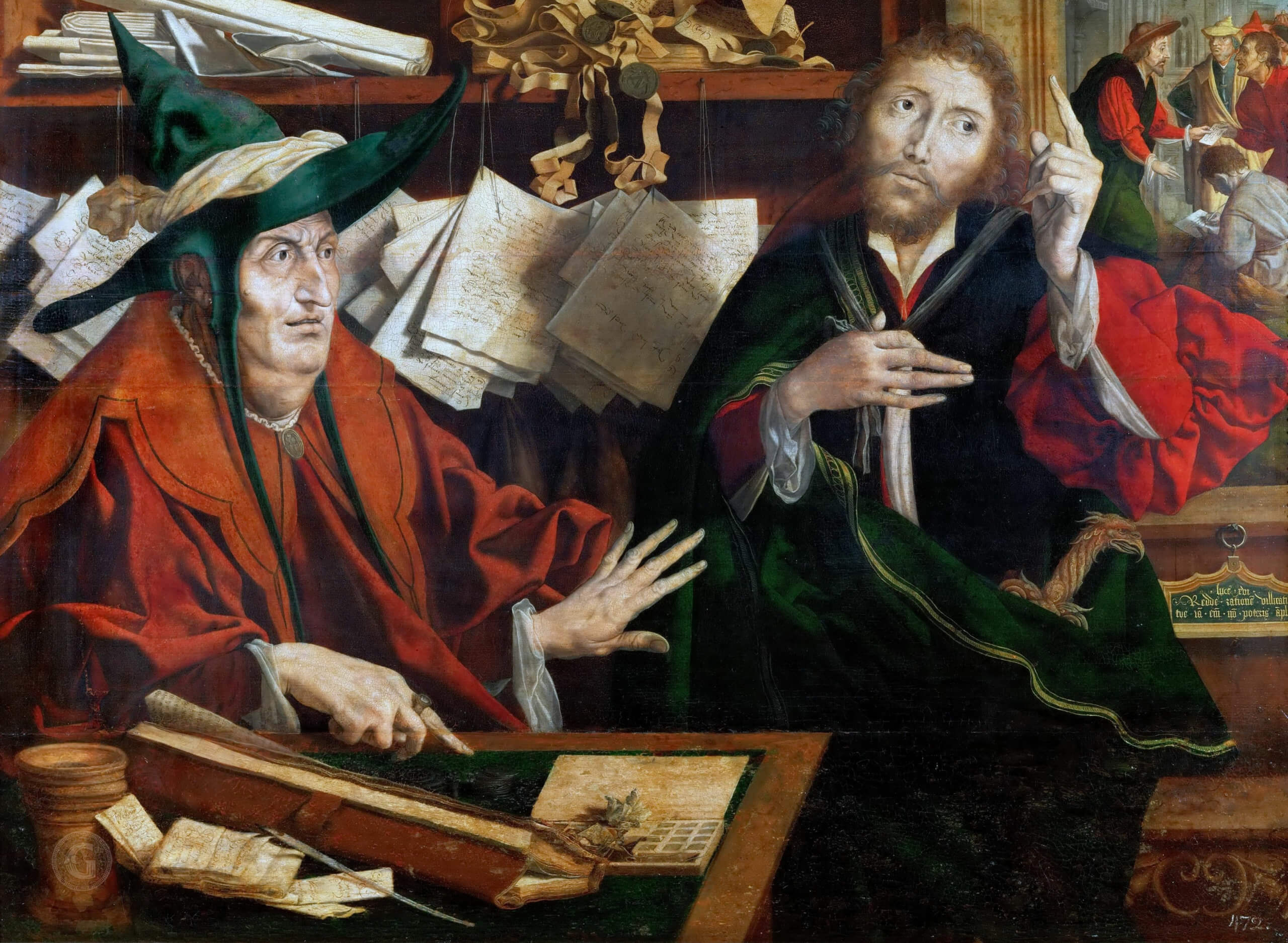
There was a rich man who had a steward, and charges were brought to him that this man was wasting his goods. 2 And he called him and said to him, ‘What is this that I hear about you? Turn in the account of your stewardship, for you can no longer be steward.’ 3 And the steward said to himself, ‘What shall I do, since my master is taking the stewardship away from me? I am not strong enough to dig, and I am ashamed to beg. 4 I have decided what to do, so that people may receive me into their houses when I am put out of the stewardship.’ 5 So, summoning his master’s debtors one by one, he said to the first, ‘How much do you owe my master?’ 6 He said, ‘A hundred measures of oil.’ And he said to him, ‘Take your bill, and sit down quickly and write fifty.’ 7 Then he said to another, ‘And how much do you owe?’ He said, ‘A hundred measures of wheat.’ He said to him, ‘Take your bill, and write eighty.’ 8 The master commended the dishonest steward for his shrewdness; for the sons of this world are more shrewd in dealing with their own generation than the sons of light. 9 And I tell you, make friends for yourselves by means of unrighteous mammon, so that when it fails they may receive you into the eternal habitations.
The “steward” (Greek οἰκονόμος, oikos + nomos, the “house-law” man) is the property manager of a wealthy man, referred to as κύριος, “lord.” His confession “fodere non valeo, mendicare erubesco”, shows a man softened by ease, unable to labor as a day-worker and too well known to stoop to begging. His transactions are not in coin but in kind , such as oil and wheat, as was common in the ancient world.
Christ’s use of “mammon” recalls the Aramaic term for wealth or profit, which by the Lord’s time bore a pejorative sense, even personified as a demon. “You cannot serve God and mammon” (Matt 6:24).
The challenge of the parable lies in the commendation of the steward’s cleverness. The Fathers grappled with this. St. Jerome even wrote to St. Augustine to ask what it meant. Augustine saw here an argumentum a minori ad maius: if the unjust steward is praised for prudence in temporal affairs, how much more should the children of light be shrewd in the things that secure eternal life. The Lord praises not the fraud but the foresight. As Augustine puts it in Sermo 359A:
“Make yourselves friends with the mammon of iniquity, so that they too, when you begin to fail, may receive you into eternal shelters. … Give alms to all and sundry, for you are unable to sift through people’s hearts. When you give alms to all, you will reach some who deserve them. Let in the unworthy, lest the worthy be excluded. You cannot be a judge of hearts.”
Thus, prodigal charity becomes the parallel to the steward’s lavish settlements — giving away what is not ours but God’s, to win eternal welcome.
Romans 8:12–17 brings a second lens. Paul contrasts the two modes of life:
12 So then, brethren, we are debtors, not to the flesh, to live according to the flesh— 13 for if you live according to the flesh you will die, but if by the Spirit you put to death the deeds of the body you will live. 14 For all who are led by the Spirit of God are sons of God. 15 For you did not receive the spirit of slavery to fall back into fear, but you have received the spirit of sonship. When we cry, “Abba! Father!” 16 it is the Spirit himself bearing witness with our spirit that we are children of God, 17 and if children, then heirs, heirs of God and fellow heirs with Christ, provided we suffer with him in order that we may also be glorified with him.
The Roman Christians hearing this would have known the legal weight of adoptio and adrogatio. By baptism, we are transferred from the dominion of sin into the familia of God. Unlike Roman manumission, which did not necessarily confer citizenship, this divine adoption gives us full heirship, cives caelorum, citizens of heaven. Yet the adoption is “perfect” in status but not yet consummated: perseverance unto death is required.
The cry “Abba, Father” is not childish “Daddy” but a term of intimate obedience, as in Christ’s agony in Gethsemane (Mark 14:36). It is the address of the obedient Son: “not what I will, but what thou wilt.” Here obedience and sonship converge with the image of Isaac carrying the wood, saying “’ab… Father” (Gen 22), prefiguring Christ.
That mortification, mortificaveritis, is indispensable:
The choice facing every believer is between life and death, final justification and final condemnation. Paul’s use of the present tense of θανατόω indicates that mortification requires continual exertion over time. Believers can successfully mortify the flesh only by the Spirit, in conscious reliance on God’s indwelling presence (cf. Ignatius Catholic Study Bible).
This harmonizes with the Collect:
Largire nobis, quaesumus, Domine, semper spiritum cogitandi quae recta sunt, propitius et agendi: ut, qui sine te esse non possumus, secundum te vivere valeamus.
I love that elegant holding over of spiritum across the conjunction et to go with both cogitandi and agendi. Did you catch the parallelism? That sine te esse… secundum te vivere? Another fancy feature from the genius who wrote this is the juxtaposition of possum and valeo: a veritable copia verborum. And vivere valeamus gives us a lovely rhythmic clausula.
One meaning of secundum in the prestigious Lewis & Short Dictionary is “agreeably to, in accordance with, according to”. Remember that largire is an imperative of a deponent verb, not an infinitive. The famous verb cogito is more than simply “to think”. It reflects deeper reflection, true pursuit in the mind: “to consider thoroughly, to ponder, to weigh, reflect upon, think”. Last week, as you might recall, we also had a “recta sunt”. Recta is from rego, “to keep straight, keep from going wrong”.
LITERAL TRANSLATION
We beg you, O Lord, bestow upon us propitiously the spirit of reflecting upon always things which are correct, and of carrying them out, so that we who are not able to exist without You may be able to live according to Your will.
We beg for the Spirit to think and to act rightly, for without God we cannot even exist, and only in accordance with Him can we live. The juxtaposition of sine te esse and secundum te vivere reflects the scholastic maxim agere sequitur esse.
This Sunday’s juxtaposition of Epistle and Gospel a deliberate call to interior conversion and wise stewardship, the right use of temporal goods, reminding us that they are only means to a higher end. We must be clever in their use, not to amass them for their own sake or worldly satisfaction, but rather to gain eternal profit.
The Mass weaves a consistent call. The children of light must exercise foresight at least equal to the worldly in securing their eternal future; we must recognize our total dependence on God’s grace; we must mortify the flesh through the Spirit; and we must live as obedient sons and heirs, crying “Abba, Father,” even through suffering, so as to be glorified with Christ.
Mortification is not an optional asceticism but the habitual alignment of our desires with our identity as God’s adopted children. It is the disciplined “no” to the flesh for the sake of the greater “yes” to the Father’s will. This is the stewardship of grace — not squandering but investing God’s gifts in works of mercy, generosity, and obedience. As Augustine says, our love is our weight (pondus meum amor meus): a heart weighed down with fleshly loves sinks to the earth; a heart aflame with divine love rises toward God.
We live now in a time, as Augustine reminds us (s. 359A), when hope must be anchored above, and patience must bear the storms below:
By fixing our hope up above, we have set it like an anchor on firm ground … not by our own strength but by that of the One in whom this anchor of our hope has been fixed. … Those who realize they are living the life of strangers in this world … must of necessity live patiently, because they have reluctantly to tolerate the fact of their being strangers and exiles, until they reach the desired home country after loving it so long.
Thus, the unjust steward’s shrewdness becomes, for the Christian, the sanctified prudence of one who knows his exile, manages the goods of Another, and plans with urgency for the day when the Master calls him to account. Our wealth, our talents, even our very lives are the Lord’s. When we give to the poor, forgive debts, or use temporal goods for eternal ends, we return them to Him who will welcome us into the “eternal habitations” (αἰωνίους σκηνάς).
The world’s children are shrewd in securing their passing tents. Shall we be less so in seeking the eternal? As adopted sons and daughters in Christ, let us mortify the flesh, live by the Spirit, and cry with obedient love, “Abba, Father.” The goods we hold are not ours but His. Spend them lavishly in mercy and the Lord Himself will receive you into His everlasting mansion.