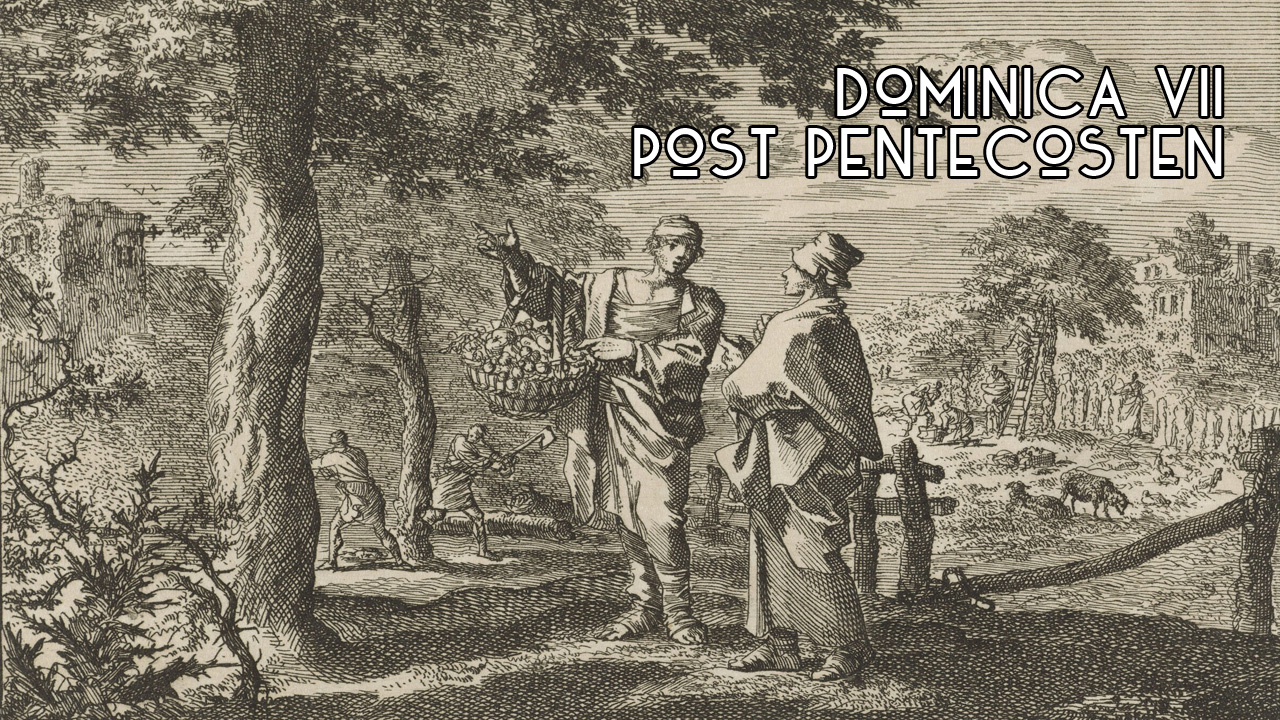
The texts for this 7th Sunday after Pentecost in the 1962 Missale Romanum, the Vetus Ordo, challenge us to examine the alignment between the profession of our faith and the actual fruit borne in our lives. “By their fruits you shall know them,” the Lord says in today’s Gospel (Matthew 7:15–21). This is a proffered soul-mirror, a divine diagnostic tool. The formulary unfolds like a spiritual CAT scan, revealing, if I am permitted further to mix metaphors, whether the tree of our soul is bearing good fruit or if it hides rot beneath green leaves.
The Epistle from Romans 6:19–23 lays out the Apostle Paul’s blunt contrast between slavery to sin and slavery to righteousness. Immediately before our Epistle pericope, Paul wrote, “servi estis iustitiae … you have become slaves of righteousness” (v.18). This not a mere observation, but rather an implicit demand. Be who are now are! Act accordingly! Paul underscores that once his readers and listeners (and we are included) were enslaved to uncleanness, leading to iniquity. But “nunc exhibete membra vestra servire iustitiae in sanctificationem … now yield your members to righteousness for sanctification”. It is a call to renounce the false liberty that sin promises and to embrace the paradoxical freedom that comes through submission to Christ. The Christian must not be content merely with avoiding evil; he must also work toward producing fruits of holiness. The soul, like a vineyard, is either cultivated or it is overgrown, useless.
The cultivation image emerges in our Gospel reading from Matthew 7:15-21 wherein Christ Himself is the divine metaphor-mixer. Our Lord starts by warning against false prophets, wolves in sheep’s clothing. Externally they seem harmless. In reality they are lethal. He does not say that we shall know them by their words, their theological degrees, their fancy rings and brightly colored sashes, but “ex fructibus eorum cognoscetis eos … by their fruits you shall know them” (v. 20). The metaphor of good fruit and bad fruit is found in Old Testament prophecy and wisdom literature, symbolizing the moral and spiritual condition of individuals and nations. For example, in Isaiah 5:1–7, Israel is compared to a vineyard planted by the Lord, expected to yield good grapes but instead producing “wild grapes,” symbolizing injustice and unrighteousness. This failed harvest leads to divine judgment. Similarly, Jeremiah 24 presents a vision of two baskets of figs, one with good figs representing the faithful remnant, and the other with bad figs, signifying the corrupt and unrepentant. Ezekiel 17 uses a parable of a vine transplanted by an eagle, reflecting Israel’s political betrayal and spiritual decay. Throughout, fruit stands for deeds. Good fruit corresponds to justice, obedience, humility before God, and bad fruit to idolatry, oppression, rebellion. The metaphor thus conveys divine expectations and impending judgment. Speaking of judgment, the Book of Revelation begins with the Lord of Hosts judging churches for their works. “I know your works” (Rev. 2:2, 2:19, 3:1, etc.).
Not your intentions. Not your feelings. Your works. Your fruits.
These aren’t theoretical fruits, ethereal notions floating on the clouds. They are tangible. Good fruit is borne of good doctrine, good worship, good discipline, and a rightly ordered moral life. Bad fruit, that is, spiritual barrenness, doctrinal confusion, rebellion against tradition, and indulgence in sin, are signs of a rotten tree. The distinction Christ draws is absolute.
“Every tree that does not bear good fruit is cut down and thrown into the fire.” (v. 19).
Our Lord is not vague. There are only two outcomes: be fruitful or be firewood.
To be good fruit-bearers, we need both actively to tend our vineyard or orchard as well as to accept whatever pruning we receive from God in the vicissitudes of our lives. When by frequent examination of conscience and thoughtful review of our state in life we find something that doesn’t belong or that has gone bad, it must be excised lest it weaken or ruin the whole. There are also times when we are tested by external circumstances which God permits to strengthen or to correct us. Trimming a tree or pruning a plant can stimulate desired growth.
This concept is rooted in the Collect oration:
Deus, cuius providentia in sui dispositione non fallitur: te supplices exoramus; ut noxia cuncta submoveas, et omnia nobis profutura concedas.
LITERAL VERSION:
God, whose providence is not circumvented in its plan, humbly we implore You, that You clear away every fault and grant us all benefits
Note that opening stress of divine providence. Latin dispositio is an oratorical term, “an arrangement”. This is how the order of an address or an argument is laid out. It is also a military term for how troops are drawn up for battle. God the Father has arranged His argument, plan, from all eternity, speaking beyond time the logos, Word, the divine reason, discourse, which orders the universe. According to his plan He called us into existence precisely where and when we were intended to be, live, work and give Him glory.
There is no getting around or circumventing God’s plan.
Why, given who God is and who we are, would we want to try?
But we do.
In the unfolding story of our lives we err. We are not to tolerate or bargain with evil, but we do. When we get back to the point of our story, having returned to the plan, with the support and might of grace we make the necessary guts and grafts and get back to the bearing of the fruit God had in mind from us.
The post-Communion oration refers to the healing operation of the sacrament.
Tua nos, Domine, medicinalis operatio, et a nostris perversitatibus clementer expediat, et ad ea quae sunt recta perducat.
LITERALLY
O Lord, may Your medicinal operation both mercifully deliver us from our perverse inclinations and also guide us to those things which are right.
Before, we had a dispositio. Now we have an operatio, “a working, labor” or by extension, “religious performance, a bringing of offerings”. This is raised heavenward by the priest when Communion has been received, when God has given us a supremely effective, operative medicine for our sick ways. “Your action, Lord”… operatio tua … purges us of evil and lead us to good. It is the Divine Physician at work, Christ’s own therapeutic ministry extended through the sacramental economy.
It is critically important to be rightly disposed when receiving the sacraments, in particular the Eucharist, the operatio to be effective.
The commonsense realism of the Roman Rite assumes that the soul is wounded and cannot heal itself, that it must be medicated, cauterized, pruned, grafted and nourished through the sacred mysteries.
The traditional Roman Rite constantly urges us to “get real”. Perhaps this is why certain people object to it so strongly, seek to suppress it. This is perhaps why those who teach clearly with the dispositio of the Faith according to reason are marginalized. They are willing to compromise with the world to the extent that the truth is blurred, that noxia and perversitas are permitted to enervate the Church, endanger souls. It may be that this these are the people about whom Our Lord says, “He who is not with me is against me” (Matt. 12:30).
Christ’s words do not only examine the tree of the individual soul, but the orchard of the Church herself. Another metaphor-mash coming up: false prophets, with their hollow bark and corrupted sap, roam in sheep’s clothing. Indeed, in shepherd clothing, with stoles and mitres and speak smooth words, but their fruit is bitter, shriveled, and alien to the depositum fidei. Pay attention to their fruits, not merely what they say.
To be a Christian, as St. Paul insists, is not merely to refrain from evil but to become wholly given over to sanctity. “Exhibete membra vestra servire justitiae.” Let your body, your intellect, your desires, your ambitions, your imagination be enslaved to justice. This is not rhetorical flourish. This is the blueprint of Christian life. Paul says elsewhere, “I have been crucified with Christ; it is no longer I who live, but Christ who lives in me” (Gal 2:20).
This truth stands in stark contrast with the incoherent pseudo-Christianity that permeates much of ecclesial life today. Where the Roman Rite once trained souls to do spiritual battle through fasting, silence, kneeling, and hierarchy, it is now mocked by many as irrelevant or dangerous. Yet the ancient liturgy of the Roman Church, its rhythm, its doctrinal clarity, its dogged realism, is precisely the fruit of holy generations. That liturgy is itself a fruit, a living operatio of holiness and obedience lovingly handed down through generations by God’s dispositio.
This Sunday’s ancient orations, the stern moral tone of the readings, and the urgency of Christ’s inspects our individual tree and collective ecclesial the vineyard. Fruits must be assessed. This work is not postponed to the afterlife. It must not be relegated to others. It must begin now. By us.
Our Postcommunion calls out clearly: “…et a malis purget et ad bona perducat.” The verb perducat implies a leading, a drawing or guiding, even an inducing or persuading. Christ does not merely illuminate the path and then watch from a distance. He takes us by the hand and leads us on His path. His operation, His operatio medicinalis, both purges and delivers. When we are properly disposed His graces have their fruitful effect. The formulary for Mass this Sunday is a mirror in which we can see ourselves. If we reflect upon what we see, we shall be constrained to make some disposing adjustments, perhaps seeking also the medicinal operation of the confessional.