
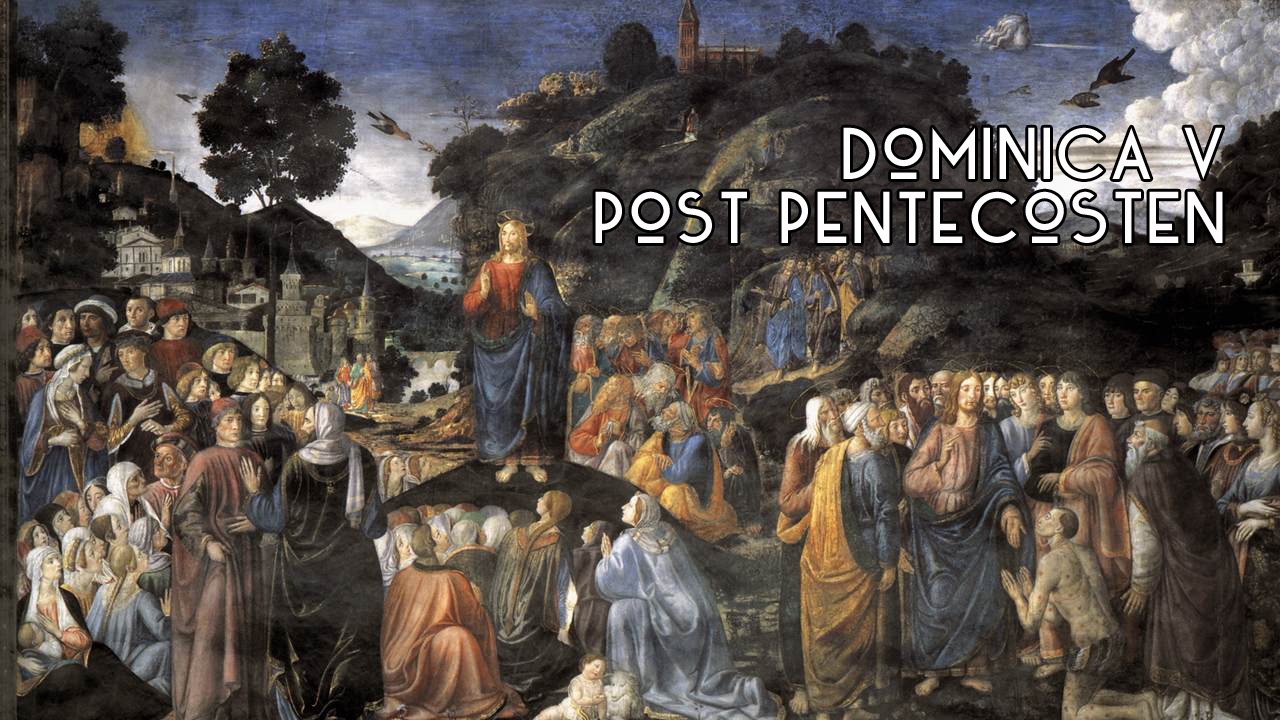
The 5th Sunday after Pentecost according to the calendar of the Traditional Latin Mass prompts us to examine the inmost dispositions of the Christian heart and the heights to which the Lord calls His followers. It is not a Sunday of spectacle. There is no miracle of fishes bursting the nets nor a parable about the lost sheep nor even a calling of the Apostles. Rather, we are told to cleanse ourselves from the interior poisons of anger, contempt, and vengeance. We are exhorted to be humble and have a tender heart even in the face of persecution.
In the Epistle reading from 1 Peter 3:8-15a, we find the first Vicar of Christ writing to the dispersed and distressed Christians of Asia Minor, a flock hemmed about with suspicion and slander. Peter, who once drew a sword in the Garden, has now learned the higher path of patient endurance. His letter is not a manifesto of social transformation but rather a spiritual charter for those who would remain unshaken in an uncomprehending world. As the modern formatting of the Epistle reading suggests, Peter quoted poetry, a song, Psalm 34:12-16, a hymn of trust in adversity. The Church’s selection of the pericope (a cutting of Scripture verses) put the hymn at the center of the exhortation:
Beloved: 8 Finally, all of you, have unity of spirit, sympathy, love of the brethren, a tender heart and a humble mind. 9 Do not return evil for evil or reviling for reviling; but on the contrary bless, for to this you have been called, that you may obtain a blessing. 10 For
“He that would love life
and see good days,
let him keep his tongue from evil
and his lips from speaking guile;
11 let him turn away from evil and do right;
let him seek peace and pursue it.
12 For the eyes of the Lord are upon the righteous,
and his ears are open to their prayer.
But the face of the Lord is against those that do evil.”
13 Now who is there to harm you if you are zealous for what is right? 14 But even if you do suffer for righteousness’ sake, you will be blessed. Have no fear of them, nor be troubled, 15a but in your hearts reverence Christ as Lord. (RSV)
Peter constructs an edifice of virtues rising from the common ground of human goodwill to the summit of a supernatural blessing. Unitas in spiritu, Greek homóphrones, unity of spirit, is the first step, the prerequisite to any enduring community of believers. There follows sympathés, the capacity to enter the sufferings of another. Then comes philádelphos, love of the brethren, and eúsplanchnos, a tender heart, a visceral word in Greek evoking the image of “the bowels of compassion”. The ancients thought that the intestinal region was the seat of emotions. Finally, the capstone of this interior edifice: tapeinophrosýne, a humble mind.
Dom Prosper Guéranger, in his L’Année Liturgique, remarks that these are not merely ornamental virtues but the cement holding together the living stones of the Church. Without them, the building is brittle.
The Apostle links the blessing of God to the bridling of the tongue: “let him keep his tongue from evil and his lips from speaking guile” (v.10). The tongue is the barometer of the heart. As the Lord Himself will teach in the Gospel, what issues forth from the mouth reveals the interior man.
The Apostle’s counsel would have sounded both consoling and formidable to his readers. Consoling, because it reminded them that the Lord’s eyes and ears were open to their distress. Formidable, because it declared that no suffering would excuse the abandonment of charity. Indeed, Peter writes: “But even if you do suffer for righteousness’ sake, you will be blessed. Have no fear of them, nor be troubled” (v. 14).
The Greek phrase is striking: “τὸν δὲ φόβον αὐτῶν μὴ φοβηθῆτε (ton de phobon auton me phobēthēte) which is “do not fear their fear”. In the Vulgate: Timórem autem eórum ne timuéritis. This could mean either “do not fear what they fear” or “do not fear their terror directed against you.” St. Augustine in his homilies frequently returns to this dynamic: the fear of the world before the holiness of the Church, a fear that lashes out in persecution. Peter, who once quailed in the courtyard, now exhorts us: “In your hearts reverence Christ as Lord” (v. 15). This is the antidote to fear.
There comes to mind Jesus repeated phrase in John 14 during the Last Supper: “Let not your hearts be troubled” (vv. 1 and 27). Just before this, at the end of John 13, the Lord predicted Peter’s betrayal. Peter seems to be sharing with the persecuted flock in Asia Minor the wisdom hard won from his personal experience.
From the Apostle’s letter, the Church takes us to the Lord’s own voice in Matthew 5:20-24, part of the Sermon on the Mount. He presents a challenge:
For I tell you, unless your righteousness exceeds that of the scribes and Pharisees, you will never enter the kingdom of heaven. (v. 20)
The Greek term δικαιοσύνη (dikaiosynē) means “righteousness” or “justice”. This is not merely conformity to a code, but the interior alignment of the will with God. The scribes and Pharisees had built their reputations on meticulous observance of the Law, but their righteousness was external, lacking the charity that fulfills the Law’s purpose. Christ calls His disciples to a higher standard.
You have heard that it was said to the men of old, ‘You shall not kill; and whoever kills shall be liable to judgment.’ But I say to you that everyone who is angry with his brother shall be liable to judgment; whoever insults his brother shall be liable to the council, and whoever says, ‘You fool!’ shall be liable to the hell of fire. (Matthew 5:21-22 RSV)
Note here the graduated penalties: judgment for mere anger, the council for insult, Gehenna for contempt. The word “fool” in English softens the severity. The Greek text preserves the Aramaic ῥακά (raca), which is transliterated in the Vulgate as Raca. It is a term of derision suggesting worthlessness, emptiness. It is a verbal cancellation of the image of God in the other.
In Jewish culture of the first century, speech had power. To utter a word of cursing was to place a man under ban. Christ thus unveils the hidden continuum between anger, insult, and homicide.
Does the Lord’s teaching preclude all harsh language toward our neighbor or enemy? St. Augustine of Hippo (+430) has a work specifically on the Sermon on the Mount in which he breaks down every verse. Concerning being angry with one’s brother, Augustine stresses “without cause”. He conjoins calling someone raka with “without cause”. The Doctor of Grace then uses the example of St. Paul, who called the Galatians “brothers”, and also called them anoētoi “fools” (v. 3:1).
We had best be wary of anger. Paul wrote to the Ephesians, “Be angry but do not sin; do not let the sun go down on your anger, and give no opportunity to the devil” (4:26).
“Do not let the sun go down on your anger.” Wise words especially for families.
There is an anger that is a movement of zeal for the truth, and there is an anger that is the seed of violence. One must discern carefully which is which.
Christ proceeds to root this ethic in the liturgical life:
So if you are offering your gift at the altar, and there remember that your brother has something against you, leave your gift there before the altar and go; first be reconciled to your brother, and then come and offer your gift. (Matthew 5:23-24 RSV)
The altar of the Temple in Jerusalem was a place of profound sacral importance. How much more are our altars upon which is renewed the Sacrifice of Calvary? If we approach the Eucharistic altar today while clutching grudges and nursing animosities, what does it profit us? Better to be reconciled, even if reconciliation is partial and imperfect. It’s a start.
Holy Mother Church knew what she was doing in bringing the Epistle reading from 1 Peter 3 to an end half way through v. 15, namely 15a. On the other hand, it would have been helpful also to have had 15b, one of the most famous lines of the Letter. In 15b we can find a fitting conclusion:
Always be prepared to make a defense to any one who calls you to account for the hope that is in you, yet do it with gentleness and reverence.
The Greek phrase is “μετὰ πραΰτητος καὶ φόβου (meta prautētos kai phobou) with meekness and fear”. Meekness toward men, fear toward God.
In our times, when the Vetus Ordo is subjected to restriction motivated by fear, when those attached to tradition are caricatured as rigid or divisive, Peter’s words are a tonic. “Have no fear of their fear”.
On this 5th Sunday after Pentecost the Church calls us to cleanse the hidden springs of the heart: to purify our speech, to humble our minds, to stretch our charity to those who wrong us. Only in this way do we prepare to attain the unseen goods that God has promised.